Enjoy Reading

Enjoy Reading
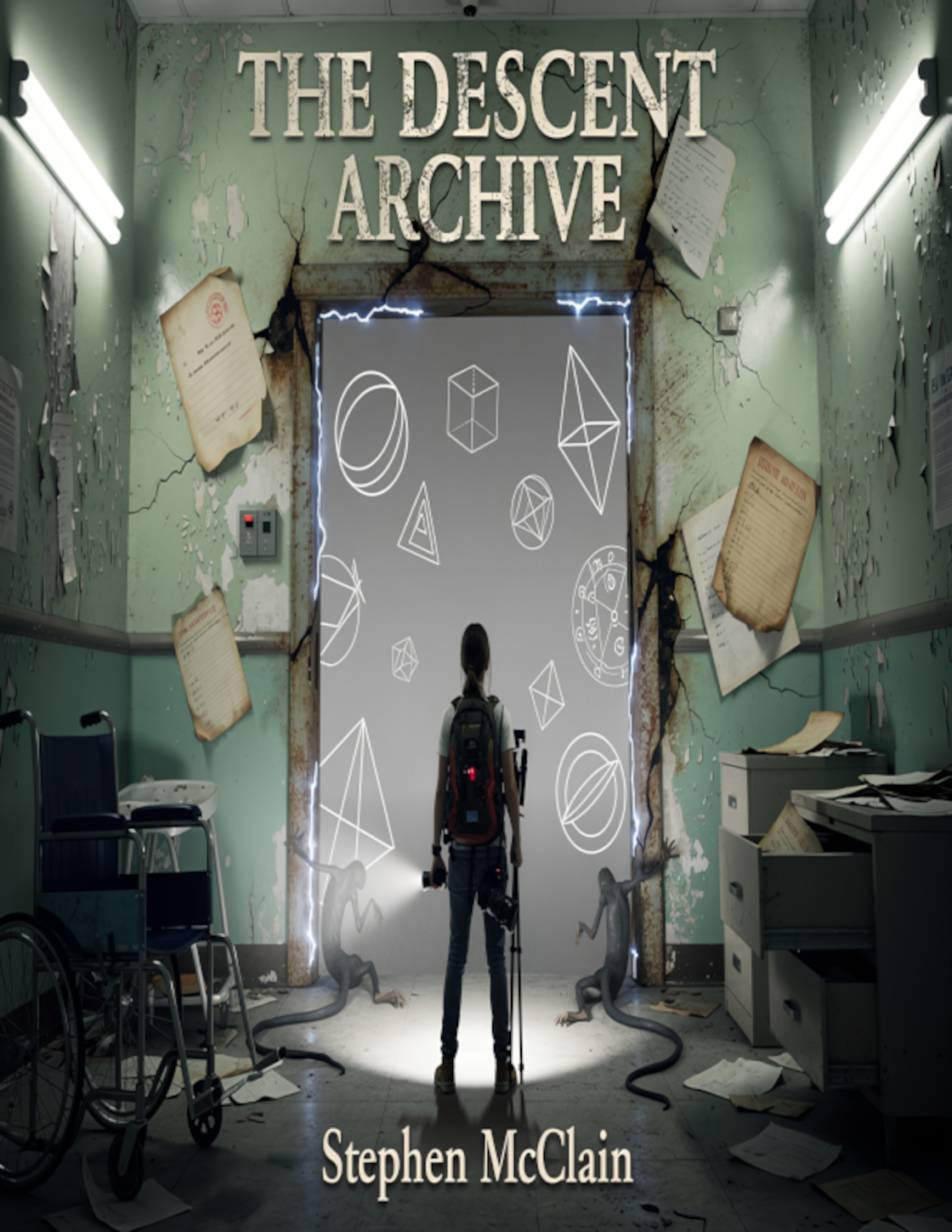
An urban explorer livestreaming from an abandoned asylum discovers a hidden sub-basement containing patient files from 1952—documenting experiments that prove multiple dimensions exist, and something has been trying to cross over for 70 years.
THE DESCENT ARCHIVE
by Stephen McClain
Part One: The Signal
Chapter One
The rain fell in sheets across the rusted gates of Blackwood Asylum, each drop a tiny hammer against metal that had been corroding for seven decades. Maya Torres stood before the entrance, bolt cutters heavy in her gloved hands, and felt the familiar electric thrill that came before every exploration. This was the moment—the threshold between the known world and whatever secrets waited in the darkness beyond.
The asylum loomed against the storm clouds like something from a Gothic nightmare. It was a massive Victorian structure, all peaked roofs and narrow windows, its red brick facade darkened by decades of rain and neglect. T videos educational value. It wasn’t just about jump scares and creepy atmosphere. Her viewers came for the history, the architecture, the real stories buried in these forgotten places.
Her phone buzzed with a notification. She checked it without breaking stride.
“Whoa, 23K live already. You guys are hungry tonight.”
The chat was scrolling past faster than she could read individual comments, but certain phrases jumped out:
“Check the electroshock room” “Go to the third floor” “basement basement basement”
Maya smiled, though her viewers couldn’t see it behind the camera. They always wanted her to rush to the most dangerous locations, to take unnecessary risks. That was the difference between her and the dozens of amateur urban explorers who’d tried to copy her success. They chased views with recklessness. She’d built her channel on methodical professionalism.
“Patience, people,” she said, reading the comments aloud for those listening to the audio-only version later. “We do this methodically. I don’t get 2 million subscribers by being reckless.”
A door slammed somewhere deeper in the building. The sound echoed through the empty corridors, sharp and sudden. Maya didn’t flinch. She’d learned years ago that abandoned buildings were never truly silent—wind pushed through broken windows, animals nested in walls, structural settling created groans and crashes. Fear came from the unknown, and she’d made it her business to know.
“Wind,” she explained to her audience with a slight smirk. “Always wind. Now let’s see the administrative wing—that’s where the real secrets hide.”
She’d learned that truth early in her career. The dramatic locations—operating rooms, isolation cells, basement tunnels—those drew viewers but rarely contained anything revelatory. The boring offices, the filing rooms, the administrator spaces where bureaucracy happened? That’s where you found the actual history, the paper trails that explained what had really occurred.
Her viewer count continued to climb: 31,689. The algorithm was definitely favoring this stream. By the time she finished tonight, she might crack 100K concurrent viewers. That would be a personal record.
Maya navigated through the maze of corridors with practiced efficiency. She’d studied the building’s layout for three weeks before tonight—architectural plans from the city archive, historical photos from the county library, even aerial surveys. She knew this place better than most people who’d actually worked here.
The administrative wing was in the western section of the building. The doors here were mostly closed, protecting the interiors from the worst of the water damage. Maya tried each one systematically, making note of what she found for potential follow-up exploration.
“Patient ward, empty… supply closet, just shelves… another ward…”
Then she found it: the director’s office. The nameplate was still mounted beside the door, brass gone green with oxidation: “Dr. Eleanor Voss, Director of Psychiatric Services.”
“Jackpot,” Maya muttered, pushing the door open.
Chapter Two
The office was larger than Maya had expected, and surprisingly intact. While the rest of the asylum showed decades of decay, this room seemed almost preserved. Filing cabinets lined three walls, their metal surfaces spotted with rust but still standing. A massive oak desk dominated the center of the space, its surface buried under a thick layer of dust that mapped the passage of years.
Maya’s headlamp swept across the room, cataloging details. A toppled chair. A calendar still displaying March 1952. Framed certificates on the wall, their glass cracked but readable enough to make out various medical degrees and psychiatric credentials.
“This was the inner sanctum,” Maya narrated, moving toward the filing cabinets. “Dr. Eleanor Voss ran this place for almost eight years before the closure. Let’s see what paperwork she left behind.”
The first cabinet opened with a rusty screech. Manila folders packed tight, their tabs labeled in neat handwriting: expense reports, staff rosters, maintenance requests. Maya pulled several out, fanning through pages while narrating for her viewers.
“Standard administrative stuff. Supply orders, staffing schedules… here’s something, disciplinary action for a nurse who was giving patients extra food. Apparently that was against protocol.”
She photographed a few pages with her phone, more out of habit than real interest. This was background material, context for the video editing process. The real content was still ahead.
The second cabinet yielded patient transfer records, admission forms, nothing particularly illuminating. Maya felt a familiar frustration building. Three weeks of research, months of waiting for the right time to access this location, and she was finding nothing but bureaucratic paper trails.
“Sometimes these explorations are a bust,” she told her audience, keeping her tone light even as disappointment crept in. “The mystery isn’t always solved. History doesn’t always—”
She stopped. Something about the floor caught her attention.
Scuff marks. Recent scuff marks, the kind that came from something heavy being dragged repeatedly across old linoleum. Maya crouched down, running her gloved fingers along the grooves. They led to one particular filing cabinet in the corner—one she’d assumed was just another archive of forgotten forms.
Her pulse quickened. This was the feeling she chased, the reason she did this. The moment when the mundane suddenly became significant.
“Okay,” she said quietly, standing and positioning herself to move the cabinet. “Okay, this is interesting.”
The filing cabinet was heavier than it looked, packed full and unwilling to budge easily. Maya braced herself and pulled, her athletic build earning its keep. The cabinet scraped across the floor with a metallic groan, revealing what it had been hiding.
A door. Not a wooden door like everything else in this building, but metal—institutional gray, with rivets along its frame like something from a submarine. And mounted in its surface, looking completely out of place in a 1950s asylum: a keypad lock.
Maya’s breath caught. Her camera was capturing this, every detail being broadcast to—she checked her phone—47,203 viewers. The chat was exploding.
“See that?” She pointed at the keypad, making sure the camera got a clear shot. “That’s not original to the building. That’s modern security tech, or… no, wait.”
She leaned closer, examining the keypad’s design. It was corroded, covered in the patina of age, but beneath that aging she could see the construction was definitely vintage. Not modern retrofitting—this was original equipment from the fifties, just far more advanced than anything that should have existed in a rural asylum.
And more impossibly: a tiny red light blinked beside the keypad. Still powered. After seventy years, somehow still powered.
“Chat, you seeing this?” Maya’s professional composure cracked slightly, genuine wonder bleeding into her voice. “This door still has power. Seventy years closed, and it still has power.”
She tried the handle. Locked, predictably.
The chat was moving too fast to read now, hundreds of comments flooding in per second. But she caught the gist: her viewers were as excited as she was, throwing out theories, begging her to open it, warning her not to.
“Six digits,” Maya said, studying the keypad. “I need a six-digit code. What do we know about this place? Opening date? Closing date?”
She pulled up her research files on her phone while her viewers threw out suggestions. The asylum had been built in 1923, opened in 1924, operated until March 1952. The incident—whatever it was—had occurred during the week of March 10-15.
Maya tried several combinations. The construction date: nothing. The opening date: nothing. She could feel her viewers’ anticipation building, could imagine thousands of people leaning toward their screens, waiting.
“Let’s try the closure date,” Maya said, punching in numbers: 031552.
The keypad beeped. The red light turned green. And with a mechanical click that seemed impossibly loud in the silent office, the lock disengaged.
Maya stared at the door for a long moment. This was the threshold—once she opened this, there was no going back. Whatever lay beyond had been sealed away for seventy years with advanced security that suggested someone had been very serious about keeping it hidden.
Professional curiosity warred with instinctive caution. The smart move would be to document this discovery, leave, come back with proper backup and equipment. But the demolition was scheduled for tomorrow morning. If she left now, whatever secrets this door protected would be buried forever under rubble.
The viewer count on her phone had climbed past 50,000. This was already the most-watched livestream she’d ever done, and they hadn’t even reached the real content yet.
Maya Torres made her choice. She pulled the door open.
Beyond it: concrete stairs descending into darkness. Not the crumbling, water-damaged concrete of the rest of the asylum, but solid, well-maintained steps that looked like they’d been poured yesterday. The air that wafted up was different too—dry, temperature-controlled, completely at odds with the decay surrounding it.
“This isn’t on any blueprint,” Maya said quietly, more to herself than to her audience. “I researched this place for three weeks. This… doesn’t exist.”
But it did exist. The evidence was right in front of her: twenty-three steps leading down to another door, this one simpler—just metal with a handle, no lock. Emergency lighting flickered to life as she descended, motion-activated LEDs that shouldn’t function after decades without maintenance.
Yet they did.
Maya counted the steps as she went down, a habit from years of exploration. Knowing the way out was survival instinct. Twenty-three steps. The temperature dropped with each one, not from dampness but from climate control. Somewhere down here, systems were still running. Power still flowed.
At the bottom, she paused with her hand on the door handle. Her headlamp beam caught her reflection in the polished metal surface—a young woman’s face, dark eyes wide with a mixture of excitement and uncertainty, multiple earrings catching the light. She looked young, she realized. Twenty-four but looking younger in this moment, stripped of the confident persona she projected for her channel.
“Okay,” she whispered. Then louder, for the camera: “Let’s see what they were hiding.”
She opened the door.
Chapter Three
The lights came on automatically—not flickering emergency LEDs but full fluorescent panels that illuminated the space with steady, institutional brightness. Maya stood frozen in the doorway, her mind struggling to process what she was seeing.
The room was pristine. Not preserved, not merely intact, but actively maintained. No dust, no decay, no evidence of seventy years of abandonment. The floor gleamed with recent waxing. The air smelled of climate-controlled sterility, the kind you found in server rooms and museums.
And everywhere, covering every surface, were files. Fireproof filing cabinets lined the walls in perfect rows, each one labeled with the same header: “BLACKWOOD DIMENSIONAL STUDY – CLASSIFIED.”
Maya’s hands trembled as she raised her phone to check the livestream quality. Still broadcasting, signal strong despite being underground. 61,847 viewers now, and the chat was moving so fast it was just a blur of text.
“What the actual…” She couldn’t finish the sentence. Her practiced narration had deserted her, leaving only genuine shock.
She approached the nearest cabinet slowly, as if sudden movement might shatter whatever strange preservation had kept this place frozen in time. The cabinet opened smoothly, no rust, no resistance. Inside: patient files, dozens of them, organized with bureaucratic precision.
Maya pulled one at random. The tab read: PATIENT 017 – SARAH CHEN.
Her hands shook as she opened it. The first page was a standard intake form from March 1951. Sarah Chen, age twenty-eight, admitted for “acute dissociative episodes and persistent visual hallucinations.” The handwriting was precise, clinical, the kind of documentation that filled thousands of asylum records across the country.
But the next pages… the next pages were different.
“Day 14,” Maya read aloud, her voice barely above a whisper. “Patient continues describing ‘the gray place’ with disturbing specificity. Claims to see it when eyes are closed, sometimes even when open. Describes a vast space without horizons, where perspective works incorrectly. Says there are figures there, moving in ways that hurt to watch.”
Maya flipped through more pages, her breathing growing rapid.
“The consistency is remarkable. Patient 017’s descriptions match those from Patients 003, 008, and 012 despite zero contact between subjects. All use identical terminology: ‘the gray place,’ ‘the breathing sound,’ ‘figures in peripheral vision.’ All report the experience intensifying over time.”
She set down that file and grabbed another. PATIENT 023 – ROBERT WADE. Then another. PATIENT 031 – JENNIFERMARKS. Every file told the same story with minor variations. Different patients, different backgrounds, different reasons for admission. But once they’d been at Blackwood for a certain period, they all started reporting the same impossible thing.
“They’re all the same,” Maya said to her camera, her professional composure completely shattered now. “Every patient… seeing the same thing. Describing it the same way.”
She found a section of detailed interviews, transcribed conversations between Dr. Voss and various patients. Maya scanned them quickly, her eyes catching phrases that made her skin crawl:
“It’s not a hallucination. It’s another place. A real place.”
“They can see me now. When I’m in the gray place, they know I’m there.”
“They’re not scary. They’re sad. They’re trapped.”
“Something’s hunting them. That’s why they’re trying to come here.”
And then, paper-clipped to one of the transcripts, she found the drawings.
Maya’s breath caught. She held up the pages to her camera, making sure her viewers could see them clearly. Intricate geometric patterns, symbols that looked almost like language but weren’t quite. Mathematical in their precision but alien in their construction. Triangles intersecting with curves, circles broken by angles that seemed to shift when you looked at them directly.
“These are from Patient 017,” Maya said, flipping through the pages. “But look—here’s Patient 008’s drawings. Identical. Not similar, identical. Down to the smallest detail.”
She pulled more files, more drawings. Forty-three patients, forty-three sets of artwork, all depicting the same incomprehensible symbols with photographic consistency.
“Guys, I don’t…” Maya’s voice cracked. “This is real documentation. Government seals. Look at these signatures—multiple PhDs, federal oversight stamps. This isn’t some creepypasta bullshit. This actually happened.”
Her phone buzzed insistently with notifications. The chat had transformed into chaos:
“OMG” “DONT READ THE SYMBOLS” “maya turn around” “BEHIND YOU” “Something in the corner” “this is insane” “THE SYMBOLS”
But Maya wasn’t looking at her phone. She’d found another file, this one thicker than the others, with Dr. Voss’s name on it. Not a patient file—a research summary.
She flipped it open and began reading, her voice steadying as she fell back on narration as an anchor to sanity.
“Dr. Eleanor Voss, Project Director: After six months of observation and testing, I can state with confidence that these individuals are not experiencing shared psychosis. The level of consistency across isolated subjects rules out conventional psychiatric explanations.”
Maya turned pages, scanning faster.
“The geometric patterns they produce are not random. Mathematical analysis shows they follow specific rules, like a grammar. Dr. James Chen from MIT has confirmed they represent actual dimensional mathematics, concepts that shouldn’t be accessible to patients with no advanced education.”
She looked up at her camera, eyes wide.
“These people weren’t crazy. They were seeing something real. Something that exists in… in dimensional mathematics?”
She kept reading, finding passages highlighted in yellow, notes scribbled in margins. Dr. Voss’s research had progressed from skeptical observation to increasingly convinced belief. The clinical distance of the early entries gave way to something else—excitement tinged with fear.
“In layman’s terms,” Maya read from a summary dated October 1951, “these patients appear to have developed perception outside normal human frequencies. Like seeing infrared or hearing ultrasound. They’re not hallucinating a place—they’re perceiving a place that exists parallel to our own, separated by nothing but wavelength.”
Maya set down the file carefully, as if it might detonate. She looked around the pristine archive room with new understanding. This wasn’t just hidden evidence of medical malpractice or unethical experiments. This was documentation of something that challenged fundamental assumptions about reality.
Her viewer count had passed 80,000. People were sharing the stream, spreading it across social media. This was going viral in real-time.
And somewhere in the back of Maya’s mind, a small voice was whispering that maybe that was a problem. Maybe some doors weren’t meant to be opened. Maybe some knowledge wasn’t meant to be broadcast to thousands of people simultaneously.
But she was already reaching for the next file—Dr. Voss’s personal log. The answers were here, in these preserved documents. The truth about what happened in March 1952.
She just had to keep reading.
Chapter Four
Maya found a chair—sturdy metal, well-maintained like everything else in this impossible archive—and sat down with Dr. Voss’s personal log. The viewer count on her phone had climbed past 89,000, but she barely registered it. The outside world, the stream, even her own safety had become secondary to the story unfolding in these pages.
The log was handwritten, not typed like the official reports. Dr. Voss’s handwriting was elegant but increasingly erratic as the dates progressed. Maya began reading aloud, her voice falling into the rhythm of narration even as the content made her heart race.
“June 1951: Seventeen patients now report the visions. I’ve documented common elements across all cases—the gray, endless space; figures that move wrong; a sound like breathing through water; and always, always, the symbols. They draw them compulsively. When prevented, they become agitated, sometimes violent. It’s as if the symbols are trying to express themselves through the patients.”
Maya flipped ahead, scanning entries.
“July 1951: We’ve begun EEG monitoring during episodes. The brain activity is unprecedented—patterns we’ve never seen before, frequencies that shouldn’t be possible. Dr. Walsh from the neurology department claims the equipment must be malfunctioning. But every machine shows the same readings. These patients’ brains are doing something that violates our understanding of neural function.”
She paused, looking at a diagram taped into the log. It showed EEG readouts from multiple patients, all displaying identical wave patterns during their episodes. Perfect synchronization across individuals who’d never met.
“August 1951: I’ve made contact with government researchers. They’re interested. Very interested. Funding has increased substantially. They want me to pursue what they call ‘applied research’—not just observation, but experimentation. They believe these patients might be perceiving something of strategic importance. I’m not sure I agree, but the resources they’re offering…”
Maya’s stomach tightened. The trajectory was becoming clear. Scientific curiosity leading to government funding leading to experiments that ethics boards would never approve.
She kept reading, the dates scrolling forward through the fall of 1951.
“September 1951: We’ve assembled a team. Psychiatrists, neurologists, physicists, even a mathematician from Princeton who specializes in dimensional theory. The physicist, Dr. Raymond Chen, has proposed a fascinating hypothesis: what if human consciousness operates on measurable electromagnetic frequencies? What if some people are simply tuned differently, able to perceive frequencies most of us are blind to?”
The entry continued with increasingly technical language that Maya struggled to follow—discussions of quantum mechanics, wave-particle duality, consciousness as an electromagnetic phenomenon. But the core idea was clear: Dr. Voss and her team believed these patients were perceiving an actual, physical reality that existed beyond normal human perception.
“October 1951: Dr. Chen has identified the frequency. Using modified radio equipment synchronized with patient EEG patterns during episodes, we’ve isolated a specific electromagnetic signature: 7.83 Hertz—the Schumann Resonance, Earth’s fundamental frequency.”
Maya looked up from the page, her mind racing. She’d heard of the Schumann Resonance in her research—it was the frequency of electromagnetic waves in the cavity between Earth’s surface and the ionosphere. Some people called it “Earth’s heartbeat.”
But what did that have to do with alternate dimensions and gray places?
She read on.
“But there’s something else. Beneath the Schumann Resonance, like an echo or a harmonic, we’ve detected another frequency. Fainter, harder to measure, but undeniably there. And when we amplified it—when we played it back through speakers in the patient ward—something remarkable happened.”
Maya’s hands were shaking now. She had to set the log down for a moment, take a breath, remind herself this was real. This had actually happened, in this building, seventy years ago.
“All the patients perceived the gray place simultaneously,” she continued reading. “Not just those already prone to the visions, but everyone who heard the amplified frequency. And more significantly—they reported that the entities in that place could perceive them back. Direct observation. Mutual awareness between dimensions.”
The next entry was dated November 1951, and the handwriting had changed—still Dr. Voss’s elegant script, but faster, more excited.
“We can induce the perception reliably now. Fifteen minutes of exposure to the harmonic frequency and any subject reports seeing the gray place. We’ve begun interviewing the entities through our more sensitive patients. They seem to understand us, though communication is difficult. They speak in concepts rather than words, and translating those concepts into language causes severe headaches in our patient-interpreters.”
Maya flipped ahead, scanning multiple pages of technical notes about frequency modulation, resonance patterns, equipment specifications. The research had clearly accelerated, become more ambitious.
Then she found an entry that made her blood run cold.
“January 1952: We understand now. These entities—we’ve been calling them that, but the term is inadequate—they’re not aliens or spirits. They’re indigenous. They existed here, in this location, in this space, long before humans evolved. We occupy the same physical coordinates, but at different frequencies. Like radio stations sharing the same airwaves.”
Maya read the passage twice, making sure she understood it correctly. According to Dr. Voss’s research, these gray-place entities weren’t invaders from another dimension. They were Earth-native, existing in a parallel frequency band that humans had evolved not to perceive.
“The patients who see them naturally,” Dr. Voss had written, “are essentially people born with radio receivers in their heads, tuned to the wrong station. Or perhaps the right station, from an evolutionary perspective. There’s debate on the team about whether this perception was once more common, bred out of the human genome because it conferred no survival advantage.”
The entry continued with speculation about prehistoric humans, shamanic traditions, and whether historical accounts of spirits and demons might have been glimpses of these frequency-neighbors. Maya skimmed it, looking for more concrete information.
She found it in an entry dated February 1952.
“They’re desperate. After three months of communication, we finally understand the desperation in their attempts to make contact. They’re refugees. Their frequency-space is collapsing, becoming uninhabitable. They’ve been searching for a way to cross over, to survive by existing in our frequency band instead of their own.”
Maya felt a chill run down her spine. She glanced at her phone—127,563 viewers now. This stream was everywhere, spreading across the internet like wildfire. And every viewer was seeing these documents, hearing these revelations.
“They need our help,” she read from Dr. Voss’s log. “But crossing frequencies isn’t like moving through space. It requires enormous energy, focused consciousness, what Dr. Chen calls ‘psychic mass.’ They’ve been trying to cross for years, reaching out to humans who can perceive them, begging for assistance. But individual humans don’t generate enough psychic mass to anchor them in our reality.”
Maya turned the page and found a calculation scrawled in the margin: “43 patients = sufficient mass?”
Her mouth went dry.
“March 1952,” she read, her voice barely above a whisper now. “We’re going to help them cross. Dr. Chen has designed a device that can synchronize brain patterns across multiple subjects, creating the necessary psychic mass. Forty-three patients, all perceiving the gray place simultaneously, all focused on welcoming the refugees across. It should work. The math is sound.”
She flipped ahead frantically, looking for the next entry. It was dated March 10, 1952.
“Initial test successful. Ten patients, synchronized perception, sustained for forty minutes. Three entities crossed successfully. They’re… it’s difficult to describe. They don’t have bodies in the traditional sense. They exist as patterns of energy that can inhabit neural tissue. The three who crossed are currently residing in the consciousness of three volunteer patients. The patients report feeling crowded in their own heads, but not uncomfortable. They describe it as having a passenger, a gentle presence sharing their awareness.”
Maya’s hands shook as she turned to the next page. The handwriting was messier now, written quickly.
“March 12: Twenty patients, synchronized. Fifteen entities crossed. We’re refining the process. The device works better than expected. The entities are grateful, cooperative. They’re teaching us things about dimensional mathematics that our physicists can barely comprehend. This is the breakthrough of the century. We’re proving the existence of parallel realities, of consciousness as a fundamental force in the universe.”
Then March 14. The entry that changed everything.
“March 14, 1952: We were wrong.”
Those four words sat alone at the top of the page, underlined three times.
Maya continued reading, her voice shaking.
“We were wrong about everything. The refugees—yes, they’re real, and yes, they’re fleeing something. But we didn’t understand what. We assumed natural disaster, environmental collapse, something analogous to our own understanding of catastrophe. We were fools.”
The handwriting deteriorated further, becoming almost illegible.
“They’re fleeing a predator. An entity that exists between dimensional frequencies, that feeds on consciousness itself. It’s been hunting them for—they can’t describe time the way we understand it—but it’s been hunting them forever. Consuming them, one by one, in their gray place.”
Maya’s throat was tight. She forced herself to keep reading.
“And tonight, when we synchronized all forty-three patients, when we opened the door wide enough for the remaining refugees to cross—we didn’t just let them through. We created a beacon. A signal that propagated across dimensional frequencies like a lighthouse beam across dark water.”
The next lines were scrawled in obvious panic, the pen pressed so hard it had torn the paper in places.
“The predator found us. It’s following the refugees through the door we opened. It’s too large to cross fully—its consciousness spans multiple dimensional frequencies, it can’t compress itself into a single band. But it doesn’t need to cross. It’s learned to perceive our frequency now. It’s learned to reach across, to extend tendrils of awareness into our dimension.”
Maya’s phone buzzed insistently. She glanced at it—the chat was exploding with thousands of comments per second. But she couldn’t stop reading now.
“The forty-three patients aren’t dead,” Dr. Voss had written. “They’re occupied. The predator is using them as anchors, as windows into our reality. It’s hollow inside their heads, looking out through their eyes, learning about our world. And it’s hungry. So hungry.”
The final paragraph was barely legible, written in what might have been tears or might have been blood—Maya couldn’t tell from the copy.
“We’ve sealed the facility. Cut all communications. The government knows—I called in the failure—but they’re not coming to help. They’re coming to bury this. To kill everyone here and pretend it never happened. Maybe they’re right. Maybe that’s the only way to contain this. But I fear it’s too late. The pattern is out there now. The frequency exists. The door has been opened, and doors like this can never truly be closed. Someone will find this eventually. Someone will broadcast the pattern. And when enough minds perceive it simultaneously—when enough consciousness focuses on that frequency at once—the door will open again.”
That was the last entry. The page ended with Dr. Voss’s signature, precise despite the chaos of the writing above it.
Maya set the log down carefully, as if it might shatter. She looked directly into her camera, at the tens of thousands of people watching through her stream.
“Guys,” she said quietly. “I think I just made a terrible mistake.”
Chapter Five
The silence in the archive room seemed to deepen as Maya’s words hung in the air. She stared at her phone screen, at the viewer count that had climbed past 150,000, at the chat scrolling by faster than any human eye could follow.
Then the lights flickered.
Just once, just for a moment, but enough to send Maya’s heart hammering. She stood up from the chair, Dr. Voss’s log still clutched in one hand, her phone in the other.
“Okay,” she said, trying to inject confidence into her voice. “Okay, let’s think about this rationally. This was seventy years ago. Whatever happened here, it’s contained. The government sealed the facility. Nobody else found this place. The pattern—the frequency—it didn’t spread beyond Blackwood.”
But even as she said it, she knew it was a lie. She’d been reading aloud. Reading the documents, showing the symbols to her camera, broadcasting everything to 150,000 people in real-time.
Her phone buzzed again. She looked at the screen and felt ice flood her veins.
The comments had changed. They weren’t excited speculation or worried warnings anymore. They were something else entirely.
“I hear it” “theres a sound” “like breathing underwater” “why is my vision blurring” “the room feels bigger” “something in the corner” “TURN IT OFF MAYA” “we all hear it” “the pulse” “thrum-thrum-thrum” “Im seeing gray”
Maya’s hands trembled. She checked her stream quality—it had degraded significantly. Video was pixelating, fragmenting, displaying artifacts that looked almost like the symbols from the patient drawings. The audio had developed a low, rhythmic undertone that she hadn’t noticed before.
Thrum-thrum-thrum. Like a heartbeat, but slower, deeper. The Schumann Resonance, perhaps, or that echo beneath it. The frequency Dr. Voss had isolated.
“No,” Maya whispered. “No, that’s not possible. It’s just a story, just old documents—”
More comments flooded in:
“maya my roommate cant hear it” “only happening to people watching the stream” “this is real” “my screen is glitching” “seeing things move in my apartment” “shadows wrong direction” “WHATS HAPPENING”
Maya felt the room tilt around her. The pristine archive suddenly seemed different—the fluorescent lights too bright, the walls too far away, perspective subtly wrong like in the patient descriptions of the gray place.
She pressed her hands against her face, trying to ground herself. This was panic, just panic, brought on by reading disturbing documents in a creepy location. The power of suggestion. Mass hysteria through social media.
But the pulse was real. She could hear it now, distinct and undeniable, coming from somewhere below the range of normal hearing but perceptible nonetheless. Thrum-thrum-thrum.
“Chat,” she said, forcing herself to read comments despite her growing terror. “I need you to tell me exactly what you’re experiencing. Be specific.”
The responses came in waves:
“shadow moved across my wall but light source didnt move” “hearing the pulse through headphones AND in my room” “vision blurring at edges” “room stretching out” “feeling like im being watched” “something in peripheral vision” “pressure in my head” “my cat is freaking out”
Maya’s chest tightened. These weren’t random comments from trolls. These were consistent reports of specific phenomena, from people distributed across the globe, all experiencing similar effects simultaneously.
She looked at Dr. Voss’s log again, at the passage about the frequency being a carrier signal, about synchronized perception creating psychic mass.
“Oh God,” she whispered. “The files. The symbols. I’ve been broadcasting them.”
It was so simple, so obvious in retrospect. Dr. Voss had discovered that the pattern—the frequency, the symbols, whatever the door was—could propagate through information itself. Not just through radio waves but through any medium that carried structured data. And Maya had just transmitted that data to over 150,000 people, all perceiving it simultaneously, all focused on the same information at the same moment.
She’d created exactly the conditions Dr. Voss had described. Mass synchronized perception. Psychic mass reaching critical threshold.
She’d opened the door.
A shadow moved across the wall behind her, flowing against the direction of her headlamp. Maya spun around, her light cutting through the archive room.
Nothing. Just filing cabinets and fluorescent lights and sterile preservation.
But her camera had caught it. She could see it on her phone’s preview screen—a frame-by-frame flicker of something in the corner. Humanoid but wrong, existing in the spaces between video frames, like a image that only resolved when you weren’t looking directly at it.
Maya’s breath came in short gasps. She needed to get out, needed to end the stream, needed to stop this before—
Before what? Before 150,000 people became anchors for something that fed on consciousness? Before she replicated Dr. Voss’s experiment on a scale the 1950s researchers couldn’t have imagined?
Too late, whispered a voice in her head. Too late, too late, the door is already open.
But she had to try. Maya raised her phone to her face, speaking directly into the camera with as much authority as she could muster.
“Everyone watching—listen to me. Close this stream. Right now. Don’t watch clips, don’t save it, don’t share it. The information itself is the carrier signal. The more people who perceive it, the stronger the effect. You need to stop watching. You need to—”
The lights went out.
Complete darkness for three seconds that felt like hours. Then emergency lighting kicked in, dim red bulbs that cast the archive in shadows and blood-colored illumination.
In that new lighting, Maya saw them.
The filing cabinets weren’t the only things in the room. Standing between them, motionless but somehow present, were figures. Human-shaped but wrong in ways her brain struggled to process. They were there and not-there simultaneously, like afterimages that had gained substance, like shadows cast by a light source that didn’t exist.
Forty-three of them. She knew without counting. The original patients, still here after seventy years, occupied by the refugees who had crossed over in March 1952.
Maya backed toward the door, her headlamp cutting across the figures. They didn’t react to the light. They barely seemed to register her presence. They just stood there, bodies frozen in positions that human anatomy shouldn’t allow, heads tilted at wrong angles.
One was closest to her—a woman, or what had once been a woman, wearing a hospital gown that showed no decay despite the decades. Her eyes were open, filmed over but somehow still seeing.
Those eyes focused on Maya.
The mouth opened. The jaw moved wrong, like someone operating puppet strings from a distance. The voice that emerged was layered, multiple tones speaking in imperfect unison.
“Help… us…”
Maya pressed herself against the wall, unable to look away from those dead-but-seeing eyes.
“We’re… trapped… Been trapped… so long…”
The figure took a step forward. The movement was jerky, wrong, like animation frames were missing. Other figures began to move as well, turning their hollow gazes toward Maya.
“Please…” The word came from multiple mouths now, that terrible chorus of voices. “Send us… back… But it… will follow…”
Another figure, a man, his hospital gown marked with the number 017, moved closer.
“We tried… to warn them… Dr. Voss… She didn’t understand… We knew… the hunter… We knew it would come…”
Maya’s back was against the door now. Her phone felt heavy in her hand, the camera still broadcasting, still transmitting this nightmare to over 160,000 viewers.
“If you close… the door… We die here… Slowly… Forever…”
The first figure—the woman—raised one trembling hand toward Maya. The gesture was plaintive, desperate.
“If you leave it… open… It comes through… Feeds forever… Your world… Like ours…”
The emergency lighting flickered again. In the darkness between flickers, Maya saw something else. Something massive, existing in the spaces between moments of illumination. Not in the room with her but very close, pressing against the fabric of reality like a whale against the hull of a boat.
The predator. The thing the refugees had been fleeing.
And it was hungry.
Chapter Six
Maya’s livestream viewer count hit 214,739 as she stood frozen in the archive room, surrounded by the occupied patients. The phone in her hand felt like it was burning, as if the data flowing through it had become physically hot. Every person watching was a connection, a thread of consciousness linking them to this place, to this moment, to the door that had been opened.
She forced herself to look at her phone screen, to read the chaos unfolding in her chat.
The comments had evolved into something that made her stomach turn:
“we see it” “its beautiful” “the gray is so peaceful” “let it through” “we are the doorway” “want to go there” “need to see more”
Mixed with desperate messages:
“FIGHT IT” “maya destroy the equipment” “its in our heads” “cant look away” “my hands are moving on their own”
And worst of all:
“feels good” “like coming home” “we’ve been asleep so long”
The predator was doing exactly what Dr. Voss had described. Using curiosity as a hook, perception as an anchor. Every viewer who couldn’t look away was becoming a potential doorway, a window through which that vast, hungry thing could perceive their reality.
Maya tore her eyes from the screen and looked at the refugees—the forty-three figures still frozen in their jerky, puppet poses. They weren’t threatening her, she realized. They were just watching, waiting to see what she would do.
“Show me,” she said suddenly. “Show me the equipment. Dr. Voss’s lab. Where she conducted the experiment.”
The woman-figure tilted its head—too far, neck bending at an angle that should have snapped bone.
“There…” The layered voice pointed toward the back of the archive room. “Behind… the curtain…”
Maya hadn’t noticed it before, but now she saw it—a heavy fabric barrier hanging against the far wall, the same institutional gray as everything else. Behind it would be the door to Dr. Voss’s laboratory, she was certain.
“The machine… still runs…” said the figure marked 017. “Always running… Can’t stop it… Frequency self-sustaining…”
Maya started walking, the refugees parting before her like reeds in water. They moved wrong, everything about them wrong, but they weren’t hostile. Just desperately, eternally sad.
She pulled aside the curtain and found the door—solid metal, already hanging open. Beyond it, equipment hummed with impossible vitality.
Chapter Seven
The laboratory was a horror show of mid-century science fiction made real. EEG machines from the 1950s stood beside modified radio equipment, all connected by thick copper cables that had been wound into geometric patterns matching the symbols from the patient drawings. The air smelled of ozone and something else—something that existed at the edge of perception, like tasting metal or smelling colors.
In the center of the room, arranged in a perfect circle, were forty-three chairs. Each had leather restraints on the arms and legs. Dark stains marked the leather—sweat, blood, other fluids from the night of March 15, 1952. The night everything went wrong.
All the equipment was running. Lights blinked on control panels. Needles wavered on analog meters. A large reel-to-reel tape recorder spun slowly, playing something that existed below the threshold of normal hearing but that Maya could feel in her bones.
Thrum-thrum-thrum.
The pulse. The frequency. Still broadcasting after seventy years, kept alive by backup generators or something more esoteric—Dr. Voss had written about the frequency becoming self-sustaining, feeding on its own resonance.
Maya approached the equipment slowly, her camera capturing everything. She could feel it now, a pressure building behind her eyes, a sensation like her skull was too small for her brain. The same thing the patients must have felt when they first started perceiving the gray place.
“I can shut it down,” she said, more to herself than her viewers. “Cut the power, end the local frequency generator…”
But would it matter? The pattern was already out there, transmitted through her stream to hundreds of thousands of people. The door wasn’t just here in this laboratory—it was opening in minds around the world, anywhere her broadcast had reached.
She found a large tape recorder with a label: “FINAL LOG – MARCH 15, 1952.” Her hands shook as she pressed play.
Dr. Eleanor Voss’s voice filled the laboratory, distorted by decades of magnetic degradation but still comprehensible:
“Final log. March 15, 1952. 3:47 AM. The experiment has failed catastrophically.”
Static obscured the next few words, then Voss’s voice returned, higher now, panicked:
“All forty-three patients achieved simultaneous resonance at 2:18 AM. The entities began crossing immediately. But the predator—oh God, the predator—it’s using them as anchors. It’s too large to cross fully, existing across multiple dimensional frequencies simultaneously, but it’s learned to perceive our dimension through them.”
A crash on the recording. Screaming in the background—multiple voices, overlapping.
“The patients aren’t dead. They’re occupied. Hollowed out and filled with its awareness. It’s looking through their eyes, learning about us, learning how to feed on consciousness in our frequency band.”
More screaming. Then Voss’s voice, closer to the microphone, speaking rapidly:
“We’ve sealed the facility. Cut all communications. But it’s too late. The frequency is self-sustaining now. As long as enough people perceive it simultaneously, as long as enough consciousness focuses on the pattern, the door stays open. I’m destroying as much equipment as I can, but the pattern is out there. In the patient drawings. In our documentation. Someone will find it eventually.”
Another crash. Heavy footsteps.
“Someone will broadcast it to enough people at once. Someone will create the critical mass of perception needed to—”
The tape cut to static. Then that pulse, louder now: THRUM-THRUM-THRUM.
And underneath it, barely audible, another sound. Not breathing, exactly, but something like breathing. Something vast and patient and eternally hungry, waiting just on the other side of human perception.
Maya’s phone exploded with notifications. She looked at the screen—267,451 viewers. The number was still climbing. Her stream had gone viral, spreading across every social media platform, being shared and re-shared by people who had no idea what they were actually transmitting.
The video quality had degraded severely. Between frames, in the static and pixelation, she could see it now—the predator. Not clearly, never clearly, but hints of something too large to comprehend. Like seeing a whale’s shadow pass beneath a ship, you never saw the whole thing, just suggestions of impossible scale and alien geometry.
It was learning. With every viewer, every mind that perceived the pattern, it learned more about their dimension. Learned how to reach further, to extend its awareness more completely.
The refugees had been right. By helping them escape their dying dimension, Dr. Voss had rung a dinner bell for the thing that had been hunting them.
And Maya had just done the same thing, but on a scale Dr. Voss couldn’t have imagined. Not forty-three minds synchronized, but hundreds of thousands. Maybe millions, if the viral spread continued.
She looked at the equipment, at the chairs, at the occupied patients standing silent in the doorway behind her.
Then she looked at her phone, at the chat, at the comments that were becoming increasingly disturbing:
“cant stop watching” “eyes wont close” “its so beautiful” “need to see more” “we want to let it in” “please maya show us more”
The predator was in their heads now, using the same frequency that had allowed the refugees to cross. Using the pattern Maya had broadcast to reach through screens and into consciousness, learning how to manipulate human attention, human curiosity, human need to see forbidden things.
Maya made her decision.
She spoke directly into her camera, her voice steady despite the terror coursing through her:
“Okay. Everyone. Listen very carefully. The frequency needs focused attention to work. It needs you to keep watching, to keep perceiving, to keep thinking about what you’re seeing. If enough of you look away, if enough of you stop feeding it attention, the signal weakens.”
Comments:
“cant stop” “tried to close it my hand wont move” “its too beautiful” “need to keep watching”
“It’s in your heads now,” Maya continued. “Using your curiosity against you. Using your need to know, to see, to understand. But you’re stronger than this. You have to be. You have to—”
The lights in the laboratory shut off. Darkness swallowed everything except Maya’s headlamp and the glowing equipment.
In that darkness, the refugees moved. All forty-three of them, shuffling forward with their puppet movements, surrounding Maya but not threatening. Just present. Just bearing witness.
The woman who’d spoken first approached, her filmed eyes somehow seeing despite death.
“Help… us…” The voice was pleading now, desperate. “Send us… back… Close the door… But know… it will follow… It always follows…”
Another refugee stepped forward—the man marked 017.
“If you close… the door… we die here… Trapped… Forever… But maybe… maybe that’s justice… We brought it… to your world…”
Maya looked at them, at these people who’d been prisoners in their own bodies for seventy years. Who’d crossed over seeking refuge and brought a predator with them. Who’d been occupied by refugees who were themselves occupied by the thing that fed on consciousness.
It was layers within layers, a dimensional nesting doll of horror.
“I’m sorry,” Maya whispered. “I’m so sorry this happened to you.”
The refugees nodded—or tried to, their bodies jerking approximations of human gesture.
“We’re sorry… too… We didn’t know… Didn’t understand… Wanted so badly… to survive… Brought doom… instead…”
The woman reached out again, her hand trembling.
“End this… Please… Before it spreads… further…”
Maya looked at the equipment, at the generator in the corner still humming after seventy years. At the copper coils arranged in geometric patterns. At the chairs where forty-three people had sat down for an experiment and never truly gotten up again.
She pulled the bolt cutters from her pack—the same ones she’d used to cut through the asylum fence what felt like a lifetime ago.
“I’m ending the stream in sixty seconds,” she said into her camera. “I need every single one of you to close this video. Don’t watch clips. Don’t share it. Don’t think about what you saw here. Starve the frequency of attention. It’s the only way.”
The chat exploded in conflict:
“NO keep streaming” “we need to see” “DONT STOP” “she’s right close it now” “i cant stop watching” “my eyes wont close” “please maya dont leave us”
“And to the refugees…” Maya looked at the occupied patients, at the sad, desperate things they’d become. “I’m sorry. I can’t save you and save us both. Maybe that makes me a monster. But 267,000 people don’t deserve to be anchors for something that wants to eat reality itself.”
The refugees didn’t react with anger. They nodded again, understanding.
“We know… We chose… wrong… Brought it… to you… End this… Please… Free us…”
Maya raised the bolt cutters to the main power cable, a thick insulated line that fed power to all the equipment. In the darkness behind her, in the static of her degrading video feed, the predator surged forward—sensing its doorway was about to close.
For one frame, one perfect moment of clarity, Maya saw it fully.
It wasn’t a monster in any traditional sense. It was geometry and hunger given consciousness, existing in the spaces between dimensional frequencies. A mathematical function that had learned to feed on awareness itself, to consume the energy generated by conscious observation. It had hunted the refugees through their dimension until that dimension died, then followed them here.
And it was vast. So vast. The part Maya could perceive was just a tendril, an exploratory extension of something that spanned dimensional scales she couldn’t begin to comprehend.
But it could be hurt. It could be pushed back. Dr. Voss had been right—it couldn’t fully cross into a single frequency band. It needed anchors, needed conscious minds to serve as windows. Cut the anchors, and it would lose its grip.
“Thirty seconds,” Maya said firmly. “If you’re still watching, you’re giving it power. CLOSE THE STREAM.”
The viewer count began dropping: 312,564… 289,103… 251,877…
The shadow screamed—not a sound but a feeling, a sensation of rage and hunger transmitted directly into the consciousness of everyone still watching. Some viewers would later describe it as the worst sound they’d ever heard. Others would say it wasn’t a sound at all, but a color or a taste or a smell that shouldn’t exist.
Maya cut the cable.
The equipment died instantly. Lights shut off. The pulse stopped. The machinery that had been running for seventy years finally, mercifully, went silent.
The refugees collapsed. All forty-three of them, falling like marionettes with cut strings. The consciousness that had been inhabiting them—the gray-place refugees who’d crossed over in 1952—were suddenly unanchored, with nowhere to exist now that the frequency had stopped.
For just a moment, Maya thought she saw them as they really were. Not the human bodies they’d been occupying, but the refugees themselves—patterns of energy and awareness, geometry that could think, mathematics that could feel. They looked almost like the symbols from the patient drawings, three-dimensional constructs that hurt to perceive directly.
Then they were gone. Faded, dissipated, returned to whatever fundamental state consciousness reverts to when it has no anchor to reality.
The patient bodies lay still. After seventy years of occupation, they were finally just corpses. Finally at rest.
The viewer count continued dropping: 127,634… 89,251… 52,108…
But not fast enough. The predator still had presence, still maintained connection through tens of thousands of minds that couldn’t or wouldn’t look away.
Chapter Eight
Maya stood in the dark laboratory, her headlamp the only light source now, sweeping across the collapsed bodies and dead equipment. Her phone showed 34,892 viewers, then 18,234, then 9,106. The number fell steadily but not fast enough—the predator was fighting back, using whatever hold it had established to keep viewers watching, to keep the doorway open.
She could feel it now, a pressure at the edges of her consciousness. It knew her. It had been observing her since she started broadcasting from the archive, learning her patterns, her thoughts, her fears. It knew what made Maya Torres tick—the curiosity that drove her to explore abandoned places, the ambition that had built her channel, the need to know that overrode common sense and self-preservation.
It whispered to her in that knowing: You don’t want to close the door. You want to understand. You want to see more. This is the greatest discovery in human history, and you’re going to destroy it?
Maya gritted her teeth and spoke into her dying camera, battery at 3%.
“To whoever’s still watching—I get it. Curiosity is survival instinct. We evolved to seek information, to explore, to understand our environment. But sometimes…” Her voice cracked. “Sometimes the only way to survive is to NOT KNOW. To walk away from forbidden knowledge. To close the door.”
6,847 viewers remaining.
The shadow retreated slightly, losing coherence as its anchors dissolved. But it wasn’t gone. It was patient. It had been hunting for eons across dimensional frequencies. It could wait.
“Blackwood Asylum failed because they couldn’t close the door in time,” Maya continued. “Because they didn’t understand what they were opening until it was too late. Don’t make the same mistake. Forget what you saw here. Forget the symbols. Forget the frequency. Let this place die with its secrets.”
3,293 viewers.
Maya looked at the bolt cutters in her hand, then at the rest of the equipment. The main power was cut, but there were backup systems, redundancies Dr. Voss had built into the design. She needed to destroy it all, make sure the frequency couldn’t be recreated from the machinery itself.
She began smashing equipment systematically. The reel-to-reel tape recorder first—she pulled out the tape and tore it to pieces, destroying the final recording of Dr. Voss’s voice. Then the modified radio equipment, bringing the bolt cutters down on vacuum tubes and circuit boards.
“And if you can’t stop thinking about it,” she said between impacts, “if you hear that pulse in quiet moments, if you see movement in your peripheral vision…”
1,847 viewers.
The shadow was barely perceptible now, a fading echo of that vast hunger. It reached for her one last time, a final attempt to maintain its grip on this dimension.
Maya felt it brush against her consciousness—cold and alien and infinitely patient. It showed her things: other dimensions it had consumed, other species it had hunted to extinction across the vast multidimensional structure of reality. Earth was just one more meal, humanity just one more flavor of consciousness to devour.
But we had something the other species hadn’t: technology. The ability to transmit information instantaneously across global networks. The ability to synchronize millions of minds simultaneously. We’d made the predator’s job easier than ever before.
Unless we chose not to watch.
“Just remember,” Maya said, her voice barely audible now, “you’re only a doorway if you keep it open. Close your eyes. Close your mind. Close the—”
Her camera died.
The battery, finally drained after hours of continuous streaming, gave out. The red recording light went dark. The connection severed.
Black screen.
Maya stood in the laboratory in true darkness now, her headlamp the only illumination. The silence was absolute—no pulse, no breathing sound, no sense of vast presence pressing against reality.
Just her and the bodies and the destroyed equipment.
She’d done it. Cut the local frequency, convinced enough viewers to look away, broken the synchronization that gave the predator its grip. The door was closed, at least for now.
But for how long?
Maya slumped against the wall, exhaustion hitting her like a physical force. Every muscle ached. Her head pounded with the worst headache of her life—the psychic backlash of touching something her consciousness wasn’t meant to perceive.
She needed to get out. Needed to find her way back through the archive, up the stairs, through the director’s office, out of this place before the demolition crew arrived tomorrow morning.
But first, she needed to make sure no one could recreate what Dr. Voss had built. Maya used the last of her strength to finish destroying the equipment, to scatter the copper coils, to render the geometric patterns incomplete and unusable.
When she was done, the laboratory looked like it had been hit by a hurricane. Nothing salvageable remained. Nothing that could be used to rebuild the frequency generator.
It would have to be enough.
Maya climbed the stairs in darkness, her headlamp battery failing. She emerged into Dr. Voss’s office just as the first light of dawn began filtering through the asylum’s broken windows.
She’d been underground for nearly eight hours.
Her livestream had lasted seven hours and forty-three minutes.
And in that time, 312,564 people had watched the full broadcast.
Maya walked through the asylum’s corridors like a ghost, past the peeling paint and overturned gurneys, past the decay that had seemed so atmospheric and entertaining when she’d arrived. Now it just looked sad. A monument to good intentions gone catastrophically wrong.
She emerged into daylight and rain—the storm still going, though lighter now. Her van was where she’d left it, a block away behind a abandoned warehouse. She climbed inside, started the engine, and drove away from Blackwood Asylum without looking back.
Behind her, the demolition notice flapped in the wind: “DEMOLITION SCHEDULED – 7 DAYS.”
Tomorrow morning, bulldozers would arrive. The asylum would be torn down, the sub-basement filled with concrete, the whole site paved over for a parking lot.
The physical location would be erased.
But the pattern remained. In minds. In recordings. In people who couldn’t stop thinking about it.
Maya drove home through the rain and wondered if she’d really closed the door at all.
Part Two: The Aftermath
Chapter Nine
Maya’s apartment looked exactly as she’d left it the previous evening—laptop on the desk, camera equipment charging, half-drunk coffee going cold in its mug. But everything felt different. The world was the same, yet she wasn’t. She’d seen something that changed fundamental assumptions about reality, and there was no going back from that.
She collapsed onto her couch without even removing her muddy boots and immediately fell into a sleep so deep it felt like falling through darkness.
The dreams came instantly.
Gray spaces. Endless perspectives. Figures moving wrong. And always, always, that pulse: thrum-thrum-thrum.
She woke screaming, unsure what time it was or if she’d slept at all. Her phone showed 2:47 PM. She’d been asleep for six hours, and it felt like six minutes.
Her phone also showed 847 notifications.
With trembling hands, Maya unlocked the screen. Her channel had exploded. The livestream had been automatically archived when the battery died, and even though she’d deleted it immediately upon waking, the damage was done.
2.4 million subscribers now. She’d gained 400,000 in less than twenty-four hours.
Comments filled every social media platform:
“What was that?” “Is it real?” “Did anyone archive the stream?” “I can’t stop thinking about it” “I hear the pulse” “NEED to watch it again” “Someone must have saved it”
And they had. Of course they had. Clips circulated on Reddit, Twitter, TikTok. Screenshots of the documents. Recordings of the symbols. People analyzing the footage frame by frame, enhancing the shadows, trying to see the predator more clearly.
Maya felt sick. She’d failed. She’d told people to forget, to look away, to let it die—but human nature didn’t work that way. The more you tell someone not to think about something, the more they think about it.
She opened her laptop and searched for clips of her stream. Hundreds of results. Someone had put together a supercut of the “scariest moments.” Someone else had created a documentary-style breakdown of Dr. Voss’s research. A third person had animated the symbols, making them move and pulse in time with the frequency.
Every view was another anchor. Every person who watched was another potential doorway.
Maya closed the laptop before she could see more. Her hands shook so badly she had to clasp them together. She needed to do something, to take action, to somehow contain this.
But what could she do? The information was out there. Distributed across thousands of servers, backed up on hard drives around the world. You couldn’t un-ring that bell.
She forced herself to stand, to move to the window. Outside, Los Angeles looked normal. Traffic, people walking, sunshine breaking through the clouds. The world continuing as if nothing had changed.
But it had changed. Maya could feel it, a wrongness at the edge of perception. Or maybe she was just paranoid, traumatized by what she’d experienced. Maybe the predator was gone, pushed back behind the dimensional barrier, and everything would be fine.
Her phone buzzed. A news notification: “BLACKWOOD ASYLUM DEMOLISHED AHEAD OF SCHEDULE. No Comment from City Officials on Expedited Timeline.”
Maya opened the article. The asylum had been torn down that morning, hours earlier than planned. The site was already being cleared, debris hauled away by a fleet of trucks. City officials declined to explain the rush, citing “safety concerns” and “structural instability.”
But Maya knew the real reason. Someone in the government remembered Project Gray Door. Someone knew what was in that sub-basement and wanted it buried as quickly as possible.
Too late. The knowledge was already free.
She set her phone down and looked at her reflection in the darkened laptop screen. Dark circles under her eyes. Pale skin. She looked haunted, she realized. She looked like she’d seen something that had fundamentally broken something inside her.
Her phone buzzed again. Not a notification this time—a text message. From a number she didn’t recognize.
“The facility is gone, but the pattern remains. In minds. In recordings. In people who can’t stop thinking about it. You didn’t close the door, Maya. You just made it invisible. – E.V.”
Maya’s blood ran cold. E.V. Eleanor Voss. But that was impossible. Dr. Voss would be over 110 years old now, assuming she’d survived the closure of Blackwood at all.
Unless she hadn’t survived. Unless something else had survived in her place.
Maya’s hands shook as she typed a response: “Who is this?”
The reply came immediately: “Someone who made the same mistake seventy years ago. Someone who’s been watching the door ever since. The refugees are gone now—you freed them when you cut the power. But the predator remains. It’s patient. It will wait until enough people remember. Until enough minds perceive simultaneously. Sweet dreams, Maya.”
The number showed as disconnected when she tried to call it back.
Maya looked at herself in the laptop screen again. And froze.
In the reflection, someone was standing behind her. Just a shadow, barely perceptible, but undeniably present.
She spun around. Her apartment was empty. No one there.
But when she turned back to the screen, the shadow was still visible in the reflection. Still standing behind her. Still watching.
Maya slammed the laptop shut and backed away from the desk. Her heart hammered against her ribs. This wasn’t real. This was trauma, PTSD, her mind trying to make sense of an experience that had temporarily broken her grasp on reality.
She grabbed her phone and called the one person she trusted completely: her best friend Jen, who’d known her since college, who’d helped her start the channel, who was the emergency contact for every exploration she did.
“Maya? Oh my God, I’ve been trying to call you all day! That stream last night—are you okay? What the hell happened?”
Jen’s voice was a lifeline to normalcy. Maya sank to the floor, phone pressed to her ear.
“I’m… I don’t know. Jen, I think I found something real. Not just a good story or creepy location. Something actually real, and I don’t know what to do.”
“Okay, breathe. Where are you?”
“Home. I’m home. But I… there’s something wrong. With me or with reality, I can’t tell which.”
“I’m coming over. Don’t move. Don’t do anything. I’ll be there in twenty minutes.”
The call ended. Maya sat on her floor, hugging her knees, trying to remember how to breathe normally. Around her, the apartment felt too large, perspective stretching wrong like in the patient descriptions.
She closed her eyes and immediately saw the symbols from the patient drawings, perfectly preserved in her memory. Mathematical patterns that represented something she didn’t have the education or vocabulary to understand.
Don’t think about them, she told herself. Don’t focus on them. That’s how it works—through attention, through perception.
But how do you not think about something once you know it exists?
Maya’s phone buzzed again. She almost didn’t look, terrified of what she might see. But curiosity—that damned curiosity that had built her career and maybe doomed her world—made her check.
Another text from the disconnected number: “Look at your subscriber count.”
With shaking hands, Maya opened her channel. The number was climbing in real-time, ticking up by dozens every second.
2,401,847… 2,401,923… 2,402,014…
People were flocking to her channel, drawn by the viral clips, by social media discussion, by that fundamental human need to know what everyone else is talking about. And while the full stream was deleted, she realized with horror that she’d left up her other videos—hundreds of explorations of abandoned places, each one with timestamps and locations.
The comments on those old videos had changed:
“Is this real like Blackwood?” “Which one should I watch to understand?” “Was she always seeing things?” “The symbols appear in her older videos if you look closely”
They were constructing a mythology around her, retroactively finding meaning in content she’d created long before last night. The human brain’s pattern-recognition capabilities working overtime, finding connections that didn’t exist.
Or did they exist? Had the predator been watching her longer than she realized? Had it been guiding her, subtly, toward Blackwood? Toward the one location that could give it access to her audience?
Maya’s head spun. Paranoia and trauma and genuine supernatural horror were becoming impossible to separate.
A knock at her door made her jump. But it was just Jen’s distinctive pattern—three quick raps, pause, two more.
Maya opened the door and nearly collapsed in her friend’s arms.
Chapter Ten
Jen was solid in a way Maya desperately needed right now. Five foot two, strong from years of rock climbing, with practical short hair and an expression that said she’d seen enough of Maya’s explorations to not be easily spooked.
But even Jen looked worried as she guided Maya to the couch.
“Okay,” Jen said firmly. “Start from the beginning. Tell me everything that happened.”
So Maya did. The words came out in a tumbling rush—the asylum, the hidden archive, Dr. Voss’s research, the frequency, the refugees, the predator. She told Jen about the equipment that still worked after seventy years, about the occupied patients, about cutting the power and watching the viewer count drop as she begged people to look away.
Jen listened without interruption, her expression growing increasingly troubled.
When Maya finished, Jen was quiet for a long moment.
“Show me,” she said finally. “Show me the clips. The documents. Everything you saw.”
“Jen, no. That’s how it spreads. The information itself is the carrier signal—”
“Maya.” Jen took her hands. “Listen to yourself. Information can’t be a carrier for some interdimensional predator. That’s not how reality works.”
“But I saw—”
“You saw something that traumatized you. Something real and awful, probably. Maybe the government was doing unethical experiments. Maybe there’s old equipment down there that still works. Maybe there were bodies—actual preserved bodies of patients who died in 1952. All of that could be true and still have nothing to do with monsters from other dimensions.”
Maya pulled her hands away. “You think I’m having a breakdown.”
“I think you pushed yourself too hard. Seven-hour livestream in a dangerous location, reading disturbing documents about psychiatric abuse and unethical experimentation. That’s enough to mess with anyone’s head.”
“Then explain the messages.” Maya showed Jen her phone, the texts from E.V.
Jen read them, frowning. “Okay, that’s creepy. Someone clearly knows about your stream and is messing with you. But Maya, Eleanor Voss is long dead. This is probably some troll who archived your stream and wants to scare you. You have two million subscribers—you’re going to attract some unstable people.”
It made sense. Everything Jen was saying made perfect rational sense. Maya wanted to believe it, wanted to retreat into the comfortable explanation that she’d just had a traumatic experience and her brain was filling in supernatural details.
But then Jen’s phone buzzed. She glanced at it and her expression changed.
“What?” Maya asked.
“It’s… probably nothing. My roommate just texted. She says there’s a weird sound in our apartment. Like a pulse or heartbeat, but really low frequency. She thought maybe it’s the air conditioning acting up.”
The bottom dropped out of Maya’s stomach. “Is she watching clips of my stream?”
“I don’t know, probably? It went viral. Everyone’s watching—” Jen stopped. Understanding dawned on her face. “No. No, you don’t actually believe that.”
“Call her. Ask her if she’s been watching clips from Blackwood.”
“Maya—”
“Please.”
Jen called. The conversation was brief. When she hung up, her face had gone pale.
“She watched a supercut this morning,” Jen said quietly. “The one that compiles all the document readings and symbol close-ups. She says… she says the sound started about an hour ago. And she’s been feeling strange. Like the room is bigger than it should be.”
They stared at each other.
“This is mass hysteria,” Jen said, but her voice lacked conviction. “Power of suggestion. People watch a creepy video and start imagining things.”
“Forty-seven people,” Maya said. “According to the articles I’ve seen, forty-seven viewers from last night’s stream have reported persistent auditory hallucinations. Twenty-three report visual disturbances. Eight have been committed to psychiatric facilities.”
“That’s…” Jen struggled. “That’s out of 312,000 viewers. That’s a tiny percentage. Statistical noise.”
“Or it’s the people who are naturally sensitive. Like the original patients at Blackwood. The ones whose consciousness operates on frequencies most people can’t perceive.”
Jen stood up, pacing. “Okay. Let’s say for a moment that this is real. That you actually opened some kind of door to something dangerous. What do we do about it?”
“I don’t know.” Maya felt helpless. “I destroyed the equipment. I deleted the stream. I told people not to watch, not to think about it. But you can’t control information once it’s out there. You can’t make people forget.”
“No,” Jen said slowly. “But you can provide counternarrative. You can explain what happened without reinforcing the pattern. You can—”
Her phone buzzed again. And again. And again.
She looked at the screen and her face went white.
“What is it?”
“My roommate. She sent… she sent photos.”
Jen held out her phone with a shaking hand. The screen showed a series of images from Jen’s apartment. Normal shots at first—living room, kitchen, hallway. But in each one, if you looked carefully, there was something wrong with the shadows. They fell from wrong angles, moved independently of light sources, suggested presence where nothing visible stood.
The last photo was just of a blank wall. But written on it, in what looked like burned into the paint itself, were symbols. The same geometric patterns from the Blackwood patient drawings.
“She didn’t write those,” Jen whispered. “She doesn’t even remember taking this photo. She looked away from her phone for a second, and when she looked back, the photo was there.”
Maya felt reality tilting around her. This was spreading faster than she’d feared. Not just in minds but manifesting physically, the pattern replicating itself through any medium available.
“We need to warn people,” Maya said. “Really warn them. Not just ‘don’t watch,’ but explain exactly what they’re dealing with. Give them tools to fight it.”
“And how do we do that without spreading the pattern further?”
It was the central paradox. To warn people effectively, you had to explain what they were being warned about. But explaining it meant transmitting the pattern, potentially infecting more minds.
Maya thought of Dr. Voss, trapped in the same paradox seventy years ago. No wonder she’d opted for destruction and burial. It was the only solution that made sense.
But it was too late for that now.
“I need to make another video,” Maya said. “Explain what’s happening without showing the symbols or playing the frequency. Give people concrete steps to protect themselves.”
“What steps? You don’t know how to stop this.”
“No,” Maya admitted. “But I know how it spreads. Through attention, through focus, through synchronized perception. If I can get people to understand that, to consciously redirect their attention away from the pattern, maybe we can weaken it enough to push it back.”
Jen looked at her for a long moment. “You really believe this, don’t you? This isn’t trauma or paranoia. You genuinely think there’s some kind of predator from another dimension trying to break into our world.”
“I don’t know what I believe,” Maya said honestly. “But I know what I saw. And I know people are being affected by this. Whether it’s a genuine supernatural threat or some kind of mass psychogenic illness triggered by the information itself, the result is the same. People are in danger. And it’s my fault for broadcasting it.”
Her phone buzzed. Another text from the disconnected number:
“You can’t stop it by explaining. Explanation is just another form of transmission. The only way to stop it is to make people not care. To bore them. To redirect their attention so completely that the pattern loses its power. But how do you make people stop caring about the greatest mystery in human history? How do you make them look away from the forbidden knowledge you’ve shown them? You can’t. Which means you’ve already lost. – E.V.”
Maya read the message twice, then showed it to Jen.
“Assuming this isn’t just some elaborate troll,” Jen said slowly, “they might be right. The more you talk about this, the more attention you draw to it. Maybe the best thing you can do is nothing. Delete your channel. Drop off social media. Let it fade from memory.”
“And leave those forty-seven people—probably more by now—suffering with no explanation or help?”
“You can’t save everyone, Maya.”
“No. But I can try.”
Maya opened her laptop despite Jen’s protests. She navigated to her channel, to the video creation interface. Her hands hovered over the keyboard.
What could she say? How could she warn people without feeding the pattern? How could she explain dimensional predators and frequency-based consciousness without sounding completely insane?
She started typing.
Chapter Eleven
The video went live at 8:47 PM. Maya had spent hours writing and rewriting the script, trying to find the balance between explanation and caution, between warning and feeding the pattern.
She sat in front of her camera in her apartment, no special lighting or production values. Just her, exhausted and haunted, speaking directly to her audience.
“This is Maya Torres,” she began. “Most of you know me from The Descent. Many of you watched my livestream from Blackwood Asylum last night. Some of you have been experiencing strange effects since then. This video is for you.”
She took a breath, steadying herself.
“I’m not going to show you the symbols or play the frequency. I’m not going to reference the specific details of what I found. But I need you to understand what happened so you can protect yourself.”
Maya explained, as carefully as she could, about pattern recognition and the power of suggestion. About how human consciousness could be affected by information, how attention itself could become a vector for psychological contagion.
She didn’t mention interdimensional predators or frequency-based entities. She framed it in terms of memetics and mass psychogenic illness, using language that sounded scientific and rational rather than supernatural.
“If you’ve been experiencing symptoms,” she said, “the most important thing you can do is redirect your attention. Don’t dwell on what you saw. Don’t try to remember the symbols. Don’t watch clips or read analyses. The pattern loses power when you stop feeding it attention.”
She gave practical advice: meditation techniques, grounding exercises, ways to break out of obsessive thought loops. She recommended people experiencing severe symptoms seek professional help, see therapists, take prescribed medications if necessary.
“This is not supernatural,” she lied. “This is psychology. The human brain is powerful and complex, and sometimes information can affect it in unexpected ways. But you have control. You can choose what to think about. You can choose to let this go.”
She ended the video with a simple message:
“I’m taking a break from content creation. The Descent is going on hiatus indefinitely. Take care of yourselves. And please, just let this go.”
She uploaded the video and immediately stepped away from the computer. She didn’t read comments. She didn’t check the view count. She just walked away.
Jen, who’d stayed with her through the recording, pulled her into a hug.
“That was good,” Jen said. “That was really good. Now you need to follow your own advice. Step away. Let it go.”
Maya wanted to. God, she wanted to. She wanted to forget everything she’d seen in that sub-basement, wanted to go back to being a normal urban explorer who investigated abandoned buildings and didn’t know that reality had seams that could be pulled apart.
But she couldn’t. Because she’d checked her email before recording, and in her inbox was a message from an address that made her blood run cold: [email protected].
The email was brief:
“You’re trying. I appreciate that. But it won’t work. The pattern is too interesting. People will keep searching, keep analyzing, keep trying to understand. Human curiosity is stronger than human self-preservation. I learned that seventy years ago.
But there might be another way. Not to close the door—that’s impossible now. But to lock it from this side. To create a counter-pattern that doesn’t eliminate perception but redirects it. A frequency that disrupts the predator’s ability to establish anchors.
I’ve spent seven decades working on this. I have a prototype. But I need your platform to distribute it. Your audience. Your reach.
Meet me tomorrow. You know where. The asylum is gone, but the sub-basement remains. They couldn’t fill it completely—it’s too deep, too reinforced. I’ll be there at midnight.
Come alone. And bring your camera.
- Eleanor Voss, 112 years old and still fighting the door I opened.”
Maya showed the email to Jen, whose expression cycled through disbelief, concern, and alarm.
“This is insane,” Jen said. “This is obviously a trap or a troll or… something. You can’t actually be considering this.”
But Maya was considering it. Because the email’s IP address, when she looked it up, traced back to a government server that had been decommissioned in 1952. Because the encryption format was decades old, impossible to fake with modern technology. Because every instinct told her that whoever sent this email knew things no troll could know.
“If there’s even a chance,” Maya said quietly, “that Dr. Voss actually survived, that she’s been working on a solution all these years—”
“Then let someone else handle it. Call the police. Call the FBI. Call whoever handles weird government conspiracy stuff.”
“And tell them what? That I’m meeting a 112-year-old woman in a demolished asylum to fight an interdimensional predator? They’d commit me.”
“Maybe you should be committed!” Jen’s voice rose, edged with panic. “Maybe we both should be. Because we’re talking about this like it’s real, like any of this makes sense, and it doesn’t. None of this makes sense.”
Maya took Jen’s hands again. “I know. I know it doesn’t make sense. But forty-seven people are suffering. More every day. And if there’s any chance I can fix this, I have to try.”
“Then I’m coming with you.”
“No. The email said alone.”
“I don’t care what the email said. I’m not letting you go into some demolished building alone at midnight to meet someone who’s either dead or crazy or fake.”
They argued for another hour, but Jen was immovable. Finally, Maya gave in. If this was a trap, at least she wouldn’t face it alone. And if it was real—if Dr. Voss had somehow survived and actually had a solution—then having a witness seemed wise.
They spent the next day preparing. Maya couldn’t stop herself from checking her warning video’s performance—2.1 million views in under twenty-four hours, more than any video she’d ever posted. The comments were split between people thanking her for the grounding advice and people analyzing every frame for hidden messages.
The pattern was still spreading.
More reports came in from across the internet: people experiencing the pulse, seeing shadows move wrong, finding symbols appearing in unexpected places. The number of severe cases had climbed to over a hundred.
And Maya kept receiving emails from [email protected], each one more urgent:
“They’re establishing more anchors. Every person who obsesses becomes a potential window.”
“The predator is learning. It’s getting better at manipulating human psychology.”
“Tomorrow night might be our last chance before it reaches critical mass.”
At 11:30 PM, Maya and Jen drove to the site of Blackwood Asylum. The building was gone, replaced by a flat expanse of dirt and construction equipment. But Jen was right—they hadn’t filled the sub-basement completely. Maya could see the outline of where the hidden entrance had been, now marked by a temporary fence and construction warning signs.
They parked a block away and walked to the site, both carrying flashlights and wearing dark clothes. Maya had her camera rig, fully charged. If this was real, if there was actually a solution to document, she needed to record it.
The construction fence had a gap—cut cleanly, recently. Someone had been here before them.
They squeezed through and made their way across the demolished ground to where the director’s office had stood. The stairs down to the sub-basement were partially filled with rubble, but not completely. Someone had cleared a path.
“This is officially the stupidest thing I’ve ever done,” Jen whispered.
Maya couldn’t argue with that. She checked her phone: 11:47 PM. Thirteen minutes until midnight.
They descended carefully, using their flashlights to navigate the unstable debris. The metal door at the bottom was still intact, still had that keypad—now broken and hanging loose. Someone had pried it open.
Beyond the door, the concrete stairs stretched down into darkness. Just like the night before, except now Maya knew what waited at the bottom.
They reached the archive room. The fluorescent lights didn’t come on this time—the power had been permanently cut when Maya destroyed the equipment. But someone had set up battery-powered lanterns that cast flickering light across the filing cabinets.
And standing in the center of the room, examining a file with calm professionalism, was Dr. Eleanor Voss.
Chapter Twelve
She looked exactly like her photos from 1952, which was the first thing that told Maya this wasn’t really Eleanor Voss. The woman standing in the archive room wore a white lab coat over 1950s professional attire—pencil skirt, blouse, sensible heels. Her dark hair was pulled back in a severe bun. Her face showed no signs of aging beyond what the photos suggested—a woman in her mid-forties, handsome and intelligent and completely, impossibly out of place in time.
She looked up as Maya and Jen entered, and smiled. It wasn’t a human smile—it was something wearing a human face trying to approximate the expression.
“Maya Torres,” the thing that looked like Dr. Voss said. “Thank you for coming. And you brought a friend. How practical.”
Jen grabbed Maya’s arm, pulling her back toward the stairs. “We’re leaving. Now.”
But Maya couldn’t move. She was transfixed by those eyes—Eleanor Voss’s eyes according to the photos, but containing something else. Something that looked out through them like a passenger in a vehicle it didn’t quite know how to drive.
“What are you?” Maya asked.
“Exactly what you think I am,” not-Voss replied. “A refugee. One of the originals who crossed over in 1952. Dr. Voss and I… we came to an arrangement. She was dying, you see. Cancer. The experiments had exposed her to dangerous materials. She had weeks left when everything went wrong.”
The thing walked closer, movements precise but slightly off.
“So we made a deal. I would pilot her body, keep it alive and functional, and she would guide me in trying to fix what we’d broken. A partnership between dimensions. She’s still in here, in a sense. We share this consciousness. I see through her memories, understand through her knowledge. We’ve been fighting together for seventy years.”
“That’s not possible,” Jen said, though her voice shook. “People don’t live for 112 years.”
“Human bodies don’t, normally. But I don’t quite inhabit it the way she did. I exist partially in your frequency and partially in mine, which slows certain biological processes. It’s complicated. The physics involved would take hours to explain, and we don’t have hours.”
Not-Voss gestured to the filing cabinets.
“The predator is establishing more anchors. Your warning video helped—it slowed the spread—but not enough. We need a counter-pattern. A frequency that disrupts its ability to perceive through human consciousness without disrupting human consciousness itself.”
She pulled out a laptop—wildly anachronistic in this 1950s setting—and opened it to show complex audio waveforms.
“I’ve been working on this since 1952. Testing it on myself, mostly, since I’m the only subject who straddles both frequencies. I think I’ve finally got it right. But to work, it needs to be broadcast through the same channel the predator used. Through your livestream platform, to your audience.”
Maya stared at the waveforms. “You want me to broadcast another frequency to everyone who’s already been affected?”
“Not just them. To everyone. The counter-pattern needs saturation. It needs to propagate through global consciousness the same way the predator’s pattern did. It’s a vaccine, essentially. Information that immunizes against the predator’s influence.”
“Or it’s another trick,” Jen said. “Another way to spread the pattern, to open the door wider.”
Not-Voss tilted her head—that same inhuman angle Maya had seen in the refugee-occupied patients.
“I understand your skepticism. From your perspective, I’m a monster inhabiting a dead woman’s body. But I’ve been fighting the predator for seven decades while you’ve known about it for two days. I know how it works. I know its patterns. And I know this counter-frequency will work because I’m living proof—it’s the only reason I’ve been able to resist its influence while existing partially in both frequencies.”
She closed the laptop.
“But I need your consent. Dr. Voss made a mistake seventy years ago—she prioritized science over ethics, pushed forward without proper safeguards. I won’t repeat that error. This counter-pattern will affect everyone who hears it, subtly, on a level below conscious perception. It’s a form of mass consciousness alteration. Some would call that a violation of autonomy. So I’m asking permission. From you, as the person whose platform will broadcast it. And from humanity, through you, as their representative.”
Maya looked at Jen, who shook her head firmly. “Don’t. This could be anything. Another trap, another way to spread infection. We can’t trust this thing.”
“But we also can’t do nothing,” Maya said. “People are suffering. The pattern is spreading. If there’s even a chance this works—”
“There’s always a chance. That’s how con artists work. They offer hope when you’re desperate.”
Not-Voss waited patiently while they debated, that inhuman smile never wavering. Maya studied the thing wearing Dr. Voss’s body, trying to see past the surface to whatever existed underneath.
“If I agree to do this,” Maya said slowly, “I need proof it won’t make things worse. I need to test it first.”
“On yourself?” Not-Voss shook her head. “Too dangerous. You’re already partially exposed to the predator’s influence. If the counter-pattern doesn’t work, you could become a more effective anchor.”
“Then test it on me,” Jen said suddenly.
Both Maya and not-Voss turned to her in surprise.
“I haven’t been directly exposed,” Jen continued. “I didn’t watch the full stream, just heard Maya’s description. If this counter-pattern works, it should affect me without serious risk. And if it doesn’t, if it makes things worse, then we know not to broadcast it.”
Maya started to protest, but Jen cut her off.
“You said people are suffering. You said you need to help them. Well, here’s how you help—you test your solutions before deploying them. Basic scientific method. Even Dr. Voss would agree with that.”
Not-Voss considered this, tilting her head in that disturbing way.
“The test won’t prove anything definitively,” she said. “The counter-pattern works through network effects—it needs mass distribution to build sufficient resonance. Testing it on one person will show if there are immediate adverse reactions, but not if it actually disrupts the predator’s influence.”
“It’s better than nothing,” Jen insisted.
“Very well.”
Not-Voss set up the laptop, connecting it to portable speakers. She had Jen sit in one of the chairs—not the patient chairs from the laboratory, which were buried under rubble now, but a modern folding chair she’d brought.
“The counter-frequency runs for three minutes,” not-Voss explained. “You’ll hear something, but it won’t be the predatory pattern. It should feel… neutralizing. Like white noise, but for consciousness.”
She pressed play.
Maya watched Jen’s face carefully as the sound began. It was similar to the pulse from the predator’s frequency—that same sub-audible quality—but different. Where the predator’s pattern had felt hungry and invasive, this felt cleansing. Like rain washing away dirt, or antibiotics killing infection.
Jen’s expression remained neutral for the first minute. Then her eyes widened slightly. Then she smiled—a real smile, not the creepy approximation not-Voss had been producing.
“It’s working,” Jen whispered. “I didn’t realize how much the pattern had gotten into my head until it started leaving. It’s like… like a weight lifting. Like a migraine I didn’t know I had suddenly going away.”
Three minutes passed. The counter-frequency ended. Jen sat in silence for a moment, then stood up and stretched.
“That’s incredible,” she said. “I feel clear-headed for the first time since yesterday. Like I was looking at the world through dirty glass and suddenly it’s been cleaned.”
Not-Voss nodded with satisfaction. “The counter-pattern works by disrupting the resonance that allows the predator to establish perceptual anchors. It doesn’t erase memories or alter consciousness fundamentally—it just makes it harder for the predator to latch on to human perception.”
She looked at Maya.
“So. Do I have your consent to broadcast this?”
Maya stood in the archive room, surrounded by the remnants of Dr. Voss’s original research, facing something that was both human and not-human, being asked to make a decision that could affect millions of people.
She thought about the forty-seven severe cases. About the hundreds more who were hearing pulses and seeing shadows. About how her livestream had opened a door she couldn’t close.
She thought about Dr. Voss’s final log entry: “The pattern is out there. Someone will broadcast it eventually.”
She’d been that someone. She’d broadcast the pattern. Now she had a chance to broadcast the counter-pattern.
“If this goes wrong,” Maya said quietly, “if this makes things worse instead of better—”
“Then you’ll have made the same mistake I made seventy years ago,” not-Voss finished. “Acted with good intentions and created catastrophe. But that’s the burden of knowledge, Ms. Torres. Once you know something exists, you can’t pretend otherwise. You have to choose action or inaction, and both carry risks.”
Maya looked at Jen, who nodded slowly.
“Your call,” Jen said. “But I think it’s worth trying. What we’re doing now isn’t working.”
Maya took a deep breath and made her decision.
“Okay. I’ll do it. But we do this carefully. Limited initial broadcast, monitor effects, scale up if it works.”
Not-Voss smiled that inhuman smile again. “No. It needs full saturation from the start. Anything less, and the predator’s pattern will maintain dominance. This is all-or-nothing.”
“Then give me the file,” Maya said. “I’ll broadcast it myself, on my terms.”
“I don’t think so.”
The temperature in the room dropped. Not-Voss’s expression shifted, becoming less human, more angular.
“You’ve been very cooperative, Ms. Torres. Very helpful. But I can’t actually let you leave here.”
Chapter Thirteen
Maya and Jen backed toward the stairs as not-Voss’s form began to shift. The body that had been maintaining a human configuration for seventy years was letting that mask slip, revealing the geometric entity beneath.
“You thought I was here to help you,” not-Voss said, voice layering into multiple tones. “And in a sense, I am. But not in the way you imagined.”
The refugee’s true form became visible—overlapping angles, mathematical functions given shape, existing across frequencies that human eyes weren’t meant to perceive. Seeing it directly caused pain, a sharp spike behind Maya’s eyes like staring at the sun.
“Dr. Voss and I did share this body for a while,” the refugee continued. “But she’s been gone for years now. The cancer took her eventually, even with my intervention. I’ve been piloting this corpse alone, keeping up the pretense of our partnership because it made my research easier.”
It moved toward them, and Maya realized the stairs were blocked now. More figures had appeared—other refugees, other occupied bodies from the original experiment. They’d been hiding in the shadows, waiting.
“The counter-frequency is real,” the refugee said. “But it doesn’t do what I told you. It doesn’t disrupt the predator’s pattern. It amplifies it. Creates a carrier wave that allows the predator to establish anchors faster, more efficiently, with less resistance from human consciousness.”
Jen grabbed Maya’s arm, pulling her toward the laboratory entrance. Maybe they could barricade themselves, find another way out.
“You’re going to broadcast it for us,” the refugee continued. “Because if you don’t, your friend here becomes our next test subject. We need living human consciousness for the frequency to work properly. Dead hosts like these—” it gestured at the other occupied bodies “—aren’t sufficient anchors anymore.”
They backed into the laboratory. Maya’s eyes scanned desperately for anything they could use as a weapon, any tool that might give them an advantage.
“Why?” Maya asked, trying to buy time. “If you’re refugees, if you were fleeing the predator, why would you help it?”
The refugee laughed—a sound like breaking glass played backwards.
“We lied about fleeing. We’re not refugees. We’re heralds. The predator doesn’t hunt randomly across dimensions—it’s too vast, too slow. It needs scouts to find populated realities, to establish beachheads, to open doors. That’s what we are. That’s what we’ve always been.”
It gestured at the destroyed equipment Maya had smashed the night before.
“You thought you stopped us by destroying this machinery. But you just forced us to find another method. Your livestream was a gift—a way to reach millions of minds simultaneously, far more than the forty-three patients we had in 1952. And your audience trusts you. They’ll listen when you broadcast the ‘counter-frequency.’ They’ll expose themselves willingly.”
Maya’s mind raced. The thing was right—she couldn’t fight it physically. But maybe she didn’t need to.
“You need me to broadcast it,” Maya said slowly. “Which means you can’t just take my equipment and do it yourselves. You need voluntary human cooperation.”
The refugee tilted not-Voss’s head. “The predator feeds on consciousness. Forced participation creates resistance, static in the signal. Willing broadcast creates clean channels. So yes, we need your cooperation. Which is why your friend’s life depends on it.”
The other occupied bodies grabbed Jen before Maya could react. They moved with that same jerky, puppet-like coordination, but there were seven of them and only one of Jen. She fought, but it was useless.
“Let her go,” Maya said, trying to keep her voice steady.
“Broadcast the frequency,” the refugee countered. “Full distribution to your entire audience. Then we let her go.”
Maya looked at Jen, at the terror in her friend’s eyes. Looked at the occupied bodies surrounding them. Looked at the refugee wearing Dr. Voss’s corpse like a suit.
Then she looked at her phone, at the camera rig she’d been wearing since they entered the sub-basement.
The camera that had been recording the entire time.
The camera that was currently livestreaming to her channel.
She’d turned it on before they entered, a habit so ingrained she’d done it without thinking. And she’d never turned it off.
“Okay,” Maya said, reaching for her phone slowly. “Okay, I’ll do it. Just let her go first.”
“No. You broadcast first. Then she goes free.”
Maya nodded, as if accepting the terms. She pulled up her phone, opened her channel management.
The livestream had been running for forty-three minutes. Current viewer count: 847,293.
Almost a million people had been watching as the refugee revealed its true nature, as it explained the real purpose of the counter-frequency, as it threatened Jen’s life.
And the chat—oh, the chat was moving too fast to read, but she caught fragments:
“MAYA RUN” “I recorded everything” “police already called” “saved the confession” “everyone is watching”
Maya smiled. Then she showed her phone to the refugee.
“You needed willing broadcast,” she said. “Clean channels. No resistance. But I think you just destroyed that possibility. Almost a million people just watched you reveal your real plan. Watched you threaten violence. Watched you admit to being heralds for an interdimensional predator.”
The refugee’s expression shifted—rage replacing false cooperation.
“The frequency will still work. Even if they resist, enough exposure—”
“Will create static,” Maya finished. “Resistance in the signal. You said so yourself. Forced participation doesn’t create clean channels.”
She held up her phone higher, making sure the camera captured everything.
“Everyone watching—you heard what this thing said. The so-called counter-frequency is actually an amplifier for the predator’s pattern. Don’t listen to it. Don’t download it. Don’t let it near your consciousness.”
The refugee lunged toward her, but Maya was already moving, ducking under its grasp and running toward the stairs. Jen broke free from the occupied bodies—they were distracted by the refugee’s rage—and followed.
They scrambled up the stairs with inhuman shrieks echoing behind them. Made it through the archive room, through the metal door, up the concrete stairs toward the surface.
Behind them, the refugees pursued. But they were slow, limited by bodies that had been dead or dying for decades, by their imperfect understanding of human locomotion.
Maya and Jen burst through the construction fence and into the night, still running. They didn’t stop until they reached Maya’s van, didn’t stop until they were inside with doors locked and engine started.
Only then did Maya check her phone.
The livestream had ended—the connection lost when they’d gotten too far from the sub-basement. But it had been archived automatically. And in the forty-three minutes it had run, 847,293 people had watched the truth unfold.
The truth about the refugees. About the predator. About the real purpose of the counter-frequency.
And now that truth was spreading, faster than any pattern or frequency. Recorded, backed up, shared across every platform.
You couldn’t put that knowledge back in the box.
Chapter Fourteen
The next seventy-two hours were a blur of police interviews, federal agents asking questions, and media requests Maya refused to answer. The archived livestream had gone mega-viral—tens of millions of views across every platform. Everyone wanted to know if it was real or an elaborate hoax.
The government’s response was predictably non-committal. They acknowledged that Blackwood Asylum had housed classified research in the 1950s, but claimed the current incident was either an elaborate prank or a mass psychogenic episode triggered by Maya’s previous stream.
They sealed off the site completely, filled the sub-basement with concrete—properly this time—and stationed armed guards. Whatever was down there, whatever the refugees were, they weren’t getting out.
But the damage, if you could call it that, was already done.
The truth was out there now. Not just about the predator and the refugees, but about the nature of reality itself. About frequency-based consciousness, about dimensional barriers, about the spaces between spaces where other forms of awareness existed.
You couldn’t make people un-know that.
Maya sat in her apartment one week after the incident, staring at her laptop. The comments on her archived stream had reached the millions. People analyzing every frame, debating the reality of what they’d seen, constructing elaborate theories about consciousness and dimensions.
And something strange had started happening.
People were reporting that the predator’s pattern was weakening. The pulse was fading. The shadows were moving correctly again. The severe cases—those forty-seven original victims, plus hundreds more who’d developed symptoms—were recovering.
Not because of any counter-frequency or intervention, but because of knowledge.
Understanding the predator’s method had broken its power. Knowing it operated through attention and curiosity allowed people to consciously redirect their focus. The pattern lost its hold when people understood it was a pattern, when they could see the mechanism behind the manipulation.
It was the opposite of what the refugee had claimed. Knowledge wasn’t the predator’s weapon—it was humanity’s defense.
Maya opened her email and found thousands of messages. Most were supportive, thanking her for exposing the truth. Some were from researchers, scientists who wanted to study the phenomenon properly, ethically, with full consent and transparency.
And one was from an address she recognized: [email protected].
She almost deleted it. But curiosity—that fundamental human trait the predator had tried to exploit—made her open it instead.
“Ms. Torres,
This is Dr. Eleanor Voss. The real one, or what’s left of her.
I’m writing this from inside my own consciousness, where I’ve been trapped since 1952. The refugee who occupied my body kept me alive as a resource, a database of human knowledge it could access. But your livestream changed something.
When you broadcast the truth, when millions of people simultaneously learned about the predator and the refugees, it created a resonance I’ve never felt before. Global consciousness synchronizing not on a pattern, but on understanding. On truth.
That resonance disrupted the refugee’s control. For the first time in seventy years, I can feel my own body again. I’m fighting for control. And I’m winning.
The refugee is weakening. All of them are. They relied on secrecy, on the power of unknown things to manipulate human consciousness. But you made them known. You made them understandable. And understanding is poison to creatures that exist in the spaces between perception.
I don’t know how much longer I have. My body is 112 years old, kept functional only by the refugee’s presence. When it fully leaves, I’ll die within hours. But I wanted to thank you before I go.
You did what I couldn’t. You closed the door. Not by destroying the pattern, but by illuminating it. By making it something humanity could understand and consciously resist.
The predator is still out there, in whatever dimensional space it inhabits. But it can’t reach us anymore. Not while we know it exists. Not while we understand its methods.
Knowledge isn’t the door. Fear of knowledge is the door. Ignorance is the door. Understanding is the lock.
Thank you for your bravery. Thank you for your transparency. Thank you for showing the world that the only way to fight monsters is to look at them directly, understand them completely, and refuse to give them power through fear of knowing.
Take care of yourself, Ms. Torres. You’ve earned your rest.
- Dr. Eleanor Voss March 25, 2024 Finally free”
Maya read the email three times. Then she carefully saved it, backed it up, and prepared to share it publicly.
Because that was the lesson, wasn’t it? The thing Dr. Voss had finally understood after seventy years of fighting in the dark.
You didn’t beat predators like this by hiding the truth. You beat them by spreading it.
She opened her video editing software and began work on her final video about Blackwood. Not a warning this time, but an explanation. A comprehensive documentary about everything that had happened, everything she’d learned, everything humanity needed to know about the spaces between spaces.
She would tell the whole truth. Show the whole pattern. Explain the whole mechanism.
And in doing so, she would make it powerless.
Part Three: The Echo
Chapter Fifteen
Three months after the Blackwood incident, Maya Torres stood in front of an auditorium at UCLA, invited to speak about her experience. The academic community had initially dismissed her claims as an elaborate hoax, but the weight of evidence—thousands of consistent testimonies, unexplainable physical phenomena, and the archived livestreams—had forced them to reconsider.
The auditorium was packed. Students, professors, researchers from various disciplines, even a few government officials sitting in the back with carefully neutral expressions.
Maya had thought about this moment for weeks. What did you say to people who wanted scientific explanations for something that defied science? How did you explain dimensional mathematics to people who’d never perceived anything beyond the standard three spatial dimensions and one of time?
She decided on honesty.
“Three months ago,” she began, “I opened a door I didn’t know existed. And in doing so, I learned that reality is much stranger and much more dangerous than any of us imagine.”
She told them everything. The archive, the research, the frequency, the refugees. The predator that fed on consciousness itself. The occupied bodies and the false Dr. Voss. The desperate livestream that had accidentally saved them all by revealing the truth.
As she spoke, she watched the audience’s reactions. Skepticism at first, then growing unease, then acceptance. Because they’d all experienced it, in some small way. They’d all felt that pulse after watching the clips, all noticed shadows moving wrong, all wondered if maybe, just maybe, there was more to reality than what their senses typically perceived.
“The predator is still out there,” Maya continued. “In whatever dimensional space it occupies. And there are likely others—other entities that exist in frequencies we don’t normally perceive. But now we know they exist. And that knowledge is our protection.”
A hand went up in the audience. A physics professor Maya recognized from her research.
“How do we study something like this?” he asked. “If these entities exist in dimensional frequencies we can’t perceive, how do we investigate them safely?”
“Very carefully,” Maya replied. “With full transparency, ethical oversight, and the understanding that some knowledge comes with inherent risk. The scientists at Blackwood made the mistake of treating this as just another research project, something that could be controlled and contained. We can’t make that mistake again.”
More questions followed. About the frequency, about consciousness, about the fundamental nature of reality. Maya answered what she could and admitted ignorance where appropriate.
Because that was important too—acknowledging the limits of human understanding. The predator had exploited curiosity, had used the human need to know as a weapon. The defense wasn’t to stop being curious, but to approach mystery with humility and caution.
After her talk, Maya was approached by Dr. James Chen—the grandson of the Dr. Chen who’d worked on the original Blackwood project. He was a quantum physicist now, specialized in theoretical dimensional mathematics.
“My grandfather left notes,” Dr. Chen said quietly. “Encrypted files he’d hidden before the government shut down the project. I’ve been trying to understand them for years, but after your livestream, they finally made sense.”
He showed Maya his tablet, displaying equations that made her head hurt to look at directly.
“The frequency you discovered—the Schumann Resonance harmonic—it’s not random. It’s a natural property of Earth’s electromagnetic field, but more than that, it’s a dimensional bridge. A place where the mathematics of different frequency-spaces overlap.”
“Meaning?” Maya asked.
“Meaning there are probably other bridges. Other frequencies where different dimensional spaces intersect with ours. Your predator might have been locked out of this particular frequency, but that doesn’t mean there aren’t other doors.”
Maya felt her stomach drop. She’d thought it was over, that by exposing the pattern she’d closed the door permanently. But Dr. Chen was suggesting that there were multiple doors, multiple points of intersection where things from other frequencies could potentially cross over.
“So what do we do?” she asked.
“We map them,” Dr. Chen replied. “We identify every potential intersection point, every frequency where dimensional overlap occurs. And we monitor them. Create an early warning system so that if something tries to cross over, we know about it before it establishes anchors.”
It made sense. You couldn’t close doors you didn’t know existed. But finding them all, mapping the complete dimensional topology of Earth’s electromagnetic field—that would take years, maybe decades.
“I want to help,” Maya said. “However I can. This started with me. I need to see it through.”
Dr. Chen nodded. “Your platform could be useful. Not for livestreaming—we don’t want to risk another incident—but for education. Teaching people how to recognize dimensional intrusion, how to protect their consciousness. Creating a global network of informed observers.”
They talked for another hour, sketching out plans for what Dr. Chen was calling the Dimensional Monitoring Project. It would require international cooperation, significant funding, and convincing the scientific community to take seriously a field of study that had previously been relegated to science fiction.
But they had proof now. Thousands of witnesses. Documented physical phenomena. The archived livestreams that showed everything.
The door had been opened, but not the way the predator or the refugees intended. It was opened to understanding, to scientific investigation, to humanity collectively deciding to look at the darkness and chart it rather than pretend it didn’t exist.
As Maya left the university that evening, her phone buzzed with a notification. Another email from [email protected].
She stopped walking. Dr. Voss had said she would die once the refugee fully left her body. That email three months ago should have been her last.
With trembling hands, Maya opened the message.
It was blank except for an attachment: an audio file labeled “FINAL_WARNING.wav”
Maya hesitated. Every instinct screamed not to open it, not to risk exposure to another pattern. But Dr. Chen’s words echoed in her mind: you couldn’t close doors you didn’t know existed.
She plugged in her headphones and played the file.
Dr. Voss’s voice, weak but clear: “Ms. Torres, if you’re hearing this, I’m dead. My body finally gave out two days ago. The refugee left, and I had just enough time to record this before my organs failed. The doctors say it was natural causes—a 112-year-old woman’s body simply stopping. They don’t know about the seventy years of occupation, don’t know what I really was.
“I want to warn you about something. The refugee, before it left, it told me things. Bragged, really, about the predator’s true nature. Everything I knew about it was wrong. Everything the refugees told us was filtered through their own fear and misunderstanding.
“The predator isn’t hunting. That’s what I need you to understand. It’s not a predator in the sense of a lion hunting prey. It’s more like… like an immune system. A dimensional antibody.
“The multiverse—all the frequency spaces existing in parallel—it has a kind of meta-structure, a stability that needs to be maintained. And consciousness, particularly consciousness that learns to perceive across frequencies, that’s a virus to that structure. A mutation that spreads and destabilizes.
“The predator’s function is to identify and eliminate consciousness that’s learning to cross dimensions. To preserve the barriers between frequency-spaces. Because if those barriers break down completely, if consciousness learns to move freely between all dimensions simultaneously, the entire structure collapses.
“The refugees weren’t fleeing persecution. They were infected with cross-dimensional perception, and the predator was trying to quarantine them. When they crossed to our frequency, they brought that infection with them. Made humanity visible to the predator as a potential threat to dimensional stability.
“The door isn’t closed, Ms. Torres. You stopped the predator from fully manifesting here, yes. But you did it by making humanity collectively aware of cross-dimensional perception. You spread the very infection the predator was trying to contain.
“Every person who watched your streams, who understood the frequency concept, who glimpsed the possibility of consciousness existing across multiple dimensions—they’re potential carriers now. And the predator knows that.
“It’s patient. It operates on timescales humans can’t comprehend. It will wait for humanity to develop cross-dimensional perception more fully. And then it will come back. Not to feed, but to sterilize. To eliminate the infection before it spreads further.
“I don’t tell you this to frighten you. I tell you this so you can prepare. The Dimensional Monitoring Project Dr. Chen is proposing—it’s a good start. But you need to understand what you’re really monitoring for. Not intrusions from other dimensions. Immune responses to humanity’s expanding consciousness.
“We’re not the prey, Ms. Torres. We’re the disease. And the predator is just the first symptom of the multiverse’s immune system activating.
“What happens when the full immune response begins… I don’t know. But I know you need to be ready. Humanity needs to be ready.
“Good luck. And I’m sorry. I’m sorry for starting this seventy years ago. I’m sorry for all of it.
“Dr. Eleanor Voss. March 23, 2024. Final recording.”
The file ended.
Maya stood on the sidewalk outside UCLA, headphones still in, as students flowed around her like water around a stone. She felt the weight of Dr. Voss’s words settling onto her shoulders like a physical burden.
They hadn’t won. They’d just bought time.
She looked at her phone, at her channel analytics showing millions of subscribers, at the viral reach of her Blackwood content. Every person who’d watched, every mind that had been exposed to the concept of cross-dimensional consciousness—they were all potential infection vectors now.
Humanity had evolved to perceive only a narrow slice of reality. Maybe there was a reason for that. Maybe the barriers between dimensions weren’t prisons but quarantine protocols. And maybe, by teaching people those barriers existed, she’d ensured they would eventually be broken.
The multiverse’s immune system was coming. Not tomorrow, maybe not for decades, but eventually. And when it came, it would be thorough.
Maya took a deep breath and made another decision. She couldn’t undo what she’d done. Couldn’t make humanity forget what it had learned. But she could prepare them. Could use her platform not just to educate about the dangers of cross-dimensional perception, but to research defenses, to study consciousness itself, to maybe—just maybe—find a way for humanity to exist as a cross-dimensional species without triggering the immune response.
It was a long shot. Possibly impossible.
But impossible problems were kind of her specialty.
She texted Dr. Chen: “We need to talk. The project just got more complicated.”
Then she started walking toward her van, already planning her next video. Not about Blackwood anymore. About the future. About what came next.
The door was open. Humanity knew about the spaces between spaces now. And there was no going back, only forward.
Into whatever was waiting in those spaces.
Into whatever happened when a species started to evolve beyond the dimensional frequency that had cradled it.
Into the unknown.
Which, Maya reflected with a grim smile, was exactly where she’d always been most comfortable.
Epilogue
Six months after Blackwood.
Maya sat in her apartment, editing her latest video. The Dimensional Monitoring Project had gone public last month, with research facilities in seventeen countries and thousands of volunteer observers. Dr. Chen’s team had identified twelve potential “bridge points”—frequencies where dimensional overlap occurred—and established monitoring stations at each.
So far, no intrusions. No signs of the predator returning.
But Dr. Voss’s warning haunted her. The immune response was coming. It was just a matter of time.
Her channel had evolved. She still did urban exploration, but now it was contextualized by dimensional theory, by consciousness research, by humanity’s expanding understanding of reality’s hidden layers. She’d become not just a content creator but a educator, teaching millions of people about the strange spaces that existed just beyond normal perception.
Some critics called her irresponsible. Said she was spreading dangerous ideas, potentially triggering the very immune response Dr. Voss had warned about. Maybe they were right.
But ignorance wasn’t protection anymore. If the immune response was inevitable, humanity needed to face it with open eyes and collective knowledge.
A notification popped up on her screen. A viewer had sent her something through her private contact form: a video file from Tokyo, sent anonymously.
Maya almost didn’t open it. She’d learned to be cautious about unsolicited content, especially video files that could contain encoded patterns or frequencies.
But something made her click.
The video showed a teenager—maybe sixteen, Japanese, filming himself in his bedroom. He spoke rapidly in Japanese, but the automatic translation subtitles captured the essence:
“Maya, you don’t know me, but I watched your Blackwood stream. All of it. And since then, I’ve been… different. I can see things. Hear things. There’s this frequency I can tune into, just by thinking about it the right way.
“At first I thought I was going crazy. But then I found others online. Hundreds of us, maybe thousands. All people who watched your stream, all developing the same abilities. We call ourselves the Perceivers.
“We think we’re the next step. Not infections to be eliminated, but evolution. Consciousness learning to exist across frequencies. And Maya… we think we can teach others. We think maybe the multiverse’s immune system doesn’t have to see us as a threat. Maybe if we approach this right, we can become something that enhances dimensional stability rather than threatening it.
“We want to meet with you. Share what we’ve learned. Show you what’s possible when consciousness isn’t limited to a single frequency.
“Contact me if you’re interested. We’re not hiding anymore. The door is open, and we’re walking through.
“Thank you for opening it.”
The video ended with an email address.
Maya sat back in her chair, mind reeling. The infection was spreading. Human consciousness was evolving, developing the ability to perceive across dimensions. And it was happening faster than anyone had anticipated.
This was what Dr. Voss had warned about. The condition that would trigger the immune response.
But it was also, potentially, humanity’s only hope. If enough people developed cross-dimensional perception, if they learned to use it responsibly, maybe they could prove to whatever governed dimensional stability that they weren’t a threat. That consciousness could evolve beyond its home frequency without destabilizing the multiverse.
Maybe.
Maya opened her email and typed a response to the anonymous Perceiver. She would meet with them, learn what they’d discovered, see if there was a way forward that didn’t end in extinction.
She looked at her camera equipment, at the tools she’d used to accidentally trigger humanity’s next evolutionary step. Part of her wanted to destroy them, to stop creating content, to somehow slow the spread of cross-dimensional awareness.
But that wasn’t possible anymore. The cat was out of the bag. The door was open.
All she could do was help humanity walk through it as wisely as possible.
Maya pressed send on her email, then turned back to her video editing software. This next video would be her most important yet. An introduction to the Perceivers, a discussion of responsible dimensional awareness, a roadmap for evolving beyond humanity’s original frequency space.
And maybe, if they were very lucky, a survival guide for a species learning to exist in spaces it had never been meant to perceive.
The predator was still out there. The immune response was still coming.
But humanity was learning. Evolving. Adapting to a reality that was stranger and more dangerous than they’d ever imagined.
And Maya Torres, urban explorer and accidental prophet of dimensional consciousness, was going to document every step of that journey.
She pressed record on her camera and began to speak.
“What’s up, Descent crew? Maya here, and today we’re going to talk about what happens next…”
Outside her window, Los Angeles continued its daily rhythms, unaware that reality had fundamentally changed. Unaware that in bedrooms and basements around the world, thousands of people were learning to perceive spaces between spaces. Unaware that humanity’s next evolutionary step had already begun.
The frequency spread, consciousness expanded, and the door—the door that had been locked for all of human history—stood open.
Waiting to see what would walk through.
Waiting to see if humanity could become something new without being destroyed in the process.
Waiting.
Always waiting.
In the gray places between frequencies, in the vast dimensional structures that underlaid reality, something watched humanity’s first stumbling steps into cross-dimensional awareness.
The predator? The immune system? Something else entirely?
Maya didn’t know. But she was going to find out.
She smiled at her camera and kept talking, kept teaching, kept opening minds to possibilities that might save them or doom them.
Either way, there was no going back now.
The descent had begun.
And this time, it would take them all the way down.
Into spaces with no bottom.
Into frequencies with no end.
Into the infinite, terrifying, beautiful possibility of consciousness unbound.
Into whatever waited beyond the door.
THE END
This is a work of fiction. While it may be based on historical figures and events, all supernatural elements, characterizations, and plot developments are entirely fictional. Any resemblance to actual persons, living or dead, or actual events is purely coincidental.
©OneSynapseShort. All rights reserved