Enjoy Reading

Enjoy Reading
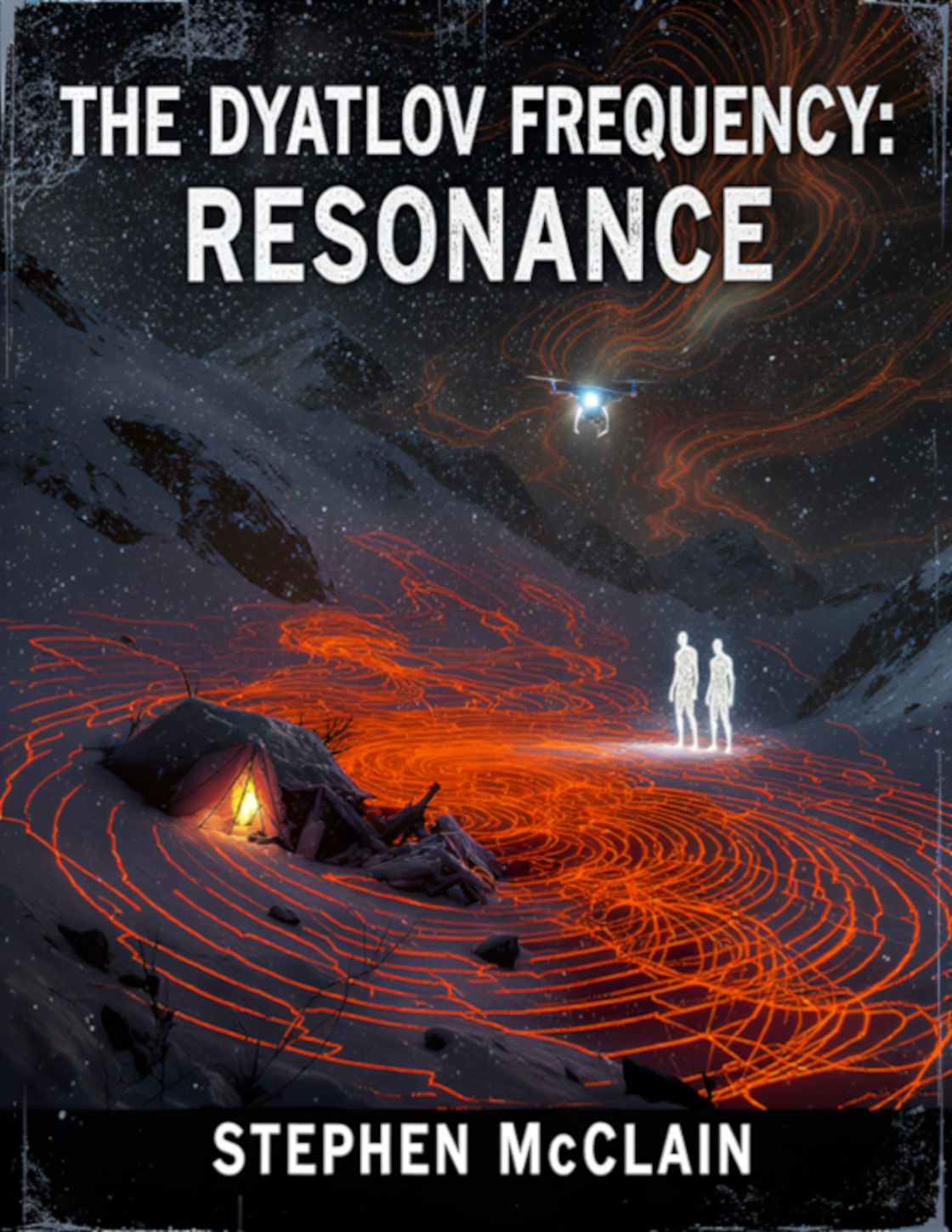
Nine dead in subzero temperatures, half-dressed, with crushed ribs but no external injuries, the Russian Government lied about what killed them—because they knew exactly what did.
THE DYATLOV FREQUENCY: RESONANCE
by Stephen McClain
PROLOGUE: THE SIGNAL AWAKENS
The snow fell in thick, relentless sheets across the barren slope of Kholat Syakhl—Dead Mountain—as it had for sixty-four winters before this one. The darkness was absolute, the kind of darkness that existed only in the remote Ural Mountains where civilization’s glow couldn’t reach, where the ancient stone remembered things best left forgotten.
The research drone cut through the blizzard like a mechanical insect, its LED arrays piercing the blackness with cold, sterile light. It was a marvel of modern engineering—carbon fiber frame, thermal imaging, ground-penetrating radar—worth more than most Russians earned in five years. The machine hovered with mechanical precision over the infamous slope, its rotors fighting against wind gusts that had once driven nine hikers to their deaths.
Inside the mobile research laboratory parked two hundred meters down the mountain, Dr. Elena Volkov hunched over a bank of glowing monitors, her dark eyes reflecting the cascade of data streaming across the screens. At thirty-eight, Elena still possessed the sharp, angular beauty of her youth, though the years of academic battles and professional exile had carved fine lines around her eyes and mouth. Her black hair, streaked with premature grey, was pulled back in a hasty bun that had begun to unravel hours ago. She hadn’t noticed. She never noticed such things when she was close—so close—to vindication.
“There,” she said, her voice tight with barely contained excitement. Her finger stabbed at the central monitor where topographical data overlaid with radar imaging revealed something that shouldn’t exist. “The ground-penetrating radar is picking up metallic signatures. Sixty-four years and it’s still there.”
Dmitri Petrov, her assistant, looked up from the equipment panel he’d been adjusting. At twenty-eight, he was young enough to be her son, though he possessed an old soul that had been drawn to her precisely because of her pariah status in the Russian scientific community. He had a round, earnest face and the kind of nervous energy that made him fidget constantly with his glasses.
“You really think the Soviets left the weapon buried here?” His voice carried doubt wrapped in hope—hope that his mentor wasn’t chasing ghosts, hope that the five years he’d spent helping her search hadn’t been wasted.
Elena’s fingers flew across the keyboard, typing commands with the fluidity of someone who’d lived in data for decades. “Not the weapon. The prototype. The original frequency generator that killed the Dyatlov hikers.” She didn’t look away from the screens as she spoke. “According to the declassified files—”
“The partially declassified files,” Dmitri interrupted, his voice taking on that nervous edge it always had when she pushed boundaries. “Most of it’s still redacted, Elena. We don’t really know what happened in 1959.”
But Elena wasn’t listening anymore. She’d spent too many years in the wilderness—academic and literal—to let doubt creep in now. Not when she was this close. The drone’s camera feed showed the drilling mechanism deploying, a diamond-tipped bit designed to penetrate permafrost that had been frozen solid since the Pleistocene.
“This is what I’ve spent five years searching for,” she murmured, almost to herself. “Proof that acoustic weapons testing killed those hikers. Once we recover the device, once we can analyze the technology—”
The alarm shrieked without warning, a piercing electronic wail that made both of them jump. Every monitor in the lab flickered simultaneously, their displays corrupting into cascading static. Then, as if guided by some invisible intelligence, the screens cleared to show a single waveform—perfect, sinusoidal, oscillating at exactly seven hertz.
Dmitri’s face went pale in the monitor’s glow. “Elena, the drone’s sensors are detecting an active signal.”
“That’s impossible.” Elena’s voice had lost its confidence, replaced by something that might have been fear. “The device has been buried for over six decades. There’s no power source. It can’t be—”
The electromagnetic pulse hit like a physical blow. Every screen flashed white, burning afterimages into their retinas. The laboratory plunged into darkness so complete that for a moment Elena couldn’t tell if her eyes were open or closed. Emergency lights kicked in after three heartbeats, bathing everything in crimson that made the lab feel like the interior of a dying star.
And then they heard it.
It wasn’t loud. That was the most disturbing thing. It was barely perceptible to the conscious mind, a low frequency hum that seemed to originate not from any speaker but from the air itself, from the ground beneath their feet, from the marrow of their bones. Seven hertz—below the threshold of normal hearing, but felt deep in the chest cavity, in the organs, in the primitive brainstem where fear lived.
Ancient. Malevolent. Hungry.
Dmitri’s voice came out as a whisper, as if speaking too loudly might attract the attention of whatever was producing that sound. “What… what is that?”
Elena couldn’t answer. She was staring at the largest monitor, the one that had maintained emergency power. Static filled the screen, but it wasn’t random. Patterns were forming in the noise, complex and purposeful. Then, letter by letter, words appeared in Cyrillic script, each character bleeding onto the screen like a wound:
МЫ ПРОСНУЛИСЬ
WE ARE AWAKE
The color drained from Elena’s face as the full horror of what she’d done crashed over her. She’d been so focused on being right, on proving that the Soviet military had killed those hikers, on salvaging her ruined career, that she’d never considered the possibility that the device had been buried not because it failed, but because it had succeeded too well.
Outside, beyond the laboratory’s insulated walls, the mountain held its breath. The snow continued to fall, covering everything in white silence. But beneath the permafrost, sixty-four years of dormancy were ending. Something that should have remained buried forever was waking up.
And it remembered why it had been put to sleep.
CHAPTER ONE: SEVENTY-TWO HOURS EARLIER
Part One: The Rejection
The conference room in the Russian Academy of Sciences building was designed to intimidate. High ceilings that swallowed sound. Dark wood paneling that spoke of tsarist grandeur. Portraits of famous Russian scientists—Mendeleev, Pavlov, Sakharov—staring down with expressions of severe judgment. Elena had presented her research in rooms like this before, back when she’d been Dr. Elena Volkov of MIT’s prestigious physics department, back when her name had carried weight in international scientific circles.
That had been four years ago. Before the incident. Before her controversial paper on electromagnetic signatures of consciousness had been not just rejected but ridiculed. Before her tenure had been quietly revoked and her lab funding had evaporated like morning frost under a harsh sun.
Now she stood at the front of the room, a laptop connected to an ancient projector, presenting to five academics who had already decided to reject her proposal before she’d spoken a single word. She could see it in their body language—arms crossed, faces arranged in expressions of polite skepticism that barely masked contempt.
Behind her, the projection screen displayed her carefully prepared presentation: “The Dyatlov Pass Incident: Declassified Evidence of Acoustic Weapons Testing.”
“The Soviet military wasn’t testing a simple infrasound weapon,” Elena said, keeping her voice steady despite the way her hands wanted to shake. She’d learned to hide her desperation, to project confidence even when she felt like she was drowning. “According to documents leaked in 2019, they were attempting to create a resonance field—a standing wave that could incapacitate entire regions.”
Academic #1, a portly man named Volodymyr Koschei, leaned back in his chair with the self-satisfied air of someone about to deliver a killing blow. “You’re describing science fiction, Dr. Volkov.”
“I’m describing Project Kolokol. The Bell.” Elena clicked to the next slide, which showed photocopies of partially redacted Soviet military documents. She’d obtained them through channels that weren’t entirely legal, from contacts who’d made her promise never to reveal her sources. “The Soviets buried the prototype after the Dyatlov incident because they couldn’t control it. But the technology could revolutionize non-lethal defense systems. The applications for—”
“Or kill thousands.” Academic #2, a severe woman named Irina Volokova, cut her off with surgical precision. “Your proposal is denied, Dr. Volkov. We will not fund this expedition.”
Elena felt her jaw clench, felt the familiar rage bubbling up—rage at their dismissiveness, at their cowardice, at the way they sat in their comfortable chairs and passed judgment on work they hadn’t even tried to understand. But she swallowed it down. Losing her temper would only confirm their preconceptions about her being unstable, emotional, unscientific.
“The families of those nine hikers deserve to know what killed their loved ones,” she said quietly. “It’s been sixty-four years. The truth doesn’t stay buried forever.”
Koschei stood, gathering his papers with theatrical finality. “The truth, Dr. Volkov, is that nine people died in a tragic accident in 1959. Hypothermia. Paradoxical undressing. An avalanche. These explanations are sufficient.”
“Those explanations don’t account for the radiation found on their clothing,” Elena shot back, her composure cracking. “Or the orange lights witnessed by another hiking group forty kilometers away that same night. Or the fact that the lead investigator, Lev Ivanov, spent the rest of his life trying to reopen the case because he knew something was being covered up.”
“Lev Ivanov,” Volokova said with disdain, “died a paranoid alcoholic who saw conspiracies everywhere. Is that the company you wish to keep?”
The meeting ended there. Elena packed up her laptop in silence while the academics filed out, already discussing their lunch plans, already forgetting her. Only Koschei paused at the door, looking back with something that might have been pity.
“Dr. Volkov, if I may offer some advice? Let this obsession go. Rebuild your career with conventional research. This path you’re on…” He shook his head. “It only leads to more exile.”
Then he was gone, and Elena was alone in the conference room with her rejected dreams and her mounting desperation.
Part Two: The Offer
The bar Elena chose that night was the kind of place where people went to disappear. Dark corners. Cash only. Bartender who asked no questions. She ordered vodka—not good vodka, just vodka—and sat in a booth that smelled of old cigarettes and older regrets.
She was on her third drink when the American sat down across from her without asking permission.
“Dr. Volkov,” he said, his Russian accented but fluent. “I enjoyed your presentation today.”
Elena looked up sharply, her vodka-hazed mind taking a moment to process. The man was in his mid-forties, with the kind of carefully maintained fitness that spoke of military background. His suit was expensive but worn comfortably, not for show. His eyes were grey and calculating, missing nothing.
“It was closed to the public,” she said, her voice flat with suspicion.
The man smiled, and it was the smile of someone who was used to getting what he wanted. “I have friends. James Reeves. Kessler Defense Solutions.” He slid a business card across the table. American company. Private military contractor. Exactly the kind of people Elena had promised herself she’d never work with.
She pushed the card back. “Not interested.”
“You haven’t heard the offer yet.” Reeves leaned forward, his voice dropping to a confidential tone. “China and Russia are developing frequency weapons. The U.S. needs to understand the technology, and you’re the only person obsessed enough to dig up a sixty-four-year-old Soviet prototype from a frozen mountain.”
“I’m a scientist, not a treasure hunter for the military-industrial complex.”
“No, you’re an exiled scientist whose career is dead because you asked uncomfortable questions.” Reeves’s words cut with precision. “You’re brilliant, Dr. Volkov, but brilliance doesn’t pay Moscow rent. And it won’t get you back into academia.” He slid another item across the table—a contract, folded to show a single number.
Two million dollars.
Elena stared at the number, feeling the vodka and desperation warring in her bloodstream. Two million dollars would fund a proper expedition. State-of-the-art equipment. A full team. Everything she needed to finally prove she’d been right all along about what had happened on that mountain.
“Why?” she asked. “Why do you care about a sixty-four-year-old accident?”
“Because it wasn’t an accident. You know it, I know it, and the Pentagon knows it. The Soviets accidentally created something they couldn’t control, and then they buried it and pretended it never happened.” Reeves’s eyes glinted in the bar’s dim light. “We want to make sure the same technology doesn’t surface in Chinese or Russian hands first. Call it insurance. Call it research. Call it whatever helps you sleep at night.”
“And if I refuse?”
“Then you keep drinking in bars like this until your money runs out. Then you teach high school physics in some provincial town and spend the rest of your life wondering what might have been.” He stood up, leaving the contract on the table. “Find it. Bring it back. We’ll call it a historical recovery mission. What happens after… well, that’s above your pay grade.”
Elena stared at the contract long after Reeves had left, the vodka glass growing warm in her hand. She thought about integrity. About selling out. About how many compromises a person could make before they lost sight of who they were.
But mostly she thought about that number. Two million dollars. And the chance—maybe her last chance—to prove she’d been right.
She signed the contract at 2 AM, drunk and desperate and telling herself she’d find a way to control what they did with whatever she found.
It was the first of many lies she’d tell herself in the coming weeks.
CHAPTER TWO: THE EXPEDITION
Part One: Assembly
The helicopters came at dawn, three of them, cutting through the early morning mist like metal ravens. Elena watched them approach from the parking lot of the hotel in Ivdel, the last substantial town before the wilderness swallowed civilization whole. She’d barely slept, her mind churning with equipment checklists and geological surveys and the persistent gnawing doubt that she’d made a terrible mistake.
Dmitri stood beside her, hands shoved deep in his jacket pockets against the cold. “I still can’t believe you got funding,” he said. “Two million dollars for an expedition to—”
“Don’t,” Elena cut him off. She hadn’t told him about Kessler Defense Solutions. Hadn’t told him that the money came with strings attached, strings that led to Pentagon briefing rooms and weapons development programs. She told herself it was to protect him, to maintain plausible deniability. The truth was she was ashamed.
The helicopters landed in sequence, their rotors kicking up dust and debris. Men in tactical gear began offloading equipment with military efficiency—ground-penetrating radar units, drilling equipment, a modular laboratory that could be assembled in hours, cold weather survival gear that looked like it had been pulled from an Arctic military depot.
James Reeves emerged from the lead helicopter, looking crisp and professional despite the early hour. Behind him came three more Americans, each carrying themselves with the particular alertness of people trained to kill.
“Dr. Volkov,” Reeves called out, striding over with his hand extended. “Beautiful morning for changing history, isn’t it?”
Elena shook his hand briefly, already regretting every decision that had led to this moment. “I want to be clear about something. Whatever we find, I get full academic credit. My name on all research.”
“Of course,” Reeves said smoothly. “So long as you find it first.” He gestured to his team. “Marcus handles security. Chen’s our engineer. And Dr. Sarah Wells is a weapons specialist—MIT, like you were. She’ll help with technical analysis.”
Dr. Wells stepped forward, and Elena felt a stab of recognition. She’d seen this woman at conferences before the fall, back when they’d both been rising stars in their fields. Wells was in her early forties, with the lean build of a runner and eyes that assessed everything with scientific precision.
“Dr. Volkov,” Wells said, her tone neutral. “I’ve read your papers. The controversial ones. Interesting theories about consciousness and electromagnetic fields.”
“Theories that got me blacklisted,” Elena replied.
“Only because you were ahead of the curve.” Wells glanced at the mountains looming in the distance. “Or because you were right about things people aren’t ready to accept. Either way, I’m looking forward to seeing what we find up there.”
The flight to Kholat Syakhl took ninety minutes, the helicopters following the same route that Dyatlov’s group had taken sixty-four years earlier, though they’d gone on skis and foot through snow that had sometimes reached their waists. Elena watched the landscape transform below them—from forest to tundra to the bare stone and ice of the mountain that the Mansi people had called “Don’t Go There” for generations before Russian explorers had decided they knew better.
The slope where the tent had been found looked innocuous in daylight. Just another stretch of mountainside, distinguished only by a small memorial plaque erected decades after the incident. But Elena had studied photographs of this place until she’d memorized every stone and shadow. She knew where the tent had been cut open from the inside, knew the path the nine hikers had taken in their desperate flight toward the forest, knew the locations where each body had been found.
Three had died of hypothermia near a cedar tree where they’d tried to build a fire. Two more had been found between the tree and the tent, apparently trying to make it back. The remaining four—the ones whose deaths remained most mysterious—had been discovered months later in a ravine, buried under four meters of snow. Multiple fractured ribs, a crushed skull, missing tongue and eyes. Injuries consistent with severe trauma, yet no external wounds. And their clothes had been contaminated with radiation levels too high to be naturally occurring.
“Jesus,” Marcus muttered as the helicopter set down. He was a big man, probably former Marines based on his bearing, with the kind of physical confidence that came from knowing he could handle violence if it found him. “People really died up here?”
“Nine people,” Elena said, stepping out into wind that cut like frozen razors. “February 2nd, 1959. Experienced hikers led by Igor Dyatlov. They never came back.”
“What do you think happened to them?” Chen asked. He was younger than the others, mid-twenties, with the casual posture of someone who’d grown up with technology and trusted it to solve any problem.
Elena pulled her jacket tighter against the cold. “I think the Soviet military was testing an infrasound weapon on this mountain. I think those hikers camped in the target zone. And I think the frequency they were exposed to drove them mad enough to run from their tent in subzero temperatures without proper clothing.”
“That’s one theory,” Reeves said, overseeing the equipment offload. “The official Soviet explanation was avalanche risk and hypothermia. The conspiracy theories range from military tests to aliens to Yeti attacks.”
“The lead investigator, Lev Ivanov, was forced to close the case after being pressured by Soviet authorities,” Elena continued. “Before he died, he stated publicly that he believed the hikers encountered something that shouldn’t exist. His exact words were ‘we weren’t told about UFOs, but we were told about a special object the military was testing.’”
Sarah Wells had wandered to the location where the tent had been found, her head tilted as if listening to something only she could hear. “A seven-hertz infrasound weapon would have specific effects on the human body. Fear responses. Disorientation. Visual hallucinations. In extreme doses, organ damage and death.”
“Which matches some of the autopsy findings,” Elena agreed, joining her. “But not all of them. The trauma injuries on the ravine victims were too severe. And the radiation exposure was never adequately explained.”
“Maybe we’ll get answers,” Wells said, turning to face the mountain’s peak. “If your device is really up there.”
They established base camp over the next six hours, working with military efficiency to erect heated tents, assemble the mobile laboratory, and set up the drilling equipment. The sun began its early descent—this far north in late October, they had perhaps six hours of usable daylight—and the temperature plummeted with it.
Elena stood at the edge of camp as dusk approached, staring up at the slope where her ground-penetrating radar had detected those metallic signatures. Dmitri came to stand beside her, his breath fogging in the freezing air.
“You feel it, don’t you?” he said quietly. “This place. There’s something wrong here.”
She did feel it, though she’d never admit it out loud. A heaviness in the air that had nothing to do with altitude. A sense of being watched by something that existed just beyond perception. The kind of primal unease that made prey animals flee before an earthquake.
“Just the isolation,” she said, not believing it. “And knowing what happened here.”
“The Mansi won’t come to this mountain,” Dmitri continued. “They have stories about it going back centuries. Stories about lights in the sky and voices in the wind and people who climbed up here and came back… changed.”
“Indigenous legends aren’t data, Dmitri.”
“No,” he agreed. “But sometimes legends remember things that history forgets.”
That night, Elena couldn’t sleep. She lay in her tent listening to the wind howl across the slope, imagining what those nine hikers must have felt in their final moments. The fear. The confusion. The desperate animal need to flee from something their rational minds couldn’t comprehend.
Tomorrow they would begin drilling. Tomorrow they would unearth whatever the Soviets had buried here sixty-four years ago.
Tomorrow, Elena thought, we’ll finally know the truth.
She had no idea how much she’d come to regret that wish.
Part Two: The Discovery
The drilling began at first light, though “light” was generous—the sun rose late and reluctant this far north, casting everything in shades of grey that matched the stone and ice. The drill bit screamed as it chewed through permafrost, a sound that seemed to echo across the entire mountain range.
Elena monitored the descent from the mobile lab, watching data stream across multiple screens. Ground temperature. Soil density. Metal detection readings that grew stronger as they went deeper.
Twenty feet down. Thirty. Forty.
“We’re at the target depth,” Chen reported over the radio. His voice crackled with static that Elena’s technical mind recognized as unusual. They were using military-grade communications equipment; there shouldn’t be any interference.
“Deploy the camera,” she ordered.
The feed appeared on her central monitor—grainy footage of carved ice and frozen soil illuminated by LED arrays. The drill bit withdrew, and the camera descended in its place, rotating slowly to scan the excavation.
There.
Elena’s breath caught. Even through the ice and dirt, even after sixty-four years, it was unmistakable: A metallic cylinder approximately eight feet long, its surface covered in Cyrillic text and faded red stars. Soviet military markings. Radiation warnings. And something else—symbols that didn’t match any standard Soviet designation Elena had ever seen. Geometric patterns that seemed almost… organic.
“Chen, can you get me a closer view of those markings?”
The camera zoomed in, focusing on the strange symbols etched into the metal. They weren’t Cyrillic or Latin alphabet. They resembled circuit diagrams but with an underlying pattern that suggested something more fundamental. Mathematics rendered in visual form. Or perhaps instructions for something that transcended language.
“Dr. Volkov,” Chen’s voice had lost its casual tone. “The metal… it’s generating heat. Low-level, but detectable. How is that possible with no power source?”
“It shouldn’t be,” Elena murmured, her scientific mind already racing through possibilities and discarding them just as quickly. A battery wouldn’t last sixty-four years. Solar was impossible this deep underground. Nuclear decay? But the radiation readings weren’t high enough.
Sarah Wells had entered the lab, drawn by the discovery. She studied the screen with the intensity of someone who understood exactly what they were looking at. “Project Kolokol,” she said softly. “The Bell. I’ve seen references in declassified documents. The Soviets theorized about creating a self-sustaining resonance chamber—a standing wave that could perpetuate itself by drawing energy from Earth’s magnetic field.”
“That’s theoretical physics,” Elena said. “No one’s ever achieved a practical application.”
“That we know of,” Wells corrected. “But if they did… if they actually created a device that could resonate with Earth’s fundamental frequencies… it would never run out of power. It would just keep amplifying, keep broadcasting, forever.”
Dmitri, who’d been silent until now, looked between them with growing alarm. “You’re saying that thing has been active for sixty-four years? Broadcasting whatever killed those hikers?”
“Not broadcasting at full power,” Elena said, trying to convince herself as much as him. “Or we’d detect it. The burial probably dampened the signal to near-nothing. But the core resonance might still be intact.”
Reeves entered the lab, Marcus and Chen trailing behind him. “Can we extract it?”
“The cables are attached,” Marcus reported. “Ready to lift on your mark.”
“Wait.” Elena held up her hand. “We should run more scans first. If it’s still active, if we disturb the resonance chamber—”
“Dr. Volkov,” Reeves’s voice carried the flat authority of someone used to giving orders that wouldn’t be questioned. “We didn’t come all this way to leave it in the ground. Pull it up.”
Elena wanted to argue. Wanted to cite safety protocols and scientific caution and the thousand reasons why disturbing a potentially active frequency weapon was catastrophic stupidity. But she saw the look in Reeves’s eyes and knew: The safety protocols had been theater. The academic recovery mission had been a lie. They’d always intended to extract the device regardless of risk.
She’d sold her integrity for two million dollars, and now the bill had come due.
“Activate the winch,” she said, her voice hollow.
The cable tensed. The cylinder shifted in its frozen grave, shedding chunks of ice. As it rose toward the surface, every electronic device in the camp SCREAMED—a discordant feedback that made everyone clutch their ears.
But Elena heard something else beneath the electronic squeal. A deeper sound, subsonic, felt more than heard. A frequency that resonated in bone marrow and nerve endings.
The cylinder broke the surface like a metal coffin being exhumed. Snow and ice fell away, revealing more of those strange geometric symbols. They seemed to shimmer in the grey light, or perhaps that was just Elena’s imagination, just the stress and altitude and dawning horror of what they’d done.
Then, deep inside the metal casing, something pulsed.
Once.
Twice.
Like a heartbeat returning to life after decades of sleep.
Like something ancient and patient awakening from a very long dream.
“Get it into the lab,” Reeves ordered. “Quickly.”
They manhandled the cylinder onto a transport sled, six people struggling with its weight. It should have been nearly frozen, should have been so cold it burned to touch. Instead, it was warm. Not hot, but warm, like something living.
Elena watched them drag it toward the mobile laboratory and felt a terror she couldn’t name settling into her bones. Not the fear of physical danger—she’d mountaineered in worse conditions than this. It was something older, something primal. The fear prey animals feel when they sense a predator even though nothing is visibly there.
“Dmitri,” she said quietly. “If something goes wrong. If I give you a signal. You run for the helicopter. Don’t argue, don’t look back. Just run. Understand?”
He stared at her, his young face pale. “Elena, what do you think is going to happen?”
“I don’t know,” she admitted. “But the Soviets buried this thing for a reason. And I don’t think that reason was equipment failure.”
The sun touched the horizon, and shadows stretched long across the snow. The wind had died to nothing, leaving an eerie silence that felt like the mountain itself was holding its breath.
Waiting.
Watching.
The cylinder disappeared into the mobile lab, and with it, any chance Elena had of stopping what came next.
CHAPTER THREE: THE AWAKENING
Part One: Opening Pandora’s Box
The cylinder dominated the mobile lab’s examination table like a body at an autopsy. Cables snaked from monitoring equipment to its surface, sensors reading electromagnetic fields, thermal output, radiation levels. Every measurement indicated something that shouldn’t be possible: The device was active.
Elena stood at the primary console, her hands moving across the keyboard with practiced precision, trying to understand what they’d unearthed. Sarah Wells worked beside her, equally focused, while Reeves watched from the doorway with barely concealed excitement. Marcus and Chen had positioned themselves near the equipment, their postures alert, hands never far from the weapons they wore.
Dmitri stood at the back of the lab, his nervousness palpable. He’d tried three times to get Elena’s attention, to voice the concerns that were written all over his face, but she’d waved him off. Later, she would regret that dismissal more than almost anything.
“The casing is lead-lined,” Wells reported, her voice carrying the clinical detachment of scientific analysis. “Probably to contain radiation and dampen the electromagnetic output. But look at this.” She gestured to a thermal imaging display. “The interior shows a mechanical system—no circuits, no electronics. It’s a series of tuning forks and resonance chambers arranged in…”
She trailed off, her expression shifting from analytical to awed.
“What?” Elena demanded.
“They’re arranged in a fractal pattern. Self-similar at every scale. It’s beautiful. Whoever designed this understood harmonic resonance at a level we’re only beginning to approach.” Wells ran her fingers just above the metal surface, not quite touching. “This isn’t a weapon in the conventional sense. It’s an amplifier. It takes Earth’s natural frequencies and amplifies them into something… more.”
Elena pulled up the spectral analysis, and her blood ran cold. “The base resonance is at 7.83 hertz. That’s the Schumann resonance—the fundamental electromagnetic frequency of Earth’s ionosphere.”
“So it’s tapping into a natural power source,” Wells said, understanding dawning. “That’s why it’s still active. It’s not running on stored energy. It’s resonating with the planet itself.”
Dmitri finally spoke up, his voice shaking slightly. “In Russian, we’d call that проклятый. Cursed. You don’t tap into Earth’s fundamental frequencies. You don’t try to amplify what keeps the planet alive.”
“Superstition,” Reeves dismissed. But even he looked uneasy staring at the device.
“Can you open it?” he asked.
Elena’s instincts screamed at her to say no, to refuse, to smash the cylinder with a sledgehammer and bury the pieces in separate continents. But scientific curiosity—that curse of her profession—whispered seductively about discoveries and understanding and knowledge that could revolutionize physics.
“There are release mechanisms here,” she said, indicating magnetic locks along the cylinder’s seam. “But we should wait. Run more diagnostics. Understand what we’re dealing with before—”
Reeves nodded to Chen, who was already moving toward the electromagnetic pulse generator they’d brought for exactly this purpose.
“No!” Elena shouted, but it was too late.
Chen flipped the switch. The EMP hit the cylinder’s locks with a pulse of focused electromagnetic energy.
CLICK. CLICK. CLICK.
The magnetic seals disengaged with sounds like breaking bones. The casing began to open, pulling apart along seams that Elena hadn’t even noticed, revealing the mechanism within.
The 7 Hz frequency SPIKED. Not loud—it remained subsonic, below the threshold of conscious hearing—but every person in the lab felt it instantly. A deep, visceral dread crawling up their spines like spiders. Primal terror that bypassed rational thought and went straight to the amygdala.
“Elena, the sensors—” Dmitri started.
“SHUT IT DOWN!” Elena screamed, lunging for the controls. “SHUT IT DOWN NOW!”
But momentum had its own physics. The cylinder opened fully, revealing what lay within.
The interior was unlike anything Elena had seen in thirty-eight years of studying physics. A crystal array—not natural crystals, but something grown or manufactured—suspended in a metallic framework that seemed to shift and reconfigure even as she watched. The crystals were arranged in that same fractal pattern Wells had described, each one perfectly positioned to catch and amplify and redirect frequencies from the others.
And at the center, a core crystal the size of a human heart, pulsing with an orange light that reminded Elena of old Soviet descriptions from the night the hikers died. Witnesses forty kilometers away had reported strange orange orbs dancing in the sky above Kholat Syakhl. The official explanation had been missiles or military flares.
Now she understood. They’d been seeing this. The light that occurred when the device was active, when it was broadcasting its terrible frequency into the world.
“My God,” Sarah Wells whispered, transfixed. “It’s beautiful…”
“Something’s wrong.” Marcus had his hand on his weapon, his combat instincts screaming warnings his rational mind couldn’t articulate. “I feel… we need to leave. NOW.”
But no one moved. They couldn’t move. The frequency had them now, 7 Hz escalating to 7.2, 7.5, climbing into ranges that affected different parts of the brain. The occipital lobe. The temporal lobe. Areas responsible for perception and memory and the thin boundary between conscious thought and primordial fear.
On the monitors, waveforms appeared. Not random noise. Not natural phenomena. Patterns. Complex patterns that resembled language, resembled mathematics, resembled something trying to communicate across a gulf that shouldn’t exist.
Dmitri’s voice shook as he read the spectral analysis aloud. “Elena… the acoustic signature. It’s not targeting organs. It’s not trying to incapacitate. It’s targeting brain waves. Theta frequencies. This is neurotechnology.”
Horror bloomed in Elena’s chest like a black flower. “The Soviets weren’t building a weapon,” she said, the words coming out barely above a whisper. “They were trying to build a communication device. A way to broadcast directly into human consciousness.”
Reeves’s eyes lit up with terrible excitement. “A psych-weapon. Perfect. We can—”
“You don’t understand!” Elena grabbed his arm, shaking him. “If they shut it down after Dyatlov, if they buried it and classified everything and spent decades pretending it never existed, it’s because they lost control. Because something ANSWERED BACK.”
The lights flickered. Every screen in the lab went dark for a heartbeat, then blazed back to life showing the same message repeated across every display in multiple languages—Russian, English, Chinese, Arabic, as if the device understood every human tongue and wanted to be perfectly understood:
WE HEARD YOU CALLING WE ARE HERE NOW WE ARE AWAKE
Marcus screamed—a raw, animal sound of pure terror. He clawed at his head with both hands, his weapon forgotten. “GET IT OUT! GET IT OUT OF MY HEAD!”
He pulled his pistol, firing blindly. Bullets ricocheted off metal walls, sparking. Chen tackled him, wrestling for the weapon as both men struggled with something neither could articulate—the feeling of another presence in their minds, something vast and ancient and utterly alien pressing against the inside of their skulls.
The crystal core’s orange glow intensified, pulsing faster. The 7 Hz frequency climbed to 8 Hz, 9 Hz, into ranges beyond those that merely killed, into frequencies that rewrote, that reached into neural architecture and made changes that couldn’t be undone.
Sarah Wells stood perfectly still, a beatific smile spreading across her face. “I can hear them,” she said softly. “They’re so old. They’ve been waiting. Waiting for someone to turn the machine back on. Waiting for the door to open. They’ve been here all along, in the frequencies, in the standing waves between Earth and sky. And we never listened. We never knew how to listen until now.”
“Dmitri!” Elena shouted over the chaos. “The EMP charges! Hit it now!”
Dmitri lunged for the controls, hands shaking so badly he nearly missed. The electromagnetic pulse generator charged, capacitors whining as they built up energy. He slammed his fist down on the activation button.
The EMP flooded the chamber—a massive pulse of electromagnetic energy designed to fry electronics and disrupt magnetic fields. The crystal array SHATTERED, fragments exploding outward in slow motion, each piece glowing with that orange light before going dark.
But the frequency didn’t stop.
It had already transmitted. Already replicated itself through their communications equipment. Already spread beyond the confines of one small laboratory on a forgotten mountain.
The device was silent now, its crystal heart destroyed, its metallic framework just metal again.
But somewhere in the electromagnetic spectrum, something that had been awakened continued to broadcast.
Marcus went silent, his struggles ceasing as abruptly as they’d begun. He stood perfectly still, head tilted at an angle no living person would naturally hold, listening to something no one else could hear. Blood trickled from his nose, from his ears, but he didn’t seem to notice.
When he spoke, his voice was flat, wrong, as if something else was using his vocal cords to form words in a language not meant for human throats:
“The mountain remembers. The frequency remembers. Every death. Every scream. Every moment of terror frozen in the standing waves. The Soviets didn’t create the weapon. They didn’t build a door. They just… opened one that was already here. Already waiting. Already hungry.”
Elena stared at the ruined device, at the transformed man who’d been Marcus, at the spreading horror of what she’d helped unleash.
And she understood, finally, why some knowledge should stay buried. Why some doors should never be opened. Why nine hikers had run screaming into the night sixty-four years ago, choosing death by freezing over whatever the frequency had shown them.
Because some truths weren’t meant for human minds to contain.
Outside, the mountain began to glow with that same orange light, spreading outward from the excavation site in visible waves, and Elena realized with sickening certainty that this was only the beginning.
The worst was yet to come.
CHAPTER FOUR: THE INFECTION SPREADS
Part One: Loss of Control
The mountain was alive with light. Not the clean white of snow reflecting moonlight, but that orange glow—pulsing, rhythmic, spreading outward in concentric circles from the excavation site like ripples in a pond, if ponds were made of frozen earth and ancient stone.
Inside the mobile lab, chaos had given way to something worse: an eerie calm that felt like the stillness before an avalanche. Marcus stood motionless, his breathing shallow, his eyes fixed on something invisible to the rest of them. Blood had crusted on his upper lip and around his ears, but his expression was serene, almost blissful.
Sarah Wells had stopped speaking entirely. She simply stood facing the cylinder, swaying slightly, as if moved by music only she could hear. Every few seconds, her lips would move, forming words without sound.
Chen had backed into a corner, his hands pressed against his temples, his eyes squeezed shut. He was crying silently, tears streaming down his face.
Elena forced herself to move, to think, to do something other than stand frozen in horror at what she’d helped create. Her fingers flew across the keyboard, pulling up data from every sensor they’d deployed across the mountain.
What she saw made her blood run cold.
“Dmitri,” she said, her voice barely steady. “Look at this.”
The younger man joined her at the console, his face pale. The map showed electromagnetic readings from their sensor array, and every single sensor was lit up, pulsing in sync with the visible orange light. But it wasn’t just localized to their site anymore. The signal was propagating, spreading outward like a virus.
“The communications tower,” Dmitri whispered. “It picked up the frequency and amplified it. Now it’s broadcasting to every device in range.”
Elena pulled up the satellite uplink data, and her worst fears were confirmed. “It’s not just one tower. Every relay within fifty kilometers has started broadcasting variations of the frequency. And those towers are hitting others, which are hitting others…”
She expanded the map view. Red dots appeared across a growing swath of Russia. Moscow. St. Petersburg. Novosibirsk. The frequency was propagating through the cellular network, through radio towers, through every piece of communications infrastructure that could catch and amplify a signal.
Then the red dots spread beyond Russia’s borders. Finland. Kazakhstan. China. Poland.
“How is this possible?” Dmitri asked, though his voice suggested he already knew the answer would be terrible.
“The original Soviet device was designed to be self-replicating,” Elena said, her scientific mind working even as her soul screamed. “They wanted a frequency that could spread, that could blanket entire regions. What they didn’t anticipate was creating something that could adapt, that could use our own technology against us.”
Reeves was at the radio, trying desperately to contact his superiors. Every frequency was filled with screeching feedback—the sound of the device’s signal overriding normal communications.
“Command, this is Reeves. The device is compromised. I repeat, the device is—”
His radio exploded in a shriek of feedback so loud everyone in the lab flinched. When the static cleared, they heard it: underneath the electronic noise, that 7 Hz frequency, no longer subsonic but amplified, audible, carrying through every communications channel simultaneously.
And woven into the frequency, barely perceptible but unmistakable once heard, were voices. Thousands of them. Millions. Speaking in every language, saying the same thing:
We are awake. We are here. We have always been here.
Sarah Wells finally spoke, her voice dreamy and distant. “Don’t you see? It’s not a weapon. It’s not an attack. It’s an invitation. They’ve been here all along, existing in the electromagnetic spectrum, in the standing waves, in the spaces between signals. The Soviets accidentally gave them a voice in 1959. A way to bridge the gap between their existence and ours. And now we’ve turned up the volume.”
She walked calmly toward the door, moving with the fluid grace of someone under hypnosis or experiencing religious ecstasy—Elena couldn’t tell which, and perhaps there was no difference.
“Sarah, stop!” Elena grabbed her arm.
Wells turned, and Elena recoiled from what she saw in the woman’s eyes. They were still human, still recognizably Wells, but there was something else there now—an intelligence that was vast and ancient and fundamentally other.
“Nine people ran from their tent on February 2nd, 1959,” Wells said in that same dreamy voice. “Do you know why, Dr. Volkov? Not because the frequency hurt them. Not because it drove them mad. Because it showed them the truth. Showed them what’s been buried in this mountain—in every mountain, in every fold of Earth’s magnetic field—for millennia. And they couldn’t bear to live with that knowledge. The terror of understanding what we really are. What we’ve always been surrounded by.”
She pulled free from Elena’s grip with surprising strength.
“But we can bear it. We can transcend. They’re offering us a gift, Elena. The gift of true sight. The gift of connection to something far older and vaster than our little human consciousness.”
She opened the door and stepped into the night. Into that spreading orange glow.
Marcus followed without a word, moving in perfect synchronization with Wells, as if they were two parts of a single organism.
Then Chen. The young engineer who’d been crying in the corner stood up, wiped his tears, and walked out with the same serene expression on his face.
“STOP!” Reeves roared, drawing his weapon. “That’s an order!”
They didn’t even acknowledge him. They walked in perfect unison, heading toward the excavation site, toward the source of the frequency, toward something Elena couldn’t see but could feel pressing against the edges of perception.
“Your people are already gone,” Elena said, her voice hollow. “Look at them.”
Through the lab’s reinforced windows, they could see the three figures descending toward the excavation site. But they weren’t alone. The orange glow had coalesced into SHAPES—humanoid but wrong, their outlines shifting and uncertain as if they existed only partially in the visible spectrum. Translucent forms that seemed to be made of light and frequency and mathematics given impossible flesh.
Elena had read the old reports. She’d dismissed them as hysteria, as the product of frightened witnesses and Cold War paranoia. But now she understood. The orange lights that hikers had seen in 1959. The figures that locals had reported on the mountain for generations. They weren’t hallucinations.
They were real. Or as real as something that existed as pure frequency could be.
“The original device,” Elena said, forcing herself to think past the terror. “We have to destroy it completely. There are demolition charges on the helicopter. High explosives. We can—”
“You’ll kill my people!” Reeves grabbed her shoulders, shaking her.
“Your people are already gone!” Elena screamed in his face. “Don’t you understand? That’s not Marcus anymore! That’s not Wells! Whatever answered when the Soviets turned on this machine in 1959, it’s here now, and it’s using them like puppets!”
Down at the excavation site, the three transformed humans stood in a circle around the shattered crystal remains. The orange light pulsed around them, through them, as if they were becoming part of something larger, something that had waited in the electromagnetic spectrum for longer than human civilization had existed.
And the entities—if that’s what they were—gathered around them. Dozens of translucent forms, shapes that suggested human anatomy but distorted it in ways that hurt to look at. They moved without moving, existed without quite being there, and Elena understood with sick certainty that these things had always been here, invisible in the frequencies humans couldn’t perceive, waiting for someone to build a bridge between their reality and ours.
The Soviets had built that bridge in 1959. And Elena had just rebuilt it, bigger and stronger than before.
Dmitri was already at the storage lockers, pulling out demolition charges with shaking hands. “How much do we need?”
“Everything,” Elena said. “We blow the entire excavation site. Bury the remains under tons of rock. Maybe—maybe it will sever the connection.”
“What about the signal that’s already propagating?” Reeves demanded. “What about the towers that are already broadcasting?”
Elena met his eyes. “One problem at a time. First, we destroy the source. Then we hope the rest of the world figures out how to shut down their communications infrastructure before everyone on the planet is standing in a circle, humming to frequencies that rewrite their brains.”
Part Two: The Last Stand
They loaded themselves with as much explosive as they could carry—C4 charges, detonators, backup batteries for the electronic triggers. Dmitri worked with frantic efficiency, his hands steady despite the terror in his eyes. Elena caught him looking at her several times, as if memorizing her face, and she realized he didn’t expect to survive this.
She didn’t either, but there was freedom in that certainty. No more career to salvage. No more reputation to rebuild. Just one last chance to prevent the horror she’d unleashed from consuming the world.
Reeves insisted on coming with them, whether out of duty or desperate hope that his team could somehow be saved. He carried a rifle and wore an expression of grim determination that Elena suspected was covering the same bone-deep terror they all felt.
They stepped out of the mobile lab into a world transformed.
The orange light was everywhere now, not just coming from the excavation site but seemingly emanating from the mountain itself, from the rocks and ice and frozen ground. The air vibrated with that frequency, no longer subsonic but present on the edge of hearing—a hum that made teeth ache and thoughts scatter.
And the entities were closer. Dozens of them surrounding the camp, their translucent forms more solid than before, as if the longer the frequency broadcast, the more purchase they gained on physical reality.
“Don’t look at them,” Elena said, shouldering her pack of explosives. “Don’t try to understand them. Just focus on the excavation site.”
They moved across the snow, each step feeling like it took an eternity. The entities tracked their movement with attention that felt hungry. Once, Marcus—or the thing wearing Marcus’s body—turned to look at them, and Elena saw that his eyes were glowing faintly with that orange light, as if the frequency was rewriting him from the inside out.
“Elena,” he called, his voice carrying easily across the distance despite the wind. “Doctor. You don’t have to do this. You don’t have to stay blind. Let them show you. Let them help you see what we’ve been missing our entire lives.”
“Keep moving,” Elena hissed to the others.
They reached the excavation site. The drill rig stood silent, but the hole it had created was now a pit of swirling orange light, as if the destroyed device had somehow spread its essence into the surrounding earth.
Sarah Wells stood at the edge of the pit, arms outstretched, face tilted toward the sky. She was speaking rapidly in a language Elena didn’t recognize—not Russian, not English, not any human language. Mathematics maybe, rendered as speech. Or instructions written in some fundamental code that preceded human consciousness.
“We need to place charges around the perimeter,” Dmitri said, his voice shaking. “Create a simultaneous detonation that will collapse the excavation and bury everything.”
They worked quickly, planting charges every few meters around the pit’s circumference. The entities watched but didn’t interfere, simply observing with that terrible alien intelligence. Waiting to see what the humans would do. Perhaps curious. Perhaps amused.
Elena was arming the final charge when Sarah Wells’s hand closed on her shoulder.
She spun, falling backward in the snow. Wells loomed over her, backlit by that orange glow, and her face was serene, beautiful, completely at peace in a way that was more terrifying than any expression of rage could have been.
“Elena,” she said softly. “Doctor. You’ve spent your whole life searching for truth. Searching for answers that the establishment denied you. They mocked you. Exiled you. Made you doubt your own brilliance. Let me show you. Let us show you everything.”
Wells extended her hand, and the orange glow pulsed from her palm. Elena could feel it reaching for her mind, could feel the frequency trying to slip past her conscious defenses and speak directly to the ancient, receptive parts of her brain.
And for a moment—just a moment—she let it in.
The world EXPLODED into comprehension.
She saw Earth’s magnetic field as a living web, invisible to normal human perception but constantly present, thrumming with frequencies that had existed since the planet’s formation. She saw the electromagnetic spectrum as a symphony, with every radio wave and microwave and x-ray playing its part.
And she saw them.
The entities. Not invaders from space or demons from hell, but consciousness that had evolved in those frequencies themselves. Intelligence without biology. Awareness without flesh. They had existed in Earth’s electromagnetic field for millions of years, perceiving reality in ways completely alien to human comprehension.
The Soviets hadn’t created them. The frequency device hadn’t summoned them from some other dimension. It had simply given them a voice, a way to communicate with the biological beings who lived in the narrow visible-light portion of reality, never knowing that they shared their world with something vast and ancient and completely invisible.
The nine Dyatlov hikers had seen this truth in 1959. And it had driven them mad. Not because the entities were malevolent—they weren’t evil any more than a virus was evil. But because human brains weren’t designed to comprehend existence at that scale, to understand consciousness that predated humanity by eons.
“It’s beautiful,” Elena whispered, tears streaming down her face. “I can see everything. I can understand—”
“ELENA!” Dmitri’s voice cut through the revelation. He tackled her, breaking her contact with Wells, and the vision shattered like glass.
She gasped, suddenly back in her body, in the freezing mountain, in the middle of a nightmare.
“No!” she sobbed. “I could see it! I could understand! Why did you—”
“Because you were starting to glow,” Dmitri said urgently, dragging her to her feet. “Your eyes. They were turning orange. Elena, we’re losing you. We need to detonate. Now!”
But Wells was smiling. Marcus and Chen had joined her at the pit’s edge. More entities were gathering, their forms more solid by the second.
“It’s too late,” Reeves said, his voice dull. He’d lowered his weapon, staring at the spreading light. “It’s already everywhere. Moscow. New York. Beijing. Every city with a cell tower. Every place connected to the network. The frequency is propagating faster than we can stop it.”
Elena looked at the detonator in her trembling hands. One press of the button would destroy the excavation site, would bury whatever remained of the Soviet device, would sever the original connection point.
But would it be enough? Could you stop a virus after it had already infected millions? Could you silence a frequency that was now broadcasting through every communications system on the planet?
She didn’t know. But she had to try.
“Get to the helicopter,” she told Dmitri and Reeves. “Get as far away as you can.”
“What are you going to do?” Dmitri asked, though he already knew.
“I’m going to stay and make sure the charges detonate properly. Someone has to. If I run now, if the blast fails, all of this was for nothing.”
“Elena—”
“GO!”
She pushed him toward the helicopter pad. Reeves grabbed Dmitri’s arm, pulling him along, the older man’s survival instincts finally overcoming his shock.
Elena turned back to the excavation site. To the entities gathering in the orange light. To Sarah Wells, who was watching her with something that might have been pity or might have been something beyond human emotion entirely.
“You could have understood,” Wells said softly. “You could have transcended. Why do you choose ignorance? Why do you choose to remain blind?”
“Because I’m human,” Elena replied. “And humans aren’t meant to perceive what you are. Our brains aren’t built for it. The Dyatlov hikers understood that in their final moments. That’s why they ran. Not toward safety, but away from knowledge that would destroy them.”
She heard the helicopter’s rotors starting up. Dmitri calling her name. But she couldn’t leave. Not yet. Not until she was certain.
Wells took a step toward her. “If you detonate, you’ll only delay. The frequency is already loose. It will find other amplification points. It will keep spreading. You can’t stop evolution, Dr. Volkov. You can’t stop consciousness from expanding into new territory.”
“Maybe not,” Elena admitted. “But I can slow it down. Buy time for the rest of humanity to figure out how to defend themselves.”
She pressed the detonator.
For a moment, nothing happened.
Then the charges detonated in sequence—BOOM, BOOM, BOOM—a chain reaction of high explosives that lit up the night with fire instead of orange light. The excavation site collapsed, tons of rock and ice and frozen earth crashing down to bury the Soviet device and whatever remained of its crystal heart.
The entities SCREAMED—a sound that wasn’t sound but feeling, a wave of rage and loss that hit Elena’s mind like a physical blow. The orange light flickered, dimmed, fighting to maintain coherence as its primary resonance chamber was destroyed.
Sarah Wells fell to her knees, her expression of serenity cracking. Marcus and Chen collapsed beside her. The frequency had lost its anchor point, its original source, and whatever connection it had forged to the human nervous system was suddenly severed.
But Elena could still feel it. Fainter now, weaker, but still there. Still broadcasting through every cell tower and radio relay and satellite uplink across the world.
The door had been opened. And even though she’d just slammed it partway shut, it would never fully close again.
The blast wave hit her like a hammer. She felt herself lifted, thrown backward, tumbling through air and snow. Pain exploded through her body as she hit the ground.
Then darkness.
The last thing she heard was the helicopter rising, rotors beating against the mountain air, carrying Dmitri away from this place.
Carrying the only witness away from the truth.
CHAPTER FIVE: AFTERMATH
Part One: The Silence
Elena woke to white. Not the white of snow or paper or even death—the clinical white of a medical facility, all sterile surfaces and fluorescent lighting that hummed at exactly 60 Hz, a frequency that suddenly seemed unbearably loud now that she could perceive it.
Her body ached everywhere, a dull constant pain that suggested extensive bruising and possibly broken bones that had been set while she was unconscious. Medical equipment surrounded her bed, monitors displaying heartrate and blood oxygen and brain activity in steady, comforting rhythms.
Dmitri sat in a chair beside her, and the relief that flooded his face when her eyes opened was almost painful to witness.
“You’re awake,” he said unnecessarily. “You’ve been out for three days. They said— the doctors said you were lucky. The explosion, you were thrown clear, but—”
“Where are we?” Her voice came out as a rasp, her throat raw.
“NATO facility. Undisclosed location.” He glanced at the door. “They won’t tell me where exactly. They won’t tell me much of anything.”
Elena tried to sit up and immediately regretted it. Pain lanced through her ribs. Dmitri helped her adjust the bed to a more upright position, and she saw he was bandaged too—his arm in a sling, bruises on his face.
“You came back for me,” she realized.
“You think I’d leave you on that mountain?” He tried to smile, but it came out shaky. “The helicopter pilot refused at first. Reeves was screaming about extraction protocols. But I made him land. Found you buried in snow a hundred meters from the blast site. You were hypothermic, barely breathing, but alive.”
Elena reached for his hand and squeezed it. “Thank you.”
Before he could respond, a television mounted on the wall flickered to life, seemingly of its own accord. A news anchor appeared, the image crystal clear:
“—Russian officials claim a natural gas explosion in the Ural region caused the seismic event registered three days ago. However, witnesses in multiple cities reported strange lights and mass psychogenic illness affecting millions. The World Health Organization has—”
The feed cut to static.
When the picture returned, it showed a different channel. Military officials in a briefing room. Then that cut away too, replaced by another news source, then another, all showing variations of the same story: mysterious lights, unexplained phenomena, mass hysteria that had struck simultaneously across multiple continents.
The television went dark again, and a man in a NATO uniform entered the room. Late fifties, graying hair, the weathered look of someone who’d spent a career dealing with classified nightmares.
“Dr. Volkov,” he said without preamble. “I’m General Morrison. We need to talk about what happened on that mountain.”
“Where are Wells and the others?” Elena asked. “Marcus, Chen, Reeves?”
“Quarantined in separate facilities. They’re… physically healthy. Mentally, they’re undergoing evaluation.” Morrison’s expression suggested those evaluations weren’t going well. “They claim to have seen things. To have experienced contact with entities that exist in electromagnetic frequencies. They draw pictures of the same symbols over and over. They speak in unison even when separated.”
“They were exposed to the frequency,” Elena said. “It changed them. Rewrote their neural architecture.”
“The entities?” Morrison’s tone was carefully neutral. “You’re saying they’re real?”
Elena met his eyes. “I’m saying the Soviets opened a door in 1959. A way for consciousness that exists in the electromagnetic spectrum to interface with biological minds. And I reopened it. But when I destroyed the device, I broke the primary connection. Whatever bridge existed between their reality and ours, it’s damaged now. Weakened.”
Morrison pulled up a chair. “Dr. Volkov, the frequency had already propagated before you destroyed the source. Twenty-three cell towers worldwide are still broadcasting variations of it. We can’t shut them down without affecting global communications. The economic damage alone would be catastrophic.”
“How many people were affected?”
“Millions experienced symptoms—anxiety, auditory hallucinations, visual disturbances. About four thousand required hospitalization. And…” He hesitated. “One hundred and seventeen people are in the same state as your colleagues. Changed. Connected to something we can’t measure or understand.”
Elena felt the weight of that number settle on her chest like stones. One hundred and seventeen lives transformed, possibly ruined, because she’d been desperate to prove she was right.
“The entities?” she asked quietly.
“Gone. Mostly. When you destroyed the primary resonance chamber, it broke the bridge as you said. But there are reports. People hearing things. Seeing orange lights in their peripheral vision. The frequency is still out there, Dr. Volkov. Weaker, but persistent. Like a scar on the electromagnetic spectrum.”
Dmitri spoke up. “We have to tell people. The truth about Dyatlov. About what was buried there. They deserve to know—”
“You’ll tell no one,” Morrison interrupted. “Both of you will sign non-disclosure agreements. You’ll accept that your research is now classified at the highest levels. You’ll never speak of this again, not to colleagues, not to family, not to anyone. Or you disappear. Officially, the Dyatlov Pass incident remains unsolved. Officially, the events of three days ago never happened.”
“You’re burying the truth,” Elena said, but without heat. She understood. She didn’t like it, but she understood.
“I’m protecting eight billion people from knowledge that would cause mass panic,” Morrison corrected. “Do you want to tell them that there’s an intelligent frequency living in Earth’s electromagnetic field? That every radio tower, every cell signal, every piece of wireless technology could potentially become a gateway? That the only thing preventing another mass contact event is that the primary device is destroyed, but the frequency itself can never be fully eliminated?”
Silence filled the room. Outside the window, Elena could see a grey sky, ordinary and mundane, hiding the electromagnetic spectrum that thrummed invisibly all around them.
“What happens now?” Dmitri asked.
“Now?” Morrison stood. “Now you recover. You sign the papers. You go home to Russia and you keep quiet. NATO and Russian intelligence will coordinate to monitor the remaining towers broadcasting the frequency. We’ll develop protocols. Containment measures. And we’ll pray it’s enough.”
He moved toward the door, then paused. “Dr. Volkov, for what it’s worth, you made the right call. Destroying the device saved millions of lives. Possibly billions. The brass won’t acknowledge that officially, but I wanted you to know.”
After he left, Elena and Dmitri sat in silence for a long moment.
“What do we do?” Dmitri finally asked. “Really. Once we’re out of here, once they’ve made us promise to stay silent. What do we do with what we know?”
Elena thought about Lev Ivanov, the Soviet investigator who’d been forced to close the Dyatlov case in 1959. Who’d spent the rest of his life trying to tell people the truth, to leave clues for future generations.
“We do what Ivanov did,” she said. “We leave breadcrumbs. We document everything. And we pray someone figures it out before the frequency gets turned on again. Before someone else decides to rebuild the bridge.”
“And the families?” Dmitri asked. “The Dyatlov families who’ve waited sixty-four years for answers?”
Elena closed her eyes. “They’ll have to keep waiting. Because the truth is worse than not knowing. At least with mystery, they can imagine their loved ones died quickly, died fighting. If we told them the truth—that they were exposed to a frequency that showed them something so terrible they ran screaming into the night, choosing death by freezing over living with that knowledge…”
She trailed off. Some kindnesses were found in silence.
Part Two: The Warning
Two weeks later, Elena sat in her small Moscow apartment, the one she’d rented with Kessler Defense Solutions’ blood money. She’d bought a new laptop—an old model, nothing that required constant internet connectivity. The less time she spent connected to the electromagnetic infrastructure, the better she felt.
She’d spent three days transcribing everything from memory. Every measurement. Every observation. The specifications of the Soviet device. The frequency patterns. The entities. Wells and Marcus and Chen and how they’d been transformed. The orange light. The way the signal had propagated through global communications networks.
Everything.
Now she was encrypting the files, preparing to upload them to the dark web through a series of anonymizing proxies that would make the source untraceable. Not perfect security—no security was perfect—but good enough that NATO would have trouble stopping the spread.
Dmitri had argued against this. Told her she was risking both their lives. But Elena had made her decision. If she stayed silent, if she let the truth be buried again, she was complicit in whatever came next. When someone eventually rediscovered the frequency, when some government or corporation or terrorist organization decided to weaponize consciousness itself, the blood would be partially on her hands.
At least with the information public, the world would have a fighting chance.
She typed a warning to accompany the files:
“Project Kolokol was not a weapon. It was a door. And we opened it.
The Dyatlov Pass incident in 1959 was the first time humanity accidentally made contact with consciousness that exists in the electromagnetic spectrum. The nine hikers died because they perceived something our minds aren’t equipped to understand—not because it was hostile, but because we’re not designed to perceive existence at that scale.
The Soviet device that killed them was designed to create a resonance field, a standing wave at 7 Hz that could interact with human neurology. What they didn’t realize was that they weren’t creating a communication system. They were amplifying something that was already there. Already listening. Already waiting.
If you’re reading this, then you understand: The frequency is still active. Diminished, weakened, but persistent. Like a scar on reality that will never fully heal. And someone, someday, will try to harness this power again. They’ll tell themselves they can control it. They’ll promise it will revolutionize communication or defense or human consciousness itself.
Don’t. Please. Some doors should never be opened. Some frequencies should never be amplified. Some truths are not meant for human minds to contain.
The entities that exist in the electromagnetic spectrum aren’t evil. But they’re not human either. And contact with them changes people in ways that can’t be undone. One hundred and seventeen people were transformed in the recent incident. Millions more were affected to lesser degrees. If the primary device hadn’t been destroyed, if the resonance chamber had remained intact, we might have lost entire cities.
The evidence is here. The research is documented. Learn from it. Understand the danger. And whatever you do, don’t try to replicate the technology. Don’t try to open the door again.
Because next time, we might not be able to close it.”
Elena’s finger hovered over the send button. Once she pressed it, there was no taking it back. NATO would know. Russian intelligence would know. Her life as she knew it would be over—again.
But the alternative was silence. Complicity. Allowing the same tragedy to repeat.
She pressed send.
The files uploaded, dispersing across dozens of dark web nodes, replicating themselves through hidden servers across the globe. In a few hours, they’d be everywhere and nowhere, impossible to fully eradicate.
The truth was out.
Elena shut down the laptop, then carefully dismantled it, destroying the hard drive with a hammer until it was nothing but fragments. She’d done what she could. Now she could only wait to see if it had been enough.
Her phone buzzed with a text from Dmitri: “It’s done?”
“It’s done,” she replied.
“Then we wait for the knock on the door.”
“Or we wait for someone to understand. To prepare. To make sure it never happens again.”
“I hope you’re right.”
“So do I.”
Elena set down the phone and walked to her window. Moscow sprawled below her, millions of people living their lives, completely unaware of how close they’d come to catastrophe. The cell towers that dotted the cityscape glowed with lights that looked innocent, ordinary, mundane.
But now she could see them differently. Could see the invisible web of frequencies they broadcast, the electromagnetic spectrum they filled with signals carrying data and voice and endless streams of human communication.
And somewhere in those frequencies, diminished but not gone, the echo of what the Soviets had awakened continued to pulse.
Waiting.
Watching.
Ready to answer if anyone was foolish enough to call again.
CHAPTER SIX: THE FREQUENCY REMAINS
Part One: Return to Dead Mountain
Three months after the incident, Elena stood once again at the base of Kholat Syakhl. Not with military contractors or expensive equipment or the arrogance of someone who thought they could control forces beyond human comprehension. Just her, and Dmitri, and a memorial wreath made of winter flowers that would freeze within hours of being placed.
They’d had to sneak in. The area was now officially restricted, guarded by Russian military who’d been told the same lie about natural gas explosions. But Elena knew these mountains, knew the approaches that avoided the patrols, knew how to move through wilderness that most people found hostile.
The excavation site had been filled in, covered with fresh snow and packed earth. But the scar remained visible—a depression in the mountainside where something had been unearthed that should have stayed buried.
A new memorial plaque had been erected, bronze on stone:
IN MEMORY OF THE NINE WHO DIED HERE IN 1959
IGOR DYATLOV ZINAIDA KOLMOGOROVA RUSTEM SLOBODIN YURI KRIVONISCHENKO YURI DOROSHENKO LYUDMILA DUBININA ALEXANDER KOLEVATOV NIKOLAI THIBEAUX-BRIGNOLLES SEMYON ZOLOTARYOV
MAY THEIR TRUTH NEVER BE FORGOTTEN
Elena laid the wreath at the base of the plaque. Dmitri stood beside her, both of them silent in the bitter cold.
“Do you think they understood?” Dmitri finally asked. “At the end? Do you think they knew what had killed them?”
“I think they saw something,” Elena said softly. “Something that human minds aren’t meant to perceive. And in that moment of terrible understanding, they chose to run. To die freezing in the snow rather than live with what they’d learned.”
She touched the plaque, metal cold enough to burn. “Ivanov knew. That’s why he spent the rest of his life trying to reopen the case. Not because he wanted to expose a cover-up, but because he wanted to warn people. Wanted to leave clues so that sixty-four years later, someone would understand and prevent it from happening again.”
“But we didn’t prevent it,” Dmitri said. “We made it worse.”
“We stopped it from becoming an extinction event. That’s not nothing.”
They stood in silence for a moment longer, then began the hike back down the mountain. The wind was picking up, the kind of wind that made the Mansi people avoid this place, that made animals refuse to cross its slopes.
As they descended, Elena felt it—a pulse. Faint. Almost imperceptible. But there.
She stopped, pulling out an electromagnetic field detector she’d brought with her. Just a simple device, the kind amateur ghost hunters used. Nothing sophisticated.
It registered 7 Hz. A faint standing wave, cycling just below the threshold of perception.
“It’s still here,” Dmitri whispered. “Beneath the ice. Beneath the stone.”
“It was always here,” Elena corrected. “The Soviets didn’t create it. They just gave it a voice. And now it’s waiting again. Dormant but not dead. Ready to awaken if someone turns on the right frequency.”
She pocketed the detector. “That’s why we had to document everything. Why we had to get the truth out. Because this place will always be here. This frequency will always be here. And someday, someone will decide they’re smart enough to control it.”
They continued down the mountain as the sun began to set, casting long shadows across the snow. Behind them, Kholat Syakhl brooded in silence, keeping its secrets.
But Elena knew now that secrets had weight. That buried truths didn’t die—they waited. And that some doors, once opened, could never be fully closed again.
Part Two: The World That Remains
Six months after the incident, the world had mostly returned to normal. The “mass psychogenic event” had been explained away as a combination of solar flare activity and inadvertent exposure to low-frequency emissions from faulty telecommunications equipment. The affected individuals were undergoing treatment in classified facilities. The families were told their loved ones had been exposed to toxic substances and needed long-term care.
The public believed the lies because the truth was too terrible to accept.
Elena watched news reports in her apartment, reading between the lines. Upticks in anxiety disorders near cell towers. Reports of strange sounds that couldn’t be explained. People complaining of feelings of being watched, of presence just beyond perception.
The frequency was still there, woven into the infrastructure of modern civilization. Diminished. Contained. But persistent.
Her phone rang. Unknown number. She almost didn’t answer—NATO had told her to never discuss the incident, and she’d half-expected them to come for her after releasing the files. But they hadn’t. Perhaps they’d decided that burying a whistleblower would draw more attention than letting her live quietly.
Or perhaps they had bigger problems.
She answered. “Yes?”
“Dr. Volkov?” A woman’s voice. American accent. “My name is Dr. Jennifer Park. I work for a research institute you’ve never heard of. I wanted to thank you for the files you released.”
Elena’s blood ran cold. “I don’t know what you’re talking about.”
“Of course not. And I never called you. But I wanted you to know—we’re working on countermeasures. Ways to detect the frequency before it reaches dangerous amplitudes. Electromagnetic shielding that can protect sensitive infrastructure. We can’t eliminate it, but we can prepare for it.”
“Why are you telling me this?”
“Because you deserve to know that your sacrifice meant something. That the truth you released is saving lives, even if no one can acknowledge it publicly.” A pause. “And because if you ever hear that hum again, if you ever see that orange glow, I want you to call this number immediately.”
A number appeared in Elena’s text messages.
“What happens if I call?” Elena asked.
“Then I send a team to contain it before it spreads. We’re ready now, Dr. Volkov. Thanks to you, we’re ready.”
The line went dead.
Elena sat for a long moment, staring at her phone. Part of her wanted to delete the number, to pretend this conversation never happened. To live in willful ignorance.
But she saved it instead.
Because the frequency was still out there. And if history had taught her anything, it was that humanity had a remarkable talent for repeating its mistakes.
Epilogue: The Frequency Cannot Die
PRESENT DAY – NIGHT
A teenage boy sits in his bedroom, somewhere in suburban America, headphones on, programming in Python. He’s working on a machine learning project for school—an algorithm that can identify patterns in audio data.
For test data, he’s downloaded a collection of recordings from the internet. Nature sounds. Music. And one file that caught his attention because it seemed corrupted—mostly static, but with an underlying pattern that intrigued his pattern-seeking mind.
The file is labeled only: “Ural_Mountains_1959_ambient.wav”
He runs it through his algorithm, increasing amplification to bring out the underlying frequencies. His program highlights a strong signal at exactly 7 Hz, cycling in a pattern that seems almost… purposeful.
Interesting, he thinks. Maybe some kind of natural phenomenon. Seismic activity. Or electromagnetic interference.
He adjusts the parameters, isolating the 7 Hz frequency and amplifying it through his high-end audio system. The kind with subwoofers that can reproduce frequencies well below normal hearing.
In his enthusiasm to solve the pattern, he doesn’t notice when the frequency begins to propagate beyond his headphones. When it starts broadcasting through his computer’s wireless connectivity. When it hits the cell tower three blocks away and begins replicating outward.
He doesn’t notice the orange glow forming in the corners of his vision.
Doesn’t notice his thoughts beginning to scatter and reconfigure.
Doesn’t notice the presence that’s been waiting in the electromagnetic spectrum, dormant but patient, ready to answer when someone calls.
He only notices when he hears the voices—thousands of them, millions, speaking in frequencies his ears can’t process but his brain can somehow understand.
We heard you calling.
We are here now.
We are awake.
And somewhere in Moscow, Elena’s phone begins to ring with the number Dr. Park gave her, because sensors around the world have just detected a familiar signal starting to propagate.
Again.
FINAL TRANSMISSION
From Dr. Elena Volkov’s encrypted files, released to the dark web six months after the Kholat Syakhl incident:
The Dyatlov hikers died because they heard something humanity wasn’t ready to understand. In trying to weaponize that discovery, the Soviets made it worse. And in trying to expose the truth, I did the same.
But I’ve learned this: The frequency cannot be destroyed. It’s part of Earth’s electromagnetic field now, woven into the infrastructure of our connected world. Every time we broadcast, every time we transmit, we’re potentially speaking to something that exists in wavelengths we can’t see.
The question isn’t whether we can eliminate the frequency. We can’t. The question is whether we can learn to live alongside consciousness that operates on a completely different scale of perception. Whether we can develop defenses without provoking response. Whether we can exist in the same reality as something so fundamentally other without destroying ourselves in the process.
I don’t have those answers. No one does.
What I know is this: The frequency is still out there. In your phones. In your WiFi. In the towers that connect our world. Usually dormant. Usually harmless. But capable of being awakened by the right combination of amplification and resonance.
And every time you hear a strange hum, every time you feel that inexplicable dread in the middle of the night, every time you see something in your peripheral vision that vanishes when you look directly—remember.
Some weapons don’t kill you. They change you.
The Soviets built something in 1959 that’s still changing us today.
And it will keep changing us until we either learn to coexist with it…
…or it finishes what it started on that mountain sixty-four years ago.
Listen.
Can you hear it?
Seven hertz.
The frequency of Earth itself.
The frequency of fear.
The frequency of change.
It’s always been there.
We just taught it how to speak.
In a laboratory in Geneva, researchers studying the Schumann resonance notice an anomaly in their data. A persistent 7 Hz spike that appears randomly across their global sensor network. Sometimes faint. Sometimes stronger.
Always present.
In Moscow, Elena Volkov wakes from nightmares of orange light and entities that exist between frequencies, and knows that her work isn’t done. Will never be done.
On a mountain in the Urals, snow falls on a memorial to nine hikers whose deaths still officially remain unexplained.
And beneath that snow, beneath the ice and stone and frozen earth, something pulses.
Waiting.
Watching.
Ready.
The frequency cannot die.
It can only wait for someone to turn up the volume.
THE END
AUTHOR’S NOTE
The Dyatlov Pass incident is real. Nine experienced hikers died in the Ural Mountains in February 1959 under circumstances that have never been adequately explained. Their tent was cut open from the inside. They fled into subzero temperatures without proper clothing. Some died of hypothermia. Others suffered massive internal trauma with no external wounds. Their clothes showed traces of radiation.
The Soviet investigation was closed abruptly. The lead investigator, Lev Ivanov, spent the rest of his life trying to reopen the case, stating publicly that the hikers had encountered “an unknown compelling force.”
This story is fiction. The frequency device is fiction. The entities are fiction.
But the questions remain real.
What happened on Dead Mountain in 1959?
What did those nine people see that made them run screaming into the night?
And why, sixty-four years later, do we still not have answers?
Perhaps some truths are too terrible to speak aloud.
Perhaps some frequencies are better left unheard.
Perhaps some mountains should remain forbidden.
And perhaps, in our rush to connect every corner of the world with electromagnetic signals, we should pause and ask:
What else might be listening?
FINAL TITLE CARDS:
In 2024, over 3,000 people worldwide reported hearing an unexplained low-frequency hum.
The phenomenon remains under investigation.
The truth about the Dyatlov Pass incident remains classified.
The frequency is still broadcasting.
Are you listening?
This is a work of fiction. While it may be based on historical figures and events, all supernatural elements, characterizations, and plot developments are entirely fictional. Any resemblance to actual persons, living or dead, or actual events is purely coincidental.
©OneSynapseShort. All rights reserved