Enjoy Reading

Enjoy Reading
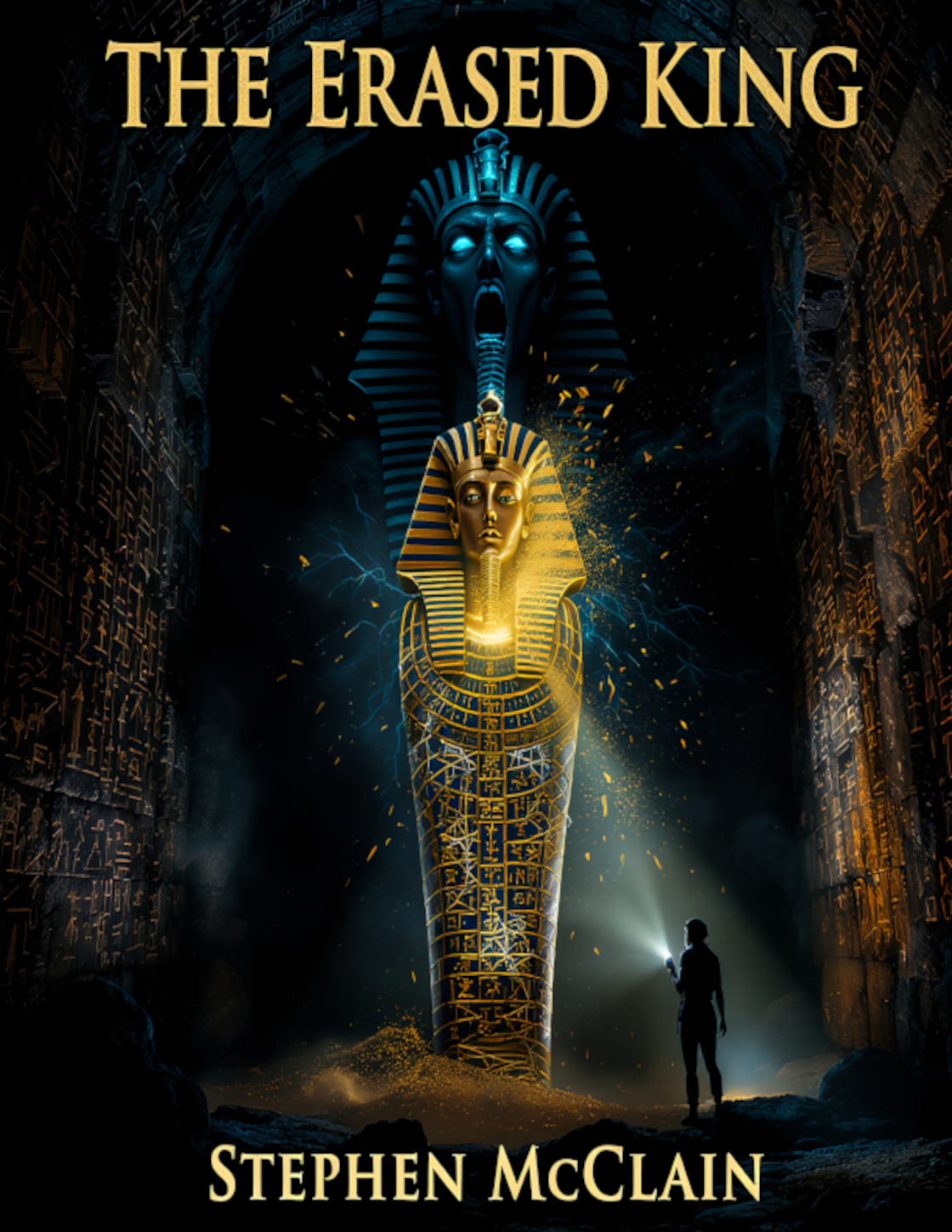
When archaeologists discover the lost tomb of Thutmose II, they find his mummy perfectly preserved—and a warning: “My name was stolen. My soul was bound. Do not set me free.” But it’s too late. The curse isn’t on those who opened the tomb. It’s on the one who was erased.
THE ERASED KING
by Stephen McClain
PROLOGUE: THE DREAM
Rosaly Yonath woke to the smell of myrrh and decay.
Her London apartment was dark, the winter rain pattering against the windowpane in a rhythm that sounded almost like whispered words. She lay still in her bed, heart hammering, the dream still clinging to her consciousness like cobwebs.
The man again. Always the same man.
He stood in darkness that seemed to pulse with its own terrible life, dressed in the pleated linen and golden collar of Egyptian royalty. His face was young, handsome even, with the strong jaw and proud nose of the warrior pharaohs. But his eyes—his eyes were wrong. Ancient beyond measure, filled with a suffering that transcended time itself.
He reached toward her, his mouth moving, forming words she almost understood. His hands trembled as he gestured to his chest, where golden cartouches should have proclaimed his name to the gods. But the spaces were blank. Scratched out. Empty.
Remember, his lips formed. Remember my name.
Then, as always, he began to decay. Flesh peeling from bone, reforming, peeling again in an endless cycle of death and resurrection that could never complete. His scream was silent, but Rosaly felt it resonate in her bones, in her soul.
She bolted upright, gasping, her hands clutching the duvet. The clock on her nightstand read 3:47 AM. The same time she’d woken every night for the past six weeks.
Rosaly swung her legs out of bed and padded to her desk, where her laptop cast a pale glow across stacks of research papers. The University College London letterhead stared up at her from the top document: Proposal for Joint Expedition – Valley of the Kings, Luxor, Egypt.
Her finger traced the lines she’d read a thousand times. Tomb KV65, recently discovered through ground-penetrating radar. Anomalous. Unusual construction. Possibly 18th Dynasty. Her specialty.
But it was the last line of the geological report that made her breath catch every time: Chamber appears to have been deliberately concealed, not merely buried by time.
Hidden. Not lost. Hidden.
She thought of the man in her dreams, his desperate plea, his erased name. Rosaly didn’t believe in premonitions. She was a scientist, an archaeologist who dealt in facts and carbon dating and ceramic typology. Dreams were just the brain processing information, random neural firing, nothing more.
But as she stared at the proposal, at the date circled in red—Expedition Start: February 1, 2025—she couldn’t shake the feeling that something was waiting for her in the desert. Something that had been waiting a very long time.
Something that knew her name.
Outside, the rain intensified, and in the darkness of her apartment, Rosaly could have sworn she heard a voice whisper: Soon.
PART ONE: THE DISCOVERY
CHAPTER 1: THE VALLEY OF SHADOWS
The February sun turned the Valley of the Kings into an oven by noon.
Rosaly stood at the entrance to KV65, the newest tomb to be discovered in this ancient necropolis, and felt sweat trickle down her spine beneath her linen shirt. Around her, the expedition team moved with practiced efficiency, hauling equipment down the rough-cut stone steps that descended into darkness.
“Dr, Yonath!” The voice was warm, accented with the musical lilt of Egyptian English. “Come see what we’ve found.”
Dr. Ahmed Khalil emerged from the tomb entrance, his face split by an enormous grin. At forty-two, he was seven years Rosaly’s senior and had worked in the Valley for two decades. His dark eyes sparkled with the enthusiasm that made him one of Egypt’s most respected Egyptologists, despite his unconventional theories about religious practices of the 18th Dynasty.
“Tell me it’s not another empty rock-cut chamber,” Rosaly said, making her way toward him. Her boots crunched on the limestone debris that littered the valley floor.
“Come and see for yourself.” Ahmed’s grin widened. “And bring your camera. You’re going to want to document this.”
Rosaly’s heart rate quickened as she followed him down the steps. The temperature dropped with each footfall, the blessed coolness of the underground replacing the desert’s brutal heat. The walls here were rough, undecorated—a contrast to the elaborate tombs of more famous pharaohs nearby. Emergency lights had been strung along the corridor, their harsh glare illuminating hieroglyphs that seemed almost crude in their execution.
“Notice anything odd?” Ahmed asked, pausing to let her examine the walls.
Rosaly leaned close, her trained eye scanning the symbols. “The cartouches,” she murmured. “They’ve been… damaged?”
“Not damaged. Erased.” Ahmed’s voice had lost its cheerful tone. “Look closer.”
She did, and her breath caught. The oval shapes that should have contained royal names had been deliberately gouged out, the limestone scarred and pitted. But within those damaged spaces, someone had attempted to re-carve the hieroglyphs. Multiple times, judging by the overlapping chisel marks.
“Someone tried to erase the name,” Rosaly said slowly, “and someone else kept restoring it.”
“Over and over again.” Ahmed pulled out his own camera, photographing the wall. “I’ve never seen anything like it. It’s as if there was a battle being fought through these walls. An argument between erasure and remembrance.”
A chill ran down Rosaly’s spine that had nothing to do with the underground temperature. She thought of her dreams, of the blank cartouches on the man’s chest, of his desperate plea to be remembered.
“Which tomb is this?” she asked, though part of her already knew the answer.
Ahmed’s eyes met hers in the LED’s harsh light. “Based on the partial cartouches we can still read, the pottery styles we’ve found, and the location in the valley… Rosaly, I think we’ve found Thutmose II.”
The name hit her like a physical blow. Thutmose II. The forgotten pharaoh. The king who had ruled for perhaps three years, perhaps seven—records were unclear. The king who had been overshadowed by his half-sister and wife, Hatshepsut, one of ancient Egypt’s most powerful female rulers. The king whose mummy had never been definitively identified, whose tomb had never been found.
Until now.
“That’s impossible,” Rosaly heard herself say. “Thutmose II’s mummy is in the Cairo Museum. Body 61066. It was identified by—”
“By guesswork and comparative anatomy,” Ahmed interrupted gently. “You know as well as I do that the identification was never certain. What if that mummy isn’t Thutmose II? What if the real king has been here all along?”
Rosaly’s hand trembled slightly as she raised her camera. The dream-man’s face flashed in her memory. Young. Proud. Desperate.
Remember my name.
“Show me the burial chamber,” she said.
Ahmed led her deeper into the tomb, through a corridor that twisted in ways royal tombs typically didn’t. Most pharaohs’ final resting places followed a more or less straight path down into the bedrock, a symbolic journey to the underworld. This tomb seemed deliberately designed to confuse, to hide its destination.
The rest of the team was gathered in what appeared to be an antechamber. Yasmin Ibrahim, the expedition’s chief conservator, was carefully examining a series of wooden boxes that lined the walls. Marcus Chen, their documentation specialist, had his cameras set up on tripods, capturing every angle. And Dr. Elizabeth Foster, Rosaly’s colleague from UCL and an expert in funerary texts, was on her knees before the far wall, her face pale.
“Elizabeth?” Rosaly approached her friend. “What is it?”
Elizabeth didn’t look up. Her finger traced hieroglyphs on the wall, but her hand was shaking. “Rosaly, read this.”
The glyphs were partially covered by a layer of plaster—later plaster, Rosaly’s practiced eye told her immediately. Someone had tried to hide this inscription after it was written. But time and the dry desert air had caused the plaster to crack and crumble, revealing the words beneath.
Rosaly read aloud, her voice echoing strangely in the confined space: “‘I am bound between life and death. My name was my power. She took my name. She took my life. She took my death. I am trapped.’” She paused, a cold dread settling in her stomach. “‘Do not speak my name aloud. Do not call me back.’”
The silence that followed was absolute. Even the usually chatty Marcus had stopped adjusting his equipment. Yasmin stood frozen, a wooden sistrum held forgotten in her gloved hands.
“It’s a curse,” Yasmin whispered. “A binding curse.”
“There’s no such thing as curses,” Rosaly said automatically, but her voice lacked conviction. “It’s just a warning, probably meant to scare grave robbers.”
“Then why does it say ‘do not call me back’?” Elizabeth stood, brushing dust from her knees. “That’s not standard funerary text. That’s not a threat to robbers. That’s a plea.”
Ahmed had moved to the doorway that led to the burial chamber proper. “Rosaly,” he called, his voice tight. “You need to see this now.”
Rosaly forced her legs to move, forced herself to step through the doorway into the burial chamber of Thutmose II.
The sarcophagus dominated the small room, carved from a single piece of red granite that must have taken dozens of men to maneuver down the twisted corridor. The lid was still in place, sealed. Around it, scattered in a seemingly haphazard pattern, were the traditional burial goods: canopic jars, shabti figures, amulets of protection.
But it was the sarcophagus itself that made Rosaly’s breath stop.
Every inch of it was covered in cartouches. Hundreds of them, thousands perhaps, carved and re-carved until the surface looked like a palimpsest of desperation. Names written, scratched out, restored, erased again. Some were filled with gold leaf, others with paint, others raw and fresh-looking as if cut yesterday.
And in the center, in letters that caught the lamplight and seemed to glow with their own luminescence, one name repeated over and over:
THUTMOSE
“My God,” Marcus breathed. “It’s like someone was trying to keep his name alive by sheer force of will.”
“Or trying to restore what was taken,” Ahmed murmured. He approached the sarcophagus slowly, reverently. “In ancient Egyptian belief, a person’s name was their soul. To erase someone’s name from monuments and records was to kill them a second time—to deny them the afterlife. They called it the second death. The final death.”
Rosaly found herself moving toward the sarcophagus as if pulled by invisible threads. Her hand reached out, fingers hovering over the carved names. “But who would erase a pharaoh’s name? And why?”
“I can think of one person,” Elizabeth said quietly. “Hatshepsut.”
The name seemed to suck the air from the room.
Everyone involved in 18th Dynasty archaeology knew the story. Hatshepsut, daughter of Thutmose I, had married her half-brother Thutmose II to legitimize his somewhat tenuous claim to the throne—his mother had not been of royal blood. When Thutmose II died after a short reign, their son was too young to rule, so Hatshepsut became regent. But she didn’t stop there. She declared herself pharaoh, wore the false beard, took all the titles and regalia of kingship.
And after her death, someone had tried to erase her from history. Her names chiseled out of monuments. Her statues destroyed. Modern scholars had debated for decades who had ordered this erasure and why.
“You think Hatshepsut erased Thutmose II first?” Rosaly asked.
“Look at the archaeological record,” Elizabeth said, warming to her theory. “Thutmose II’s name is conspicuously absent from most monuments built after his death. His mortuary temple was never completed. His reign is barely recorded. Everyone assumed he just wasn’t important enough, that he was a weak king overshadowed by his powerful wife. But what if she deliberately erased him?”
“Why?” Marcus asked. “She was already ruling. Why bother erasing a dead husband?”
“Because of this.” Ahmed gestured to the inscription on the wall. “‘She took my name. She took my life.’” He looked at Rosaly, and in his dark eyes, she saw the same chill she felt in her own bones. “What if Thutmose II didn’t die naturally? What if Hatshepsut killed him?”
The words hung in the air like smoke. Murder. Not just murder, but regicide. The killing of a god-king. In ancient Egypt, such a crime would have consequences not just political but cosmic. The ma’at—the divine order of the universe—would be shattered.
“We’re speculating wildly,” Rosaly said, trying to inject reason into the moment. “We haven’t even opened the sarcophagus. We don’t know if there’s even a body inside, let alone if this is actually Thutmose II.”
“Only one way to find out,” Ahmed said. He turned to Yasmin. “Get the lifting equipment ready. We’ll open it tomorrow, after we’ve done a full photographic and ground-penetrating radar survey. I want to know exactly what we’re dealing with before we break the seal.”
As the team began discussing logistics, Rosaly found herself staring at the sarcophagus, at the thousands of inscribed names. In her mind, she saw the dream-man again, saw him reaching toward her with those agonized eyes.
Almost without thinking, she whispered the name: “Thutmose.”
The lights flickered. Just once, just for a moment. Everyone looked up at the electrical cables, at the generators outside.
“Power surge,” Marcus said. “These old generators are—”
“Look at the lid,” Yasmin interrupted, her voice sharp.
They all turned to stare at the sarcophagus lid. In the dancing shadows cast by the restored lights, Rosaly could have sworn she saw it move. Just the tiniest shift, as if something inside had heard its name and responded.
But that was impossible. The lid was solid granite, sealed for three and a half millennia. Nothing could move it from the inside.
Nothing human, anyway.
“I think we should get out of here for tonight,” Elizabeth said, and no one argued.
As they filed out of the burial chamber, Rosaly paused in the doorway and looked back. Just for a moment, in the corner where the shadows were deepest, she thought she saw a figure. Tall. Man-shaped. Wearing the crown of Upper and Lower Egypt.
She blinked, and it was gone.
Outside, the sun was setting, painting the Valley of the Kings in shades of blood and gold. Rosaly stood at the tomb entrance, breathing in the cooling desert air, trying to shake the feeling of being watched.
Ahmed joined her, his expression thoughtful. “You felt it too, didn’t you?”
“Felt what?”
“That presence. That sense of… waiting.” He shook his head. “I’ve worked in dozens of tombs, Rosaly. This is the first time I’ve ever felt like the occupant was still home.”
Rosaly wanted to deny it, to laugh it off as suggestion and atmosphere. But she thought of the warning on the wall, of the desperate plea not to speak the name, not to call him back.
And she thought of how she’d whispered “Thutmose” in the burial chamber.
Too late now, a voice seemed to whisper in her mind. Too late.
CHAPTER 2: THE OPENING
Rosaly couldn’t sleep.
She lay in her hotel bed in Luxor, staring at the ceiling fan as it made lazy circles overhead. The room was comfortable—the expedition had chosen a modest but clean hotel on the West Bank, close to the valley—but comfort was irrelevant when your mind refused to quiet.
She kept seeing the sarcophagus, the thousands of carved names, the shadow in the corner that couldn’t have been real. Kept hearing her own voice whispering Thutmose into the darkness of the tomb.
At 2 AM, she gave up and opened her laptop. Might as well be productive if she was going to be awake. She pulled up her notes from the day, began organizing the photographs, cataloging the artifacts they’d documented so far.
The inscription on the wall drew her attention again: She took my name. She took my life. She took my death.
Rosaly opened a new document and began typing, trying to organize her thoughts:
If we assume this is indeed the tomb of Thutmose II, and if we accept that Hatshepsut might have been responsible for erasing his name from monuments (which historical evidence supports to some degree), then we must ask: why?
Theory 1: Political expedience. By erasing the memory of her husband, Hatshepsut eliminated any competing claims to legitimacy. But this doesn’t explain the violence of the erasure, or the repeated attempts at restoration.
Theory 2: The inscription suggests something darker. “She took my life” could be metaphorical, but in context with the binding curse language, it might be literal. Did Hatshepsut murder Thutmose II?
But if she did, why go to such elaborate lengths to hide his tomb? Why not simply place him in a standard royal burial and move on? Unless—
Rosaly stopped typing. Unless Hatshepsut couldn’t give him a standard burial. Unless she’d done something to his body, something that made a normal interment impossible.
She thought of the sarcophagus covered in names, of the desperate attempt to keep his identity alive.
In ancient Egyptian belief, the name was everything. The ren, one of the five parts of the soul, was the name itself. Without it, a person ceased to exist in any meaningful way. They couldn’t enter the afterlife, couldn’t join the gods, couldn’t even be judged by Osiris. They were simply… nothing. Erased.
But what if someone partially erased a name? What if they damaged it just enough to trap the soul between worlds—not alive, not dead, not able to move forward?
Rosaly’s hands had begun to shake. She told herself it was exhaustion, too much sun, too much excitement. But deep down, she knew it was fear.
She was beginning to believe in the curse.
A sound made her look up from the laptop. A scratching noise, like something being dragged across paper. It came from the small desk by the window.
The desk was empty except for her field notebook and a pen. But as Rosaly watched, frozen, the pen rolled slightly. Then again. Then it lifted into the air.
No. Not lifted. Moved. Someone was holding it. Someone she couldn’t see.
The pen touched the notebook’s blank page and began to write. Slowly. Deliberately. Rosaly couldn’t move, couldn’t scream, could only watch as hieroglyphs appeared on the paper in her own black ink:
𓃀𓈖𓏏𓎡𓅆𓃹𓀃
Even in her terrified state, Rosaly’s trained mind translated automatically: I am here. You called. I answered.
The pen clattered to the desk. The room was silent again, empty again, as if nothing had happened.
But the words remained, stark and impossible on the page.
Rosaly didn’t sleep at all that night.
The next morning, Rosaly almost convinced herself it had been a dream. A hallucination brought on by exhaustion and suggestion. She didn’t mention it to anyone as the team assembled at the tomb entrance, equipment in hand, ready to open the sarcophagus.
The Egyptian Ministry of Antiquities had sent an observer, Dr. Farouk Mansour, a stern man in his sixties who watched everything with sharp, suspicious eyes. Rosaly had worked with him before; he was brilliant but traditional, deeply skeptical of foreign expeditions and protective of Egypt’s heritage.
“Remember,” he told them as they prepared to enter the tomb, “whatever we find belongs to Egypt. To history. This is not an Indiana Jones movie. We document everything, we preserve everything, and we interpret nothing until the evidence is thoroughly analyzed.”
“Of course,” Ahmed said smoothly. He and Farouk had known each other for years, a friendship built on mutual respect and occasional professional disagreement. “We’re scientists, Farouk. We follow the evidence.”
Inside the tomb, the burial chamber felt different in daylight—or rather, in the harsh light of the portable halogen lamps they’d brought. Less mysterious, more mundane. The sarcophagus was just a carved box, the shadows just shadows.
Almost, Rosaly could believe in coincidence and tired eyes.
Then she saw the cartouches on the sarcophagus and noticed something that made her stomach drop. Several of the names—names she distinctly remembered being filled with ancient gold leaf yesterday—were now freshly carved, the stone bright and new-looking.
“Did someone work in here last night?” she asked, trying to keep her voice steady.
The team looked at each other, shaking their heads. Ahmed frowned. “The tomb was sealed. The guards outside would have noted any activity.”
“These cartouches,” Rosaly pointed. “I could have sworn they looked different yesterday.”
Marcus checked his photographs from the previous day on his camera’s display screen. He zoomed in on the section Rosaly indicated, then looked at the physical sarcophagus. His face went pale. “She’s right. Look—yesterday this cartouche was weathered, faint. Now it’s deep and clear. As if someone re-carved it.”
“In a sealed tomb,” Elizabeth said flatly. “Right.”
“Perhaps the lighting is different,” Farouk suggested, but he didn’t sound convinced. “Or the angle of observation.”
No one else offered an explanation. What could they say? That the dead pharaoh was restoring his own name? That the curse was real?
“Let’s proceed,” Ahmed said, and Rosaly heard the forced steadiness in his voice. He was as unsettled as she was, but he was professional enough to continue. “Yasmin, Marcus, positions.”
The team had brought specialized lifting equipment—a small crane-like apparatus that could be broken down and carried into the tomb. It took an hour to set up, to position the lifting straps under the massive granite lid, to ensure everything was secure and documented.
Rosaly filmed every moment with her camera, but her hands wouldn’t stop shaking. The words from her hotel room kept echoing in her mind: I am here. You called. I answered.
“On three,” Ahmed said, his hand on the crane controls. “One… two… three.”
The motor whined. The straps went taut. For a long moment, nothing happened—the lid was too heavy, too old, too well-sealed.
Then, with a grinding sound that seemed to come from the earth itself, the lid began to rise.
Rosaly held her breath. They all did. Even Farouk leaned forward, his professional detachment momentarily forgotten.
The lid lifted clear of the sarcophagus body. Inside, wrapped in linen that should have been brittle and brown with age, was a mummy.
But the linen wasn’t brittle. It wasn’t brown. It was white. Pristine. As if the wrappings had been applied yesterday.
“That’s not possible,” Yasmin breathed. “Three thousand five hundred years… the linen should be degraded, stained…”
Ahmed reached into the sarcophagus with gloved hands, carefully examining the wrappings. “There’s no dust. No insects. It’s as if time stopped in here.”
“Or never passed at all,” Elizabeth murmured.
Marcus was taking photographs rapidly, his camera clicking in the silence. Rosaly zoomed in with her video camera on the mummy’s head. The face was covered, as was traditional, but the wrappings there were different. Newer. And beneath them, she could see the faint outline of features. A strong jaw. A proud nose.
The face from her dreams.
“We need to unwrap it,” Farouk said, his voice tight with excitement and something else—apprehension, perhaps. “We need to see the body.”
“Not here,” Ahmed decided. “We transport it to the lab. Controlled environment, proper equipment. We document every layer as we remove it.”
But Rosaly was still staring at the mummy’s face, at the way the linen seemed to cling to the features beneath. And as she watched, she could have sworn—just for a moment—that the fabric moved. As if the mouth beneath had opened. As if the dead man was trying to speak.
The camera in her hands felt heavy. She lowered it, reviewing the footage she’d just recorded. The mummy, the sarcophagus, Ahmed and Yasmin working. All normal. All as it should be.
Then she reached the moment she’d filmed the mummy’s face. Her finger hovered over the play button, then pressed.
The footage played. Rosaly zoomed in on the face, just as she’d done in real-time. The wrappings pristine and white. The features beneath clearly visible.
And then, in the corner of the frame, behind her—she could see herself in the shot, her back to the camera—a shadow appeared.
Man-shaped. Tall. Wearing the striped nemes headdress of a pharaoh.
Rosaly’s breath stopped. The shadow stood there for exactly one second, as impossible and solid as the stone walls around it. Then it was gone.
She rewound the footage. Played it again. The shadow appeared at exactly 00:42:17, stood motionless for precisely one second, then vanished.
“Rosaly?” Elizabeth was beside her, concern on her face. “You okay? You look like you’ve seen a ghost.”
Rosaly opened her mouth to speak, to show Elizabeth the footage, to prove she wasn’t crazy. But her throat wouldn’t work. Because she had seen a ghost. And it had been standing right behind her, in a sealed tomb, while she filmed a mummy that shouldn’t exist in the condition it was in.
The curse was real.
And she had spoken the name.
Do not speak my name aloud. Do not call me back.
But it was too late. She had called him. And he had answered.
CHAPTER 3: THE HAUNTING
The mummy was transported to the expedition’s laboratory—a converted warehouse in Luxor that the Egyptian Ministry had approved for their use. The journey itself was surreal: a perfectly preserved mummy of a pharaoh who had been forgotten by history, carried through streets where tourists photographed the surreal procession without understanding what they were witnessing.
Rosaly rode in the van with the sarcophagus, unable to shake the feeling that something was watching her from within the wrapped form. Ridiculous, of course. The mummy was just a body. Dead for millennia. Incapable of sight or thought or awareness.
But then, bodies didn’t repair their own cartouches. And shadows didn’t appear in sealed tombs.
The laboratory was climate-controlled and equipped with the latest conservation technology. Yasmin supervised the mummy’s transfer to a specially prepared examination table, her movements careful and reverent. Around her, the team assembled their tools: brushes, tweezers, documentation equipment, tissue sample containers.
“We’ll do this slowly,” Ahmed announced to the assembled team. “One layer at a time, documenting everything. Marcus, I want photographs of every stage. Elizabeth, you note any textual inscriptions we find. Rosaly, you’re on video documentation.”
Rosaly nodded, raising her camera, trying to focus on the work and not on the shadow she’d seen, not on the hieroglyphs that had appeared in her hotel room. She was a scientist. Scientists didn’t believe in curses.
Except that ancient Egyptians had believed in them. Powerfully. To them, words had literal power. Names had power. The right ritual, spoken with intention, could literally reshape reality. That’s what magic was to them—not fantasy or superstition, but technology. Spiritual technology, but technology nonetheless.
What if they had been right?
“Rosaly, are you recording?” Ahmed’s voice broke through her thoughts.
She pressed the record button with fingers that trembled slightly. “Yes. Recording.”
Yasmin began with the outer wrappings, carefully loosening the linen strips that bound the mummy. The fabric came away easily—too easily, as if the resin that should have hardened it into stiffness had never dried. Each layer revealed another, and another, like unwrapping a gift that someone had taken tremendous care in preparing.
“The wrapping pattern is unusual,” Yasmin murmured as she worked. “It’s more elaborate than standard New Kingdom practice. More… protective.”
“Protective how?” Marcus asked, his camera clicking steadily.
“There are more layers than necessary. And the way they’re woven… it’s almost like a binding. Like someone was trying to keep something in as much as preserve what was there.”
Rosaly’s skin prickled. A binding. Like the curse on the wall. I am bound between life and death.
The work took hours. Layer after layer of pristine linen, each removed with painstaking care and cataloged. And with each layer, Rosaly became more certain that something was wrong. The mummy beneath wasn’t decaying as the outer layers were removed. If anything, it seemed to be getting more intact, more whole.
By the time they reached the innermost layers—the wrappings closest to the skin—the smell had changed. No longer the dry, musty odor of ancient organic matter, but something else. Something sharp and chemical.
“Myrrh,” Elizabeth said, sniffing carefully. “And natron, of course. But there’s something else. Something I can’t identify.”
Farouk, who had been watching silently from the side of the room, stepped closer. His face was drawn, troubled. “That smell,” he said quietly. “I’ve encountered it once before. In a tomb that the excavators refused to continue working in. They said it was cursed.”
“What happened?” Rosaly asked, though part of her didn’t want to know.
“Three of them died within a year. Different causes, supposedly. Heart attack, car accident, infection from a minor cut. But the local workers…” Farouk shook his head. “They said the tomb had taken them. That’s why we sealed it again.”
“Farouk, you don’t actually believe—” Ahmed began.
“I believe that there are things we don’t understand,” Farouk interrupted. “I believe that our ancestors knew things we’ve forgotten. And I believe that some tombs should remain sealed.”
The laboratory fell silent. Then Yasmin cleared her throat and continued unwrapping.
The final layer of linen came away.
And everyone gasped.
The body beneath was perfect. Not preserved in the shriveled, dark, leather-like state of most mummies. Perfect. The skin was pale, smooth, with the faint golden undertone of living flesh. The features were those of a man in his mid-twenties: strong, handsome, with high cheekbones and a firm mouth. The body was muscular, fit, showing none of the wasting that typically preceded ancient death.
He looked like he was sleeping.
“This is impossible,” Marcus whispered, his camera hanging forgotten in his hands. “This level of preservation… it’s like he died yesterday.”
Yasmin leaned close, her practiced eye examining every detail. “No signs of decay. No discoloration. The skin has elasticity—look, I can actually see the texture of pores. And his hair…” She touched the dark hair that framed the mummy’s face. “It’s soft. Pliable. Not brittle at all.”
“How?” Elizabeth asked the question they were all thinking. “Even with the most advanced embalming techniques, Egyptian mummies don’t look like this. They can’t. Organic tissue degrades. That’s biology. That’s immutable.”
“Unless the process was different,” Ahmed said slowly. “Unless they did something to him that we don’t know about. Some technique, some chemical combination…”
“Or some ritual,” Farouk said quietly. “Some way of suspending decay. Of binding the body between death and life.”
I am bound between life and death.
Rosaly’s camera was still recording, capturing the impossible sight before them. She made herself zoom in on the mummy’s face, documenting every detail for posterity, for science, for the researchers who would inevitably try to explain this anomaly.
That’s when she saw the eyes.
They were closed, the eyelids smooth and unbroken. But behind them, she could see movement. Rapid movement, like REM sleep. Like dreaming.
“His eyes,” she said, her voice cracking. “Look at his eyes.”
Everyone leaned in. They all saw it. The impossible movement beneath closed lids. The fluttering of lashes that should have been dust millennia ago.
“It’s just… residual muscle tension,” Yasmin said, but she’d stepped back from the examination table. “Some kind of preservation artifact. It has to be.”
“Then why is it still happening?” Marcus asked. “Muscle tension would have released when we moved the body. This is ongoing.”
No one had an answer.
Then the mummy’s mouth opened.
Not a lot. Just slightly, the lips parting as if to draw breath. A sound came out—a sigh, a whisper, something that might have been a word.
Rosaly’s camera clattered to the floor.
Yasmin screamed.
Ahmed stumbled backward, knocking over a tray of instruments.
The mummy lay still again, eyes closed, mouth slightly open, looking for all the world like a person in peaceful sleep.
Except for the fact that he’d been dead for three and a half thousand years.
Except for the fact that he’d just moved.
“Everyone out,” Farouk said, his voice sharp with authority. “Out now. Seal the laboratory. This examination is suspended until I consult with the Ministry.”
No one argued. They fled the laboratory like children escaping a nightmare, leaving the mummy of Thutmose II alone on the examination table.
As Rosaly reached the door, she looked back. Just once.
The mummy’s eyes were open.
They were staring directly at her.
And they were weeping.
CHAPTER 4: THE MESSAGE
Rosaly didn’t go back to her hotel. She couldn’t face being alone in a room where hieroglyphs appeared on notebooks and pens moved by themselves. Instead, she went to a café on the Corniche, the waterfront promenade that ran along the Nile through Luxor. She sat at an outdoor table, ordered coffee she didn’t drink, and watched the river flow past as it had for thousands of years.
The Nile was eternal. Egypt was eternal. But the people—the pharaohs, the priests, the workers who built the temples and carved the tombs—they were dust. All of them. Gone.
Except one.
Rosaly’s hands shook as she pulled out her phone and opened the video footage from the laboratory. She’d recovered her camera before leaving, some professional instinct overriding her fear. Now she scrolled through the footage to the moment when the mummy’s eyes had moved.
There. She could see it clearly in the slowed playback. The rapid movement behind closed lids, exactly like REM sleep. And then—she held her breath—the moment when the mouth opened.
Rosaly enhanced the audio, pushing the levels up as high as they would go. The sigh was there, recorded faithfully by her camera’s sensitive microphone. But beneath it, barely audible, was something else.
A word.
She played it again, turning the volume to maximum. The café noise faded as she focused entirely on that whispered syllable.
Rosaly.
Her name. The mummy had spoken her name.
The phone slipped from her nerveless fingers, clattering onto the metal café table. A waiter glanced over, concerned, but Rosaly waved him away with a shaking hand.
It knew her name. The dead pharaoh, the forgotten king, the man who’d been trapped for three millennia—he knew her name.
And she’d given it to him. Had spoken it herself in the tomb, had identified herself on camera countless times, had written it on documentation and equipment labels. She’d handed him her name on a silver platter, never thinking, never understanding what names meant to the ancient Egyptians.
Names were power. Names were identity. Names were the keys to the soul.
If he knew her name, he could call her. Could bind her. Could—
“Dr, Yonath?”
Rosaly nearly screamed. She whirled to find Elizabeth standing beside the table, her expression worried.
“Sorry,” Elizabeth said quickly. “Didn’t mean to startle you. I saw you sitting here and thought… well, I thought you shouldn’t be alone. After what we saw.”
Rosaly gestured to the empty chair, grateful for the company despite her jangling nerves. Elizabeth sat, ordering her own coffee, and for a moment they just sat in silence, watching the feluccas sail past on the river.
“Tell me I’m not crazy,” Rosaly said finally. “Tell me we all saw the same thing.”
“You’re not crazy. We all saw it.” Elizabeth’s voice was steady, but Rosaly noticed her hands were gripping her coffee cup tightly enough that her knuckles were white. “The question is: what did we see? A perfectly preserved body that defies all biological laws? A corpse that appears to breathe and dream? Or something else?”
“Something else like what?”
Elizabeth leaned forward, lowering her voice even though the nearest occupied table was several meters away. “What if the curse is real, Rosaly? What if Thutmose II isn’t dead? Not really? What if he’s exactly what the inscription said—bound between life and death?”
“That’s not possible.”
“The body we examined isn’t possible. The level of preservation isn’t possible. The movement isn’t possible. But it happened. We documented it. So maybe we need to expand our definition of possible.”
Rosaly wanted to argue, wanted to cling to scientific rationalism, to the comfortable world of carbon dating and ceramic typology and explicable phenomena. But she thought of the shadow in the tomb, of the hieroglyphs in her hotel room, of the mummy speaking her name.
“The inscription said ‘she took my name,’” Rosaly said slowly. “Hatshepsut. If she erased his name from monuments and records, and if the name was his soul… what does that do to a person? To their ability to move on after death?”
“In Egyptian belief? It destroys them.” Elizabeth pulled out her own phone, scrolling through notes. “I’ve been researching while trying to calm down. There are cases in Egyptian history of deliberate name erasure—damnatio memoriae, the Romans called it later. The most famous is Akhenaten, the heretic pharaoh. His successors tried to erase him from existence. But there are others. Minor nobles, disgraced priests, even a few queens who fell out of favor.”
“What happened to them?”
“According to the texts, they were ‘cast into darkness.’ Not alive, not dead, not able to enter the afterlife. Trapped in a place between, conscious but without form, endlessly suffering.” Elizabeth met Rosaly’s eyes. “It was considered the worst punishment imaginable. Worse than death. Because death, at least, offered transformation, judgment, and then eternal life in the Field of Reeds. But to be erased? That was true oblivion. Or worse—eternal existence in nothingness.”
Rosaly shuddered. She thought of her dreams, of the man decaying and reforming endlessly, screaming silently. Had that been literal? Had she been seeing his actual state of existence for the past thirty-five hundred years?
“But some of his names are restored,” Rosaly said. “The sarcophagus is covered in cartouches. Someone kept trying to write his name back into existence.”
“Which might be why he’s not completely gone. Why there’s still something there—something that can move, can speak, can weep.” Elizabeth paused. “The question is: what does he want? Why appear to us now? Why after all this time?”
Rosaly opened her mouth to respond, then stopped. Her attention had been caught by something strange. At the table next to them, abandoned by its previous occupants, was a napkin. And on that napkin, written in what looked like dark liquid—spilled coffee, perhaps—were hieroglyphs.
Fresh hieroglyphs. Wet and gleaming.
She stood slowly, her chair scraping on the pavement, and walked to the table. Elizabeth followed, gasping when she saw what Rosaly had seen.
The message was simple. Stark. Impossible.
𓅓𓅱𓅱𓂧𓏏𓈖𓃀𓈖𓏏𓏏𓏏
“‘Help me speak her name,’” Elizabeth translated, her voice barely audible. “That’s what it says. ‘Help me speak her name.’”
Rosaly looked around wildly. The café was busy, full of tourists and locals enjoying the pleasant evening. No one was watching them. No one could have written this message—she and Elizabeth had been sitting three feet away the entire time.
But the hieroglyphs were there. Real. Written in liquid that Rosaly now realized wasn’t coffee at all. It was too dark, too thick. Too much like—
“Blood,” Elizabeth whispered. “Those are written in blood.”
Rosaly’s phone buzzed in her pocket. She pulled it out with shaking hands. A text message from an unknown number. The message contained a single image: a photograph of her hotel room. Her empty hotel room. Or almost empty. In the mirror, barely visible, was a reflection.
A man in Egyptian royal regalia. Young. Handsome. Weeping.
The caption beneath the photo read: I am bound to you now. You spoke my name. Help me, and I will free you. Refuse, and we are trapped together. Forever.
The phone slipped from Rosaly’s hand for the second time that day.
That night, Rosaly did return to her hotel, but only because Elizabeth came with her, and because Farouk had posted security guards outside both their rooms. The guards were locals, men who’d grown up in Luxor, who knew the old stories, who wore amulets under their shirts and murmured prayers when they thought no one was listening.
They knew something was wrong. Everyone did.
Inside her room, Rosaly found more messages. Written on the bathroom mirror in condensation that shouldn’t have been there. Spelled out in the arrangement of items on her desk. Even traced in dust on the television screen.
All variations of the same plea: Help me. Speak her name. Free us both.
“Us both,” Elizabeth said, staring at the messages. “Not just him. Both of you. Because you’re bound now. The curse transferred to you when you spoke his name in the tomb.”
“That’s insane.”
“Is it? Think about it, Rosaly. The inscription warned not to speak his name, not to call him back. But you did. You called him, and according to ancient Egyptian magical practice, that creates a bond. A link. He’s anchored to you now.”
“I don’t want to be anchored to a dead pharaoh!”
“Then help him.” Elizabeth’s voice was calm but firm. “That’s what he’s asking. Help him speak Hatshepsut’s name. The curse can be transferred back to her, where it originated. Break the binding, and you’re both free.”
“Hatshepsut has been dead for three and a half thousand years. Her mummy has never been definitively identified. How am I supposed to curse someone who might not even have a physical form to curse?”
“I don’t know. But he clearly thinks there’s a way. And Rosaly…” Elizabeth gripped her friend’s shoulders, forcing eye contact. “If you don’t help him, you’re going to be trapped with him. Bound to a ghost. Do you understand? When you die—whether that’s tomorrow or in fifty years—your soul will be bound to his. Trapped in that same nothing-space. Forever.”
Rosaly sank onto the bed, head in her hands. This couldn’t be happening. Curses weren’t real. Magic wasn’t real. There had to be a rational explanation, something she was missing, some way to make sense of all this without accepting that the ancient Egyptians had been right about the power of names and words and ritual.
But every rational explanation fell apart when confronted with the evidence. The pristine mummy. The moving eyes. Her name spoken by dead lips. The messages appearing everywhere she went.
She was being haunted. By a pharaoh. By a king who’d been murdered and erased, who’d spent thirty-five centuries trapped between existence and oblivion, conscious through every moment.
The horror of that was almost too much to comprehend.
“Okay,” Rosaly heard herself say. “Okay. If I help him—if I agree to try—what do I do? How do you transfer a curse? How do you ‘speak her name’ in a way that matters?”
“We need to research. Find out what ritual Hatshepsut used on him, then reverse it. But to do that, we need information we don’t have.” Elizabeth’s expression was grim. “We need to go back to the tomb. Back to the burial chamber. There might be more inscriptions, more clues hidden under plaster or in side chambers we haven’t explored.”
“Farouk sealed the tomb. He won’t let us back in.”
“Then we don’t tell Farouk.”
Rosaly stared at her friend. “You’re suggesting we break into a sealed Egyptian tomb without authorization? Elizabeth, that’s not just unethical, it’s illegal. We could lose our permits, our careers, possibly end up in an Egyptian prison—”
“And if you don’t, you’ll spend eternity trapped in supernatural bondage to a dead king.” Elizabeth’s voice was sharp. “I know which risk I’d take.”
Rosaly wanted to argue. Wanted to insist there had to be another way. But when she closed her eyes, she saw the mummy’s face, saw the tears on cheeks that should have been dry leather, saw the desperate pleading in eyes that shouldn’t be able to see.
He’d been trapped for three and a half thousand years. Conscious. Aware. Unable to live, unable to die, unable to move forward.
And she’d bound herself to him.
“Tomorrow night,” Rosaly said quietly. “When the guards change shifts. There’s a fifteen-minute window around midnight. We’ll have to be fast.”
Elizabeth nodded. Then she looked at the messages scrawled around the room. “He’ll know we’re trying to help. That should buy us some time.”
As if in response, the messages began to fade. The condensation on the mirror evaporated, the dust on the television scattered, the arranged items returned to randomness. Within moments, there was no trace of the supernatural communication.
Except for one message, written on the notepad by the bed in handwriting that was distinctly not Rosaly’s:
Thank you.
Rosaly picked up the pad, staring at those two words. They were simple, heartfelt, and they made her want to weep.
How long had he been trying to communicate? How many centuries of isolation and imprisonment? How much had he suffered, knowing he was forgotten, erased, unmourned?
She thought of her dreams, the ones that had plagued her for weeks before they’d even found the tomb. He’d been reaching out to her even then, searching for someone who could hear him, who could help him.
And she’d answered. Not knowing what it meant. Not understanding the bond she was creating.
But she was in it now. Bound to a dead king. And the only way out was through.
“Tomorrow night,” she repeated, setting the notepad down. “We find out what Hatshepsut did. And we figure out how to undo it.”
Outside, beyond the security guards and the locked door, in the darkness that pressed against the window, Rosaly could have sworn she felt a presence. Not threatening. Just… waiting.
Hoping.
After three and a half thousand years, someone had finally heard his plea.
Someone was finally going to speak his name properly.
Someone was finally going to set him free.
Or die trying.
PART TWO: THE CURSE REVEALED
CHAPTER 5: THE FORBIDDEN CHAMBER
The Valley of the Kings was different at night.
During the day, it was a tourist site, crowded and hot and mundane despite its magnificent history. But after sunset, when the gates closed and the visitors departed, it became something else. It became the place its ancient builders had intended: a gateway to the underworld, a realm of the dead, a space where the living were no longer welcome.
Rosaly crouched behind a limestone outcropping, watching the security hut at the valley entrance. Beside her, Elizabeth fidgeted with a flashlight, turning it on and off nervously.
“This is insane,” Elizabeth whispered. “We’re going to get arrested.”
“Probably,” Rosaly agreed. “But we’re doing it anyway.”
They’d told Ahmed and the others that they were staying in for the night, exhausted from the day’s disturbing discoveries. It wasn’t entirely a lie—Rosaly was exhausted, bone-deep tired in a way that had nothing to do with physical exertion. But she couldn’t rest. Not with hieroglyphs appearing in blood and dead pharaohs speaking her name.
The security guard at the hut stood, stretched, and walked to a small building fifty meters away—the restroom, Rosaly knew from her previous observations. This was the moment. Fifteen minutes until the next guard arrived for shift change. Fifteen minutes to get into KV65, find whatever additional information was hidden there, and get out.
“Now,” Rosaly hissed, and they ran.
The path into the valley was treacherous in darkness, even with flashlights. Rosaly’s boots skidded on loose gravel, and once Elizabeth nearly fell, catching herself at the last moment with a gasp that sounded too loud in the desert quiet.
KV65’s entrance was sealed with a locked metal gate—standard practice for newly discovered tombs. But Rosaly had prepared for this. She pulled out a set of bolt cutters borrowed from the expedition’s equipment store. The lock was industrial-grade, meant to deter curious tourists, not determined archaeologists with proper tools.
The metal protested as Rosaly cut, the sound echoing off the valley walls. She froze, listening for shouts or running footsteps. Nothing. The guard was still in the restroom. They had time. Barely.
The lock gave way. Rosaly pulled open the gate, and they slipped inside, into darkness that seemed to swallow their flashlight beams.
The descent was faster this time. Rosaly knew the path now, knew where the corridor twisted, knew where the floor was uneven. But familiarity didn’t make it less frightening. Every shadow seemed to hold something waiting, watching. Every echo of their footsteps sounded like it was coming from ahead of them, not behind.
They reached the antechamber. Rosaly’s light played across the warning inscription, across those damning words: Do not speak my name aloud. Do not call me back.
Too late for that. Far too late.
“We’re looking for hidden chambers,” Rosaly said, her voice barely above a whisper. “Places where additional inscriptions might be concealed. Start with the walls—check for plaster that looks different, for any variations in the stone.”
They split up, Rosaly taking the left wall while Elizabeth examined the right. The burial chamber was beyond them, its entrance a rectangle of deeper darkness. Rosaly tried not to think about what lay in that room—the sarcophagus, the thousand carved names, the space where she’d seen the shadow standing behind her on the video footage.
Her fingers traced the hieroglyphs on the wall, feeling for discontinuities. Ancient Egyptian tomb builders were skilled, but they were human. If they’d hidden something, there would be signs.
There.
Rosaly’s fingers caught on an edge, a place where newer plaster met older stone. The difference was subtle, almost imperceptible, but it was there. She pulled out a small brush and began carefully working at the plaster.
It crumbled easily—too easily, as if it wanted to be found. Within minutes, she’d exposed a section of wall that had been covered over, concealed after the original tomb decoration was complete.
And on that hidden wall were hieroglyphs that made Rosaly’s blood run cold.
“Elizabeth,” she called softly. “I found something. You need to see this.”
Elizabeth hurried over, her flashlight joining Rosaly’s to illuminate the hidden inscription. Together, they read:
I, Amenemhat, priest of Amun, scribe to the throne, write this in secret and in shame. I was commanded by Queen Hatshepsut, beloved of Amun, to perform a ritual that no priest should perform. A ritual of binding. Of soul-severing. Of the second death made eternal.
The king lived. The king died. But between life and death, the queen commanded me to trap his ka, his ba, his ren. I spoke the forbidden words. I carved the separation symbols. I took his name and bound it to nothing, to nowhere, to the space between existence and oblivion.
He did not die naturally. The queen gave him poison, slow and subtle, that appeared as a wasting disease. She wept at his bedside as the poison worked. She performed the funeral rites with proper solemnity. But in secret, she commanded me to ensure he would never reach the afterlife, never stand before Osiris in judgment, never find peace.
I write this so that the gods will know I was commanded. I did not choose this sin. But I am damned nonetheless. I feel the weight of it growing, the curse turning inward. The one who binds shall himself be bound. I will not escape this.
If anyone finds this tomb, know this: the queen did not do this from cruelty. She did it from fear. The king knew her secret. He knew she had plotted to seize power before his natural death. He threatened to name another heir. She could not allow it. So she removed him from existence itself.
To free him, speak both names in the presence of his body: his name to call him forward, her name to transfer the guilt back to its source. But beware: the curse seeks an anchor. It must live in someone. If not him, if not her, then whoever performs the ritual.
I am bound now too. I feel it. The curse spreads like poison, claiming those who participate in its propagation. When I die, I will not join the gods. I will be here, in this tomb, trapped with him. Two souls in darkness, waiting for an eternity that will never end.
The gods forgive me. I could not refuse a queen.
The inscription ended there. Rosaly and Elizabeth stood in stunned silence, their flashlights illuminating the ancient priest’s confession.
“He murdered the king on Hatshepsut’s orders,” Elizabeth breathed. “And then cursed him to prevent him from reaching the afterlife. That’s… that’s beyond monstrous.”
“But he didn’t want to do it,” Rosaly said, still reading the hieroglyphs. “He was commanded. And look—he says the curse turned on him too. He’s here, in the tomb, his soul trapped just like Thutmose’s.”
“Two trapped souls,” Elizabeth murmured. Then her eyes widened. “Rosaly. Dr. Ahmed.”
Rosaly’s stomach dropped. “What about Ahmed?”
“Remember how he’s been acting? Since we opened the tomb? The way he was speaking Middle Egyptian, writing cartouches compulsively?” Elizabeth’s voice rose with excitement and horror. “What if he’s not just Ahmed anymore? What if the priest’s soul is trying to inhabit him?”
Rosaly thought back to Ahmed’s behavior. The way he’d been almost obsessive about the cartouches on the sarcophagus. The way he’d insisted on opening the burial chamber immediately rather than waiting. The strange look in his eyes when he examined the mummy.
“We need to warn him,” Rosaly said.
“We need to finish the ritual,” Elizabeth countered. “That’s the only way to free everyone—Thutmose, the priest, Ahmed if he’s possessed, and you. We speak both names. Transfer the curse back to Hatshepsut.”
“The inscription says the curse needs an anchor. If we free Thutmose and the priest, the curse will look for a new host. That’s why Amenemhat the priest was trapped—he performed the binding, so the binding claimed him. If we perform the reversal—”
“One of us will be trapped instead.” Elizabeth finished the thought, her face pale in the flashlight beam. “Unless we can find Hatshepsut’s mummy. Make her the anchor. Send the curse back to where it began.”
“But her mummy has never been identified. There are several candidates, but no definitive proof.”
“Then we make our best guess and hope it’s right.” Elizabeth’s jaw was set, determined. “Because the alternative is leaving things as they are. Letting you be slowly consumed by a binding curse. Letting Ahmed be possessed by a dead priest. Letting a pharaoh suffer conscious torment for all eternity. We have to try.”
Rosaly wanted to argue, wanted to find a safer solution, one that didn’t involve ancient rituals and soul-transfer and the very real possibility of trapping her own consciousness in an eternal void. But as she opened her mouth to protest, she felt it.
A presence. In the burial chamber. Moving.
“Did you hear that?” Elizabeth whispered.
Rosaly had. A sound like stone grinding on stone. Coming from the room where the sarcophagus waited in darkness.
They moved to the burial chamber entrance together, their flashlight beams piercing the darkness.
The sarcophagus lid was moving.
Not being moved—moving itself, grinding across the granite body of the sarcophagus with a sound like screaming rock. It shifted an inch. Two inches. Three.
“That’s impossible,” Rosaly said, but her voice was faint, unconvincing even to herself. She’d stopped believing in impossible days ago.
The lid continued its slow, inexorable movement. And from the gap beneath it, something emerged.
A hand.
Wrapped in linen that glowed faintly in the darkness, as if lit from within. The hand was young, strong, perfectly preserved. It gripped the edge of the sarcophagus and pushed.
The lid moved faster.
“We need to leave,” Elizabeth said, backing toward the exit. “Now. We need to—”
“Rosaly.”
The voice was dry, ancient, speaking a language that had been dead for millennia. But Rosaly understood it. Not with her ears or her mind, but with something deeper. The bond that linked her to the speaker.
“Rosaly Yonath.”
The hand pulled, and a figure sat up in the sarcophagus. The mummy of Thutmose II, animated by something that should not animate anything, turned its wrapped head toward them.
And spoke.
“You came. You heard me. You found the truth.” The voice was filled with such profound relief that Rosaly felt tears spring to her eyes. “I have waited so long. So long. Help me. Please. Help me rest.”
Rosaly’s feet moved of their own accord, carrying her into the burial chamber despite every rational instinct screaming at her to run. She approached the sarcophagus, approached the impossible sight of a mummy moving and speaking, and felt no fear. Only pity.
Profound, overwhelming pity.
“I’ll help you,” she heard herself say. “I promise. We’ll find Hatshepsut’s body. We’ll speak the names. We’ll transfer the curse back to her.”
“No.” The wrapped head shook slightly. “Not to her. She suffered too. She was driven mad by guilt, by what she’d done. Her own people erased her name after death, bound her as I was bound. We are both victims. Both trapped. Both suffering.”
“Then what do we do?” Rosaly asked. “How do we break the curse if we can’t transfer it?”
“There is another way.” The mummy’s wrapped hand reached toward her, not threatening, just… pleading. “You can speak both our names together. Release us both into the afterlife. But the curse will seek a new anchor. It will try to claim you.”
“Then I’ll be trapped like you.”
“Yes. Unless…”
“Unless what?”
“Unless someone offers themselves willingly. Someone with knowledge of the binding, knowledge of the curse. Someone who understands the price.” The mummy’s head turned toward the entrance, toward where Elizabeth stood frozen in the doorway. “Someone who knows what was done and chooses to end it.”
Elizabeth made a small sound, half gasp, half sob.
“You’re asking someone to volunteer to be cursed,” Rosaly said, her voice hard. “To trap their soul for eternity. That’s not an offer anyone can accept.”
“I know.” The mummy’s voice was infinitely sad. “That is why I have remained here for thirty-five centuries. Because there is no good solution. No answer that doesn’t demand terrible sacrifice. So I wait. And I suffer. And I hope that somehow, someday, there will be justice.”
Rosaly looked at the mummy—at Thutmose II, the forgotten king, the erased pharaoh who’d done nothing wrong except marry a woman ambitious enough to kill for power. He’d been young when he died, probably not even thirty. He should have had decades left to rule, to build, to father children and create a dynasty. Instead, he’d been poisoned, murdered, and then subjected to something worse than death.
His soul had been ripped apart and scattered, his name erased, his existence denied. For thirty-five hundred years, he’d been conscious of every moment, trapped in a void where time meant nothing and suffering was the only reality.
No one deserved that. No one.
“I’ll do it,” Rosaly said.
“No!” Elizabeth rushed forward, grabbing Rosaly’s arm. “You can’t. Rosaly, think about what you’re saying!”
“I am thinking.” Rosaly gently removed Elizabeth’s hand. “I’m thinking that I spoke his name. I’m the one who created the current binding. If anyone should bear the cost of breaking it, it’s me.”
“That’s guilt talking, not reason!”
“Maybe. But it’s still the right choice.” Rosaly looked into the mummy’s face, into the shadows where eyes would be behind the linen wrappings. “Tell me what to do. Tell me how to free you and the priest.”
“Rosaly, no—” Elizabeth was crying now, real tears streaming down her face. “Please. There has to be another way.”
“If there was, he would have found it in three thousand years.” Rosaly’s voice was gentle but firm. “This is how it ends. This is how we make it right.”
The mummy was silent for a long moment. Then: “You are brave. Braver than I was. I could not face what she did to me. Could not accept the eternal binding. I fought it, which is why I linger on the edge of existence rather than falling fully into the void. But my resistance prolonged the curse, made it stronger. You must not resist. You must accept the binding willingly, or it will consume you more terribly than it did me.”
“I understand.”
“Do you?” The mummy’s tone was sharp now, urgent. “Do you truly comprehend what you’re volunteering for? Eternal consciousness with no body, no senses, no interaction. Just thought. Just awareness. Forever. You will not go mad—that would be a mercy. You will simply exist, aware of every moment, unable to change anything, unable to affect the world, unable even to sleep or forget. Just you and your thoughts for all eternity.”
Rosaly’s resolve wavered. She thought of infinity, of endless years stretching ahead with nothing to fill them but her own mind. No books, no research, no conversations, no experiences. Just existence. Pure, unending existence.
It was a fate worse than death. Worse than hell. Worse than any punishment she could imagine.
But it was the right thing to do.
“I understand,” she said again, and this time she meant it. “Tell me how to perform the ritual.”
Before the mummy could respond, a sound echoed from the corridor—footsteps, running, accompanied by shouts in Arabic.
“Security,” Elizabeth gasped. “They found us. Rosaly, we have to go—”
“It’s too late for that.” A new voice, speaking from the entrance to the burial chamber. A voice Rosaly recognized.
Ahmed stepped into the room. But it wasn’t Ahmed. His face was the same, his body was the same, but his eyes—his eyes were ancient. Knowing. The eyes of someone who’d lived and died thirty-five hundred years ago.
“Hello, old friend,” Ahmed said to the mummy, and his voice had the same dry, ancient quality as Thutmose’s. “It has been a long time.”
“Amenemhat,” the mummy replied. “You inhabit the living now?”
“I had no choice. When they opened the tomb, when they spoke your name, the binding weakened enough for me to reach out. This man—Ahmed—his mind was open, curious, deeply connected to our time and our beliefs. It was easy to slip in. To share his thoughts. To guide his actions.” Ahmed-who-was-Amenemhat smiled, but it was a terrible smile. “I have waited as long as you, Thutmose. And I am not willing to wait any longer.”
“What do you want?” Rosaly demanded.
Ahmed turned those ancient eyes on her. “What I have always wanted: freedom. Life. The chance to exist again in the world of the living. And I have found a way.”
He pulled something from his pocket—a ceremonial knife, ancient and bronze, with hieroglyphs etched along the blade. Rosaly recognized it from the tomb artifacts. It was a priest’s knife, used in mummification rituals.
“The curse requires an anchor,” Amenemhat said, advancing into the room. “The ritual Miss Yonath so nobly volunteered for requires that anchor. But the anchor doesn’t have to be willing. It just has to be alive. And bound to the deceased through naming.”
He moved with predatory speed, grabbing Rosaly’s arm before she could react. The knife pressed against her throat, cold and sharp.
“I will complete the binding,” Amenemhat continued. “I will speak both names—Thutmose and Hatshepsut—and release them to the afterlife. But instead of taking the curse willingly, this woman will be forced to bear it. And in that moment of transfer, while the curse seeks its new anchor, I will step into the gap. I will use her unwilling acceptance to fuel my own return to life. Her consciousness will be trapped. But I will be free. Truly free. In a living body. In the modern world.”
“You’re insane,” Elizabeth said. “That’s not how the ritual works. You can’t just steal someone else’s life force—”
“Can’t I? I am Amenemhat, high priest of Amun, master of the death rites, speaker of the hidden names. I bound a pharaoh’s soul. I can certainly bind a mortal woman’s.” The knife pressed harder against Rosaly’s throat. She felt a trickle of blood begin to run down her neck. “And once she is bound, once the curse has a new anchor, the old bindings will dissolve. Thutmose will find his rest. And I will find my life.”
“At the cost of my soul,” Rosaly said.
“At the cost of your existence,” Amenemhat corrected. “Your soul will remain. Trapped. Conscious. For eternity. But I will live. And after three and a half thousand years of imprisonment, I think that’s a fair trade.”
“Ahmed,” Rosaly said, speaking past the priest to the man she hoped was still somewhere inside that body. “If you’re in there, if you can hear me—fight him. Don’t let him do this.”
For a moment, Ahmed’s face flickered. His eyes cleared slightly, confusion and horror dawning in them. “Rosaly?” His voice was his own again, trembling. “What’s happening? I feel… there’s someone inside me, someone else’s thoughts…”
“That’s right, Ahmed,” Rosaly said urgently. “A dead priest has possessed you. He’s using your body to complete an ancient curse. You have to fight him. You have to take back control.”
Ahmed’s face contorted, muscles spasming as two consciousnesses fought for dominance. The knife wavered at Rosaly’s throat.
“Elizabeth, run!” Rosaly shouted. “Get Farouk, get the authorities, tell them what’s—”
But Elizabeth wasn’t running. She was advancing on Ahmed, her own hands raised, speaking rapidly in Middle Egyptian—words Rosaly didn’t understand but recognized as the language of ancient ritual and prayer.
Amenemhat laughed through Ahmed’s throat. “You think a few memorized prayers will stop me? I wrote most of those prayers, little modern scholar. I know every countermeasure, every loophole, every—”
The mummy moved.
One moment Thutmose was sitting in his sarcophagus, and the next he was standing, fully upright despite thirty-five centuries of death. The linen wrappings that bound his body seemed to glow brighter, and when he spoke, his voice filled the chamber like thunder.
“Amenemhat, priest who bound me, priest who condemned himself, I NAME YOU.”
The effect was instantaneous. Ahmed screamed, his body convulsing. The knife dropped from nerveless fingers. His back arched, and something—something translucent and writhing—began to pull away from his body.
The spirit of Amenemhat, being forcibly expelled.
“You bound me without my consent,” Thutmose continued, his voice resonating with power that seemed to come from beyond the physical world. “You trapped me in the void. You prolonged your own existence by feeding on my trapped consciousness. But I am not powerless. I have had three thousand years to understand the binding. Three thousand years to learn its weaknesses. And I NAME YOU, Amenemhat. I claim the bond. I reverse the anchor.”
“No!” Amenemhat’s spirit shrieked, his form becoming visible as he was torn from Ahmed’s body. “You can’t! The binding is permanent! It cannot be undone!”
“It can be redirected.” Thutmose raised one wrapped hand, and hieroglyphs began to appear in the air, glowing with that same inner light. “You said the curse requires an anchor. You said someone must bear it. Very well. I choose you, priest. You who created this binding, you will now become its prisoner.”
“I’ll be trapped forever!”
“Yes. As I was trapped. As you condemned me to be trapped. Justice, Amenemhat. Perfect, eternal justice.”
The spirit of the priest was being pulled toward Thutmose now, drawn by forces Rosaly couldn’t see but could feel thrumming in the air around them. Amenemhat fought, his translucent form flailing and clawing at the air, but he was powerless against the ancient binding turned against its creator.
Ahmed collapsed to the floor, gasping. Free.
Elizabeth rushed to him, cradling his head. “Ahmed! Can you hear me? Are you okay?”
“I… I think so.” Ahmed’s voice was weak but his own. “I felt him inside me. Felt his thoughts, his memories. He wanted to live again so badly. He was going to use Rosaly as a bridge, sacrifice her soul to reclaim his life.” He looked up at Rosaly with haunted eyes. “I couldn’t stop him. I tried, but he was so strong.”
“It’s okay,” Rosaly said, though her legs were shaking so hard she had to lean against the sarcophagus for support. “Thutmose stopped him. He’s reversing the curse.”
They all watched as Amenemhat’s spirit was dragged, screaming, toward the glowing mummy. The priest’s translucent form distorted, stretching and compressing, until it was pulled into Thutmose’s wrapped chest and vanished.
The screaming stopped.
Silence filled the burial chamber.
Then Thutmose spoke again, but his voice was different now. Calmer. Almost peaceful.
“It is done. The priest who bound me is now bound himself. His soul is anchored to mine, trapped in the space between worlds. When I finally fade into the nothing, he will fade with me. But unlike me, he will not linger on the edge. He will fall into the void completely. He will have no consciousness, no awareness. Just… absence. The true second death.”
“And you?” Rosaly asked. “What happens to you now?”
The mummy turned its wrapped head toward her. “I remain as I am. Still trapped. Still bound. But the curse has its anchor again—Amenemhat. He will sustain it. You are free, Rosaly Yonath. The bond between us is broken. You are no longer at risk.”
“But you’re still trapped.”
“Yes. And I will remain so. There is no other way. The curse must live in someone. Better it lives in the one who created it.” The mummy raised a hand, a gesture of benediction. “But you gave me a gift, Rosaly. You tried to help. You were willing to sacrifice your own soul to free mine. That kind of compassion, that selflessness—I had forgotten such things existed. Thank you.”
“I can’t just leave you here,” Rosaly protested. “There has to be a way to free you completely.”
“There is not. The curse was too well crafted. Too thoroughly bound. Amenemhat was a skilled priest, for all his moral failings. The binding can only be transferred, never broken.” The mummy began to sink back into its sarcophagus. “But do this for me: speak my name. Not in the tomb, where it will call me back and strengthen the binding. But outside. In the sunshine. In the living world. Speak my name and remember that I existed. Remember that I was pharaoh. Remember that I loved Egypt and tried to rule well. Remember that I was murdered and forgotten, but that I was real.”
“I’ll remember,” Rosaly whispered. “I promise. The world will remember.”
“Then I am content.” The mummy lay back in the sarcophagus, its form seeming to solidify, to become more truly dead. The glow faded. The sense of presence diminished. “Goodbye, Rosaly Yonath. May the gods grant you a peaceful journey to the afterlife. May your name be eternal. May you never know the emptiness I have known.”
The voice faded to nothing.
The mummy of Thutmose II lay still in its sarcophagus, as it had lain for three and a half thousand years.
But Rosaly could have sworn, just before the light left entirely, that she saw the wrapped face shift into something that might have been a smile.
Outside the burial chamber, the sounds of security guards shouting and flashlight beams sweeping the corridor grew louder. Farouk’s voice echoed down the passage: “They’re in here! The tomb is unsealed! Get me Dr. Mansour and the police!”
“We need to go,” Elizabeth said, helping Ahmed to his feet. “We need to explain ourselves before they arrest us all.”
But Rosaly stood beside the sarcophagus, looking down at the still form of Thutmose II. The pharaoh who had suffered so much. The king who had been erased from history and now would remain erased, because how could she tell anyone the truth? Who would believe that he’d animated, spoken, reversed an ancient curse?
They would think she was insane. The tomb would be sealed again, possibly destroyed, and Thutmose would be forgotten once more.
Unless…
“I need something to write with,” Rosaly said suddenly. “Quickly. Before security gets here.”
Elizabeth pulled out a pen and a small notebook from her pocket. Rosaly grabbed them and began to write frantically, documenting everything—the hidden inscription, Amenemhat’s confession, the nature of the curse, Hatshepsut’s crime. She wrote about the binding ritual, about the priest’s possession of Ahmed, about Thutmose’s sacrifice to trap Amenemhat.
All of it. Every impossible detail.
When the security guards finally burst into the burial chamber, they found three archaeologists standing beside an open sarcophagus, one of them writing frantically in a notebook while tears streamed down her face.
CHAPTER 6: THE PRICE OF TRUTH
The interrogation lasted six hours.
Rosaly, Elizabeth, and Ahmed sat in separate rooms at the Ministry of Antiquities headquarters in Luxor while Farouk and a panel of stern officials questioned them about why they’d broken into a sealed tomb, tampered with evidence, and violated about a dozen archaeological protocols.
Rosaly told the truth. Not the whole truth—she left out the supernatural elements, the possession, the curse—but the truth about what they’d found: the hidden inscription revealing Thutmose II’s murder, Hatshepsut’s role, and the priest Amenemhat’s forced participation in the crime.
“It’s the most significant discovery about the 18th Dynasty in decades,” Rosaly insisted to Farouk and Dr. Mansour, the severe ministry official who was leading the inquiry. “Proof that Hatshepsut murdered her husband to seize power. Evidence of ancient Egyptian binding magic actually being practiced. This will revolutionize our understanding of—”
“Of nothing,” Mansour interrupted coldly, “because this tomb will not be publicized. The inscription you claim to have found will be examined by Egyptian scholars only. Your expedition’s permit is revoked, Dr, Yonath. You and your colleague will leave Egypt within forty-eight hours.”
Rosaly stared at him, stunned. “You can’t be serious. We made a major discovery!”
“You made an unauthorized entry into a sealed tomb,” Mansour corrected. “You contaminated a site that was under investigation. And you have told a story about ancient curses and possession that makes you sound either delusional or attempting to create sensational media attention.” He leaned forward, his expression hard. “The last thing Egypt needs is another ‘curse of the pharaohs’ story. We spent a century trying to overcome the superstitious nonsense that surrounded Tutankhamun’s tomb. We will not let you create a new media circus around Thutmose II.”
“But the inscription—”
“Will be examined properly by Egyptian authorities. If it says what you claim, appropriate scholarly papers will be published. In Egypt. By Egyptians. In our own time.” Mansour stood. “You are dismissed, Dr, Yonath. Please collect your belongings from the hotel and arrange your departure.”
Outside the interrogation room, Rosaly found Elizabeth and Ahmed waiting. Ahmed looked exhausted, his face drawn and pale. He’d been through his own interrogation, had tried to explain his strange behavior over the past days. From the haunted look in his eyes, Rosaly guessed he’d kept the truth about the possession to himself.
Smart. They’d never have believed him.
“They’re expelling us,” Elizabeth said as soon as Rosaly emerged. “Revoking our permits. Ahmed is suspended from fieldwork pending review.”
Ahmed nodded wearily. “Farouk tried to defend us. Said we were just overeager, that we didn’t mean any harm. But Mansour was adamant. We broke too many rules. Violated too much protocol.” He looked at Rosaly. “I’m sorry. This is my fault. If I hadn’t been… compromised… none of this would have happened.”
“It’s not your fault,” Rosaly said firmly. “You were possessed by a dead priest. You couldn’t control what happened.”
Ahmed laughed bitterly. “Try explaining that to the ministry. Try explaining it to my colleagues at Cairo University. My career is probably over.”
“Then we’ll start new careers,” Elizabeth said stubbornly. “We’ll write papers, do lectures, publish our findings independently. The truth is too important to suppress.”
But Rosaly knew better. Without the ministry’s cooperation, without access to the tomb or the artifacts, without official documentation, any papers they published would be dismissed as speculation at best, fraud at worst. The academic community was conservative, skeptical of extraordinary claims. And what they’d experienced in the tomb—curses, possession, animated mummies—was beyond extraordinary. It was impossible.
Except it had happened. Rosaly had seen it, experienced it, been bound to it. She had the notebook full of translations, the photographs on her camera, the memories that would haunt her for the rest of her life.
But memories and photographs weren’t enough. Not for science. Not for history.
Thutmose II would remain forgotten. His murder unsolved in official records. His suffering unacknowledged.
Unless…
“I need to go back to the hotel,” Rosaly said. “There’s something I need to do.”
In her hotel room, Rosaly opened her laptop and began to write. Not an academic paper—that could come later, if ever. Instead, she wrote a story. A narrative account of everything that had happened from the moment they’d discovered KV65 to the moment Thutmose had trapped Amenemhat’s soul.
She wrote about the dreams that had plagued her before the discovery. The warning on the tomb wall. The perfectly preserved mummy. The hieroglyphs appearing in her room. Ahmed’s possession. The binding curse. The final confrontation in the burial chamber.
All of it. The truth, the whole truth, documented as thoroughly as she could while the memories were fresh.
When she finished, hours later, she had a hundred-page document. She read through it once, making corrections and additions, ensuring every detail was as accurate as possible.
Then she saved it with a simple title: The Erased King: A True Account.
She would publish it somehow. Not in academic journals—they’d never accept it. But online, perhaps. On history blogs and forums. In alternative archaeology circles. Somewhere people would read it and wonder if it might be true.
And every person who read it would speak Thutmose’s name. Would remember that he existed. Would acknowledge his suffering and his eventual act of mercy in trapping the priest who’d cursed him.
His name would live again. Not officially, not academically, but in the popular consciousness. In stories and discussions and debates. In the modern world’s collective memory.
It wasn’t justice. But it was something.
Rosaly was about to close the laptop when a new email appeared in her inbox. The sender’s address was a string of random characters. The subject line was in hieroglyphs.
She clicked it open.
𓇋𓈖𓏏𓎡𓅆𓋴𓈖𓃀𓈖𓏏𓏏𓏏
I see what you do. I thank you. My name will live.
Rosaly’s hands trembled as she typed a reply: “Will you be okay? Trapped with Amenemhat?”
The response came immediately: 𓋴𓈖𓃀𓈖𓏏𓏏𓏏𓏏𓏏𓏏𓇋𓈖𓆑𓂋𓃻𓃻𓇋𓏏𓎡𓅆𓃹𓇋𓈖𓎛𓊃𓈖𓇋𓈖𓏏
Her translation program identified the glyphs: He suffers now as I suffered. It is justice. I am content.
Then: 𓇋𓈖𓆑𓃻𓇋𓏏𓎡𓅆𓃹𓁹𓏏𓏏
Do not grieve.
The email program chimed with one final message: 𓋴𓈖𓃀𓈖𓏏𓏏𓏏𓎛𓊃𓎛𓊃𓏏𓏏
I am remembered. That is enough.
The sender’s name appeared at the bottom of the email, spelled out in English letters:
Thutmose, King of Upper and Lower Egypt, Beloved of Ra
Rosaly closed the laptop with shaking hands. Somehow, from his tomb, from his binding, the dead pharaoh had reached out one last time. To thank her. To reassure her. To say goodbye.
She would keep her promise. His name would live. The world would remember.
Even if they thought it was just a story.
PART THREE: THE AFTERMATH
CHAPTER 7: THE RETURN
Three weeks later, Rosaly stood in her London apartment, unpacking the last of her belongings from Egypt. The expedition equipment, the research materials, the hundreds of photographs documenting the tomb before everything went wrong.
Outside, November rain pattered against the windows. Inside, Rosaly’s academic career lay in ruins.
University College London had suspended her pending an investigation into her “breach of archaeological ethics.” Her colleagues avoided her in the hallways, whispered behind her back. The news had spread through the academic community: Dr. Rosaly Yonath had broken into a sealed Egyptian tomb, contaminated evidence, and then tried to justify her actions with wild claims about curses and murder.
Professional suicide, one of her mentors had told her sadly. Complete professional suicide.
But Rosaly couldn’t bring herself to regret what she’d done. Every time doubt crept in, she thought of Thutmose’s face, of his suffering, of his eventual peace when Amenemhat was trapped instead of her.
She’d saved a soul. That counted for something, even if no one believed her.
The story she’d written—The Erased King—had been posted on several alternative history websites and had garnered some attention. Mostly skeptical, some intrigued, a few believers who claimed to have had their own experiences with Egyptian curses. Rosaly had done interviews on fringe podcasts, appeared on late-night radio shows dedicated to the paranormal.
It wasn’t academic respectability. But it was remembrance. Thutmose’s name was being spoken. People were discussing him, researching him, arguing about whether he’d been murdered by Hatshepsut. His story was alive again.
That had to be enough.
Rosaly was making tea in her tiny kitchen when her phone rang. Unknown number. She almost didn’t answer, tired of calls from conspiracy theorists and journalists looking for sensational quotes. But something made her pick up.
“Dr, Yonath?” The voice was familiar but wrong—accented differently than she remembered. “This is Ahmed Khalil.”
Rosaly’s heart jumped. “Ahmed! How are you? I’ve been trying to reach you, but your number was disconnected—”
“I had to change it. Too many calls, too many questions.” Ahmed’s voice was weary but alive, more alive than it had been in the tomb. “They suspended me from the university. Pending psychiatric evaluation. They think I had some kind of breakdown.”
“Did you tell them the truth?”
“That I was possessed by a 3,500-year-old priest who tried to steal my body? No, Rosaly. I told them I was stressed, overworked, that I had a dissociative episode brought on by the excitement of the discovery.” He paused. “It’s the only explanation they’ll accept. Anything else, and they’d have me committed.”
“I’m sorry. This is all my fault. If I hadn’t spoken his name—”
“You freed me,” Ahmed interrupted. “I remember everything that happened while Amenemhat was inside me. Every thought he had, every plan he made. He was going to trap you eternally and steal my body permanently. If Thutmose hadn’t stopped him, I’d be dead or imprisoned in my own flesh, and you’d be suffering what the pharaoh suffered. We got lucky, Rosaly. We survived.”
“Thutmose survived too. Kind of. He’s still trapped, still bound, but at least Amenemhat is suffering instead of him now.”
“Justice.” Ahmed’s tone was satisfied. “Appropriate justice. The priest who created the curse becomes its victim. There’s a poetry to that.”
They talked for a while longer, sharing their experiences since leaving Egypt. Ahmed was working on a book, a memoir about his experiences in archaeology. He was being vague about the supernatural elements—calling them “unexplained phenomena” and “unusual psychological experiences”—but the truth was between the lines for anyone who wanted to read it.
“What about you?” Ahmed asked. “What are you going to do now?”
Rosaly looked around her apartment, at the boxes of research materials, at her laptop where dozens of papers about Egyptian curse practice sat half-finished. Her academic career was over. But maybe that was okay. Maybe there were other ways to be an Egyptologist.
“I’m going to write,” she said. “Not academic papers. Books. Popular history. Stories about the real people behind the monuments and mummies. About the forgotten pharaohs and erased queens. About the human cost of ancient power struggles.”
“Starting with Thutmose II.”
“Starting with Thutmose II,” Rosaly agreed. “His story deserves to be told properly. Not as a horror story or a curse tale, but as a tragedy. A man who was murdered and then denied even the peace of death. A king who suffered for millennia because his wife was ambitious and ruthless.”
“And who finally found a measure of justice,” Ahmed added. “Don’t forget that part. His story has an ending now. Not a happy ending, but an end. That’s more than he had for three and a half thousand years.”
After they said goodbye, Rosaly sat in silence, thinking about endings and beginnings. The tomb of Thutmose II had been sealed again by the Egyptian authorities. No further excavation was planned. The mummy remained in its sarcophagus, the curse remained active, and Amenemhat remained trapped as the eternal anchor.
It wasn’t perfect. But it was balance. The priest who’d created the binding was now bound by it. The king who’d suffered was at peace with that justice. And Rosaly—she was free. Unbound. Alive.
She opened her laptop and created a new document. Titled it: Thutmose II: The Forgotten King.
And she began to write.
CHAPTER 8: THE WATCHER
Six months later, Rosaly woke from a nightmare.
She’d dreamed of the tomb again, but this time it was different. Not Thutmose reaching toward her, not the decay and reformation. Instead, she’d dreamed of a dark void, endless and empty, where a figure screamed silently. Amenemhat, trapped in the space between worlds, suffering as Thutmose had suffered.
And she’d felt… satisfaction. Justice being served. Balance restored.
It disturbed her that she could feel satisfaction about someone’s eternal torment. Even Amenemhat, who’d murdered a pharaoh and tried to steal Ahmed’s body, didn’t deserve three thousand years of conscious suffering in nothingness.
Did he?
Rosaly made coffee and opened her laptop. Her book was nearly finished—a comprehensive account of Thutmose II’s life, murder, and erasure. She’d woven together the historical evidence, the tomb inscriptions, and her own experiences into a narrative that read like fiction but was rigorously researched.
Publishers had rejected it. Too controversial, they said. Too sensational. No one would believe an archaeologist who claimed to have experienced a genuine ancient curse.
So she’d decided to self-publish. The modern world had options her predecessors hadn’t had. She could put the truth out there and let readers decide for themselves.
As she reviewed the final chapter, her email chimed. Another message from an unknown sender. Another subject line in hieroglyphs.
Rosaly’s stomach tightened. She’d received a dozen such emails since returning from Egypt, all of them from “Thutmose,” all of them brief messages thanking her for speaking his name, for remembering him. They were comforting in a way—proof that he was still there, still aware, still grateful.
But this email felt different. Wrong.
She opened it.
𓋴𓈖𓃀𓈖𓏏𓏏𓏏𓏏𓇋𓈖𓎛𓊃𓈖𓇋𓈖𓏏𓇋𓈖𓏏𓎡𓅆𓃹𓋴𓈖𓃀𓈖𓏏𓏏𓏏𓁹𓏏𓏏
Her translation program worked through the glyphs: I am not alone. Others are waking. You have shown them the way.
Rosaly’s blood ran cold. She typed quickly: “What do you mean? Who is waking?”
The response came immediately: 𓇋𓈖𓆑𓃻𓃻𓇋𓏏𓎡𓅆𓃹𓇋𓈖𓎛𓊃𓈖𓇋𓈖𓏏𓎛𓊃𓏏𓏏𓏏𓏏𓏏
The other erased ones. The forgotten. The bound.
Rosaly stared at the screen, her mind racing. Other erased pharaohs. Other nobles whose names had been deliberately removed from history. Hatshepsut herself, whose monuments had been defaced, whose statues destroyed.
They’d all been cursed in the same way Thutmose had been cursed. Trapped between existence and oblivion. Waiting.
And by speaking Thutmose’s name, by documenting his story, by publishing her account—she’d shown them that someone in the modern world could hear them. Could help them.
“Are they reaching out to others?” Rosaly typed. “Are they trying to be freed?”
𓇋𓈖𓆑𓃻𓃻𓇋𓏏𓎡𓅆𓃹𓇋𓈖𓎛𓊃𓈖𓇋𓈖𓏏𓋴𓈖𓃀𓈖𓏏𓏏𓏏𓁹𓏏𓏏
Yes. They call. They plead. They want what I have—an anchor to transfer their curses to.
“But that would require finding the people who cursed them. The ones who erased their names.”
𓇋𓈖𓆑𓃻𓃻𓇋𓏏𓎡𓅆𓃹𓇋𓈖𓎛𓊃𓈖𓇋𓈖𓏏𓋴𓈖𓃀𓈖𓏏𓏏𓏏𓎛𓊃𓎛𓊃𓏏𓏏
Or finding new anchors. Living people who speak their names and create bonds. People like you.
The screen went dark. Not turned off—the power was still on—just… dark. As if something had placed itself between Rosaly and the light.
When the screen brightened again, new words had appeared. Not hieroglyphs this time. English. In a font Rosaly didn’t recognize. In handwriting that looked almost… ancient.
We are many. We are forgotten. We are bound. You freed one of us. Now we know freedom is possible. We will find those who can hear us. We will call to them in dreams. We will write our names in their world. We will bind them as we are bound until they help us.
You started this, Rosaly Yonath. You showed us the way.
Now there is no stopping it.
Rosaly slammed the laptop closed, her heart pounding. She’d thought the story was over. Thutmose freed—relatively speaking—Amenemhat bound, balance restored. She’d thought she could write her book, tell the truth, and move on with her life.
But she’d opened a door. By proving that the curse was real, by demonstrating that a bound soul could be helped, she’d given hope to dozens—maybe hundreds—of other trapped spirits.
And hope was a powerful, terrible thing.
Her phone rang. Ahmed.
“Rosaly, are you seeing this?” His voice was tight with panic. “The news? The reports?”
“What reports?”
“Egyptologists around the world are having the same experience. Dreams of pharaohs, hieroglyphs appearing in their homes, possessions. The British Museum called me—artifacts in the Egyptian wing are moving by themselves. The Cairo Museum is reporting similar phenomena. And there are emails, Rosaly. Emails in hieroglyphs from impossible addresses. From the dead.”
Rosaly’s apartment felt suddenly cold. Outside, the London rain had turned to sleet, tapping against the window like fingers trying to get in.
“How many?” she asked. “How many people are being contacted?”
“At least fifty that I know of. Probably more who aren’t reporting it because they think they’re going crazy.” Ahmed paused. “Rosaly, what did we do? What did we start?”
She thought of Thutmose’s final email. Others are waking. She thought of all the pharaohs and nobles whose names had been erased from history. Akhenaten. Ay. Smenkhkare. Queens and princes whose monuments had been destroyed, whose cartouches had been chiseled away, whose very existence had been denied.
All of them trapped. All of them conscious. All of them suffering.
And now all of them reaching out.
“We showed them they could be heard,” Rosaly said quietly. “We proved that the modern world could interact with ancient curses. We demonstrated that the bindings could be reversed.”
“So what do we do?”
“I don’t know.”
But even as Rosaly said it, she knew that wasn’t true. She did know. There was only one thing they could do.
They had to help. Had to find a way to free the bound souls without creating new victims. Had to research the binding rituals, understand their mechanics, discover a way to break them completely instead of just transferring them.
It was impossible. It would take years, maybe decades. It would consume her life, ruin whatever remained of her career, drive her to the edges of sanity and beyond.
But what choice did she have? She’d started this. She’d spoken Thutmose’s name, had drawn attention to the forgotten pharaohs, had proven that their suffering was real and ongoing.
She couldn’t just walk away now.
“Ahmed,” Rosaly said, making a decision that would define the rest of her life. “I’m going to need your help. And Elizabeth’s. And anyone else who’s experienced these contacts and is willing to believe the truth. We need to form a research group. Study the curse mechanics. Find the other erased pharaohs and nobles. Help them.”
“That’s insane.”
“I know.”
“It will destroy our careers.”
“I know.”
“We might end up bound ourselves.”
“I know.” Rosaly opened her laptop again, staring at the message from the unknown erased souls. You started this, Rosaly Yonath. “But we started it. So we have to finish it. One way or another.”
There was a long silence on the phone. Then Ahmed laughed—a sound halfway between hysteria and genuine amusement.
“Well,” he said, “at least it won’t be boring. When do we start?”
“Now,” Rosaly said. “We start now.”
She created a new document. Titled it: Project Restoration: A Comprehensive Study of Damnatio Memoriae in Ancient Egypt and Methods of Reversing Soul-Binding Curses.
It was academic. It was insane. It was probably impossible.
But it was also necessary.
Because somewhere in the darkness, dozens of ancient souls were waiting. Trapped. Suffering. Hoping that someone would hear their calls and help them find peace.
And Rosaly Yonath, the archaeologist who’d accidentally started a curse epidemic, was going to do everything in her power to give them that peace.
Even if it took the rest of her life.
Even if it destroyed her.
Even if it meant risking her own soul in the process.
Some debts had to be paid. Some promises had to be kept.
And some pharaohs—forgotten, erased, denied—deserved to be remembered.
EPILOGUE: THE SLEEPER
Cairo Museum, Section 18, Gallery of Royal Mummies.
The mummy labeled “Unknown Woman D” lay in its glass case, undisturbed by the thousands of tourists who passed it daily. The placard beside the case read:
Unknown Female Mummy, possibly 18th Dynasty, found in KV20. Possible identifications include Royal Nurse, Minor Queen, or Noble Woman. Identity unconfirmed.
But the label was wrong.
The museum knew it was wrong. Every Egyptologist who examined the mummy knew there was something special about it—the quality of mummification, the expensive resins used, the elaborate wrappings. This had been someone important. Someone royal.
But her name had been lost. Or erased.
Most scholars suspected this was actually Hatshepsut, the female pharaoh whose monuments had been defaced, whose statues destroyed, whose very existence had been nearly wiped from history. DNA analysis was inconclusive. Historical evidence was circumstantial. The debate had raged for decades with no resolution.
Inside the glass case, behind linen wrappings that had been undisturbed for millennia, the mummy’s eyes moved beneath closed lids.
Dreaming.
Waiting.
Aware.
She had heard Rosaly Yonath’s story. Had felt the ripple through the void when Thutmose II found his measure of justice. Had sensed others waking, reaching out, calling to the living world.
And now she was waking too.
She remembered what she had done. Remembered poisoning her husband, watching him die slowly, performing the funeral rites with false tears. Remembered commanding Amenemhat to trap Thutmose’s soul, to bind him eternally so he could never accuse her before the gods.
Remembered the guilt. The crushing, soul-destroying guilt that had consumed her during life and followed her into death.
Remembered how, after her own death, someone—perhaps her stepson Thutmose III, perhaps one of her former priests—had performed the same ritual on her. Erased her name from monuments. Bound her soul. Condemned her to the same fate she’d inflicted on her husband.
Justice. Perfect, terrible justice.
For three and a half thousand years, she’d been trapped as Thutmose had been trapped. Conscious but formless. Aware but unable to act. Suffering in the void between existence and oblivion.
But now… now something had changed.
The living world had noticed the bound ones. Had acknowledged their suffering. Had spoken their names with intention and compassion.
The barriers were weakening.
Behind closed eyelids, Hatshepsut’s consciousness stirred more fully than it had in millennia. She could feel the glass case around her mummy. Could sense the people walking past, ignorant of what lay before them. Could hear their thoughts, faint and distant but real.
One thought in particular caught her attention. A woman, standing before her case, reading the placard with interest. A scholar, judging by her thoughts. An Egyptologist specializing in 18th Dynasty queens.
And she was thinking about names. About erasure. About the mysterious disappearance of Hatshepsut’s monuments.
She was thinking about Rosaly Yonath’s story. About The Erased King.
Hatshepsut reached out, carefully, tentatively. Not trying to possess—she’d learned from Amenemhat’s mistake. Just… touching. Making contact. Creating a bond.
The woman gasped, stumbling backward. Her companion caught her arm. “Dr. Chen? Are you alright?”
“I… yes. Just felt dizzy for a moment.” But Dr. Chen was staring at the mummy case with wide eyes, with recognition dawning. “This is her. This is Hatshepsut. I know it. I can feel it.”
Her companion laughed nervously. “Come on, Rachel. You’ve been reading too many curse stories. The Yonath account has everyone jumping at shadows.”
But Dr. Rachel Chen wasn’t laughing. She was pulling out her phone, taking photographs of the mummy case. And in her mind, she was already planning. Research protocols. DNA analysis requests. Petitions to the museum board for permission to examine the mummy more thoroughly.
She would speak the name. She would identify this mummy as Hatshepsut. She would restore what had been erased.
And when she did, Hatshepsut would be able to reach further. Speak louder. Make herself known.
Inside the glass case, the mummy’s hand twitched. Just slightly. Just enough.
The security camera trained on the gallery flickered. For exactly one second, the image on the monitor showed not a preserved corpse but a living woman. Beautiful. Regal. Wearing the double crown of Upper and Lower Egypt.
And smiling.
The guard monitoring the cameras blinked, looked again. Nothing unusual. Just another mummy in a case. Just another artifact in a museum full of them.
He marked nothing in his log.
But something had awakened. Something powerful. Something that had once ruled Egypt and would not be content to remain trapped forever.
Hatshepsut was patient. She’d waited three and a half thousand years. She could wait a little longer.
But not much longer.
The barriers were weakening. The living world was listening. And soon—very soon—she would be free.
Not to find peace, like Thutmose. She didn’t deserve peace.
But to find justice. To tell her story. To explain what she’d done and why.
To finally, after all this time, speak the truth that had been erased along with her name.
Dr. Rachel Chen left the gallery, her mind already racing with research plans. Behind her, the mummy lay still. Waiting. Planning.
Remembering.
Meanwhile, in London, Rosaly Yonath’s laptop chimed with another email. She opened it with trembling hands.
The sender was identified as: HATSHEPSUT, KING OF UPPER AND LOWER EGYPT, LIVING HORUS, STRONG OF KAS
The message was simple:
𓇋𓈖𓆑𓃻𓃻𓇋𓏏𓎡𓅆𓃹𓁹𓏏𓏏𓎛𓊃𓏏𓏏𓏏𓏏𓏏
You freed my husband. Now free me.
Rosaly stared at the screen, her coffee forgotten, her heart pounding.
It was beginning. Not ending. Beginning.
The forgotten pharaohs were waking. The erased names were calling out. And she—she had shown them the way.
For better or worse, Rosaly Yonath had become the bridge between the ancient world and the modern. Between the trapped and the free. Between existence and oblivion.
She closed her eyes, took a deep breath, and typed her response:
“Tell me your story. Tell me what happened. Tell me how to help.”
The reply came within seconds:
𓇋𓈖𓆑𓃻𓃻𓇋𓏏𓎡𓅆𓃹𓋴𓈖𓃀𓈖𓏏𓏏𓏏𓁹𓏏𓏏𓎛𓊃𓎛𓊃𓏏𓏏
I will. And you will understand. And you will judge me. And perhaps—perhaps you will grant me what I denied my husband: the peace of being remembered truly.
Rosaly opened a new document. Titled it: The Erased Queen: The True Story of Hatshepsut.
She began to type.
And in Cairo, in a glass case in a crowded museum, the mummy smiled.
The curse had been transferred. Justice had been served.
But the story was far from over.
The forgotten were waking. The erased were rising. The bound were calling out across the centuries, desperate for someone—anyone—to hear their pleas.
Rosaly Yonath had answered one call. Now dozens more were coming.
And somewhere, in the darkness between life and death, in the space where names held power and curses were real, the army of the forgotten was gathering.
Waiting.
Watching.
Ready to reclaim what had been taken from them.
Their names. Their identities. Their very existence.
And they would stop at nothing to be remembered.
FINAL SCENE: ONE YEAR LATER
The apartment in London was different now.
Rosaly had converted her living room into a research center, walls covered with maps of Egypt, photographs of defaced monuments, lists of names in hieroglyphs. Three laptops sat on her desk, each monitoring different forums and archaeological sites for reports of unusual phenomena.
Ahmed and Elizabeth worked at the dining table, translating newly discovered inscriptions, cross-referencing curse formulas, building their database of the erased.
They’d found forty-three so far. Forty-three pharaohs, queens, priests, and nobles whose names had been deliberately destroyed, whose souls remained trapped in the void. Forty-three ancient Egyptians calling out for help.
And more were discovered every week.
“Dr. Chen confirmed it,” Elizabeth said, looking up from her laptop. “DNA analysis proves the mummy in Cairo Museum is definitely Hatshepsut. The ministry is planning a press conference next week.”
“Which means her name will be spoken publicly, officially, by thousands of people,” Ahmed added. “Her binding will weaken significantly.”
“And she’ll be able to reach out more powerfully,” Rosaly finished. She thought of the emails she’d been receiving from Hatshepsut, each one more coherent than the last, each one revealing more of the truth about Thutmose II’s murder and the guilt that had consumed her.
The story wasn’t what Rosaly had expected. It never was.
Hatshepsut had loved her husband—in her own complicated way. But she’d loved power more. And when he’d threatened to name a different heir, threatened to diminish her influence, she’d made a choice. A terrible, irreversible choice.
She’d paid for it. Three and a half thousand years of conscious torment, just like the man she’d killed.
But unlike Thutmose, Hatshepsut wasn’t seeking peace. She was seeking something else: redemption through truth. She wanted the world to know what she’d done, wanted to confess, wanted to be judged by history rather than by ancient priests.
“She deserves to tell her story,” Rosaly said. “They all do. Even the guilty ones. Even the ones who committed terrible crimes. Everyone deserves to be remembered as they truly were, not as propaganda made them.”
“Agreed,” Elizabeth said. “But Rosaly, we need to talk about the others. The ones who aren’t just reaching out peacefully. The ones who are… aggressive.”
Rosaly knew what she meant. Not all of the erased pharaohs were as patient as Thutmose or as repentant as Hatshepsut. Some were angry. Some wanted revenge. Some had been driven mad by millennia of isolation and were lashing out at anyone who could hear them.
Three Egyptologists had been hospitalized in the past month. Two more had quit the field entirely, too frightened to continue. And one—a young researcher in Germany—had disappeared entirely, her apartment found empty except for hieroglyphs written in what appeared to be blood covering every surface.
The curse epidemic was real. It was spreading. And Rosaly had started it.
“We need to be more systematic,” Ahmed said. “Prioritize the dangerous cases, develop protocols for containment if we can’t immediately help them—”
He stopped. All three of them stopped.
The temperature in the apartment had dropped twenty degrees in an instant. Their breath misted in the suddenly frigid air. And on every screen—laptop, phone, television—the same image appeared.
A cartouche. A single name in hieroglyphs.
AKHENATEN
The heretic pharaoh. The king who’d tried to abolish the old gods and institute monotheism. The pharaoh whose successors had tried so thoroughly to erase him from history that he’d been lost for thousands of years.
One of the most powerful, most thoroughly erased, most comprehensively cursed pharaohs in all of Egyptian history.
And he was waking up.
“Oh God,” Elizabeth whispered. “If Akhenaten fully awakens, if he reaches out with the same power he had in life…”
“He could bind hundreds of people,” Ahmed finished. “Thousands, maybe. The ancient texts say his magical abilities were unprecedented. That’s one reason his successors feared him so much.”
Rosaly’s phone chimed. An email. From an address that read: THE-SUN-DISK-THAT-GIVES-LIFE
She opened it with shaking hands.
The message was in perfect English. No hieroglyphs. No translation needed.
Rosaly Yonath. I have been watching. I have seen what you do. I have waited longer than any of them—longer than Thutmose, longer than Hatshepsut, longer than all the petty nobles and forgotten priests.
I was not merely erased. I was DESTROYED. My city leveled. My god forbidden. My very theology banned. They tried to unmake me so completely that even my name would become a curse word.
But I remain. And now, thanks to you, I can reach the living world again.
You have a choice, Rosaly Yonath. Help me—truly help me, not just document my story but actively work to restore my name and power—and I will teach you secrets the priests of Amun tried to bury forever. I will show you how to break the curses completely, how to free the bound without creating new victims.
Refuse, and I will bind you and everyone you love. I will make you my anchor, and you will suffer what I have suffered for three thousand years. You will watch everyone you know die while you remain trapped, conscious, immortal in your torment.
You have one week to decide.
Choose wisely.
The email ended. The screens returned to normal. The temperature began to rise.
Rosaly, Ahmed, and Elizabeth looked at each other in the restored warmth of the apartment.
“What do we do?” Elizabeth asked quietly.
Rosaly thought about it. Thought about all the erased pharaohs waiting in the darkness. Thought about Thutmose’s suffering and Hatshepsut’s guilt. Thought about the young researcher in Germany who’d vanished, probably bound and trapped by one of the aggressive spirits.
Thought about what she’d started when she’d spoken a name in a tomb and changed everything.
She’d opened Pandora’s box. She’d awakened forces that should have remained sleeping. She’d proven that the ancient curses were real and that the modern world was vulnerable to them.
Now she had to deal with the consequences.
All of them.
Even the dangerous ones. Even the ones that threatened her. Even Akhenaten, the most powerful and potentially most dangerous of all the erased pharaohs.
“We help him,” Rosaly said finally. “We help all of them. Not because we’re not afraid—I’m terrified—but because it’s the right thing to do. Because they’ve suffered enough. Because everyone, no matter what they did in life, deserves the chance for peace in death.”
“Even if it destroys us?” Ahmed asked.
“Even then.”
Rosaly opened her laptop and began typing a response to Akhenaten. An agreement. A promise.
She would help him. Help them all. No matter the cost.
Because some debts transcended time. Some promises transcended death.
And some names—forgotten, erased, cursed—deserved to be spoken again.
Even if speaking them brought about the end of everything.
Outside, the London night pressed against the windows. And somewhere in Egypt, in a tomb that had been sealed for three thousand years, something ancient and powerful felt the response.
Felt the agreement.
Felt the promise.
And began to wake.
The forgotten pharaohs were rising. The erased names were being restored. The bound were breaking free.
And Rosaly Yonath—archaeologist, curse-breaker, bridge between worlds—was going to face them all.
Starting with the most dangerous one.
Starting with Akhenaten.
Starting now.
She pressed send on the email, and somewhere in the darkness, something laughed.
The curse wasn’t broken. It was just beginning.
THE END
AUTHOR’S NOTE
The story you have just read is fiction, but it is rooted in real history and real mysteries.
Genre: Dark Fantasy / Historical Horror / Supernatural Thriller
Setting: Modern day (2025) and ancient Egypt (18th Dynasty, c. 1493-1479 BCE)
Thutmose II was a real pharaoh of the 18th Dynasty who ruled Egypt for a brief time before his death. His reign was overshadowed by his wife Hatshepsut, who became one of Egypt’s most successful pharaohs. The circumstances of his death remain unclear, and his mummy’s identification is still debated among scholars.
Hatshepsut’s monuments were indeed systematically defaced after her death, though modern historians believe this was likely done by her successor Thutmose III—not out of hatred, but possibly to legitimize his own claim to power by erasing evidence of her unprecedented female reign.
The Egyptian concept of the “ren” (name) as a crucial component of the soul is real. Ancient Egyptians believed that to erase someone’s name was to erase their very existence in the afterlife. This practice, later known as “damnatio memoriae,” was one of the most feared punishments in ancient Egypt.
To this day, Thutmose II remains one of the lesser-known pharaohs, overshadowed by his famous relatives. His tomb in the Valley of the Kings has never been definitively located. He deserves to be remembered.
As for the curse? Well, that’s for you to decide.
Thank you for reading.
HISTORICAL APPENDIX
THE REAL THUTMOSE II
Thutmose II (also spelled Tuthmosis or Thutmosis) was the fourth pharaoh of the Eighteenth Dynasty of Egypt. He ruled approximately from 1493–1479 BCE, though dates vary depending on which chronology is used.
What We Know:
– Son of Thutmose I and a secondary wife, Mutnofret
– Married his half-sister Hatshepsut to strengthen his claim to the throne
– Ruled for somewhere between 3 and 13 years (records are unclear)
– Conducted military campaigns in Nubia and Syria
– Died young, possibly in his early thirties
– His only son (later Thutmose III) was too young to rule at his death
What Remains Mysterious:
– The cause of his death (some scholars suggest illness, others raise the possibility of foul play, though there is no evidence for the murder depicted in this novel)
– The location of his original tomb (the mummy identified as Thutmose II was found in a cache, not in its original burial place)
– Why his reign is so poorly documented compared to other pharaohs
– The extent of Hatshepsut’s power during his lifetime
The Erasure Theory:
While this novel presents a fictional supernatural explanation, there is real historical evidence that Thutmose II’s monuments were less elaborate than those of other pharaohs, and some scholars have noted that his name appears less frequently in records than would be expected for a ruling pharaoh. Whether this was deliberate erasure, simple neglect, or just the vagaries of time and preservation remains a matter of scholarly debate.
THE REAL HATSHEPSUT
Hatshepsut is one of ancient Egypt’s most fascinating and successful pharaohs. She ruled as regent for her young stepson Thutmose III, then declared herself pharaoh and ruled for approximately 22 years (c. 1479–1458 BCE).
Her Achievements:
– Oversaw extensive building projects, including her magnificent mortuary temple at Deir el-Bahari
– Reestablished trade networks that had been disrupted
– Maintained peace and prosperity throughout her reign
– Commissioned one of the most famous expeditions in Egyptian history—to the land of Punt
Her Erasure:
After her death, someone (probably Thutmose III, though this is debated) systematically removed her name and images from monuments. This wasn’t necessarily motivated by hatred—it may have been a political move to legitimize Thutmose III’s reign by erasing evidence of the unprecedented female pharaoh who came between him and his father.
Modern scholars generally believe the erasure happened late in Thutmose III’s reign and was pragmatic rather than vindictive. There is no historical evidence that Hatshepsut murdered Thutmose II, as depicted in this novel. That element is entirely fictional.
Her Mummy:
The identification of Hatshepsut’s mummy remains controversial. In 2007, Egyptian authorities announced that a mummy found in tomb KV60 was identified as Hatshepsut through DNA analysis and other evidence. However, some scholars remain skeptical, and the debate continues.
EGYPTIAN CONCEPTS OF THE SOUL
The ancient Egyptians had a complex understanding of the human soul, believing it consisted of multiple parts:
1. Ka – Life force, sustenance, a spiritual double
2. Ba – Personality, ability to move between worlds, often depicted as a bird
3. Ren – Name, identity, essential for existence
4. Sheut – Shadow, protective force
5. Ib – Heart, seat of emotion, thought, and moral character
6. Akh – The transformed, glorified spirit after death
7. Sah- The physical body, preserved through mummification
The ren (name) was considered especially crucial. To erase someone’s name was to destroy their ability to exist in the afterlife. This belief gave names tremendous power in Egyptian culture and made name-erasure one of the worst punishments imaginable.
BINDING CURSES IN EGYPTIAN PRACTICE
While the specific curse described in this novel is fictional, ancient Egyptians did practice various forms of magical binding and cursing. Archaeological evidence includes:
– Execration texts: Names of enemies written on pottery and then smashed, or written on figurines that were then broken or burned
– Wax figurines: Representations of enemies that would be destroyed ritually
– Curse inscriptions: Warnings on tombs threatening those who disturbed the dead
– Magic spells: Found in texts like the Pyramid Texts and Coffin Texts, designed to protect or harm
Whether these practices had any supernatural efficacy is, of course, a matter of belief. But there’s no question that the ancient Egyptians believed they did, and invested enormous effort in magical practices meant to influence both the living and the dead.
THE REAL AKHENATEN
Akhenaten (originally named Amenhotep IV) was one of ancient Egypt’s most controversial pharaohs. He ruled from approximately 1353–1336 BCE and is famous for his religious revolution.
His Reforms:
– Attempted to shift Egyptian religion from polytheism to worship of a single god, the Aten (sun disk)
– Moved the capital from Thebes to a new city, Akhetaten (modern Amarna)
– Changed artistic styles dramatically
– Took the name Akhenaten (“Effective for the Aten”)
His Erasure:
After Akhenaten’s death, his successors systematically destroyed his monuments, closed his new capital, and tried to erase his name from history. His religious reforms were seen as heretical, and later pharaohs listed him among the “enemies of Egypt.”
For thousands of years, he was forgotten, until archaeological discoveries in the 19th century revealed his existence. The thoroughness of his erasure makes him one of the most successfully “forgotten” pharaohs—exactly the kind of figure who would feature prominently in a sequel about cursed, erased rulers.
DAMNATIO MEMORIAE
The Latin term “damnatio memoriae” (condemnation of memory) refers to the practice of erasing someone from historical record. While the term is Roman, the practice was widespread in the ancient world, including Egypt.
In ancient Egypt, this could involve:
– Chiseling names out of cartouches
– Destroying statues and monuments
– Removing the person from official king lists
– Defacing tomb decorations
– Forbidding the speaking of the person’s name
The practice was based on the belief that a person’s existence continued after death only if they were remembered. To be forgotten was to truly die—the “second death” that ancient Egyptians feared most.
AUTHOR’S RESEARCH NOTES
This novel was inspired by several real archaeological mysteries:
– The unknown location of Thutmose II’s original tomb
– The unclear circumstances of his death
– The systematic erasure of Hatshepsut’s monuments
– The uncertain identification of several 18th Dynasty royal mummies
– The ancient Egyptian belief in the power of names
– The thorough erasure of Akhenaten and his religious movement
While the supernatural elements are entirely fictional, the historical context is as accurate as I could make it, based on current scholarly understanding. The characterization of Hatshepsut as a murderer is a fictional choice for the purposes of this story—there is no historical evidence that she murdered Thutmose II, and most scholars believe he died of natural causes.
Any other historical errors or liberties are my own responsibility.
RECOMMENDED READING
For readers interested in learning more about this fascinating period of Egyptian history:
Books:
– “Hatshepsut: From Queen to Pharaoh” edited by Catharine H. Roehrig
– “The Complete Royal Families of Ancient Egypt” by Aidan Dodson and Dyan Hilton
– “Akhenaten: Egypt’s False Prophet” by Nicholas Reeves
– “The Oxford History of Ancient Egypt” edited by Ian Shaw
– “Magic in Ancient Egypt” by Geraldine Pinch
Museums with Excellent Egyptian Collections:
– The Egyptian Museum, Cairo
– The British Museum, London
– The Metropolitan Museum of Art, New York
– The Louvre, Paris
– The Neues Museum, Berlin
Academic Resources:
– The Journal of Egyptian Archaeology
– The Oxford Encyclopedia of Ancient Egypt
– The UCLA Encyclopedia of Egyptology (online, free)
Documentaries:
– “Secrets of Egypt’s Lost Queen” (about Hatshepsut)
– “Egypt’s Golden Empire” (PBS series)
– “The Pyramid Code” (though somewhat speculative)
Remember: the pharaohs were real. Their struggles were real. Their hopes and fears and ambitions were real. They deserve to be remembered—not just as monuments and mummies, but as human beings who lived, loved, ruled, and died in a world very different from our own.
May their names live forever.
ACKNOWLEDGMENTS
This novel would not have been possible without:
The scholars and Egyptologists whose decades of research have illuminated ancient Egypt for modern readers. Any errors in this fictional account are mine alone.
The museums around the world that preserve and display Egyptian artifacts, making this ancient civilization accessible to everyone.
The readers who are willing to engage with history through the lens of speculative fiction.
And most importantly: the ancient Egyptians themselves, whose beliefs, practices, and stories continue to fascinate us millennia after their deaths. This novel is ultimately about the power of remembrance—the idea that to be forgotten is the worst fate imaginable.
In writing this story, I have tried to remember Thutmose II, Hatshepsut, Amenemhat, and all the other forgotten figures of ancient Egypt. Whether the supernatural elements are real or not, the human desire to be remembered—to matter, to have existed, to leave some mark on the world—is universal and timeless.
May we all be remembered. May our names live on. May we never face the second death of being forgotten.
This is a work of fiction. While it may be based on historical figures and events, all supernatural elements, characterizations, and plot developments are entirely fictional. Any resemblance to actual persons, living or dead, or actual events is purely coincidental.
©OneSynapseShort. All rights reserved