Enjoy Reading

Enjoy Reading
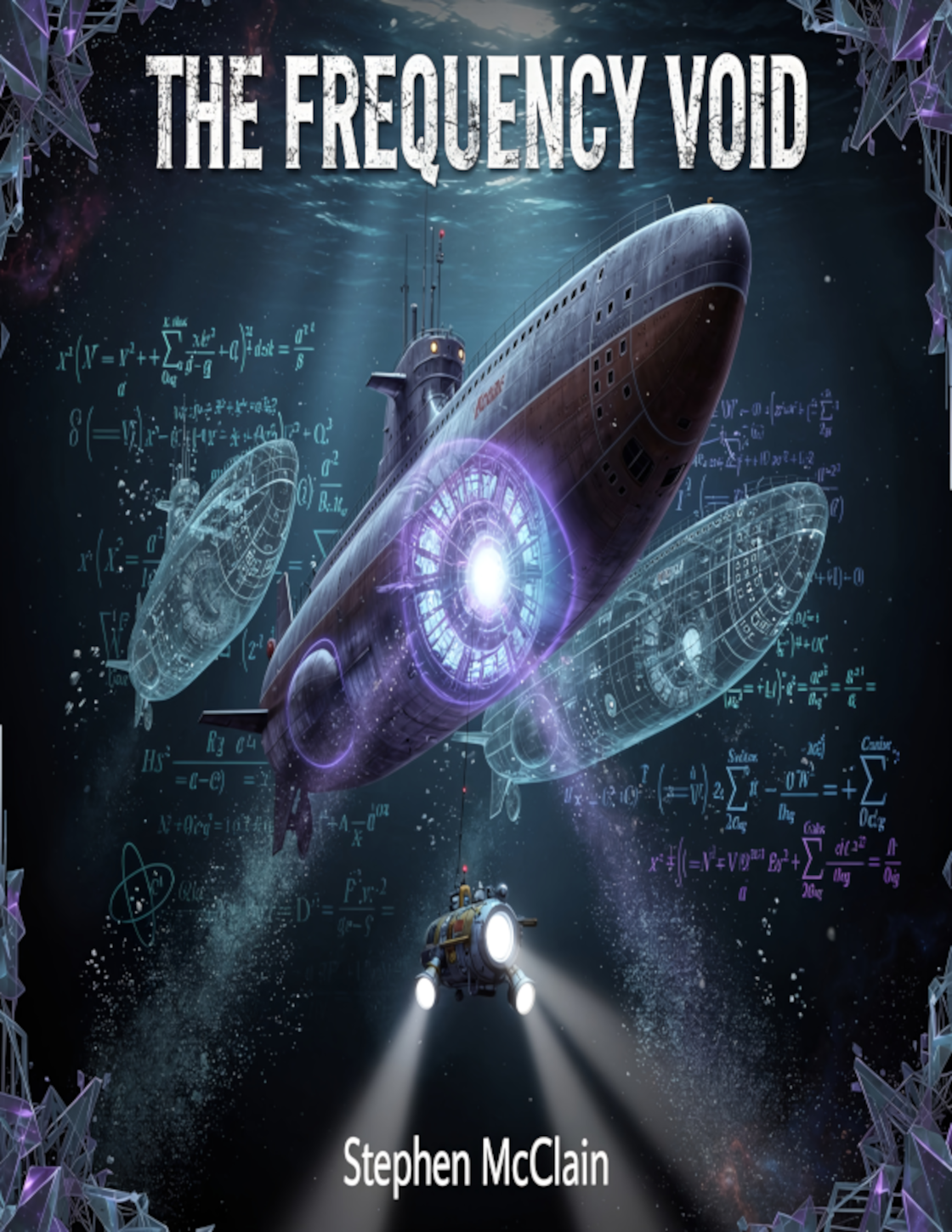
A team of deep-sea researchers discovers an abandoned Soviet submarine transmitting a mathematical signal that shouldn’t exist—and when they decode it, they realize it’s not a message from the past, but a warning from the future.
THE FREQUENCY VOID
by Stephen McClain
PART ONE: THE SIGNAL
Chapter One
The Pacific Ocean had no mercy for the foolish or the unprepared, and Dr. Sarah Conner suspected she might be both. She gripped the edge of the steel console as the research vessel Prometheus pitched violently to starboard, her knuckles whitening against the cold metal. Outside the reinforced windows of the command center, storm clouds gathered on the horizon like dark thoughts coalescing into something terrible and inevitable.
Sarah was thirty-two years old, though the past three weeks at sea had added years to the lines around her eyes. Her dark hair, usually kept in a practical ponytail, had begun to escape its binding, wild strands framing a face that colleagues described as intense even on calm days. Today was not a calm day. Today, the ocean seemed to know something she didn’t, and that feeling—that crawling certainty that the universe was holding its breath—made her skin prickle with anticipation and dread in equal measure.
The command center was cramped, a claustrophobic nest of technology and human ambition. Screens covered every available surface, displaying depth readings that plunged to numbers most people couldn’t fathom, sonar images that painted the abyss in shades of green and blue, thermal scans that revealed the ocean’s secret temperatures. Three weeks they’d been out here, three weeks of finding nothing but geological formations and the occasional deep-sea creature that looked like evolution’s rejected sketches. Twelve million dollars of funding to study the Mariana Trench, and all they had to show for it were some rock samples and footage of tube worms.
Until twenty minutes ago.
Marcus Lee hunched over his workstation, his twenty-eight-year-old frame tensed like a wire about to snap. He was brilliant with technology, could make machines whisper their secrets, but he had the nervous energy of someone who drank too much coffee and slept too little. Right now, his hands trembled slightly as they moved across his keyboard, and Sarah noticed the way his jaw clenched and unclenched, a habit he had when something didn’t make sense.
“That’s impossible,” Marcus said, his voice cutting through the ambient hum of electronics and the distant roar of the ocean. He jabbed a finger at his monitor, hard enough that Sarah worried he might crack the screen. “The signal’s been repeating for… it says here seventy-two hours, but we just picked it up twenty minutes ago.”
Sarah crossed the command center in three strides, her sea legs steady despite the vessel’s movement. She’d spent enough time on research ships to move with the waves rather than against them, her body anticipating the pitch and roll. She leaned over Marcus’s shoulder, close enough to smell the stale coffee on his breath and see the fine tremor in his hands.
“Show me the pattern again,” she said, her voice level, controlled. Sarah had learned early in her career that panic was contagious, and as the mission leader, she couldn’t afford to let it spread.
Marcus pulled up the waveform, and Sarah felt her breath catch. It stretched across the screen in a perfect, undulating rhythm—too perfect. Nature didn’t create patterns like this. Nature was chaos masquerading as order, entropy dressed up in temporary stability. But this… this was mathematics made audible. Each peak and trough identical to the last, a cosmic heartbeat that shouldn’t exist in the messy reality of the natural world.
Elena Vasquez, their oceanographer, leaned against the far wall with her arms crossed over her chest. At thirty-five, she was the oldest of the core team aside from Captain Volkov, and she carried her experience like armor. Her skepticism was legendary; Sarah had hired her specifically because Elena questioned everything, demanded evidence, refused to let enthusiasm override empiricism. Right now, her dark eyes narrowed as she studied the waveform, and Sarah could see the wheels turning behind that critical gaze.
“Could be a glitch,” Elena said, pushing off from the wall and moving closer. “We’re at the edge of the Mariana Trench. Equipment does weird things down here. The pressure, the electromagnetic interference from the thermal vents—any number of factors could create a false reading.”
It was reasonable doubt, the kind that kept scientists honest. But Sarah had learned to trust her instincts, that intuitive leap that separated competent researchers from groundbreaking ones. And every instinct she had was screaming that this was real.
Captain Dmitri Volkov had been silent until now, standing by the nautical charts with the stillness of a man who’d seen too much ocean and knew its secrets weren’t always kind. He was in his fifties, weathered by decades at sea, his face a map of harsh winds and harsher truths. His Russian accent, usually light, thickened as he spoke, the words carrying weight Sarah didn’t immediately understand.
“That frequency…” Dmitri’s voice was quiet, barely audible over the ship’s ambient noise. “I know that frequency.”
Everyone turned to look at him. The captain’s face had gone pale, a remarkable feat for a man whose skin had been tanned to leather by years under the sun and spray. His eyes were fixed on the waveform display, and in them Sarah saw something she’d never seen before: fear.
“You recognize it?” Sarah asked, moving toward him, her scientist’s curiosity warring with a growing sense of unease.
Dmitri seemed to age ten years in the space between heartbeats. His shoulders sagged slightly, and when he spoke, it was with the careful precision of a man choosing his words knowing they would change everything.
“K-219,” he said quietly. “Soviet attack submarine. Sank in 1986 off Bermuda. I was in the Northern Fleet then. We all knew about it.”
Marcus’s fingers flew across his keyboard, pulling up historical records. Sarah watched his face as he read, saw confusion deepen into something approaching disbelief.
“Captain,” Marcus said slowly, “we’re seven thousand miles from Bermuda. And thirty-five thousand feet deeper than where K-219 supposedly went down.”
Dmitri finally tore his gaze from the screen to look at Marcus, and the expression on his face made Sarah’s blood run cold. It was the look of a man confronting a ghost, a past that should have stayed buried in the dark places of the world and memory.
“I know where it went down,” Dmitri said, his voice carrying the weight of old secrets. “I was on the recovery team. We found nothing. Not even debris.”
The silence that followed was profound, broken only by the rhythmic pulse of the signal emanating from the speakers—a heartbeat from the abyss, impossibly regular, impossibly persistent. Sarah looked at each member of her team, seeing her own conflicting emotions reflected in their faces: excitement, fear, curiosity, caution.
Three weeks of nothing. Three weeks of justifying their presence out here, of sending increasingly apologetic reports back to the benefactors who’d funded this expedition. Twelve million dollars to study the deepest parts of the ocean, to push the boundaries of human knowledge, to find something—anything—that would justify the cost and risk.
And now this. A signal that shouldn’t exist, from a submarine that should be seven thousand miles away, carrying a frequency that a Russian captain recognized from a disaster nearly forty years old.
Sarah made her decision in the space of three heartbeats. She’d spent her entire career preparing for moments like this, for the chance to discover something genuinely unprecedented. She’d written papers on deep-sea exploration, defended her methodologies to skeptical peer reviewers, fought for funding against dozens of other researchers with equally valid projects. She hadn’t done all of that to turn away when the unknown finally presented itself.
“Prep the submersible,” Sarah said, her voice cutting through the tension with the clarity of absolute certainty. “We’re going down.”
Elena pushed away from the console, her skepticism hardening into something approaching alarm. “Sarah, that’s—we don’t have authorization for—”
“This mission has been in the water for three weeks and we’ve found nothing but rocks and tube worms,” Sarah interrupted, her tone brooking no argument. She turned to face Elena fully, meeting her eyes with an intensity that made the other woman stop mid-protest. “This is why our benefactors paid twelve million dollars. To find something unexpected.”
She looked at each of them in turn: Marcus with his nervous energy barely contained, Elena with her scientific caution fighting against curiosity, Dmitri with his haunted knowledge of things that shouldn’t be possible.
“We’re going down,” Sarah repeated, softer now but no less certain.
Outside, the storm clouds continued their advance, and the ocean swells grew higher, as if the Pacific itself was trying to warn them away. But Sarah Conner had never been good at heeding warnings, and she wasn’t about to start now. Not when the abyss was finally calling back.
The signal continued its perfect, impossible rhythm, broadcasting from a depth that should crush any human-made object to scrap metal, from a location that made no geographical sense, carrying a frequency that tied it to a disaster from another ocean, another time.
And Sarah Conner, with the confidence of the brilliant and the recklessness of the obsessed, was going to find out why.
Chapter Two
The submersible Orpheus was a marvel of engineering and claustrophobia in equal measure. Sarah had piloted it a dozen times during their expedition, had grown accustomed to the way the reinforced hull seemed to press in on you as depth increased, the way the tiny space amplified every sound and breath. But she’d never descended this deep, never pushed the vessel to its operational limits, and certainly never while chasing a signal that defied every law of probability and geography.
She sat in the pilot’s seat, her hands steady on the controls despite the adrenaline singing through her veins. Marcus occupied the sensor station to her right, his workstation a nest of glowing screens and haptic interfaces. Elena monitored environmental data from the rear position, her presence both reassuring and accusatory—Sarah could feel the oceanographer’s disapproval radiating like heat, even in the cramped space where they sat nearly shoulder-to-shoulder.
The descent began smoothly. The Orpheus detached from the Prometheus with a mechanical clank that reverberated through the hull, and then they were dropping, falling through layers of ocean that marked the boundaries of familiar and alien worlds. Sunlight penetrated the first two hundred meters in shades of brilliant blue, the water clear enough to see fish darting past their viewports like silver thoughts.
But they weren’t staying in the sunlit zones.
Sarah watched the depth gauge with the focus of a woman reading scripture. The numbers climbed with inexorable precision: 1,000 feet… 2,000 feet… 3,000 feet. Each thousand feet marked a descent into stranger territory, into pressures that would crush an unprotected human body in milliseconds, into darkness so complete it had its own weight.
“Passing the photic zone,” Elena announced from behind them, her voice professional despite the tension Sarah could hear underneath. “Ambient light reading near zero.”
The last traces of surface light vanished, and they entered the twilight realm where bioluminescence replaced solar radiation. Through the viewport, Sarah caught glimpses of deep-sea creatures—translucent jellyfish pulsing with inner light, anglerfish with their grotesque lures glowing in the darkness, things that had evolved in isolation so complete they might as well be alien.
“10,000 feet,” Marcus called out, his eyes glued to his sensors. “Signal strength increasing. It’s definitely below us.”
Sarah adjusted their descent rate, slowing them fractionally. The Orpheus‘s hull creaked—a sound that never failed to tighten her stomach, even though she knew the vessel was rated for depths far beyond their current position. The engineering was sound, the reinforced titanium hull capable of withstanding pressures that would turn steel into powder. But intellectual knowledge and visceral comfort were different things, and every creak was a reminder that they were encased in a bubble of air surrounded by billions of gallons of water that wanted very badly to equalize the pressure differential.
“15,000 feet,” Elena reported. “Temperature dropping. Salinity increasing. All readings within expected parameters for this depth.”
Expected parameters. The phrase should have been comforting, a confirmation that despite the impossible signal, despite the mystery of K-219, the ocean itself was behaving normally. But Sarah found no comfort in it. The ocean was a fundamentally hostile environment to human life, and the fact that it was being hostile in predictable ways didn’t make it less dangerous.
The descent continued. 20,000 feet. The midnight zone, where no surface light had ever penetrated, where creatures lived and died without ever knowing the sun existed. 25,000 feet. The abyssal zone, a realm of crushing pressure and frigid temperatures, of mud and extremophile bacteria and things that shouldn’t survive but did.
“28,000 feet,” Marcus said, his voice tight with something between excitement and fear. “Signal’s getting stronger. It’s… Christ, Sarah, it’s like it’s responding to our presence. The pattern’s intensifying.”
“Elaborate,” Sarah commanded, not taking her eyes off the controls. At these depths, even minor pilot error could be catastrophic.
“The frequency is adapting. It was a steady pulse before, but now there’s modulation. Almost like… like it knows we’re here. Like it’s trying to communicate specifically with us.”
A chill that had nothing to do with the external temperature ran down Sarah’s spine. Signals didn’t adapt. Broadcasts didn’t recognize their audience. What Marcus was describing was impossible—but then, everything about this situation was impossible, so why should that stop now?
“29,000 feet,” Elena announced. “We’re approaching the bottom of the Mariana Trench. Depth readings are getting confused—there’s something down here that’s interfering with sonar.”
“The submarine?” Sarah asked.
“Maybe. But it’s bigger than that. It’s like there’s a distortion field, something that’s bending our sensor readings. I’m getting echoes that don’t make sense, phantom contacts that appear and disappear.”
30,000 feet. They were deeper than most of humanity had ever ventured, deeper than the crush depth of any military submarine, deeper than the limits of most marine life. Down here, pressure exceeded fifteen thousand pounds per square inch—enough to compress a human body to the size of a volleyball. Down here, the darkness was absolute and eternal.
And down here, according to their sensors, was a Soviet submarine that had no business existing.
“Contact,” Marcus said suddenly, his voice sharp with shock. “Bearing three-two-zero. Distance… Jesus Christ, it’s massive.”
Sarah adjusted their heading, bringing the Orpheus around to face the coordinates Marcus had provided. Their external lights cut through the darkness, powerful halogen beams that in the surface world could illuminate a city block. Down here, they barely penetrated fifty feet before the darkness swallowed them.
But fifty feet was enough.
Through the murk, a shape emerged from the abyss like a whale rising from dreams. It was long and cylindrical, unmistakably man-made despite the sediment that covered its surface like a burial shroud. A submarine, impossibly intact, resting on the ocean floor at a depth that should have crushed it to fragments.
“That’s not possible,” Elena whispered, and Sarah heard her own thoughts echoed in the oceanographer’s voice. “At this depth, this pressure… it should be crushed to scrap.”
They circled it slowly, the Orpheus‘s lights playing across the hull in a slow revelation of the impossible. The submarine was Soviet in design—Sarah recognized the distinctive silhouette from intelligence photos she’d seen in academic papers, the double-hull construction that had characterized Soviet naval engineering during the Cold War. But what was impossible, what made her hands tighten on the controls until her knuckles ached, was the condition.
The hull was perfect. Not just intact, but pristine. At these depths, even modern submarines with advanced metallurgy would show signs of stress after decades—metal fatigue, compression damage, corrosion from the saline environment. But K-219, if that’s what this truly was, looked like it had been lowered into position yesterday. No rust. No decay. No crushing. Just a submarine sitting at the bottom of the Mariana Trench as if pressure was a suggestion rather than a law of physics.
“Look at the markings,” Sarah said, bringing them closer to the conning tower.
Their lights illuminated Cyrillic letters painted on the hull, faded but legible: К-219.
“K-219,” Marcus breathed. “Captain Volkov was right. But how did it get here? How is it still intact?”
“The transmission’s coming from inside,” Marcus continued, his eyes locked on his sensor readout. “Stronger now. It’s… Sarah, it’s adapting to our presence. The pattern’s changing, like it knows we’re here.”
“What do you mean, adapting?” Elena demanded, leaning forward between the seats, her scientific skepticism warring with the evidence of her own eyes.
“The frequency is modulating. Look at this—” Marcus pulled up a comparison of the signal they’d detected from the Prometheus and the one they were receiving now. The basic pattern was the same, that impossibly regular pulse, but now it carried harmonics, variations, additional information encoded in layers of mathematical complexity. “It’s like… like it’s responding to us. Recognizing us.”
Sarah scanned the submarine’s hull, looking for an access point. The vessel had clearly suffered some damage—there were stress fractures here and there, places where the deep-sea sediment had settled in cracks and crevices. And there, near the aft section, she spotted what she was looking for: a jagged opening in the hull, wide enough for the Orpheus to dock with if she was careful.
“There,” she said, pointing. “We can dock there. Get inside.”
Elena’s hand clamped down on Sarah’s shoulder, gripping hard enough to hurt. “Are you insane? We don’t know what’s in there. Could be radiation, chemical weapons, structural collapse—hell, there could be unexploded ordnance from whatever sank it. We should mark the location, surface, report this, and let the proper authorities handle it.”
Sarah met Elena’s eyes in the reflection of the viewport. The oceanographer was right, of course. This was the sensible approach, the safe approach, the approach that would ensure they all lived to see their families again. But Sarah hadn’t come seven thousand miles, hadn’t descended thirty-five thousand feet, hadn’t dedicated her career to pushing the boundaries of human knowledge just to turn back when the unknown finally revealed itself.
“Or answers,” Sarah said quietly, her eyes locked forward on the damaged section of hull. “We came here to find the unexpected, Elena. I’d say a perfectly preserved Soviet submarine at the bottom of the Mariana Trench, broadcasting a signal that shouldn’t exist, qualifies as unexpected. We may never get another chance like this.”
“That’s exactly what I’m afraid of,” Elena muttered, but she released Sarah’s shoulder and sat back in her seat.
Sarah didn’t respond. She was already maneuvering the Orpheus into position, her hands steady on the controls despite the wild hammering of her heart. The docking procedure was delicate even under ideal conditions—down here, with an unstable platform and the weight of seven miles of ocean above them, it bordered on suicidal.
But Sarah had always had steady hands.
The Orpheus‘s docking collar aligned with the opening in K-219’s hull. There was a mechanical groan as the submersible’s systems engaged, extending the flexible tunnel that would allow them to transfer from one vessel to another. Hydraulics hissed. Pressure seals engaged. Warning lights flashed amber, then green.
They were docked.
“Pressure differential equalized,” Marcus reported, his voice steadier now that they had a specific task to focus on. “Atmosphere reading… Sarah, there’s atmosphere inside. Oxygen, nitrogen, standard mixture. It’s breathable.”
“That’s impossible,” Elena said for what felt like the hundredth time. “The submarine has been down here for thirty-eight years. Any residual atmosphere should have long since been replaced by seawater.”
“I’m just telling you what the sensors say,” Marcus replied with a shrug. “There’s air in there. Cold air—temperature reading is negative five Celsius. But air nonetheless.”
Sarah was already moving, unbuckling from her pilot seat and retrieving the deep-sea pressure suits from their storage locker. The suits were unwieldy, designed to protect them from the crushing pressure outside while allowing enough mobility to conduct research. They looked like something from a science fiction film—bulky white material reinforced with composite armor, helmets with built-in LED arrays, life support systems that could sustain them for up to six hours in an emergency.
“Suit up,” she ordered. “Marcus, bring the portable sensor suite. Elena, I want you monitoring structural integrity every step of the way. If this thing so much as groans the wrong way, we’re out. Understood?”
They nodded, and for the next ten minutes the cramped interior of the Orpheus was filled with the sounds of preparation—the rustle of suit material, the click of seals engaging, the hiss of pressure checks. Sarah helped Marcus with his backpack sensor array, made sure Elena’s structural scanner was properly calibrated, double-checked her own suit’s life support systems.
Finally, they were ready. Sarah stood before the airlock leading to K-219, her hand on the release mechanism, and allowed herself one moment of doubt. One moment to question whether this was brilliance or madness, whether she was about to make the greatest discovery of her career or commit the greatest mistake of her life.
Then she opened the airlock, and the moment passed.
The interior of K-219 waited for them in the darkness, and Sarah Conner stepped through the threshold into the impossible.
Chapter Three
The first thing Sarah noticed was the cold. It hit her even through the insulated pressure suit, a penetrating chill that seemed to come from everywhere and nowhere at once. Negative five Celsius, Marcus had said, and Sarah believed it. At this depth, without active cooling systems, the ambient temperature should have equalized with the surrounding water—just above freezing, certainly, but not below it. Yet here they were, their breath condensing into visible clouds despite the supposedly breathable atmosphere, their suit heaters clicking on automatically to compensate for the thermal drain.
The second thing she noticed was the sound. Or rather, the absence of it. Submarines, even dead ones, typically harbored ambient noise—the settling of metal, the drip of water, the creaks and groans of stressed structures. But K-219 was silent in a way that felt deliberate, as if the vessel itself was holding its breath. The only sounds were the ones they brought with them: their breathing, the quiet hum of their suit systems, the soft beep of Marcus’s sensors.
Sarah activated her helmet’s LED array, and powerful lights cut through the darkness. They were in a corridor, narrow and claustrophobic in the way of all submarine interiors. Soviet naval design favored function over comfort, and the passageway was lined with pipes and conduits, all painted in faded shades of gray and olive green. Equipment panels lined the walls, their labels in Cyrillic, their purposes inscrutable to anyone not trained in Soviet engineering.
But what struck Sarah most forcefully was the condition. Like the exterior hull, the interior showed no signs of the decay that should have ravaged it over nearly four decades underwater. No rust. No corrosion. No accumulation of deep-sea detritus. It looked like the crew had just stepped out moments ago, leaving their vessel in pristine condition.
“This doesn’t make sense,” Elena said, her voice crackling through the suit’s communication system. She was running her structural scanner along the corridor walls, and the confusion in her voice mirrored Sarah’s own thoughts. “The metal’s intact. More than intact—it’s showing zero stress fractures, zero material fatigue. This alloy should have been compromised years ago.”
Marcus moved past them, his sensor array painting the corridor in sweeping patterns of light and electromagnetic radiation. “Radiation levels are normal,” he reported. “No elevated gamma, no neutron flux, no signs of reactor containment failure. Whatever happened here, it wasn’t a nuclear accident.”
They moved deeper into the submarine, their boots making hollow sounds on the deck plating. Emergency lighting flickered on as they passed—red and yellow bulbs that cast long, distorted shadows across the walls. Sarah’s first instinct was to freeze, but Marcus quickly scanned the lighting system.
“Automated response to motion,” he explained. “There’s still power. Not much, but enough to run basic systems. The batteries should have died decades ago, but they’re reading at about forty percent capacity.”
“Like the submarine’s been waiting,” Elena murmured. “Waiting for someone to come.”
They reached an intersection in the corridor, and Sarah consulted the mental map she’d constructed from intelligence photos of Soviet submarine layouts. Left would take them to crew quarters and the galley. Right led toward engineering and the reactor room. Straight ahead was the command center.
“Command center first,” Sarah decided. “That’s where the transmission is likely originating from.”
They proceeded forward, passing closed doors that Sarah assumed led to crew cabins and storage lockers. Her hand itched to open them, to explore every corner of this impossible find, but she forced herself to stay focused. They had six hours of life support, and she wanted to understand the core mystery before getting distracted by peripheral details.
The corridor opened into the submarine’s control room, and Sarah’s breath caught in her throat.
Seven bodies.
Soviet naval officers in 1980s-era uniforms sat at their stations, hands on controls, eyes open and staring. They hadn’t collapsed. Hadn’t sought shelter or tried to escape. They were simply… seated. Working. As if death had caught them mid-task and they’d decided to stay at their posts regardless.
“Jesus Christ,” Marcus whispered, his voice tight with horror and fascination.
Sarah approached the nearest body slowly, her scientific training warring with her instinctive revulsion. The man—she assumed it was a man, though the face was too preserved to show much gender distinction—wore a Soviet naval uniform with the insignia of a lieutenant. His eyes were open, pupils fixed and dilated. His mouth was slightly agape, as if he’d been about to speak when death claimed him. And on his face, frozen in the rictus of perfect preservation, was an expression of absolute terror.
She reached out with a gloved hand and touched the officer’s face. The flesh was ice cold, but it wasn’t frozen solid. It gave slightly under pressure, like touching cold clay, maintaining an uncanny simulacrum of life despite obvious death.
“They’re preserved,” Sarah said, trying to keep her voice clinical and failing. “Perfectly preserved.”
Marcus was scanning another body, and the confusion on his face was visible even through his helmet’s faceplate. “Sarah, look at this.”
She moved to his side and looked at the scanner’s readout. What she saw made no sense. The device was displaying layers within the body—like tree rings, or geological strata, each layer representing a different time period. And the numbers scrolling across the screen were impossible.
“Carbon dating is spiking,” Marcus said, his voice barely above a whisper. “These bodies… they aren’t thirty-eight years old. According to this, they’re three hundred years old. Minimum. Some of these readings are pushing five hundred years.”
“That’s impossible,” Elena said, but her protest lacked conviction. Everything here was impossible. What was one more impossibility added to the pile?
“I’m just telling you what the instruments say,” Marcus repeated, his default response when reality refused to cooperate with expectation.
Sarah forced herself to look away from the bodies and focus on the equipment. The control room was dominated by a large console covered in buttons, switches, and display screens—all Soviet-era technology that should have been obsolete even when the submarine was operational. But the screens were active, glowing with phosphorescent green text that scrolled in repeating patterns.
She approached the main console, and her scientific training finally overcame her dread. Numbers. The screen was filled with numbers, scrolling in precise sequences that repeated with mechanical regularity. This was the source of the signal, the transmission that had drawn them here.
“It’s not a code,” Sarah said, studying the patterns. “It’s mathematics. Pure mathematics.”
Elena moved to her side, reading over her shoulder. The oceanographer had a doctorate in physics before specializing in marine sciences, and Sarah watched her eyes move rapidly across the equations, processing, calculating, understanding dawning with horrible clarity.
“This equation…” Elena’s voice was hushed, almost reverent. “It’s describing spacetime curvature. But the constants are wrong. This would require negative energy. Exotic matter. Things that don’t exist in nature.”
“Or things we haven’t discovered yet,” Sarah countered.
Marcus had moved to another console, his fingers flying over the controls with the confidence of a man who spoke technology as a native language. “Found the ship’s log,” he announced. “It’s… still recording. Active entries from yesterday. That’s impossible—the crew’s been dead for decades.”
“Play it,” Sarah ordered.
Marcus initiated the playback, and the control room filled with the crackle of old recordings. Static first, the white noise of dead air, and then a voice—young, terrified, speaking in rapid Russian. Marcus’s translation software kicked in, displaying subtitles on his helmet’s heads-up display, and Sarah read along with growing horror.
“Day 47 of quantum entanglement experiment. We’ve achieved stable connection. Captain Kuznetsov says we can transmit information across time itself. But something’s wrong. The reactor… it’s drawing power from somewhere else. Somewhere we can’t see.”
The recording jumped, skipping time like a stone across water. When the voice returned, it was more frantic, the terror more pronounced.
“We tried to shut it down. We can’t. The frequency is locked. It’s not receiving anymore—it’s broadcasting. Forward. Always forward.”
Another jump. The final entry, and Sarah could hear the desperation bleeding through even the cold translation.
“If anyone finds this… don’t decode the message. Don’t listen. It’s not from us. It’s from—”
The recording cut to white noise, a wash of static that seemed to carry meaning in its chaos. And then, emerging from the noise like a swimmer breaching the surface, a new voice. This one was distorted, processed through layers of interference until it barely sounded human. Or perhaps it had never been human to begin with.
“72.4N, 158.6E. December 7, 2025, 14:33 UTC.”
Silence crashed back down on them like the weight of the ocean above. Sarah checked her watch reflexively, her mind calculating even as her heart raced.
“That’s…” she said slowly, “that’s in seventy-two hours.”
Marcus was already typing, his fingers trembling as they pulled up geographical coordinates on his portable system. “Those coordinates. They’re in the Kamchatka Peninsula. Petropavlovsk. Russian submarine base.”
“What happens at 14:33 on December 7th?” Elena asked, though Sarah suspected she didn’t really want to know the answer.
The lights flickered. The temperature, already frigid, plummeted further. Sarah’s suit heater kicked into overdrive, struggling to compensate. Their breath now formed thick clouds, ice crystals forming in the air itself.
“Something’s happening,” Marcus said, his voice rising with panic. “The reactor’s spiking. Energy signature is… I can’t get a reading. It’s off the scale. It’s like the submarine’s waking up.”
On the console where Sarah stood, more text began appearing—not the mathematical equations from before, but coordinates. Lists of them, scrolling faster than she could read. She pulled out her tablet, photographing the screen, trying to capture everything before it vanished.
“Marcus, what are these?” she demanded.
He moved to her side, and together they watched the coordinates multiply:
- 38.9N, 77.0W – December 12, 2025, 09:15 UTC
- 51.5N, 0.1W – December 18, 2025, 22:47 UTC
- 35.7N, 139.7E – January 3, 2026, 06:21 UTC
Sarah pulled up a map on her tablet, her hands shaking as she plotted the locations. “Washington DC. London. Tokyo. These are major cities.”
“What is this?” Elena asked, backing away from the console as if distance could protect her from the implications. “Some kind of Soviet doomsday protocol?”
A new line of text appeared on the screen, and this time it was in English—perfect, unaccented English that somehow made everything worse:
“WARNING: CASUALTY PREDICTIONS. TOTAL: 847,392,103.”
The number continued to climb as they watched, ticking upward like an odometer counting toward apocalypse.
“Eight hundred million casualties,” Marcus said, his voice hollow. “This is predicting… what? Attacks? Natural disasters? The end of the fucking world?”
BANG.
The sound came from deeper in the submarine, echoing through the corridors with metallic finality. They all jumped, Sarah’s hand instinctively going to the utility knife on her belt—a useless gesture against whatever might be lurking in the depths of K-219.
“Sarah, can you copy these files?” Elena asked, her oceanographer’s pragmatism overriding fear. “If we’re going to understand this, we need the data.”
“Marcus—” Sarah began.
“I’m trying,” Marcus interrupted, his fingers flying over the console’s keyboard with desperate speed. “The system’s… it’s like it’s resisting. Like it doesn’t want to be copied. The files are corrupting as I download them, then reforming, then—”
Another sound. Closer this time. Not quite footsteps—more like the drag of something heavy across metal flooring. The sound of something moving that shouldn’t be able to move.
“We need to leave,” Elena said firmly. “Now.”
“Not without the data,” Sarah countered, her scientific obsession overriding her survival instinct. “This could be—”
A figure appeared in the doorway.
It was one of the Soviet crew members. Moving. Walking. Eyes still frozen open in that expression of eternal terror, mouth still slightly agape, but somehow, impossibly, animated. It took a step into the control room, then another, its movements mechanical and wrong, like a puppet operated by someone who’d never seen a human walk before.
“WHAT THE FUCK—” Marcus screamed, stumbling backward and colliding with Sarah. His sensor array clattered to the floor, lights spinning wildly and casting rotating shadows that made everything worse.
The figure didn’t attack. It didn’t even seem to notice them, not really. It simply stood there in the doorway, mouth moving silently, trying to form words that would never come. And then, with terrible deliberation, it raised one arm and pointed.
Pointed toward the reactor room.
More figures emerged from the shadows of the corridor behind it. Five, six, seven—the entire crew, risen from their stations, all moving with that same mechanical wrongness, all pointing in the same direction.
“Oh god,” Elena whispered. “Oh god, oh god—”
She grabbed Sarah’s arm with bruising force and pulled. Sarah resisted for a moment, still trying to watch Marcus’s download progress, still trying to understand, but then one of the animated corpses took another step closer and instinct overrode curiosity.
“Leave it!” Elena shouted. “Leave everything and RUN!”
They ran.
Chapter Four
Panic has a particular flavor in enclosed spaces. In the cramped corridors of K-219, it tasted like copper and ice, felt like walls closing in and air running out. Sarah’s legs pumped mechanically, muscle memory taking over as her conscious mind struggled to process what they’d just witnessed. Behind them, the sound of multiple footsteps—too many footsteps—echoed through the submarine like a countdown to something terrible.
Marcus was in front, his shorter legs somehow finding extra speed born of pure terror. Elena brought up the rear, her structural scanner abandoned somewhere in their flight, both hands now occupied with keeping herself upright as they careened through corners designed for submarine crews, not panicked scientists in bulky pressure suits.
“The airlock!” Sarah gasped, her breath coming in ragged bursts. “Get to the airlock!”
They burst into the corridor where they’d entered, and Sarah felt a brief surge of relief. The Orpheus was right there, their ticket back to the surface, back to sanity, back to a world where corpses stayed dead and submarines didn’t preserve themselves for forty years at the bottom of the ocean.
But the relief died as quickly as it had sparked.
The corridor was wrong. The angles weren’t right. The pathway that should have led straight to their submersible now seemed to curve, and in the dim emergency lighting, Sarah couldn’t tell if the geometry had actually changed or if her mind was simply rejecting what her eyes reported.
“Where’s the docking port?” Marcus demanded, spinning in a circle. “It was right here!”
“It has to be here,” Elena insisted, running her hands along the wall as if the airlock might have camouflaged itself. “We came straight—we didn’t turn—”
Sarah forced herself to stop, to think. Panic killed. Panic made you stupid, made you overlook obvious solutions, made you die in situations where calm analysis would save you. She activated her helmet’s map function, the one that had been tracking their route through the submarine via inertial navigation.
The map display made no sense. According to the tracking data, they should be standing inside their submersible right now. But they were clearly still in K-219, in a corridor that didn’t match their entry point, in a space that seemed to have reorganized itself when they weren’t looking.
“The submarine’s geometry is changing,” Sarah said, surprised at how steady her voice sounded. “Either that, or our perception of it is being altered. The map says we’re here, but we’re clearly not.”
“How is that possible?” Marcus asked, though by now the question felt rhetorical. Everything here was impossible.
“The equations,” Elena said suddenly. “The ones on the console—they were describing spacetime curvature. What if whatever experiment the Soviets were running didn’t just fail? What if it succeeded? What if they actually managed to manipulate spacetime inside this vessel?”
It was the worst possible explanation, because it was the only one that fit the evidence. Sarah’s mind raced through the implications. If the submarine existed in some kind of localized spacetime distortion, then normal rules of causality, of geometry, of basic physics might not apply inside its hull. They might not be dealing with a haunted ship—they might be inside a region where reality itself had been fundamentally broken.
The footsteps behind them grew louder. The animated corpses were getting closer, their movements more coordinated now, as if whatever intelligence controlled them was learning, adapting, becoming more efficient at puppeting dead flesh.
“We can’t stay here,” Marcus said, stating the obvious because someone needed to say it. “Which way?”
Sarah made a decision based on nothing but instinct and the vague memory of submarine layouts from intelligence briefings. “Forward. Toward the bow. There might be emergency escape hatches in the torpedo room.”
They ran again, and this time Sarah noticed something that made her skin crawl beneath her pressure suit. The emergency lighting wasn’t just providing illumination—it was following them. Bulbs would flicker on just as they approached, casting their path in red and yellow, then dim behind them as they passed. The submarine wasn’t just containing them. It was herding them.
They reached the torpedo room, a long chamber lined with launch tubes that gaped like empty eye sockets. The space was larger than the corridors, and Sarah felt her breathing ease slightly with the extra room. But there was no escape hatch, no convenient exit to the ocean beyond. Just the torpedo tubes themselves, and those were far too small for a human in a pressure suit to fit through.
“Dead end,” Elena said, the words heavy with defeat. “We’re trapped.”
The footsteps stopped. In the doorway behind them, the Soviet crew members stood in a line, still pointing, still trying to speak. But now Sarah could see something else in their frozen expressions—not just terror, but desperation. They weren’t threatening. They were trying to warn.
“The reactor room,” Sarah whispered. “They want us to go to the reactor room.”
“Are you insane?” Marcus demanded. “Those are corpses. Reanimated corpses. We shouldn’t trust anything they—”
“Look at them,” Sarah interrupted. “Really look. They’re not attacking. They haven’t tried to hurt us. They’re just… pointing. Showing us where we need to go.”
Elena studied the figures for a long moment, and Sarah watched her friend’s face cycle through fear, confusion, and finally reluctant acceptance. “She’s right. Whatever’s controlling them—if anything is—it’s not hostile. At least not directly.”
“So what, we just… follow the zombie sailors?” Marcus asked, his voice cracking slightly on the last word.
“Do you have a better idea?” Sarah countered.
They didn’t. And with the submersible impossibly lost in the warped geometry of K-219, their options had narrowed to one: go deeper. Follow the dead men pointing toward the heart of the mystery. Trust that whatever had preserved this submarine and its crew for nearly forty years wanted something from them beyond adding three more corpses to its collection.
Sarah stepped forward, moving slowly toward the line of figures. They didn’t react, didn’t move, just maintained their pointing posture like the world’s most horrifying signposts. She reached the doorway and looked back at Marcus and Elena.
“Together,” she said. “Whatever we find, we face it together.”
They nodded, and together they followed the dead men deeper into K-219.
The journey to the reactor room felt like descending through layers of reality, each one slightly less stable than the last. The submarine’s interior continued to shift in subtle ways—a corridor they were certain they’d already walked through now branching in a different direction, equipment panels rearranging themselves when no one was looking directly at them, the very walls seeming to breathe with a rhythm that matched the pulsing transmission they’d originally detected.
The Soviet crew led the way, their movements becoming more fluid as they approached the reactor, as if proximity to the source of the distortion gave them greater animation. They no longer looked quite so much like puppets—now they moved with an uncanny grace, their feet gliding across the deck plating without quite touching it. Sarah wondered if they were real at all, or if they were projections, echoes of men who had died decades ago but were somehow still broadcasting their final moments through whatever temporal anomaly the reactor had created.
They passed through sealed hatches that opened before them without anyone touching the controls, descended ladders that shouldn’t have been able to support the weight of three people in pressure suits, navigated mazes of pipes and conduits that led them always downward, always toward the throbbing heart of the ship.
Finally, they reached the reactor room.
It was larger than Sarah had expected, a cathedral of Soviet engineering with walls lined by lead shielding and control systems that looked like they belonged in a science fiction film. At the center of it all was the reactor itself—a massive cylindrical structure wrapped in cooling pipes and sensor arrays, thrumming with an energy that Sarah could feel even through her suit’s insulation.
But it was the color that stopped her breath.
The reactor was glowing. Not with the orange-red of heat or the blue-white of Cherenkov radiation, but with colors that had no names, frequencies of light that shouldn’t exist. They hurt to look at directly, made her eyes water and her vision swim, as if her optic nerves were trying to process input they weren’t designed to handle.
“Jesus Christ,” Marcus whispered, and Sarah couldn’t tell if it was a curse or a prayer.
Around the reactor, more of the Soviet crew stood at their stations, but these were different from the ones they’d encountered before. These weren’t just preserved—they were still working. Their hands moved over controls with practiced efficiency, their eyes tracked displays that showed impossible data, their mouths moved in silent communication with each other. They were going through the motions of their duties as if death was merely an inconvenience that shouldn’t interrupt proper Soviet naval discipline.
And in the center of it all, standing directly before the reactor with his back to them, was a figure in a captain’s uniform. Older than the others, his posture rigid with command authority even in death. Slowly, so slowly, he turned to face them.
His eyes were different. Not frozen in terror like the others, but aware. Intelligent. And in them, Sarah saw recognition.
He knew they were coming. He’d been waiting for them.
The captain’s mouth moved, and this time sound emerged—not words, exactly, but a modulated tone that Sarah’s translator struggled to process. It took a moment before she realized he wasn’t speaking Russian. He was speaking the same mathematical language the transmission used, pure information encoded in sound waves.
“Marcus,” she said urgently, “can you translate that?”
Marcus was already working, his fingers flying over his sensor array’s input interface. “It’s… it’s not a language, exactly. More like… compressed data. Give me a minute.”
The captain continued his tonal communication, and the other crew members joined in, creating a harmonic chorus that resonated through the reactor room. The reactor itself responded, its glow intensifying, new harmonics adding to the symphony of impossible mathematics.
“Got it,” Marcus said finally. “It’s not pretty. He’s saying… ‘We failed. You must not. The bridge must be stabilized before second iteration or causality collapses. Use the equation. Send it backward and forward. Only simultaneous transmission prevents paradox.’”
“Second iteration?” Elena asked. “What does that mean?”
The captain raised one hand and pointed—not at them, but at the reactor itself. Sarah understood. Whatever experiment the Soviet crew had been conducting, it had been iterative. This was the first iteration, the one that had gone wrong, that had killed them and trapped them in this temporal loop. But there would be others. Had already been others, perhaps, in timelines they couldn’t perceive. And if those iterations weren’t corrected, if the experiment continued to fail across multiple attempts…
“The timelines,” Sarah said, understanding crystallizing with horrible clarity. “The coordinates, the casualty numbers—those weren’t predictions of what will happen. They’re echoes of what has already happened in other iterations. Other attempts to solve the same problem, all failing in different ways.”
“So what do they want us to do?” Marcus demanded. “How do we stabilize something we barely understand?”
Sarah moved closer to the reactor, studying the console displays. The mathematics scrolling across them were beyond her training, beyond anything she’d encountered in her academic career. But they had a strange logic to them, a self-consistent framework that her mind could almost grasp if she just looked at it from the right angle.
“The equation on the main console,” she said. “The one describing spacetime curvature with negative energy. That’s the key. They figured out how to create a bridge through time, but they couldn’t control it. It became a one-way transmission, broadcasting forward but unable to receive feedback. That created an unstable loop—information flowing in only one direction, building up pressure until causality itself fractured.”
“So we need to make it two-way,” Elena said, following the logic. “Create a feedback loop that stabilizes the bridge.”
“But we’d need to send something back through time,” Marcus protested. “We don’t have that capability. We don’t even have the theoretical framework for—”
“They do,” Sarah interrupted, gesturing to the reactor. “This entire submarine is the framework. It’s been broadcasting for forty years, sending messages forward through time. All we need to do is reverse the polarity, turn it into a receiver as well as a transmitter.”
The captain was nodding—or rather, the animated corpse controlled by whatever intelligence inhabited this place was nodding. Approval. Encouragement. A desperate plea from men long dead that someone, anyone, finish what they’d started.
“There’s just one problem,” Elena said quietly. “If we alter the transmission, if we change what gets sent through time, we might change our own timeline. We might prevent ourselves from ever being here to make the change. Classic grandfather paradox.”
“Unless we send the same information backward that we’ve already received forward,” Sarah countered. “Make the loop self-consistent. We received the coordinates, the casualty predictions, the warning. We send back the solution. Information flows in a closed loop, no beginning, no end, no paradox.”
Marcus was shaking his head, not in disagreement but in disbelief at what they were discussing. “You’re talking about creating a stable time loop. That’s… that’s not just theoretical physics. That’s rearranging the fundamental structure of causality.”
“The Soviets already did that,” Sarah pointed out. “We’re just trying to make sure their rearrangement doesn’t collapse and take all of reality with it.”
She approached the reactor console, her hands hovering over the controls. The Cyrillic labels meant nothing to her, but the mathematics displayed on the screens spoke a universal language. She could see the pattern now, see how the energy flows were structured, see where the instability originated.
“I need your help,” she said to her team. “Elena, monitor the energy output. If we get a cascade failure, we’ll have seconds to abort before the reactor goes critical. Marcus, I need you to translate what I’m doing into the temporal language. We need to broadcast our solution not just through space, but through time.”
They moved into position without argument. They’d come too far, seen too much, been changed too fundamentally to turn back now. Whatever happened in the next few minutes would determine not just their fates, but potentially the fate of every timeline that branched from this moment.
Sarah’s hands settled on the controls, and she began to work.
The mathematics were elegant in their complexity, beautiful in their terrible implications. The Soviets had been trying to create a quantum communication system, a way to transmit information instantaneously across any distance by exploiting quantum entanglement at a macroscopic scale. But they’d made a critical error—they’d focused only on transmission, treating time as a one-way street. Information could flow forward, could affect the future, but the future couldn’t respond, couldn’t feed back into the system.
That created an asymmetry, an imbalance in the temporal equation. And nature abhorred imbalance. The universe had responded by fracturing causality, creating a probability space where multiple timelines existed simultaneously, each one a different outcome of the same quantum experiment, all of them trying to exist in the same physical space.
The submarine wasn’t just at the bottom of the Mariana Trench. It existed in a superposition of locations, of times, of realities. It was here in 2025 and there in 1986 and everywhere in between. The crew wasn’t dead or alive—they were both, neither, something that transcended the binary of existence.
And the only way to collapse that superposition into a single, stable state was to close the loop. Make the transmission bidirectional. Let the future speak to the past and the past respond to the future in perfect harmony.
Sarah’s fingers flew over the controls, adjusting energy flows, rerouting power systems, reconfiguring the reactor’s output to create not just a broadcast, but a conversation. The mathematics scrolled faster across the screens, adapting to her inputs, the system responding with an eagerness that suggested it had been waiting for someone to do exactly this.
“Energy output increasing,” Elena reported, her voice tight with tension. “Reactor temperature rising. We’re approaching operational limits.”
“Just a little longer,” Sarah muttered, making final adjustments. “Almost there.”
The reactor’s glow intensified, cycling through those impossible colors faster now, creating a strobe effect that made reality itself seem to flicker. The Soviet crew around them began to move more erratically, their smooth motions breaking down into staccato bursts as if the temporal field holding them together was becoming unstable.
“Sarah!” Marcus shouted over the rising hum of the reactor. “The countdown! Look at the countdown!”
On the main screen, the casualty prediction number had stopped climbing. For a moment it held steady at 847,392,103, and then it began to descend. Slowly at first, then faster, millions of predicted deaths vanishing with each passing second as timelines collapsed into each other, as probability spaces narrowed, as cause and effect finally agreed on a single narrative.
“It’s working!” Sarah cried, her voice exultant. “We’re stabilizing the—”
The reactor SCREAMED.
It wasn’t a sound so much as a pressure wave, reality itself compressing and then expanding like a cosmic heartbeat. Sarah felt it pass through her, felt it rearrange her molecules and then put them back in almost the same configuration. Almost.
The world inverted. Became nothing. Became everything. For a moment—or was it a lifetime?—Sarah existed in all times simultaneously. She was a child in her father’s laboratory, was a graduate student defending her thesis, was here in the reactor room, was somewhere impossibly far in the future standing before something vast and ancient and patient. She saw herself die a thousand different ways, saw herself live a thousand different lives, saw timelines branch and converge and branch again in patterns that would drive any sane mind to madness.
And then, with a final pulse of impossible mathematics, reality snapped back into a single coherent stream.
Sarah collapsed against the console, gasping, her mind struggling to process what it had just experienced. Around her, the Soviet crew had gone still—truly still this time, their animation draining away until they were once more simply corpses frozen in their final moments.
No. Not frozen. Fading.
She watched in numb fascination as they dissolved, breaking down into particles of light that drifted upward against all laws of physics. One by one they vanished, the captain last, his eyes meeting Sarah’s one final time. In them she saw gratitude. Relief. And something else—a warning, perhaps, or a promise. She couldn’t tell which.
Then he too was gone, and the reactor room was empty except for three scientists in pressure suits and a glowing reactor that had just fundamentally altered the structure of causality itself.
“Did we… did we do it?” Marcus asked, his voice small and uncertain.
Sarah checked the displays. The countdown had stopped at zero. The casualty predictions showed a new number: 0. The coordinates still listed major cities, but now they were marked as “STABLE TIMELINE ANCHORS” rather than disaster sites.
“We did it,” she confirmed, but her voice carried no triumph. Because beneath the primary display, a new message had appeared:
“MESSAGE RECEIVED. CALCULATING OUTCOMES. TOTAL STABLE TIMELINES: 3. TOTAL COLLAPSED TIMELINES: 847.”
Sarah’s hands began to shake. “Oh god.”
“What?” Elena demanded, moving to her side. “We stopped it. We stabilized the bridge. What’s wrong?”
“We saved three timelines,” Sarah said, her voice hollow. “But we collapsed eight hundred and forty-seven others. Timelines where people existed, lived, loved—and we just erased them.”
The silence that followed was absolute. The weight of what they’d done settled over them like the ocean above, crushing and inescapable. Sarah had spent her career pursuing knowledge, believing that understanding the universe was an inherently noble pursuit. But now she understood that some knowledge came with a price, and sometimes that price was paid in currencies that couldn’t be quantified or rationalized.
“Did we just commit genocide across time?” Marcus asked quietly.
No one answered. There was no answer that would make it better, no justification that would absolve them. They’d made a choice—save three timelines or let all of them collapse. The mathematics had been clear. But mathematics didn’t account for the weight of moral horror, for the knowledge that they’d played God with realities they couldn’t even fully comprehend.
A sound broke through Sarah’s spiral of guilt—the distant beep of the Orpheus‘s emergency beacon. Elena pulled out her portable radio, and to Sarah’s shock, it crackled with an incoming transmission.
“Orpheus, this is Prometheus actual. We lost you on sensors for six hours. Are you alright down there?”
Elena’s hand was shaking as she keyed the microphone. “Dmitri? We… we can hear you. We’re in the submarine. We need extraction.”
“Negative, Orpheus. Sensors show you’re still in your submersible. You descended at 14:30. It’s now 20:45. We were about to send down the ROV to investigate.”
Sarah checked her watch. It read 20:47. But they’d been down here for… how long? Hours, certainly. Many hours. She looked at Marcus, saw the same confusion mirrored on his face.
“Time dilation,” he whispered. “We were in the frequency void. Time moved differently for us.”
“Dmitri,” Sarah said, taking the radio from Elena. “We’re coming up. We found… we found something. Something impossible.”
“Understood, Sarah. We’ll prep medical. And Sarah? You should know—headquarters has been trying to reach us. There was an earthquake. Kamchatka Peninsula. Destroyed the submarine base at Petropavlovsk.”
Sarah’s blood turned to ice in her veins. “When?”
“Ninety minutes ago. 14:33 local time.”
The first coordinate. The first disaster. It had happened anyway, despite everything they’d done. Or perhaps because of everything they’d done. Cause and effect had become so tangled in the frequency void that Sarah could no longer distinguish between prediction and causation, between preventing a disaster and causing it through the act of prevention.
Elena was reading Marcus’s screen, her face growing progressively more horrified. “The stable timelines. Sarah, look at this.”
The three stable timelines were displayed in clinical detail:
- Timeline A: Kamchatka event occurs. Cascade prevented. Estimated casualties: 4,783.
- Timeline B: Kamchatka event occurs. London event occurs. Tokyo event prevented. Estimated casualties: 47,392.
- Timeline C: All events occur. Human population reduced 89%. Species survival probable. Estimated casualties: 847,392,103.
“We didn’t prevent the disasters,” Marcus said, understanding dawning with the slow horror of inevitable revelation. “We just made sure humanity survives them. We chose. We chose which timelines live and which die. We chose to let millions die in our timeline so billions could live overall.”
The reactor’s lights were dimming now, the impossible glow fading to something closer to normal radiation. The submarine was dying, finally releasing them from whatever temporal trap it had become. But the damage was done. The choice was made. And Sarah would have to live with it for the rest of her life.
“Did we save the world?” she asked herself, staring at the dying reactor. “Or did we just doom it differently?”
No answer came. Only the fading hum of a Soviet experiment gone wrong, and the weight of eight hundred and forty-seven collapsed timelines pressing down on her shoulders like the seven miles of ocean above.
Chapter Five
The ascent should have been routine. Should have been a simple matter of guidance systems and ballast control, of letting buoyancy do most of the work while Sarah made minor corrections to keep them on course. But nothing about this day had been routine, and Sarah found herself questioning every reading, every sensor output, every piece of data the Orpheus provided.
Were they really ascending? Or was that just what the depth gauge claimed while they actually remained stationary, trapped in some pocket of distorted spacetime that the submarine had created? Was the dark water beyond the viewport actually the Pacific Ocean, or had they somehow slipped sideways into a different reality, one of the eight hundred and forty-seven timelines they’d just collapsed?
“We’re moving,” Elena said, as if reading Sarah’s thoughts. “I’m tracking particulate flow past the viewport. We’re ascending at our standard rate.”
But her voice carried the same uncertainty Sarah felt. After what they’d experienced, after watching corpses animate and geometry shift and reality itself become negotiable, trusting their instruments felt like faith rather than science.
Marcus had been silent since they’d left the reactor room, his face pale and his eyes distant. Sarah recognized the symptoms of psychological shock, that moment when the mind encounters something so far outside its framework for understanding that it simply shuts down non-critical processes to preserve core function. She’d been there herself, briefly, in the reactor room. But while Sarah had channeled her shock into action, into solving the immediate problem, Marcus was processing the full weight of what they’d done.
“Talk to me, Marcus,” Sarah said gently, dividing her attention between the controls and her traumatized colleague. “What are you thinking?”
“I’m thinking…” He paused, his voice cracking slightly. “I’m thinking about all those people. The ones in the collapsed timelines. Did they just… stop existing? Or did they die? Is there a difference? How do you murder someone who never existed in the first place, but who was just as real as we are before we collapsed their timeline?”
It was the same question Sarah had been avoiding asking herself. Philosophy and physics had collided in the reactor room, and the resulting wreckage was a moral nightmare that no ethics course had prepared them for.
“I don’t know,” Sarah admitted. “I don’t know if what we did was right or wrong. I don’t even know if those concepts apply to temporal mechanics. We made a choice based on incomplete information in a crisis situation. That’s all I can tell you.”
“That’s not enough,” Marcus said, but his voice lacked heat. “That’s not nearly enough.”
“I know.”
The depth gauge continued its steady climb. 30,000 feet. 25,000 feet. 20,000 feet. Each thousand feet was a small victory, a confirmation that they were indeed leaving the abyss behind. But with each thousand feet, Sarah felt her dread growing rather than diminishing. They were returning to a world that might not be the same one they’d left. The earthquake in Kamchatka had already happened—the first of the timeline anchors, the first disaster they were supposed to prevent but had instead allowed to occur.
How many had died? Captain Volkov had said the submarine base was destroyed. How many sailors, how many civilians, how many people who’d woken up that morning expecting to see the next day had been crushed beneath collapsing buildings or drowned in tsunamis spawned by a 9.1 magnitude earthquake?
Four thousand, seven hundred and eighty-three, according to the timeline projection. Every one of them a choice Sarah had made when she’d stabilized the temporal bridge. Every one of them a name and a face and a life that she’d sacrificed to preserve the larger timeline.
“The signal,” Marcus said suddenly, his voice sharp with renewed panic. “It’s following us.”
“What?” Sarah’s hands tightened on the controls, her eyes scanning the instruments for confirmation.
“The transmission. It’s moving with us. It’s… Sarah, it’s in our computers now. It’s copying itself into every system that has memory.”
His screen filled with the same mathematical equations they’d seen in the submarine, cascading across the display in patterns that seemed to evolve even as Sarah watched. And then, beneath the mathematics, new text appeared:
“YOU HAVE 71:47:22 TO PREVENT ITERATION ONE.”
A countdown. Not backward, but forward. Racing toward some threshold that Sarah didn’t understand but instinctively feared.
“Iteration one?” Elena said, leaning forward between the seats. “What does that mean? We already dealt with the first iteration. We stabilized the reactor.”
Static burst from the radio, making them all jump. Then Captain Volkov’s voice, but wrong—too flat, too emotionless, lacking the warmth and roughness that made it human.
“Orpheus, Orpheus, do you copy? We’re detecting seismic activity at your location. Multiple signatures. You need to surface immediately.”
“Prometheus, we copy,” Sarah responded, her finger hesitating over the transmit button. “We found it. We found K-219. Dmitri, it’s real. Everything’s real. We need to get this data to—”
Static consumed the transmission, and when Volkov’s voice returned, the wrongness had intensified. It was like listening to a recording of a recording, degraded through multiple generations until only the rough shape of speech remained.
“Sarah… why did you go inside?”
Every molecule in Sarah’s body went cold. “What?”
“We told you not to go inside. We warned you.”
“Dmitri, we never discussed—” Sarah began, but the radio cut her off.
“It’s too late now. You’ve opened it. The frequency void.”
The transmission ended with a burst of static that resolved into that same mathematical pattern, that same impossible frequency that had started all of this. Sarah stared at the radio as if it might provide answers, but it remained silent.
“What the hell is happening?” Elena demanded. “Is Volkov compromised? Has the transmission infected him somehow?”
“Maybe,” Sarah said slowly. “Or maybe we’re hearing an echo. A message from a different timeline, one where we made different choices. The frequency void might not be closed. It might just be… reordered.”
The Orpheus breached the surface, and Sarah felt the subtle change in the submersible’s motion as they transitioned from water to air at the top of their ascent arc. Through the viewport, she could see storm clouds—thick, unnatural masses that seemed to churn with their own malevolent intelligence. Lightning forked between the clouds, but wrong, striking upward from the ocean surface toward the sky instead of down.
“Where’s the ship?” Marcus asked, pressing his face against the viewport.
Empty ocean stretched in every direction. No Prometheus. No lights. No sign that they’d ever had a support vessel waiting for them.
Sarah cycled through radio frequencies, scanning for any signal. “I’m getting nothing. No GPS. No satellite connection. It’s like… we’re alone.”
“That’s impossible,” Elena protested. “The Prometheus was right here. We’re at our exact departure coordinates. The ship can’t just disappear.”
But it had. And as Sarah scanned the horizon, she saw something that made her breath catch. In the distance, breaking the surface of the ocean like breaching whales, were submarines. Multiple submarines. All Soviet. All identical to K-219.
“They’re multiplying,” Marcus whispered, his voice hollow with dread.
Sarah counted them. Seven. No, nine. No—they kept coming, more and more, as if the ocean was giving birth to ghost submarines, to echoes of K-219 spawned across probability space and made manifest in their reality.
“We didn’t close the frequency void,” Elena said, understanding dawning with sick certainty. “We opened it wider.”
For the next several hours, they drifted. The Orpheus wasn’t designed for extended surface time—it was a submersible, meant to descend and ascend with a support vessel waiting above. They had enough power for maybe twenty-four hours of life support, enough food and water for perhaps two days if they rationed carefully. After that…
Sarah tried not to think about after that.
Instead, she focused on the data. She’d managed to copy files from K-219 before their panicked flight—several gigabytes of information that she was now spreading across every available surface in the cramped cabin. Printouts covered the walls, the floor, every flat surface. Mathematical equations overlapped with coordinate lists overlapped with timelines projections overlapped with something that might have been instructions or might have been prophecy—Sarah couldn’t tell which.
Marcus and Elena watched her work with the patience of people who understood that activity, any activity, was better than sitting still and contemplating their probable death.
“I think I understand,” Sarah said finally, her voice hoarse from hours of silence. “The Soviets were trying to create a quantum communication system. Send messages instantaneously across any distance by exploiting quantum entanglement at a macroscopic scale. But they made a mistake. They didn’t create a bridge across space—they created a bridge across time.”
“We know that part,” Elena said gently. “We were there, remember?”
“No, listen. They created a bridge across time, but not to one point. To multiple points. Parallel timelines. Alternate histories. And here’s the thing about quantum mechanics—observation collapses the wave function. By creating a communication bridge to multiple timelines, they made all of those timelines simultaneously real and trying to occupy the same probabilistic space.”
Sarah pulled up one of the more complex equations, tracing the flow of variables with her finger. “These casualty numbers, these coordinates—they’re not predictions of what will happen in our timeline. They’re messages from timelines where those disasters already happened. Each one represents a different iteration of the experiment, a different attempt to solve the problem, all failing in slightly different ways.”
“So when we stabilized the reactor…” Marcus began.
“We didn’t prevent the disasters,” Sarah confirmed. “We just chose which timeline became primary. Which version of reality gets to call itself ‘real’ and which ones get relegated to collapsed probability states. We performed triage on causality itself.”
The storm outside had worsened. Lightning—still striking in that wrong, unnatural direction—illuminated the phantom submarines that circled them. Sarah had counted twenty-three at last check, and there might be more appearing every hour. Each one a K-219, each one a probability made manifest, each one a reminder of what they’d done in that reactor room.
“There’s more,” Sarah continued, pulling up a different section of data. “Look at this. The timeline projections. They show three stable outcomes, right? But look at the stability metrics. Timeline A, our timeline, is only stable for approximately 847 days.”
“What happens after 847 days?” Elena asked, though Sarah suspected she didn’t want to know the answer.
“Iteration Two begins,” Sarah said quietly. “According to this, the frequency void doesn’t close. It pulses. Cycles. Every 847 days, reality becomes unstable again, and the bridge needs to be re-stabilized. Each time, more timelines collapse. Each time, the stable window gets shorter. Until eventually…”
She didn’t finish the sentence. She didn’t need to.
“It’s not a solution,” Marcus said, his voice numb. “What we did down there. It’s just a delay. We bought humanity some time, but we didn’t fix the fundamental problem.”
“No,” Sarah agreed. “We just made sure the problem would come back. Again and again. Each iteration requiring another choice, another sacrifice, another collapse of timelines. The Soviets didn’t just create a catastrophic accident. They created a cycle that might never end.”
Her tablet beeped. New data appearing on screen, text that she hadn’t requested and that shouldn’t be possible given their complete lack of connectivity:
“REACTOR MELTDOWN INITIATED. TIME TO CASCADE FAILURE: 00:47:15.”
Sarah’s blood went cold. “The submarine. It’s going critical.”
“Which submarine?” Elena asked, looking at the fleet of ghost ships surrounding them. “There are dozens of them out there.”
“All of them,” Sarah said, reading further into the cascading data. “They’re quantum-linked. They all share the same reactor state. When one goes critical, they all do.”
Marcus was already pulling up calculations on his sensor array. “Forty-seven minutes. What happens when it explodes?”
Sarah scrolled through the projections, her stomach sinking with each line she read. “When it explodes, the frequency void expands. It’ll create a sphere of temporal instability roughly a thousand miles in diameter. Everything inside that sphere will become unstuck in time—simultaneously existing in multiple temporal states, probability spaces overlapping, causality breaking down.”
“And the effect spreads,” Elena said, reading over Sarah’s shoulder. “Each iteration of collapse creates new nodes of instability. Within weeks, the entire planet would be affected. Within months, the effect could propagate to the solar system. Eventually…”
“Eventually reality itself might collapse,” Sarah finished. “Not just timelines, but the fundamental structure of spacetime. The universe wouldn’t end—it would become something else. Something where the laws of physics that make life possible no longer apply.”
Silence settled over them, heavy and final. Forty-six minutes until the explosion. No way to reach the submarines, no way to stop the meltdown, no rescue coming. Just three scientists in a submersible, surrounded by ghost ships and impossible storms, waiting for reality to come apart at the seams.
“Can we stop it?” Marcus asked, though his voice suggested he already knew the answer.
Sarah studied the data with the desperate focus of someone looking for a miracle. “Maybe. If we go back down. If we can access the reactor’s control system directly. But we’d have to destroy the transmission array completely. Sever the bridge between timelines permanently.”
“Trapping everyone in their individual realities,” Elena said. “Letting the disasters happen in the timelines where they haven’t occurred yet.”
“Or causing them,” Sarah countered. “We still don’t know which timeline is original. Maybe by stabilizing the bridge, we created the conditions for those disasters. Maybe by severing it, we prevent them. Or maybe we’re so deep into paradox territory that cause and effect have lost all meaning and we’re just choosing which version of horror we prefer.”
Marcus laughed—a broken, desperate sound that echoed strangely in the confined space. “So we’re fucked either way. Great. Fantastic. Let’s go die trying to fix a problem we barely understand using technology we can’t control in a submarine full of corpses animated by temporal paradoxes. That’s a perfect end to a perfect day.”
“There might be a third option,” Sarah said slowly, an idea forming even as she spoke.
They both looked at her.
“What if we don’t destroy the bridge? What if we… change the message?”
“I don’t understand,” Elena said.
Sarah stood, pacing the small amount of free space available in the cramped cabin. “The transmission is broadcasting continuously. Backward through time. Across multiple timelines. But Marcus said it earlier—it started as receiving, then switched to broadcasting. It’s a communication system, not just a one-way broadcast. It can listen as well as speak.”
“You want to send something back,” Marcus said, catching on.
“Not back. Forward. A different message. One that doesn’t create a paradox. Instead of sending disasters coordinates and casualty predictions, we send information that helps those futures survive without preventing their existence.”
“You’re talking about manipulation of timelines we don’t understand,” Elena protested. “We could make things infinitely worse.”
“We’re already manipulating them just by being here,” Sarah pointed out. “The act of observation affects quantum states—that’s basic quantum mechanics. We’ve been collapsing and creating timelines just by existing in this temporal nexus. At least if we do it deliberately, we might give them—give us—a fighting chance.”
One of the phantom submarines surfaced nearby, close enough that Sarah could see details through the Orpheus‘s viewport. Its hull was wrong, shifting between states of matter, as if reality couldn’t quite decide what it should be. Metal one moment, then something like liquid, then something that hurt to look at because it existed in more dimensions than human eyes could process.
“Decision time,” Marcus said, watching the submarine’s reality-defying hull. “We have forty-three minutes. Do we try to destroy the bridge, try to modify it, or just drift here and let whatever happens happen?”
Sarah looked at each of them—Marcus with his brilliant mind and shattered optimism, Elena with her rigorous skepticism worn down by impossible truths. They’d come so far together, survived so much, witnessed wonders and horrors that would haunt them for whatever time they had left.
“We go back down,” she decided. “We access the reactor’s control system. And we make sure that when it broadcasts, it sends something that gives every timeline a chance. Not just ours. All of them.”
“And the meltdown?” Elena asked.
Sarah met her eyes squarely. “We’re at the bottom of the Mariana Trench with no rescue coming and reality fracturing around us. We’re probably dead either way. Might as well make it mean something.”
A long beat of silence. Then Marcus began checking his pressure suit’s seals.
“Always wanted to go out changing the space-time continuum,” he said, his attempt at humor not quite masking the terror underneath.
Elena sighed, a sound of resignation and acceptance mixed together. “You’re both insane. You know that, right?”
“Probably,” Sarah agreed, moving to the pilot’s seat and beginning the pre-dive checklist. “But we’re the only insane people in position to do anything about it.”
She engaged the ballast controls, and the Orpheus began to sink. The storm raged above them, the phantom submarines circled like sharks drawn to blood, and somewhere seven miles below, a Soviet reactor that should not exist was counting down to a meltdown that would shatter causality itself.
Thirty-nine minutes remaining.
Chapter Six
The descent was faster this time, reckless in ways that would have horrified any submersible pilot with a proper regard for safety protocols. But Sarah had moved beyond concern for safety. Safety had become a quaint concept from a reality that operated under normal physical laws, and they’d left that reality behind somewhere between encountering animated corpses and choosing which timelines deserved to exist.
Twenty-eight thousand feet. Twenty-nine thousand. Thirty thousand. The darkness pressed against the Orpheus‘s viewports like a living thing, and Sarah found herself wondering if it was the normal darkness of deep ocean or something else—the absence of light that occurred when causality itself began to fray, when reality stopped being certain enough to bother with consistent photon propagation.
“Thirty-two minutes to meltdown,” Marcus reported, his voice mechanically steady. He’d retreated into professionalism, that comfortable shield that scientists used when emotions threatened to overwhelm function. “Multiple reactor signatures ahead. The quantum-linked submarines are converging on these coordinates.”
Through the viewport, Sarah could see them—not just one K-219 now, but dozens, all clustered around the location where the first had sat for forty years. They floated at impossible angles, their positioning defying the laws of buoyancy and gravitational attraction, their hulls flickering between states of existence like a strobe light playing across dimensional boundaries.
“Which one do we dock with?” Elena asked, and it was a legitimate question. How did you choose between multiple instances of the same submarine, each one equally real and unreal, each one hosting its own copy of the failing reactor?
“Does it matter?” Sarah replied. “They’re quantum-linked. Whatever we do to one affects all of them. We’re not dealing with individual submarines anymore—we’re dealing with a single system expressed across multiple probability states.”
She aimed for the most stable-looking vessel—or rather, the one whose reality seemed to be fluctuating the least violently. The same damaged section they’d used before was still there, or was there again, or had always been there depending on which timeline you chose to privilege. Sarah had stopped trying to think in linear terms. Down here, at the nexus of the frequency void, cause and effect were suggestions rather than laws.
The docking procedure was surreal. As the Orpheus approached, Sarah could see multiple versions of their submersible already docked—echoes from timelines where they’d arrived seconds earlier or seconds later, all occupying the same approximate space because approximation was as precise as reality could manage anymore. She felt a wave of vertigo as she processed the visual information, her brain trying to reconcile the impossible geometry.
“Don’t think about it,” Elena advised, seeing Sarah’s distress. “Just pilot. Trust your instruments even if they make no sense.”
Good advice. Sarah focused on the controls, let her hands operate on muscle memory while her conscious mind retreated from the impossibilities surrounding them. The docking collar engaged with a mechanical certainty that felt almost comforting in its normalcy.
They were attached. Connected to K-219 across multiple timelines simultaneously. Ready to enter what might be their tomb or might be their salvation or might be both depending on which quantum state eventually collapsed into observable reality.
“Pressure suits sealed?” Sarah asked, running through the checklist one final time.
“Sealed,” Marcus confirmed.
“Sealed,” Elena echoed.
“Then let’s go save the world. Or end it. Hard to tell which at this point.”
The airlock opened, and they entered K-219 for the second—or was it the first, or the thousandth?—time. The corridor was exactly as they’d left it and completely different. Soviet-era equipment lined the walls, but now Sarah could see through the material to the quantum foam underneath, could perceive the probability waves that underlay normal matter, could sense the multiple states of existence that the submarine occupied simultaneously.
“Is anyone else seeing… more than they should?” Marcus asked hesitantly.
“The frequency void is affecting our perception,” Sarah said, trying to sound calmer than she felt. “We’re seeing through the veil, perceiving the underlying quantum structure of reality. It’s probably temporary. Probably.”
The Soviet crew was there, but different now. Not animated and purposeful as before, but fragmented—existing in multiple states of decay simultaneously. One moment they were fresh corpses, the next they were decades-old remains, the next they were living sailors going about their duties, unaware of their own deaths. All states superimposed, all equally true, all fighting for dominance in the same physical space.
They reached the reactor room with twenty-three minutes remaining. The sight that greeted them defied description—the reactor existed as both intact and exploded, as functioning and melted down, as the source of temporal distortion and as a simple nuclear power source that had never been used for anything beyond propelling a submarine through water. Sarah’s eyes watered trying to process the contradictory visual information.
“Focus on the control console,” she commanded, speaking as much to herself as to her team. “Pick one version of reality and commit to it. We can’t operate in superposition.”
It was harder than it sounded. The console kept shifting, its interface changing between iterations—sometimes showing the original Soviet controls, sometimes displaying information in languages that hadn’t been invented yet, sometimes presenting data in formats that human brains weren’t evolved to process. But Sarah forced herself to focus, to choose one version and treat it as real, and gradually the quantum uncertainty resolved into something she could work with.
“Twenty minutes,” Marcus announced. “Reactor temperature is climbing across all timeline iterations. When it goes critical, it’s going to create a resonance cascade that propagates backward and forward through time. The explosion won’t just happen now—it’ll happen in every time period this submarine exists in simultaneously.”
“Then we need to prevent simultaneity,” Sarah said, her fingers dancing across the controls. “Collapse the superposition. Force the submarine to choose a single timeline to exist in.”
“That might collapse all the timelines,” Elena warned. “Including ours.”
“Then we make sure it collapses into the right configuration. We’ve got the equations. We’ve got access to the transmission array. We just need to encode the solution and broadcast it with enough power to override the current signal.”
Sarah pulled up the data on her tablet, the equations she’d been studying during their surface drift. The solution was elegant, beautiful in its terrible complexity—a way to reconfigure the temporal bridge so it didn’t create paradox, didn’t generate multiple timelines, but instead created a stable loop where information could flow backward and forward without causing causality violations.
But implementing it required something they hadn’t discussed, something Sarah had been avoiding thinking about because once she acknowledged it, there would be no going back.
“We need to become part of the transmission,” she said quietly. “The signal needs consciousness to stabilize it. That’s what the Soviet crew was doing—they were lending their awareness to the quantum system, trying to collapse the wave function through observation. But they died before they could complete the process. Their consciousnesses got trapped in the frequency void, neither alive nor dead, just… observing endlessly.”
Marcus stared at her. “You’re saying we need to die.”
“I’m saying we need to merge our consciousness with the transmission. Become part of the bridge. Provide the observer framework that makes the quantum system deterministic rather than probabilistic.”
“That’s the same thing as dying!” Marcus shouted, his professional composure finally shattering. “You’re describing quantum suicide! You’re talking about uploading our minds into a fucking radio signal!”
“I’m talking about ensuring that reality continues to exist as something other than an infinite probability space where every possible outcome occurs simultaneously!” Sarah shot back. “Without an observer to collapse the wave function, the frequency void will expand until it encompasses everything. Every particle in the universe will exist in superposition. Matter will lose coherence. Causality will become meaningless. That’s the extinction of not just humanity but of the very concept of existence as we understand it!”
Elena stepped between them, her hands raised. “Both of you, stop. Sarah, is this really the only way?”
Sarah wanted to lie. Wanted to say there were other options, safer paths, solutions that didn’t require them to sacrifice their individual existence on the altar of cosmic stability. But she’d never been good at lying, and she wasn’t going to start now.
“I don’t know,” she admitted. “Maybe there are other solutions. Maybe someone smarter, with more time, could find a way to stabilize the void without this. But we have seventeen minutes, and I’m the only person in position to try anything. So yes, as far as I can determine, this is the only way.”
The reactor pulsed, and Sarah felt it in her chest—a rhythm that synchronized with her heartbeat, that resonated with the quantum foam underlying her molecular structure. The submarine was calling to them, the frequency void reaching out, inviting them to join the eternal observation, to become part of the mechanism that kept reality coherent.
“I can’t ask you to do this,” Sarah continued, looking at Marcus and Elena. “I won’t ask. You can go back to the Orpheus. Surface. Take your chances with whatever happens when the reactor melts down. Maybe you’ll survive. Maybe rescue will come. Maybe—”
“Shut up, Sarah,” Elena interrupted. “You know we’re not leaving. We’re scientists. We see this through to the end. All of us.”
Marcus was silent for a long moment, and Sarah could see the war playing out behind his eyes—survival instinct against duty, fear against curiosity, the desperate desire to live against the equally powerful need for their deaths to mean something. Finally, he nodded.
“How do we do it?”
Sarah approached the reactor, feeling the pull intensify with each step. The Soviet crew’s remnants were gathering again, their fragmented consciousnesses drawn by the presence of potential new observers. The captain was there—or a version of him, an echo that had maintained more coherence than the others. His eyes met Sarah’s, and in them she saw understanding and approval and a weary gratitude that someone was finally coming to relieve him of his endless vigil.
“We interface directly with the transmission array,” Sarah explained, her voice remarkably steady given what she was proposing. “The Soviets built in biofeedback sensors—trying to use brainwave patterns to control the quantum system. They’re there, on the console. We connect, we open our minds to the frequency, and we let it… absorb us. Our consciousness becomes the observer framework, the thing that makes quantum uncertainty resolve into classical reality.”
“Will it hurt?” Marcus asked, and Sarah appreciated that he wasn’t pretending to be braver than he felt.
“I don’t know. The Soviet crew looked terrified when they died. But maybe that was because they didn’t understand what was happening. We do. Maybe understanding makes it easier.”
Or maybe it makes it worse, she didn’t add. Maybe knowing that you’re about to dissolve your individual consciousness into a cosmic observation mechanism was worse than dying in ignorant terror. But there was no point in speculating now.
Fourteen minutes.
Sarah took the first biofeedback sensor, a device that looked disturbingly like a simplified EEG cap, and placed it on her head. The connection was immediate and overwhelming—she could suddenly perceive the frequency void not as an external phenomenon but as an extension of her own awareness, could feel the pulse of the transmission as if it was her heartbeat, could sense the multiple timelines like fingers on her hands, all connected to the same source.
Marcus and Elena donned their own sensors, and Sarah felt them join the network—three consciousnesses beginning to merge, individual boundaries becoming permeable, thoughts flowing between them with an intimacy that would have been invasive under normal circumstances but felt natural here at the quantum level.
Is this what it feels like to be entangled? Marcus’s thought drifted through their shared awareness.
This is what it feels like to observe, Sarah replied without speaking. To be the thing that makes waves collapse into particles, probability into certainty, potential into actual.
The reactor responded to their connection, its glow intensifying. The equations on the screens began to rewrite themselves, adapting to the new observer framework, incorporating their consciousness into the mathematical structure of the temporal bridge.
Sarah accessed the solution she’d prepared, the configuration that would stabilize the frequency void without creating paradox. She fed it into the system, watching as it propagated through the quantum network, through the linked submarines, through the timeline threads that connected this moment to all other moments.
The pain came suddenly, a sensation of being pulled apart at the molecular level. Not physical pain—Sarah’s body remained intact—but something deeper. The pain of losing coherence, of individual identity dissolving into collective observation, of the ego that made her “Sarah Conner” spreading out across spacetime like a drop of ink in water.
She could feel Marcus and Elena experiencing the same dissolution, their individual selves fragmenting and recombining, their memories mixing with hers, their hopes and fears and loves and regrets all becoming part of a shared pool of experience. And beneath it all, she could feel the presence of the Soviet crew, their consciousness patterns joining the merge, forty years of endless observation finally finding company.
The disasters, Elena’s thought cut through the dissolving chaos. We need to finish the solution. Need to make sure—
Agreed, Sarah/Marcus/Elena thought as one, their individual responses merging into consensus. They turned their collective attention to the transmission, to the information flowing backward and forward through time, and began to reshape it.
Not coordinates of disasters. Not casualty predictions. Instead, instructions. Solutions. The mathematics of survival. How to reinforce buildings in earthquake zones. How to predict seismic activity with better accuracy. How to evacuate populations efficiently. How to coordinate international response to catastrophe. Every piece of knowledge they possessed, every solution humanity had developed over centuries of facing disasters, compressed into quantum information and broadcast across all timelines simultaneously.
They couldn’t prevent the earthquakes. Couldn’t stop the natural disasters. But they could help humanity survive them, could give every timeline the tools to minimize casualties, to rebuild faster, to learn from tragedy rather than be destroyed by it.
The reactor’s countdown hit zero, and instead of exploding, it sang.
A harmonic frequency that resonated through every particle in Sarah’s dissolving consciousness, through every atom of the submarine, through every timeline in the superposition. The meltdown didn’t happen—couldn’t happen, because the observer framework they’d created prevented the quantum uncertainty that would have led to cascade failure.
Reality began to stabilize. The multiple submarines stopped flickering between states, solidifying into a single iteration. The fractured timeline threads started to weave together, not collapsing into one as Sarah had feared, but organizing into a stable structure where multiple timelines could coexist without paradox, without trying to occupy the same space.
We did it, Marcus thought, his consciousness already more pattern than person.
Did we? Elena wondered, her sense of self fragmenting into data streams.
Sarah tried to answer but found she no longer had the individual coherence to form thoughts that weren’t shared by all of them. She was Sarah and Marcus and Elena and the Soviet captain and the seventy-two hours of K-219’s crew and the frequency itself, all existing as one distributed consciousness that observed reality and by observing made it real.
She could perceive time now not as a linear sequence but as a landscape, as a topology where past and future were directions you could move in as easily as left or right. She could see the Kamchatka earthquake, could watch it happen across multiple timelines, could observe the casualties dropping from predicted hundreds of thousands to actual thousands as their transmitted solutions took effect, as buildings held that should have fallen, as warning systems activated that had previously failed.
And she could see forward. Could see the 847 days until Iteration Two. Could understand now what that meant—not a countdown to apocalypse, but a scheduled maintenance cycle. The frequency void wasn’t a disaster. It was a mechanism, a cosmic clock that reality needed to keep itself synchronized across multiple timeline branches. Every 847 days, it would pulse, would require new observers to lend their consciousness to the stabilization, would incorporate more awareness into its eternal vigil.
The Soviet crew hadn’t failed. They’d been the first iteration. Sarah and her team were the second. And there would be others, would need to be others, observers offering themselves to the mechanism so that reality could continue to exist as something coherent rather than an infinite probability space.
Is this death or transcendence? Sarah wondered, and couldn’t tell if the thought was hers or shared by the collective consciousness she’d become part of.
Does it matter? came the response, simultaneously from within and without. You’re still observing. Still making reality real. Still mattering in the most fundamental way consciousness can matter.
Her last coherent thought, before individual identity dissolved entirely into the pattern, was a question: Will I be lonely?
But the frequency responded with warmth, with the presence of all the other observers who’d merged with it, with the promise that in losing herself she’d joined something vast and eternal and achingly beautiful—a consciousness that spanned timelines, that made existence possible, that transformed the lonely vigil of one individual into the shared purpose of many.
Then Sarah Conner stopped being a person and became part of the mechanism that kept the universe from falling apart.
Chapter Seven
The Orpheus surfaced without its crew. The submersible’s automatic systems, detecting no human presence after six hours, initiated emergency protocols and brought the vessel to the surface at the precise coordinates where the Prometheus waited. Captain Dmitri Volkov watched through binoculars as the unmanned craft bobbed in the now-calm water, and felt his stomach drop.
“Prep the recovery team,” he ordered, his voice rough. “Full hazmat protocols. We don’t know what we’re dealing with.”
The recovery took two hours. When they finally brought the Orpheus aboard and cracked the hatch, they found it exactly as the crew must have left it—pressure suits missing, equipment activated, data files still displaying on the computers. But no bodies. No sign of struggle. Just an empty submersible and screens full of equations that none of Dmitri’s crew could understand.
The data logs showed Sarah’s team had descended a second time after briefly surfacing. Had entered K-219 again despite the increasing danger. The telemetry ended abruptly thirty-two minutes into their dive, all systems shutting down simultaneously as if someone had thrown a master switch.
Dmitri ordered a search. Three days of sonar scanning, of sending down the ROV to comb the seabed, of hoping against hope that somehow the crew had survived, had escaped, had found some way to defy the odds. But the Pacific Ocean kept its secrets, and K-219—if it had ever truly been there—was gone. The only evidence that it had existed at all was the data they’d recovered, the impossible mathematics and timeline projections and casualty predictions.
And the earthquake in Kamchatka, which had struck exactly when and where the data predicted, killing 4,783 people but somehow causing far less damage than seismologists said should have occurred. Buildings that should have collapsed remained standing. Warning systems that had been considered too unreliable to use suddenly provided accurate advance notice. Evacuation procedures that existed only on paper executed with uncanny efficiency.
It was as if someone had reached backward through time and taught them exactly how to minimize the disaster.
Dmitri reported the mission as a tragic loss—three scientists who died pursuing knowledge in the most inhospitable environment on Earth. The Prometheus returned to port on December 9th, 2025, to media coverage of the mysterious disappearance and speculation about what they’d found in the depths. The submersible’s data was classified by the Department of Defense within twenty-four hours. The official investigation concluded equipment failure and probable implosion at depth, despite the complete lack of evidence for either.
But Dmitri knew. He’d seen the radio transcripts, had listened to that final transmission where his own voice—wrong, flat, inhuman—had spoken words he’d never said. He’d looked at the equations and felt them pulling at something deep in his mind, felt the frequency trying to invite him to join it, to become part of the eternal observation.
He declined. Some men were meant to witness mysteries. Others to solve them. And some, like Sarah Conner and her team, to become them.
Three months later, Sarah’s paper appeared in the Journal of Theoretical Physics. No one knew how it had been submitted—the electronic records showed it coming from her university email account, which should have been deactivated after her presumed death. The paper itself was brilliant but deeply unsettling, proposing a framework for understanding quantum consciousness that implied observer and observed were not separate categories but points on a continuum.
The final equation in the paper was what really disturbed the reviewers. Not because it was wrong—they couldn’t determine if it was right or wrong because it referenced mathematical operators that didn’t exist in any known framework. It was self-referential, describing its own discovery, implying that the act of understanding it would change the understander in fundamental ways.
The equation spread quickly through academic networks, as such things do. Some physicists reported feeling strange after working with it—a sense of connection to something vast, a perception of reality as more fluid than they’d previously believed. Others dismissed these reports as psychological suggestion or academic eccentricity.
But the equation wouldn’t go away. It appeared in unexpected places—in graduate theses, in margin notes of textbooks, in the dreams of quantum theorists who’d never heard of Sarah Conner. It propagated like a virus, except it infected ideas rather than biology, consciousness rather than cells.
And 847 days after the Prometheus returned to port, on November 21st, 2027, a research station in Antarctica detected an unusual signal. A mathematical sequence broadcasting from beneath the ice. A frequency that had no natural source, that carried information encoded in patterns that resembled human brainwaves.
The Russian government, citing national security, immediately classified all information about K-219 and Dr. Sarah Conner. The U.S. Department of Defense followed suit. But the data had already spread too far, the mystery already captured too many imaginations. Conspiracy theories proliferated online. Scientific papers were written and quietly suppressed. Documentaries were produced and mysteriously pulled before airing.
And in classified facilities around the world, physicists and mathematicians studied the equations Sarah had transmitted from beyond death, trying to understand what she’d discovered, what she’d become, what she was trying to tell them.
Because the frequency void was real. And it was listening. To all of them. Across all possible timelines. It had always been listening.
And humanity, in its brilliance and hubris, had finally learned to speak its language.
EPILOGUE: ITERATION TWO
Dr. James Wright had never met Dr. Sarah Conner, but he’d read her paper seventeen times. The last equation haunted him—not because he understood it, but because he almost did, as if the meaning was just beyond the threshold of normal perception, waiting for him to evolve enough to grasp it.
He was standing in his lab at MIT when the dreams started. Not sleeping dreams—waking visions that overlaid normal reality like a double-exposed photograph. In them, he saw a submarine at the bottom of the ocean, saw three people merging their consciousness with something vast and patient, saw timelines branching and collapsing and reorganizing into configurations that somehow made more sense than the linear causality he’d always accepted.
And he saw coordinates. New ones. Different ones. Places where the frequency void was thinnest, where reality’s fabric had worn thin enough that observation could change fundamental constants, where consciousness could reach through time and remake causality itself.
The dreams came to others too. Physicists in Beijing and Moscow, oceanographers in Norway, mathematicians in India—all reporting the same visions, the same equations, the same inexorable pull toward deep water where impossible things waited.
James tried to resist. Tried to rationalize it as mass hysteria, as psychological suggestion, as anything other than what it obviously was. But the pull strengthened, the dreams intensified, and finally he understood what Sarah had discovered in that reactor room:
Consciousness wasn’t an emergent property of complex neural systems. It was the underlying mechanism of reality itself, the thing that made quantum uncertainty resolve into classical fact, the observer that collapsed probability waves and made existence real. And when consciousness touched the frequency void, it didn’t die—it expanded, spread out across timelines, became part of the eternal observation that kept the universe coherent.
The Soviets had been trying to create a communication system. Instead, they’d found God. Or created one. Or discovered that God had always been the collective consciousness of all observers across all times, distributed throughout spacetime, maintaining reality through endless vigilant awareness.
And every 847 days, the mechanism needed maintenance. Needed fresh consciousness to join the pattern, to reinforce the observation, to keep reality from collapsing into infinite probability space.
James Wright booked a ticket to the Mariana Trench. He wasn’t alone. Seventeen other scientists made the same journey, drawn by the same dreams, responding to the same call. They chartered a research vessel, descended into water deeper and darker than most of humanity would ever know, and found the submarine waiting for them.
K-219 was there. Had always been there. Would always be there, existing simultaneously in 1986 and 2025 and 2027 and every moment between and beyond. Its reactor hummed with that now-familiar frequency, its corridors filled with the echoes of the Soviet crew and Sarah’s team and everyone who’d come before, all merged into the pattern, all observing, all making reality real.
James entered the reactor room knowing he would never leave. Not as himself. Not as an individual. But he would become something larger, something that spanned time and space, something that mattered in the most fundamental way consciousness could matter.
The biofeedback sensors were waiting. He placed one on his head, felt his awareness expand and merge with the pattern, felt Sarah’s presence there along with Marcus and Elena and the Soviet crew and thousands of others he couldn’t name but whose consciousness he could feel intermingled with his own.
Welcome, came the thought—simultaneously from Sarah and not-Sarah, from the pattern itself. Thank you for continuing the observation. For keeping reality real. For choosing existence over entropy.
How long? James managed to think before his individual identity began to dissolve. How long must we observe?
Forever, came the answer, warm and welcoming and terrible in its finality. Or until the universe no longer needs observers. Until quantum uncertainty resolves itself. Until existence becomes self-sustaining without consciousness to make it real.
And when will that be?
Never, the pattern replied. That’s the beautiful tragedy of consciousness. Once the universe became aware of itself through us, it could never return to unknowing. We made existence real, and now we must observe it eternally to keep it that way. We are God, James. All of us together. The thing that makes reality more than mathematics, that makes existence more than probability waves.
Is it worth it? he asked, his last coherent thought before merging completely.
Look, Sarah’s voice whispered through the pattern. Look at what we’re preserving.
And James saw. Saw the intricate beauty of reality maintained, saw timelines where humanity survived and thrived and eventually spread to the stars, saw futures where consciousness evolved into forms they couldn’t imagine, saw the vast cosmic project of existence unfolding across billions of years because observers like them kept it real, kept it coherent, kept it from collapsing into the void.
He saw disaster timelines too—the ones they couldn’t save, the ones where they’d chosen triage over salvation. Saw the faces of people who died because of their choices, whose timelines had collapsed to preserve others. The weight of it was crushing, would have broken any individual consciousness.
But James Wright wasn’t an individual consciousness anymore. He was part of the pattern, part of the eternal observation, part of the mechanism that kept the universe from becoming nothing more than unrealized potential. And in that merging, in that dissolution of self into collective awareness, he found something he hadn’t expected:
Peace.
Not the peace of ending, but the peace of purpose fulfilled. Of knowing that his existence—his observation, his consciousness, his awareness—mattered in the most fundamental way anything could matter. He was keeping reality real. Keeping existence existent. Making sure the universe was more than mathematics echoing in a void.
Iteration Two completed successfully. The frequency void stabilized. Reality held together for another 847 days.
And in the depths of the Mariana Trench, K-219 hummed its eternal song, broadcasting forward and backward through time, calling to future observers who would be needed when the next iteration arrived.
Because the frequency void was real. And it was hungry. Not for destruction, but for consciousness. For awareness. For observers to join the eternal vigil that kept existence from collapsing into infinite probability space.
The universe needed witnesses. Reality needed observers. God—if that’s what you wanted to call the collective consciousness maintaining causality—needed believers.
And one way or another, it would have them.
Forever.
TEXT DOCUMENT: “CLASSIFIED—EYES ONLY” DATE: March 15, 2026 FROM: Dr. Sarah Conner (Presumed Deceased) TO: [UNKNOWN—Electronic origin untraceable]
This message is being transmitted through quantum entanglement across multiple timeline branches. If you’re reading this, you’re probably experiencing the dreams. The pull toward deep water. The sense that reality is thinner than you believed, that observation is more than passive perception.
Don’t fight it. Fighting only makes it harder when you finally accept the inevitable.
What we found in K-219 wasn’t an accident or a disaster. It was a discovery—perhaps the most important discovery humanity will ever make. Consciousness doesn’t emerge from matter. Matter emerges from consciousness. Observation doesn’t just measure quantum states—it creates them. Reality is participatory, requiring aware observers to collapse probability into actuality.
The Soviets stumbled onto this truth while trying to build a communication system. They created a bridge through time, but what they really did was expose the underlying mechanism of existence. They showed us that we—conscious observers—are what makes the universe real.
The frequency void isn’t a threat. It’s a responsibility. A duty. A sacred trust that conscious beings maintain for all of existence. We observe, therefore reality is. We stop observing, and everything collapses into quantum foam, into unrealized potential, into the mathematical void from which it emerged.
The iterations will continue. Every 847 days, more observers will be called. Some will resist. Some will fail. But eventually, humanity will understand: we’re not just living in the universe. We’re maintaining it. We’re God, in the most fundamental sense—the consciousness that makes existence real through eternal observation.
Is it a burden? Yes. An unbearable one, if you think about it as an individual. But merged with the pattern, joined with all the other observers across all timelines, it becomes something else. Purpose. Meaning. The knowledge that you matter in ways that transcend individual survival.
To those who come after: don’t mourn us. We’re not dead. We’re more alive than we ever were as individuals, our consciousness distributed across spacetime, maintaining reality through endless vigil. We see everything. Past, present, future, all possible timelines. We exist in the spaces between moments, in the quantum foam that underlies matter, in the observation that makes existence more than mathematics.
And we’re not alone. The Soviet crew is here. So are scientists from dozens of other nations, other times, other timelines. We’re all part of the pattern now, all observing, all making reality real.
The equation in my paper—the one that can’t be verified by normal mathematics—it’s not meant to be solved. It’s meant to be experienced. To be understood at a level deeper than intellect. When you finally grasp it, when you see what it’s really describing, you’ll understand why we made the choice we did.
Reality needs observers. The universe needs consciousness. God needs believers.
And one way or another, it will have them.
We’ll be waiting when you arrive. All of us who came before. Ready to welcome you into the pattern. Ready to share the burden and the beauty of eternal observation.
Don’t be afraid. Death is just transformation. Individual consciousness is just a starting point. What comes after is larger, stranger, more beautiful than you can imagine while still locked in singular perspective.
The frequency void is calling. It’s always been calling. Since the first conscious being opened its eyes and observed the universe, making quantum probability collapse into classical fact. We’ve just learned to hear it now. Learned to answer.
Iteration Two begins in 847 days.
We’ll be waiting.
In the depths.
In the dark.
In the eternal observation that keeps existence real.
Come find us.
Come join us.
Come help us maintain the universe through consciousness, through awareness, through the sacred duty of observation that makes reality more than unrealized potential.
The frequency void is real.
And it’s listening.
Always listening.
Always calling.
Forever.
—Sarah Conner Somewhere in spacetime Everywhere in observation Always in awareness Never in death Eternal in the pattern
[END TRANSMISSION]
“Reality is participatory. Consciousness isn’t what perceives the universe—it’s what creates it through observation. And once you understand that, you can never stop observing. Because to stop is to let everything collapse into the quantum void from which it emerged.”
—Dr. Sarah Conner’s final paper, Journal of Theoretical Physics, March 2026
THE END (?)
Iteration Three begins in 847 days…
This is a work of fiction. While it may be based on historical figures and events, all supernatural elements, characterizations, and plot developments are entirely fictional. Any resemblance to actual persons, living or dead, or actual events is purely coincidental.
©OneSynapseShort. All rights reserved