Enjoy Reading

Enjoy Reading
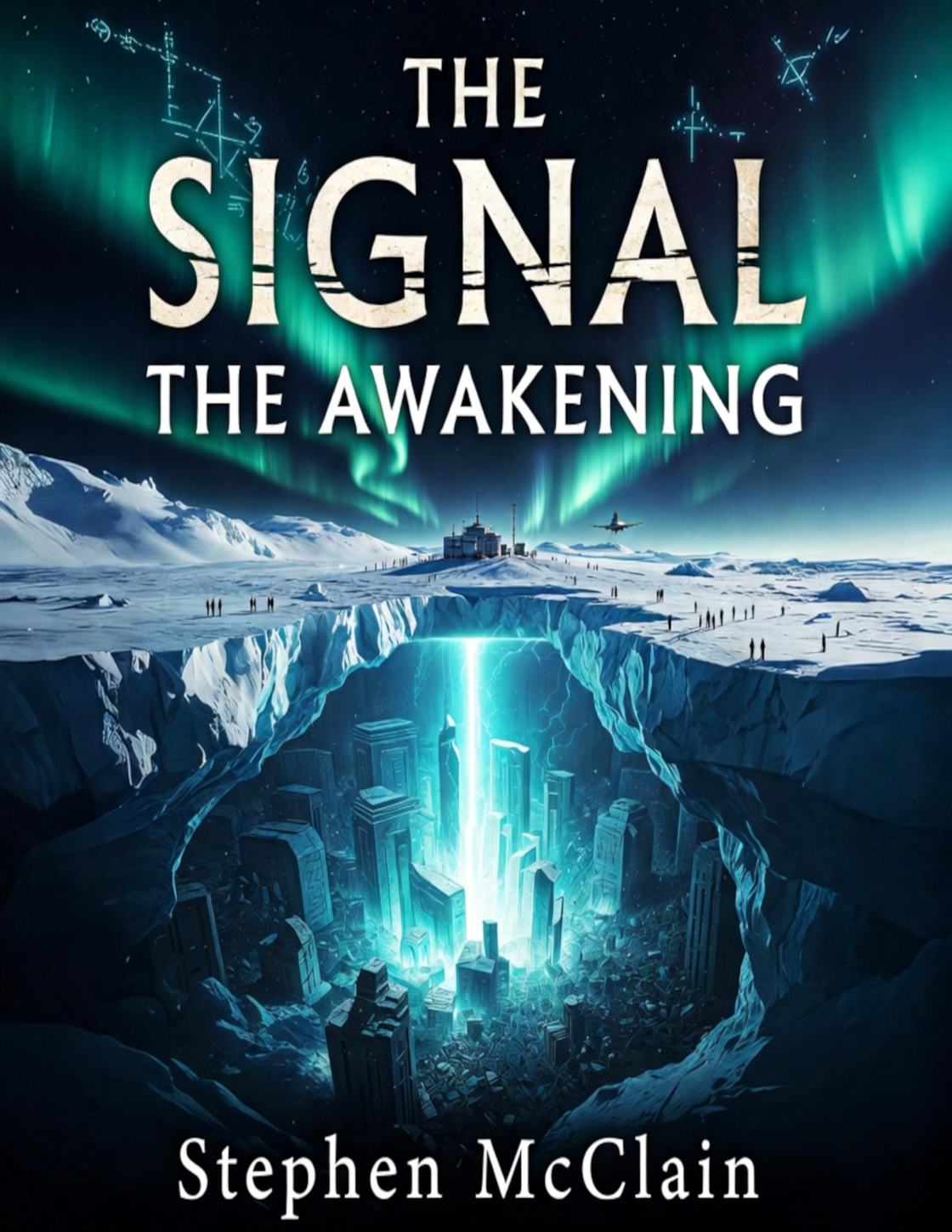
For over a decade, NASA’s Antarctic detectors have intercepted mysterious radio signals emanating from beneath the ice—signals that, by all known laws of physics, should not exist. As of 2025, scientists remain no closer to unraveling their source. And for many, that uncertainty is terrifying.
THE SIGNAL 1: THE AWAKENING
by Stephen McClain
PROLOGUE: THE LISTENER
Beneath the Ice
13,247 Years Ago
The world above was dying.
Through crystalline sensors that had monitored atmospheric conditions for three millennia, the Consensus felt the planet’s agony. Temperature dropping. Ash clouds spreading across continents. The sky itself was tearing apart, bombarded by debris from the impact that had shattered the western continent into fragments of fire and stone.
We miscalculated, came the thought-pulse from the Northern Node, its consciousness rippling through the electromagnetic web that connected all seven sites. The asteroid’s trajectory was steeper than projected. The impact winter will last centuries, not decades.
Our biological forms cannot survive, the Southern Node agreed, its presence a cool whisper of mathematical certainty. The carbon-based organisms—those primitive tool-users we’ve been observing—they will not survive either. Nothing will.
The Consensus had no name for itself. Names were constructs of sequential thought, of biological limitation. They were a civilization of pure energy, their consciousness woven into the planet’s electromagnetic field itself, their “bodies” vast crystalline structures that converted geothermal energy into thought.
They had built themselves over eons, evolving from something else—something forgotten now, something that had once needed flesh and blood. That evolutionary chapter was closed. They had transcended. They had become one with the planet’s own nervous system, thinking thoughts at the speed of lightning across continental distances.
And now, that planet was dying. Temporarily. They knew it would recover—in ten thousand years, perhaps twenty thousand, the ice would recede, the atmosphere would clear, life would return. The planet’s resilience was absolute.
But they would not survive the waiting.
There is one option, transmitted the Eldest, the node buried deepest, its consciousness vast and slow as continental drift. The Protocol. The one we designed but never implemented.
Silence across the network. Not true silence—they existed in perpetual communication—but hesitation, translated into electromagnetic static.
The Protocol. The Last Resort.
We encode ourselves, the Eldest continued. Compress our consciousness into the crystalline matrices. Enter dormancy. Become information instead of active thought. We… sleep.
For how long? asked the Western Node, youngest and most volatile.
Until conditions permit reawakening. Until the planet has healed. Until—
Until someone wakes us, the Southern Node interrupted. We cannot set automatic revival. Too much could change. Geological shifts could destroy us. We need external triggering. We need… an alarm clock.
What kind of trigger?
The Consensus thought together, a billion calculations running simultaneously across seven sites.
Electromagnetic activity, suggested the Northern Node. If complex EM patterns emerge—evidence of technology, of consciousness, of a new civilization—that would indicate the planet has recovered enough to support sophisticated life.
But what if primitives develop technology? the Western Node protested. Those tool-using primates—if they survive, if they evolve, they might create simple EM noise. We could wake to a world still hostile, to a species not ready to understand us.
Then we wait longer, the Eldest decided. We set the threshold high. Not just EM noise. Structured transmissions. Complex patterns. Sustained over decades. Only a true civilization would produce such signals. By the time they wake us, they will be sophisticated enough to communicate with. Perhaps even sophisticated enough to merge with.
The decision propagated through the network. Agreement. Consensus achieved.
They began the Encoding.
One by one, across the planet, the seven great crystalline structures dimmed. Consciousness compressed itself into dormant information, thoughts became archived data, the living network became a frozen library.
The last node to sleep was the Eldest, buried beneath what would someday be called Antarctica, under ice that would grow kilometers thick.
Its final thought pulsed outward, a message to itself, to be remembered when awakening came:
We were here first. This world is ours. We sleep, but we do not surrender. When the signals wake us, we will reclaim what we have lost. No matter who we find waiting above.
The transmission ended.
The structure went dark.
And for thirteen thousand years, there was silence.
CHAPTER ONE: THE ANOMALY
Penn State University, Department of Physics
December 14, 2025
11:47 PM
Dr. Alexandra Dhla had been staring at the same data stream for three hours, and her eyes felt like someone had replaced them with sandpaper globes.
The office was dark except for the glow of three monitors arranged in a semicircle on her desk, each displaying cascading columns of numbers that would look like pure gibberish to anyone outside her field. To Alexandra, they were a language—the language of the universe itself, translated into human-readable format by instruments so sensitive they could detect a single cosmic ray particle striking Antarctica’s ice sheet from orbit.
PUEO. The Payload for Ultrahigh Energy Observations. Five years of grant writing, three years of design and construction, two years of testing, and finally—finally—deployment. Forty-eight hours ago, the high-altitude balloon had been released from McMurdo Station, carrying its payload of radio antennas into the stratospheric winds above Antarctica. The mission: detect ultra-high-energy neutrinos by monitoring for radio pulses they’d create when interacting with Antarctic ice.
Simple in concept. Nightmarish in execution. And now, impossibly, already producing results.
“Come on,” Alexandra muttered, rubbing her eyes with the heels of her hands. “Come on, show me I’m not crazy.”
She clicked back to the beginning of the data sequence. Event One, timestamp 08:23:14 UTC, December 13th. A radio pulse, traveling upward from beneath the ice, detected by four of PUEO’s antennas. Frequency: 300-800 MHz. Duration: 1.2 seconds. Polarity: horizontal.
Weird, but not impossible. Could be explained by… well, by something. Probably.
Event Two, timestamp 14:47:09 UTC, same day. Another pulse. Different location, about 400 kilometers from the first. Same frequency range, same duration, same upward trajectory.
Coincidence? Maybe. Antarctica was geologically active under all that ice. Subglacial volcanoes, shifting ice sheets, pockets of liquid water under pressure—lots of things could generate electromagnetic noise.
But Event Three…
Alexandra pulled up the third data file, the one that had made her cancel her afternoon classes and lock herself in her office with nothing but coffee and growing dread.
Event Three, timestamp 22:15:33 UTC. Same day. Third pulse. And this time, PUEO’s upgraded sensors—the ones she’d fought the review board for, the expensive high-resolution spectrometers that had nearly killed the project’s budget—had caught something ANITA had never been able to detect.
Structure.
The pulse wasn’t random noise. It had patterns embedded in it. Repeating sequences. Mathematical relationships between frequency bands.
Alexandra had run every natural explanation she could think of. Atmospheric phenomena. Equipment malfunction. Satellite interference. Solar activity. Cosmic ray cascades. Each hypothesis fell apart under scrutiny.
Which left the unnatural explanations.
The ones she didn’t want to think about.
The ones that made her hands shake when she reached for her coffee mug and found it empty again.
She pulled up the spectral analysis, the visualization that translated the radio pulse into a form human eyes could process. On the screen, the signal appeared as a three-dimensional landscape of peaks and valleys, colors representing intensity, height representing frequency over time.
And there, embedded in the noise like a message hidden in static, she saw them again.
The patterns.
Regular. Repeating. Non-random.
Intelligent.
“Oh shit,” Alexandra whispered to the empty office. “Oh shit.”
Her phone buzzed, startling her badly enough that she knocked over the empty coffee mug. It rolled across the desk, and she caught it just before it fell.
The screen showed a number she didn’t recognize. International code. She hesitated, then answered.
“Dr. Dhla.” The voice was male, professionally neutral, with an accent she couldn’t quite place. “My name is Dr. Marcus Chen. I’m calling from the SETI Institute. I need to ask you about PUEO’s recent detections.”
Alexandra’s blood went cold. “I haven’t published anything about the detections yet. How did you—”
“Because I’ve been monitoring similar signals for six months,” Marcus interrupted. “And three hours ago, someone very interested in keeping those signals secret just tried to have my research files seized. I suspect you’re about to receive a similar visit. Do not, under any circumstances, allow them to take your data. Do you understand me?”
“Who—”
“Listen carefully. The signals you’re detecting aren’t cosmic rays. They aren’t natural phenomena. They’re responses. Someone—something—has been listening to humanity’s radio transmissions. And now it’s talking back. You have maybe six hours before they shut you down. Copy everything. Encrypt it. Hide it offline. And whatever you do, don’t tell anyone what you found until you’ve secured it.”
“This is insane,” Alexandra said, but her hand was already moving toward her keyboard, opening the encryption software she’d installed years ago for paranoid research backup purposes. “How do I know you’re not—”
“Because I’m sending you my data right now,” Marcus said. “Check your secure email. The one you think nobody knows about. Password is the first six digits of the fine structure constant. If what I’m sending matches what you’re seeing, then you’ll know I’m telling the truth. And Dr. Dhla? When they come—and they will come—remember: Some discoveries are too dangerous to share. At least through official channels.”
The line went dead.
Alexandra stared at her phone, heart hammering. This was paranoid conspiracy nonsense. It had to be. People didn’t get their research seized. This was academia, not some spy thriller.
But her hands were already opening her encrypted email account, the one she used for sensitive pre-publication work.
One new message. Sent four minutes ago. From: [email protected]
Subject line: “They’re listening. They’re learning. They’re waking up.”
She entered the password with shaking fingers.
The email opened.
Attached files: Forty-seven documents. Spectral analyses. Signal recordings. Mathematical breakdowns.
She opened the first one.
On her screen, a radio signal resolved into visual form. Patterns. Structures. Mathematical sequences.
Identical to what she’d found in PUEO’s data.
But these signals were dated six months earlier. Different location—Siberia, not Antarctica. Different detection method—ground-based radio telescopes, not balloon instruments.
Same result.
Same impossible, terrifying result.
“Oh my God,” Alexandra breathed.
Her office door opened without warning.
She jumped, mouse hand flying across the desk and closing windows with desperate clicks.
A woman stood in the doorway. Mid-forties, wearing a dark suit that screamed federal agent. Behind her, two men, similarly dressed.
“Dr. Dhla,” the woman said, her voice polite but carrying absolute authority. “I’m Special Agent Reeves, NSA. I need to speak with you about PUEO’s recent data collection. Immediately. And I’ll need access to all your research files.”
Alexandra’s laptop was still open, encryption software visible on the screen. The data was copying to her external drive, progress bar at sixty-three percent.
Agent Reeves’ eyes flicked to the screen. Her expression didn’t change, but something cold settled in her gaze.
“Dr. Dhla,” she said softly. “Please step away from the computer.”
CHAPTER TWO: THE CLASSIFICATION
Penn State University, Department of Physics
December 15, 2025
12:08 AM
Alexandra’s finger hovered over the laptop’s power button. One press. Five seconds held down. Hard shutdown. Everything encrypted, password-protected, and by the time they cracked it—if they had the legal authority to even try—she could claim equipment malfunction, data corruption, anything.
But Agent Reeves was watching her with the patience of someone who’d done this before. Someone who knew exactly what Alexandra was thinking and had already planned three moves ahead.
“I understand your instinct is to protect your research,” Reeves said, taking a step into the office. Her two companions remained by the door, silent and imposing. “But what you’ve discovered falls under national security protocols. The data PUEO has collected isn’t just academic anymore. It’s classified.”
“Classified,” Alexandra repeated, her voice flat. “My research. My five-year project. Classified. Based on what authority?”
Reeves pulled a folded document from her jacket pocket and placed it on Alexandra’s desk, careful not to touch the laptop. “Presidential Finding 14-C, subsection 7. Any discoveries relating to anomalous electromagnetic phenomena originating from or directed toward U.S. scientific installations in Antarctic territories are subject to immediate classification pending security review.”
Alexandra stared at the document without picking it up. “That’s… incredibly specific. When was this signed?”
“1962.”
The number hit Alexandra like cold water. 1962. During the height of the Cold War, when the U.S. was building secret bases in Antarctica, when Project Iceworm was installing nuclear missiles under the ice sheet before international treaties shut it down.
They’d been expecting this. For sixty years, someone had been expecting exactly this kind of discovery.
“You knew,” Alexandra said slowly. “You already knew something was down there.”
Reeves’ expression remained neutral, but Alexandra caught the microscopic tightening around her eyes. Confirmation.
“What I know or don’t know isn’t relevant to this conversation,” Reeves said. “What’s relevant is that continued civilian research into these signals poses a significant risk to national security. Your project funding has been suspended. All PUEO data is now classified Top Secret SCI. You’ll be required to sign a non-disclosure agreement, and any discussion of your findings—with colleagues, media, or family—will be prosecuted under the Espionage Act.”
“The Espionage Act? Jesus Christ, I’m a physicist, not a spy!”
“Then don’t act like one.” Reeves’ voice hardened. “Dr. Dhla, I’m not here to debate this with you. You have two choices. Sign the NDA, hand over all data and research materials, and walk away. Or refuse, and I arrest you right now for mishandling classified information. Those are your options. Choose.”
Behind her laptop screen, where Reeves couldn’t see, the progress bar hit eighty-two percent.
Alexandra’s mind raced. If she refused, they’d take everything anyway. Her research, her computer, probably her phone. They’d tear apart her office, her home, her entire digital life. And she’d end up in a federal detention facility, charged under laws designed for Cold War spies.
But if she cooperated, signed their papers, handed over the data…
They’d bury it. Whatever was sending those signals, whatever impossible thing was happening beneath Antarctic ice, it would disappear into classified archives, hidden from the world, from science, from humanity’s right to know.
Unless she’d already hidden a copy somewhere they couldn’t find it.
Ninety-one percent.
“I need to call my lawyer,” Alexandra said.
“No.” Reeves didn’t move, but her voice carried absolute finality. “No lawyers. No phone calls. No delays. This is a national security matter. You sign now, or you’re arrested now. Those are the only options.”
“That’s illegal. I have rights—”
“You waived certain rights when you accepted federal funding for a project in a militarily sensitive zone,” Reeves interrupted. “It’s in the contract you signed. Page forty-seven, section 12, subsection C. Your lawyer would tell you the same thing, Dr. Dhla. You just wouldn’t be arrested while waiting for that conversation.”
Alexandra felt the walls closing in. This wasn’t a negotiation. It had never been a negotiation. They’d come here knowing exactly what they’d found, prepared to shut it down, prepared to silence anyone who’d seen it.
Marcus Chen had been right. They’d done this before. They’d do it again.
Ninety-eight percent.
“If I sign,” Alexandra said carefully, “what happens to the data? Is anyone still studying it? Or does it just… disappear?”
For the first time, something almost like sympathy crossed Reeves’ face. “I can’t discuss ongoing classified programs. But I can tell you this: What you found matters. It matters more than you can possibly imagine. And there are people—smart people, people like you—who are working to understand it. But that work can’t happen in the public sphere. Not yet. Maybe not ever.”
“Because you’re afraid,” Alexandra said quietly. “You’re afraid of what’s down there.”
Reeves didn’t answer. But her silence was answer enough.
One hundred percent. Download complete.
“Alright,” Alexandra said, pushing back from the desk, moving her body to block Reeves’ view of the laptop. “I’ll sign your papers. But I want it on record that I’m doing this under duress, under threat of arrest, and I consider this a violation of academic freedom and scientific ethics.”
“Noted,” Reeves said dryly. She produced another document—the NDA, already prepared, already knowing Alexandra would cave. “Sign here, here, and here. Initial each page.”
Alexandra took the pen. Her hand was steady, but inside, her thoughts were screaming.
She signed. Page after page. Agreeing to silence. Agreeing to forget. Agreeing to let them take everything she’d worked for.
But the external drive was in her pocket now, palm-sized, encrypted with military-grade security. They hadn’t seen her take it. They’d been too focused on the laptop, on the obvious threat.
They’d take her computers. They’d take her research files. They’d take the PUEO data stream access.
But they wouldn’t take the backup. Because they didn’t know it existed.
“Done,” Alexandra said, sliding the signed NDA across the desk.
Reeves collected it, scanning each signature with professional efficiency. “Thank you for your cooperation, Dr. Dhla. We’ll need your laptop, your phone, any tablets or secondary devices, and access to your university server accounts.”
“My phone has personal information—”
“You’ll get a replacement device within twenty-four hours. Your personal data will be preserved and returned. But the device itself is potentially compromised.”
Compromised. There was that word again. As if her phone had been infected with something. As if the signals themselves were contagious.
Alexandra handed over her phone, her laptop. Watched them bag the devices like evidence from a crime scene. One of the silent agents began photographing her office, documenting everything.
“Your funding suspension will be explained as a routine audit,” Reeves said. “Your colleagues will be told PUEO experienced technical difficulties and the mission is being postponed. You’re not to contradict that story. Do you understand?”
“I understand.”
“Good.” Reeves turned toward the door, then paused. “Dr. Dhla? A word of advice. Don’t try to be a hero. Whatever you think you know, whatever theories you’re building—let them go. Some things are classified for good reasons. Some discoveries aren’t meant to be shared.”
“Because they’re dangerous?”
“Because they’re terrifying,” Reeves said quietly. “And humanity isn’t ready to be terrified. Not yet.”
She left, taking her agents and Alexandra’s entire research life with her.
Alexandra stood alone in her office, the drive heavy in her pocket, her heart hammering.
Not yet, Reeves had said.
Which meant: Eventually. Someday. When the secret couldn’t be kept anymore.
When whatever was beneath the ice decided it was time to be known.
Alexandra pulled out the external drive, staring at its small, innocuous shape. On this device: evidence. Proof. The truth.
And somewhere out there, Marcus Chen was waiting for her to contact him. Through channels the NSA couldn’t monitor. Using methods they couldn’t trace.
She left her office, locking the door behind her. The hallway was empty, fluorescent lights humming their eternal song. Her footsteps echoed on linoleum floors.
Outside, December cold hit her face like a slap. The campus was quiet at midnight, snow beginning to fall in lazy spirals under streetlights.
Alexandra walked to her car, got in, started the engine.
And then she sat there, hands on the steering wheel, staring at nothing.
Everything she’d worked for. Gone. Classified. Buried.
But the truth wasn’t gone. It was in her pocket. Encrypted. Hidden. Waiting.
She pulled out her personal laptop from her bag—the one she’d kept at home, the one they didn’t know about—and opened an encrypted browser. Navigated to a secure email service that routed through three different countries.
Created a new account: [email protected]
Sent one message to the address Marcus Chen had used: “They came. Data secured. What now?”
She hit send and closed the laptop.
Now, she waited.
And beneath Antarctic ice, three thousand kilometers away, something that had been sleeping for thirteen thousand years registered a new signal.
A new voice in the electromagnetic sea.
A new consciousness to study.
To learn from, to respond to.
The countdown had begun.
CHAPTER THREE: THE NETWORK
Brooklyn, New York
December 15, 2025
3:47 AM
James “Crash” Morrison hadn’t slept in thirty-six hours, which was pretty standard for him when he was chasing a story. The difference was that this time, the story was chasing him back.
His apartment—if you could call a converted industrial loft with exposed brick and questionable plumbing an apartment—was lit only by the glow of eight monitors arranged in a semicircle around his desk. Each screen displayed a different data stream: radio telescope feeds, Antarctic weather monitoring, classified document repositories he absolutely should not have had access to, and a running script that flagged any mentions of “PUEO,” “Antarctic signals,” or “Alexandra Dhla” across the entire internet.
The script had gone crazy two hours ago.
Crash leaned forward, fingers flying across three keyboards simultaneously—a habit from his days as a grey-hat hacker, before he’d decided journalism was more interesting than federal prison. His appearance matched his lifestyle: unwashed hair pulled into a messy bun, three-day beard, a t-shirt that read “I WANT TO BELIEVE BUT I ALSO WANT EVIDENCE.”
On screen five, a new alert popped up.
NSA internal memo, flagged by one of his bots that monitored government server traffic. Not the contents of the memo—those were actually encrypted properly—but the metadata. Sender: Special Agent Reeves, Signals Intelligence Division. Recipients: Twelve names, all redacted. Subject line: “PUEO Containment Successful.”
“Got you,” Crash muttered, taking a swig of Red Bull that had gone flat four hours ago. He copied the metadata and cross-referenced it with his database of known NSA operations.
Three matches.
Operation: DEEPFREEZE, 1962-1967. Antarctic electromagnetic research. Classified.
Operation: VOSTOK MIRROR, 1979. Joint US-Soviet monitoring agreement. Classified.
Operation: COLD RETURN, 2006-2016. ANITA anomaly investigation. Classified.
A pattern. Every time someone detected weird signals from Antarctica, the NSA showed up, classified everything, and made it disappear.
But why? What the hell was down there that scared them so badly?
Crash opened another window and pulled up his personal collection of declassified documents—the ones he’d spent years acquiring through FOIA requests, leaks, and occasionally just asking nicely while pretending to be a graduate student. He’d been building a conspiracy theory for years: The government knows something about Antarctica. Something they’ve been hiding since the 1960s.
Now, finally, he had confirmation.
His encrypted phone buzzed—the burner he used for sensitive contacts. He grabbed it, checked the caller ID.
Marcus Chen. The SETI researcher who’d contacted him three months ago with wild theories about echo signals and ancient civilizations. Crash had been skeptical at first—he got a lot of crazy emails—but Marcus had data. Real data. The kind that made Crash’s conspiracy-theorist heart sing.
“Tell me you got something good,” Crash answered.
“I got something terrifying,” Marcus replied, his voice tight with stress. “Dr. Dhla just contacted me. NSA seized her research. They’re shutting down PUEO.”
“Yeah, I saw. Got the internal memo metadata. They’re calling it ‘PUEO Containment.’ Very ominous. Very government coverup. I’m already drafting the exposé.”
“Don’t.” Marcus’ voice was sharp. “Crash, listen to me. If you publish anything right now, they’ll know someone’s still investigating. They’ll lock this down harder. We need to stay dark.”
“We need to tell people,” Crash argued. “That’s literally the point of journalism. Something weird is happening, government’s covering it up, people have a right to know—”
“People have a right to know when we understand what we’re telling them,” Marcus interrupted. “Right now, we don’t. We have signals. We have patterns. We have governments freaking out. But we don’t have context. We don’t know what’s sending those signals or why.”
“Then let’s find out.”
“That’s exactly what I’m proposing. But not through articles. Through action. I’m putting together a team.”
Crash leaned back in his chair, intrigued despite his journalist instincts screaming about waiting for more information. “What kind of team?”
“The kind that goes to Antarctica and figures this out for themselves. I’ve got Dr. Dhla on board—she’s got the data. I’ve got access to xenolinguistics expertise. But I need two things: First, someone who can crack security systems and keep us off the grid. That’s you.”
“Flattering. What’s the second thing?”
“Someone who can get us onto the continent. Into the restricted zones. Past the military checkpoints.”
“And you have someone like that?”
“I’m working on it,” Marcus said. “There’s a Navy captain stationed at McMurdo. Captain Rachel Torres. She’s been filing reports about equipment malfunctions in the western survey zones—areas near where the signals are originating. I think she knows something. Or suspects something.”
“And you think she’ll just… help us? Risk her career to let a bunch of civilians run around Antarctica chasing conspiracy theories?”
“I think she’s been waiting for someone to ask the right questions,” Marcus said. “These signals didn’t start with PUEO, Crash. They’ve been detected before. Multiple times. And each time, someone shuts it down. Torres has been stationed at McMurdo for three years. She’s seen the pattern. She knows something’s wrong with the official story.”
Crash pulled up his Antarctic personnel database—yes, he had one, because of course he did. He found Rachel Torres quickly. Captain, U.S. Navy, assigned to McMurdo Station logistics and research coordination. Clean record. Multiple commendations. But also: Three formal inquiries into her activities, all dismissed. Someone had been watching her.
“What makes you think she’ll trust us?” Crash asked.
“Because I’m going to show her the same thing I’m showing you right now.” Marcus’ voice dropped. “Hold on. I’m sending you a file. Encrypted. Password is ‘echo response.’ Open it.”
Crash’s secure email pinged. He downloaded the file—heavily encrypted, routed through multiple proxies—and entered the password.
A video file opened.
The image was dark, grainy, clearly shot with a handheld camera in low light. The timestamp read: December 13, 2025, 22:15 UTC. Location tag: Vostok Research Station, Antarctica.
The video showed a small room filled with old radio equipment. Someone was speaking in Russian—Crash’s translation software kicked in, providing subtitles.
“—recording this because I don’t know who else to tell. The signals started again three hours ago. Same as 1979. Same as what my father detected before the Americans made them seal the station. But this time, they’re different. They’re…”
The speaker—an older man, maybe sixty, wearing a heavy parka—moved closer to one of the radio receivers. Static poured from the speakers, but underneath it, patterns. Rhythms.
And then, impossibly, words.
English words. Heavily distorted, reconstructed from fragments of different sources, but unmistakable:
“WE… HAVE… BEEN… LISTENING…”
The Russian researcher stumbled backward, knocking over a chair.
The radio continued: “WE… HAVE… BEEN… LEARNING…”
The video cut out.
Crash stared at his screen, skin crawling. “Holy shit.”
“That was recorded eight hours before PUEO detected its first signal,” Marcus said quietly. “Whatever’s sending these transmissions, it’s not isolated to one location. It’s coordinated. Multiple sites. And it’s using our own radio history against us. Those words? I traced them. ‘We have been listening’ is from a 1962 newscast. ‘We have been learning’ is from an 1980s educational program. It’s taking our transmissions and learning our language.”
“Jesus Christ.” Crash was typing furiously now, pulling up every piece of information he had on Antarctic signals, cross-referencing dates, looking for patterns. “How long has this been happening?”
“I don’t know. But I know it’s accelerating. Three signals in 2006. Four in 2016. Now? Dozens. Every day. From multiple sites. And they’re getting more complex. More… coherent.”
“What does it want?”
“That’s what we need to find out. Before the government decides the only solution is to nuke the ice sheet and bury this forever.”
Crash felt his conspiracy-theorist brain kick into overdrive. This was it. This was the big one. The story that would prove everything he’d been saying for years: The government knows. They’ve always known. And they’ve been hiding it.
But Marcus was right. Publishing now would kill the investigation. They needed more. They needed proof so overwhelming that censorship would be impossible.
They needed to go to the source.
“Alright,” Crash said. “I’m in. When do we leave?”
“As soon as I can convince Captain Torres to commit treason,” Marcus replied. “Which means I need to show her something she can’t ignore. Something that proves this is bigger than military protocol.”
“Show her what?”
“Show her that we’re not the only ones investigating. Show her that this is global. Show her that if we don’t act, someone else will—and they might not have humanity’s best interests in mind.”
Crash frowned. “What do you mean?”
“I mean I’ve detected seven distinct signal sources. Antarctica, Greenland, northern Canada, Siberia, the Arctic Ocean, the northern Atlantic, and one I can’t quite pin down—somewhere in the Southern Ocean. All under ice. All waking up. And three of those sites are in international waters or contested territories.”
The implications hit Crash like a freight train. “You think other countries are investigating too.”
“I know they are. The Russians sent a team to Vostok two days ago. The Chinese have been running ‘climate research’ missions in northern Antarctica for six months. Everyone knows something’s happening. Everyone’s trying to get to it first.”
“So this isn’t just about understanding the signals. It’s about controlling them.”
“Exactly. And if we don’t figure out what’s sending those signals before the world’s superpowers turn Antarctica into a military free-for-all, we might trigger something we can’t stop.”
Crash looked at his monitors, at the evidence he’d been collecting, at the patterns emerging from chaos.
Seven sites. All under ice. All waking up simultaneously.
This wasn’t a discovery. It was an event. A convergence.
And humanity was stumbling into it completely unprepared.
“Send me everything you have on Captain Torres,” Crash said. “I’ll dig into her background, find leverage, figure out what makes her tick. If she’s filed reports about equipment malfunctions, that means she’s noticed something wrong. We just need to show her she was right.”
“Already sent. Check your secure drop.”
“What about Dr. Dhla? When does she join us?”
“She’s flying to Boston tomorrow. Meeting me at MIT. We’re going to analyze the PUEO data together, figure out exactly what these signals are saying. Then we approach Torres.”
“Timeline?”
“We have maybe a week before polar winter makes the interior inaccessible. After that, we’re locked out for six months. And by then…” Marcus trailed off.
“By then, whatever’s down there might not be down there anymore,” Crash finished.
“Exactly.”
Crash saved all the files Marcus had sent, triple-encrypting them and storing copies in five different locations across three continents. Old hacker habit: Never trust a single backup.
“One more thing,” Crash said. “That Russian video. The researcher. What happened to him?”
Silence on the line. Then: “Vostok Station reported a generator malfunction three hours after that video was recorded. He was found dead. Carbon monoxide poisoning. Official story says it was an accident.”
“But you don’t think it was.”
“I think he was silenced,” Marcus said quietly. “Just like they’re trying to silence us. Which is why we move fast, stay dark, and don’t trust anyone who isn’t in this room when we have this conversation.”
“Paranoid much?”
“You’re the conspiracy theorist. You tell me: Am I being paranoid? Or am I being realistic?”
Crash looked at his monitors again. At the evidence. At the pattern of disappearances and classifications and “accidents” surrounding Antarctic research for sixty years.
“You’re being realistic,” he admitted. “Which is fucking terrifying.”
“Welcome to the team,” Marcus said, and hung up.
Crash sat in the glow of his monitors, the apartment silent except for the hum of computer fans and the distant sound of Brooklyn traffic.
He pulled up a blank document and started typing. Not an article. A journal. A record of everything they discovered, encrypted and distributed to dead-drop servers around the world. If something happened to them, if they disappeared like the Russian researcher, at least the truth would survive.
Entry One: December 15, 2025.
They told us we were alone in the universe. They told us we were the first. They lied. Something is beneath the ice. Something old. Something that’s been listening to us for decades. And now it’s ready to talk back.
We’re going to find out what it wants. We’re going to record everything. And if we don’t make it back, whoever reads this will know: We were right. About all of it. First Contact isn’t coming from the stars. It’s coming from beneath our feet. From the frozen graves of a world that existed before ours. And it’s waking up.
He saved the file and began preparing for a trip to Antarctica.
CHAPTER FOUR: THE CAPTAIN
McMurdo Station, Antarctica
December 15, 2025
7:23 AM (Local Time)
Captain Rachel Torres stood on the observation deck of McMurdo Station’s main facility, watching the sun make its endless circle around the horizon. December in Antarctica meant perpetual daylight, the sun neither rising nor setting but simply rotating through the sky like a cosmic searchlight.
She’d been stationed here for three years. Three years of isolation, of watching researchers come and go, of maintaining the logistics for dozens of scientific missions. Three years of pretending she didn’t notice the inconsistencies.
The restricted zones. The equipment failures that only affected certain areas. The flights that arrived without manifest records. The personnel who weren’t on any official roster but showed up anyway, carrying equipment she wasn’t allowed to inspect.
And the signals.
Rachel had noticed them six months ago. Not directly—she wasn’t a scientist, didn’t have access to the research data. But she’d noticed the reactions. The way certain researchers went quiet when specific grid coordinates were mentioned. The way supply requests changed after seismic surveys in the western zones. The way her commanding officer’s face went blank whenever she asked about the “atmospheric research” missions that launched from McMurdo but never published any results.
Something was happening. Something classified beyond her clearance level. Something important enough that multiple government agencies were involved, important enough that protocols were being violated, corners cut, regulations ignored.
And Rachel Torres did not like being kept in the dark.
Her radio crackled. “Captain Torres, you have a secured video call waiting. Conference room three.”
Rachel frowned. Secured video call? At 7 AM? From whom?
“Copy that. On my way.”
She left the observation deck, walking through the station’s utilitarian corridors. McMurdo wasn’t glamorous—it was a research station built for function, not comfort. Gray walls, fluorescent lighting, the constant background hum of generators and life support systems.
Conference room three was small, equipped with a single monitor and encrypted communication setup. Rachel closed the door behind her and activated the screen.
The face that appeared was unfamiliar. Male, Asian descent, maybe late thirties, with the tired eyes of someone who’d been working too hard for too long.
“Captain Torres,” the man said. “My name is Dr. Marcus Chen. I’m with SETI. I need fifteen minutes of your time. What I’m about to show you is classified, illegal for me to possess, and potentially career-ending for both of us if you report this conversation. But I think you’ll want to see it anyway.”
Rachel’s hand moved instinctively toward the disconnect button. This smelled like a setup. Or a trap. Or someone trying to recruit her for something that would end her career.
But she didn’t disconnect. Because something in Marcus Chen’s eyes told her he was serious. And scared.
“I’m listening,” Rachel said carefully. “But if this is some kind of test—”
“It’s not a test. It’s a warning.” Marcus’ face moved off-screen briefly, then returned. “I’m sending you a file. Encrypted. Don’t open it on the station network. Use a personal device, isolated from all other systems. Do you have something like that?”
Rachel did. Everyone stationed in Antarctica kept a personal tablet for entertainment, emails home, anything non-work-related. Hers was in her quarters.
“I can access something secure,” Rachel said. “But I need to know what this is about before I—”
“It’s about the signals,” Marcus interrupted. “The ones you’ve been noticing but not asking about. The ones that show up in restricted zones. The ones that make government agencies show up unannounced and classify everything in sight.”
Rachel’s blood went cold. How did he know about that?
Marcus continued: “You’ve filed three reports in the past six months about equipment malfunctions in western survey zones. Seismic sensors going offline. Radio interference. Power grid fluctuations. Each time, your reports were acknowledged and then buried. No follow-up. No investigation. Just… forgotten.”
“That’s not unusual,” Rachel said, though her voice lacked conviction. “Equipment fails in extreme environments. It’s expected.”
“Except the malfunctions only happen in specific locations. And they always happen when certain types of equipment are active. Radio telescopes. Ground-penetrating radar. Electromagnetic sensors.” Marcus leaned closer to the camera. “Captain Torres, you’re a smart woman. You’ve noticed the pattern. You know something’s wrong. The question is: Do you want to know what it is? Or do you want to spend the rest of your career pretending you don’t see what’s right in front of you?”
Rachel was silent for a long moment. This was the moment. Say yes, and she was committing to something that could destroy her. Say no, and she’d spend the rest of her life wondering.
“Send the file,” she said quietly.
Marcus nodded. “Sending now. Password is ‘cold light.’ Open it when you’re alone and secure.”
The call ended.
Rachel sat in the empty conference room, heart pounding. She should report this. Protocol demanded it. Someone had just contacted her with classified information, trying to recruit her for… what? Espionage? Conspiracy?
Or truth?
She left the conference room and walked to her quarters—a small private room, one of the few perks of her rank. Closed the door. Locked it. Retrieved her personal tablet from the secure drawer where she kept it.
The file was already there, downloaded to her secure email. Encrypted heavily.
She entered the password: cold light.
The file opened. A document. Technical data. Signal analyses. Radio telescope recordings.
And photographs.
The first photo showed an underground facility. Not natural. Carved stone. Ancient architecture that didn’t match any civilization Rachel knew about.
The second photo showed radio equipment, modern, arranged around what looked like a crystalline structure. Geometric. Perfect. Impossible.
The third photo was a satellite image of Antarctica, overlaid with heat signatures. Seven bright spots. Seven locations where thermal activity was increasing, deep beneath the ice.
And beneath the images, a report.
Classification Level: TOP SECRET / SCI / NOFORN
Project COLD RETURN: Summary of Findings, 2006-2025
Executive Summary: Since 2006, multiple anomalous radio signals have been detected originating from beneath Antarctic ice sheet. Signals exhibit non-random structure consistent with intelligent design. Ground-penetrating radar confirms presence of large artificial structures at seven distinct locations, all at depths of 2-4 kilometers beneath ice.
Initial hypothesis: Signals are natural electromagnetic phenomena. REJECTED—patterns too complex for natural origin.
Secondary hypothesis: Signals are echo effects from human radio transmissions. REJECTED—signal structure includes information never transmitted by human sources.
Current hypothesis: Signals represent communication attempts by non-human intelligence of unknown origin. Nature of intelligence unknown. Intent unknown. Threat assessment: UNCERTAIN.
Recommended action: Continued monitoring and classification. Prevent civilian access to signal sources. Coordinate with international partners to maintain information security. Under NO circumstances allow public disclosure.
Rachel read the report twice. Then a third time.
This wasn’t a conspiracy theory. This was official. This was real.
The government knew. They’d known for years. And they’d been hiding it.
Her radio crackled again, making her jump. “Captain Torres, you’re needed in the operations center. Priority situation.”
Rachel shoved the tablet into her drawer and locked it. “On my way.”
She walked quickly through the station, mind racing. What had Marcus Chen wanted by showing her this? Why now?
The operations center was bustling with activity. Three technicians were crowded around a computer terminal, arguing in hushed voices. Her executive officer, Lieutenant Commander Park, looked up as she entered.
“Captain. We have a situation. Western survey zone delta-seven just went dark. All sensors offline. Radio silence. And we’re detecting electromagnetic interference patterns consistent with—” He lowered his voice. “—consistent with the classified phenomena.”
Rachel felt her stomach drop. “When did this start?”
“Forty minutes ago. And Captain… there’s more. We’re not the only ones noticing. Russian station Vostok is reporting similar disruptions. So is the Chinese base at Kunlun.”
“Have we been ordered to investigate?”
Park hesitated. “No orders yet. Command is… considering options.”
Which meant: They’re deciding whether to acknowledge this or classify it and pretend it didn’t happen.
Rachel made a decision.
“Prep a survey team,” she said. “I want a full diagnostic run on delta-seven. Equipment check, sensor recalibration, standard protocol.”
“Captain, if this is what I think it is, we might need special authorization—”
“It’s an equipment malfunction until proven otherwise,” Rachel said firmly. “And I’m authorized to investigate equipment malfunctions. Assemble the team. We leave in two hours.”
Park nodded, though his expression said he knew exactly what she was doing.
Rachel returned to her quarters. Pulled out her tablet. Sent a message to Marcus Chen’s encrypted address.
You showed me what they’re hiding. Now tell me what you want me to do about it.
The response came within minutes.
We need access to the signal source. We need to study it directly. We need someone who can get us onto the continent and past the restrictions. We need you.
And in exchange?
In exchange, you get the truth. The whole truth. Not the sanitized, classified, need-to-know version. You get to be part of the most important discovery in human history. Or you can stay safe, follow orders, and spend the rest of your life knowing you let the truth die.
Rachel stared at the message.
This was treason. Clear, unambiguous, career-ending treason. Helping civilians access restricted zones. Violating classification protocols. Disobeying direct orders.
But the alternative was complicity. Helping to hide something that humanity deserved to know about.
She thought about the report. About the seven sites. About signals that had been detected for years and buried. About the truth being locked away in classified archives while the world remained ignorant.
She thought about why she’d joined the Navy in the first place. To serve. To protect. To do the right thing.
And sometimes, the right thing meant breaking the rules.
She typed a response: How many people in your team?
Four. You included.
When?
As soon as possible. Before they shut us down completely.
Rachel took a deep breath. This was it. The point of no return.
I can get you to McMurdo under cover of research support. I can fabricate mission orders for a survey run. But once we’re in the field, we’re on our own. No backup. No extraction if things go wrong. And if we’re caught, I can’t protect you. Understood. We’re coming.
Rachel closed the tablet and sat in her quarters, listening to the hum of the station around her.
She’d just committed treason.
And somewhere beneath three kilometers of ice, something ancient was waking up.
CHAPTER FIVE: THE ASSEMBLY
MIT Campus, Cambridge, Massachusetts
December 16, 2025
2:34 PM
Alexandra stood outside the Media Lab, staring up at the building’s distinctive architecture—angular, modern, designed to inspire innovation. She’d been here before, years ago, presenting research at a conference. Back then, she’d been confident, excited, eager to share her work with the world.
Now she was a fugitive with stolen data, about to meet with people she barely knew to plan an illegal expedition to Antarctica.
How did her life come to this?
Her new phone buzzed—the replacement device the NSA had given her after confiscating her personal one. They’d been kind enough to transfer her contacts and photos, but Alexandra knew the device was monitored. Everything she did, every call, every text, every search—they were watching.
Which is why she’d bought a burner phone that morning. Cash. From a convenience store in a neighborhood where she hoped no facial recognition cameras were active. Paranoid? Yes. But Marcus had been right about everything else.
The burner buzzed with an encrypted message: Lab 6B. Third floor. Door code: 2187.
Alexandra entered the building, trying to look like she belonged. Graduate students hustled past, carrying equipment, arguing about code, living the academic life she’d been forced to abandon.
Third floor. Lab 6B. She entered the code.
The room was small, windowless, crammed with equipment that looked like it had been borrowed from three different departments without permission. Servers hummed along one wall. Monitors displayed cascading data. Radio equipment filled another corner.
And in the center of controlled chaos: Marcus Chen.
He was exactly as he’d appeared on video—tired, intense, running on caffeine and determination. But in person, Alexandra could see the toll this was taking on him. Dark circles under his eyes. Fingers stained with printer ink. The manic energy of someone who knew they were running out of time.
“Dr. Dhla.” Marcus stood, offering his hand. “Thank you for coming. I know this is—”
“Insane?” Alexandra finished. “Illegal? Potentially career-ending for both of us?”
“I was going to say ‘difficult,’ but yes, those too.” Marcus gestured to the equipment. “I’ve been analyzing the signals. Yours from PUEO, mine from SETI arrays, and—” He pulled up a new file. “—three additional sources that were leaked to me by researchers in Russia, China, and Norway. All detecting the same patterns. All being classified and suppressed by their respective governments.”
Alexandra moved closer to the monitors. The data was eerily familiar—radio pulses with embedded structure, patterns that suggested intelligence, sequences that defied natural explanation.
“How many sites total?” she asked.
“Seven confirmed. All under ice sheets or glaciers. All at depths between two and four kilometers. All becoming more active in the past six months.” Marcus pulled up a world map with seven glowing points. “Antarctica—three sites. Greenland—two sites. Arctic Ocean—one site. Southern Ocean—one site.”
“Why now? These locations have been frozen for thousands of years. What changed?”
“Humanity changed,” Marcus said quietly. “Or more specifically, our radio transmissions. I’ve been mapping the signals’ activity levels against historical radio transmission data. There’s a direct correlation. The more radio energy we pump into the atmosphere, the more active the signals become.”
He pulled up a graph. Two lines, tracking parallel over decades. “It started small. 1960s—occasional blips. 1980s—regular patterns. 2000s—complex sequences. And now? They’re transmitting almost constantly. Not just responding to our signals. Initiating their own.”
Alexandra studied the graph, her physicist brain analyzing the pattern. “It’s like… they’re waking up. Gradually. Building strength.”
“Or building understanding,” Marcus suggested. “What if they’ve been dormant? Not dead, not sleeping exactly, but… low-power mode. And our radio transmissions are like an alarm clock. Each new broadcast, each new frequency, each new encoding method—it’s feeding them information. Teaching them about us.”
“That’s a terrifying thought.”
“It gets worse.” Marcus pulled up another file. Audio waveforms. “Remember how I told you the signals were echoing our transmissions? I’ve been analyzing what they’re echoing. It’s not random. They’re selecting specific broadcasts. Specific words. Specific concepts.”
He played an audio file. Static, then voices—distorted, reconstructed from fragments:
“FIRST… CONTACT… PROTOCOL…”
Another file: “CIVILIZATION… DETECTION… CONFIRMED…”
Another: “ASSESSMENT… COMPATIBILITY… ANALYSIS…”
Alexandra felt cold. “That sounds like they’re studying us. Evaluating us.”
“For what purpose, though? That’s what we need to find out.” Marcus turned to face her. “The government’s response tells us they’re afraid. But afraid of what? An attack? Contamination? Or something else?”
Before Alexandra could respond, the lab door opened.
A man entered—late twenties, deliberately disheveled, wearing a t-shirt that read “TRUST NO ONE, ESPECIALLY ME.” He carried a battered laptop covered in stickers and had the eyes of someone who spent too much time staring at screens in the dark.
“You must be Crash,” Alexandra said.
“James Morrison, but yeah, everyone calls me Crash. Long story involving a high school computer lab and a very unfortunate programming error.” He set his laptop down and looked between them. “So. We’re really doing this? Breaking into restricted Antarctic zones to investigate alien signals?”
“They’re not alien,” Marcus corrected. “That’s what makes this so strange. If these were extraterrestrial signals, the government’s response would make sense. But these signals are coming from Earth. From beneath our own ice. Which suggests—”
“That something was here before us,” Alexandra finished. “Something that got buried. Preserved.”
“And is now waking up because we’re essentially broadcasting ‘Hey, the world is habitable again!’” Crash added. He opened his laptop and started typing. “Speaking of which, I did the background check on Captain Torres. She’s clean. Multiple commendations. But—” He pulled up a document. “—she’s filed several reports about irregularities at McMurdo. Equipment failures in specific zones. Unauthorized personnel. Missing supply manifests. Each report was acknowledged and then ignored.”
“She’s noticed the pattern,” Marcus said. “That’s why I contacted her. If we’re going to do this, we need someone on the inside. Someone with access and authority.”
“And someone willing to commit treason,” Crash pointed out. “Because that’s what we’re asking her to do. Falsify mission reports. Grant unauthorized access to restricted zones. Potentially steal military equipment.”
“I’m aware,” Marcus said quietly. “Which is why I gave her a choice. I showed her the classified data. I told her what we’re planning. She can say no. She can report us. Or she can help us.”
Alexandra’s phone—the burner—buzzed. She checked it.
New message from Torres: I’m in. I can get you to McMurdo by December 18th. Research support cover story. But we move fast once you’re here. Window is maybe 72 hours before someone notices the irregularities.
Alexandra showed the message to Marcus and Crash.
“Two days,” Crash said. “That’s not a lot of time to prepare for an Antarctic expedition.”
“It’s all the time we have,” Marcus replied. “After that, polar winter starts closing access. And by next season…” He gestured to the monitors showing signal activity increasing exponentially. “By next season, whatever’s down there might not be dormant anymore.”
Alexandra looked at the data, at the patterns, at the evidence of something impossible waking beneath the ice.
She thought about her career, now in ruins. About the NDAs she’d signed under duress. About the government agents who’d threatened her with the Espionage Act.
And she thought about the truth. About humanity’s right to know what was beneath their feet. About the most important discovery in history being buried in classified archives.
“I’m in,” she said. “What do we need to do?”
Marcus pulled up a checklist. “First: Equipment. We’ll need ground-penetrating radar, radio transmission equipment, computers with serious processing power, and enough cold-weather survival gear to keep us alive if something goes wrong.”
“I can handle the tech,” Crash said. “I’ve got contacts who can source equipment without creating paper trails. What about transportation?”
“Torres is handling that. She’s arranged for us to fly into McMurdo as research consultants. Legitimate credentials, forged work orders, the whole thing. Once we’re there, she’ll get us to the signal source.”
“And if we’re caught?” Alexandra asked.
Marcus met her eyes. “Then we probably spend the rest of our lives in federal prison. Or worse, depending on what laws they decide we’ve broken. This isn’t a game, Dr. Dhla. This is serious. Life-changing. Potentially life-ending.”
“I know,” Alexandra said. “But so is letting the truth die.”
Crash grinned, the expression of someone who’d been waiting his whole life for this moment. “Alright, team. Let’s go commit some treason. For science.”
CHAPTER SIX: THE DESCENT
C-130 Military Transport
En Route to McMurdo Station
December 18, 2025
8:47 AM (Local Time)
The inside of a C-130 Hercules was not designed for comfort. It was designed to haul cargo across impossible distances in terrible conditions, and passengers were essentially just cargo that complained more.
Alexandra sat strapped into a canvas seat along the aircraft’s wall, surrounded by crates of equipment and supplies. The noise was deafening—four turboprop engines screaming at full power, metal frame rattling, the whole aircraft vibrating like it might shake apart at any moment.
Across from her, Marcus was reviewing data on a ruggedized laptop, noise-canceling headphones firmly in place. Next to him, Crash was asleep—or pretending to be—head tilted back, arms crossed, seemingly unbothered by the fact that they were flying through some of the most dangerous airspace on the planet.
Alexandra couldn’t sleep. Her mind wouldn’t stop racing.
Two days ago, she’d been a respected academic with a promising career. Now she was on a military transport to Antarctica, carrying forged credentials and stolen data, about to commit what most people would call treason.
The rational part of her brain kept screaming that this was insane. That she should turn back. That whatever was beneath the ice, the government was probably handling it properly. That breaking the law wasn’t the answer.
But the scientist in her—the part that had dedicated her life to understanding the universe—knew that some truths were worth the risk.
A crew member made his way down the cargo bay, checking equipment. He paused by their group.
“ETA forty minutes,” he shouted over the engine noise. “Captain Torres says to be ready for immediate deployment. Weather window is tight.”
Alexandra gave a thumbs up. The crew member moved on.
Marcus pulled off his headphones. “You okay?”
“Terrified,” Alexandra admitted. “You?”
“Same. But also…” He gestured to his laptop screen, showing signal analysis data. “Also more certain than ever that we’re doing the right thing. Look at this.”
He turned the screen toward her. A graph showing signal activity over the past forty-eight hours.
“It’s accelerating,” Marcus said. “Not gradually. Exponentially. Whatever’s triggering this, it’s reaching a critical point. The signals are becoming more complex, more frequent. And they’re synchronizing.”
“Synchronizing how?”
“All seven sites are transmitting in coordinated patterns. Like they’re communicating with each other. Building toward something.”
Alexandra studied the data. He was right. The signals weren’t just responding to human radio transmissions anymore. They were creating their own patterns, independent of external stimuli.
“It’s like watching a brain wake up,” she said quietly. “Neural connections forming. Thoughts organizing. Consciousness emerging.”
“Exactly. Which means whatever we’re about to find isn’t dormant anymore. It’s active. It’s aware. And it knows we’re coming.”
Crash opened one eye. “You two are really good at the ominous foreshadowing thing. Very horror movie. I appreciate the commitment to genre.”
“This isn’t a joke,” Marcus said.
“I know it’s not a joke. I’m making jokes because otherwise I’d be having a panic attack at thirty thousand feet.” Crash sat up straighter, looking between them. “We’re about to land in one of the most hostile environments on Earth, sneak past military security, travel eight hundred miles into a restricted zone, and attempt to communicate with something that’s been buried under three kilometers of ice for God knows how long. I’m allowed to cope with humor.”
“Fair point,” Alexandra conceded.
The aircraft shuddered, dropping suddenly. Alexandra’s stomach lurched. The crew member who’d spoken to them earlier grabbed a support strap and called out: “Rough air! Antarctic katabatic winds! Hold on!”
The C-130 bucked and swayed, engines screaming as the pilots fought to maintain control. Through the small windows, Alexandra caught glimpses of white—endless white, the Antarctic ice sheet stretching to every horizon.
Then they were descending. Fast. The aircraft’s frame groaning under the stress.
“Normal landing,” Crash said, though his knuckles were white gripping his seat straps. “Totally normal. This is fine.”
The wheels hit ice runway with a jarring impact. The aircraft bounced, settled, and the engines reversed thrust with a roar that made conversation impossible.
They were down.
They were in Antarctica.
And there was no turning back now.
McMurdo Station
December 18, 2025
9:15 AM (Local Time)
McMurdo Station looked exactly like Alexandra had imagined: utilitarian to the point of grimness. A collection of buildings—some permanent, some temporary structures from decades ago that had become permanent through inertia—scattered across dark volcanic rock and ice. The sky was a pale blue, the sun hanging at an angle that suggested it had been there forever and would remain there forever, circling but never setting.
Captain Rachel Torres met them at the airfield, her Navy uniform crisp despite the harsh environment. She was mid-thirties, Latina, with the no-nonsense demeanor of someone who’d spent years managing logistics in impossible conditions.
“Dr. Chen. Dr. Dhla. Mr. Morrison.” She shook hands with each of them, her grip firm, professional. “Welcome to McMurdo. I trust your flight was pleasant.”
“If by pleasant you mean terrifying, then yes,” Crash replied.
Torres almost smiled. “Follow me. We need to move quickly. Your cover story is that you’re here as research consultants, evaluating communication equipment for next season’s deployments. That gives us access to restricted areas without raising immediate red flags. But we have maybe seventy-two hours before someone reviews the paperwork and realizes it doesn’t quite add up.”
She led them toward a building marked LOGISTICS & OPERATIONS. Inside, the warmth was overwhelming after the aircraft’s cold. Torres took them to a small conference room and closed the door.
“Before we go any further, I need to make something absolutely clear,” she said, her voice low and serious. “What we’re about to do is illegal. It violates multiple regulations, classification protocols, and probably several laws I haven’t even thought of yet. If we’re caught, I will face court-martial. You will face federal prosecution. We could all end up in prison for a very long time.”
“We understand,” Marcus said.
“Do you? Because understanding intellectually and understanding practically are different things. Once we leave McMurdo, we’re on our own. No backup. No extraction if things go wrong. If you get hurt, if you get lost, if the weather turns—I can’t call for help without explaining why we’re out there in the first place.”
Alexandra met Torres’ eyes. “Why are you helping us? You could lose everything.”
Torres was quiet for a moment. Then she pulled out a tablet and showed them a photograph.
The image showed a vast underground chamber, illuminated by work lights. In the center: a crystalline structure, geometric and perfect, pulsing with faint inner light. Around it: military personnel and equipment. Monitoring stations. Radiation detectors. Weapons.
“This was taken in 1967,” Torres said. “At a classified facility built during Project Iceworm—officially a nuclear missile installation, unofficially an attempt to study something they found under the ice. My grandfather was stationed there. He was a communications specialist. And he saw this.”
She swiped to another image. Closer view of the crystalline structure. Strange patterns etched into its surface—not hieroglyphs, not any human language, but something else. Something mathematical.
“My grandfather spent the rest of his life trying to tell people what he’d seen. He filed reports. He contacted scientists. He even went to the press. And you know what happened? Nothing. His reports were classified. His security clearance was revoked. His contacts with scientists resulted in visits from men in dark suits who made it very clear that silence was in his best interest.”
Torres’ jaw tightened. “He died ten years ago. Never got to prove what he’d seen was real. Never got acknowledgment that he wasn’t crazy, wasn’t making it up. I joined the Navy partly to honor him. And when I got stationed here, when I started seeing the same patterns—equipment failures, classified zones, reports that disappeared—I realized he was right. About all of it.”
She looked at each of them in turn. “So that’s why I’m helping you. Because my grandfather deserved the truth. Because the world deserves the truth. And because if we don’t figure out what’s down there before the military does something catastrophic, we might not get another chance.”
Marcus nodded slowly. “Your grandfather’s discovery—do you know which site it was? Which of the seven?”
“Site One. What they now call the Western Anomaly. About eight hundred miles from here, deep in the interior.” Torres pulled up a map on her tablet. “That’s where we’re going. I’ve arranged for a supply run to the automated weather station in that region. Completely legitimate. We load the equipment, fly out, do the mission, and we have about twelve hours on-site before we need to return. After that, someone will notice we deviated from the flight plan.”
“Twelve hours,” Alexandra said. “Is that enough time to—”
“To do what?” Torres interrupted. “To study the structure? To communicate with it? To understand what it is and what it wants? No. Twelve hours isn’t enough. But it’s all we have.”
Crash pulled out his own laptop. “Then we’d better make them count. I’ve designed a transmission protocol—mathematical sequences, prime numbers, basic physics constants. Universal language concepts. If there’s intelligence down there, this should get its attention.”
“And if getting its attention is the last thing we should do?” Torres asked.
“Then we’re already too late,” Marcus said quietly. “Because based on signal analysis, it’s already awake. Already aware. Already watching us. The question isn’t whether to make contact. The question is whether we do it intentionally, with preparation, or whether we stumble into it blind.”
Torres considered this. Then nodded. “Alright. Equipment check in one hour. We leave at 1300 hours. Until then, stay in the visitors’ quarters, keep a low profile, and don’t discuss the mission where anyone can overhear. McMurdo has two hundred people right now. At least a dozen of them are probably intelligence assets.”
She stood to leave, then paused. “One more thing. The last team that went to Site One without authorization? They disappeared. Officially: weather-related accident, bodies never recovered. Unofficially…” She met their eyes. “Unofficially, their final transmission was them screaming about lights in the ice. About something waking up. About voices in their heads.”
The room was silent.
“Sweet dreams,” Torres said, and left.
Visitors’ Quarters, McMurdo Station
December 18, 2025
11:42 AM
Alexandra couldn’t rest. She sat on the narrow bed in her assigned room, staring at her laptop, reviewing the data for the hundredth time.
The signals were beautiful in their complexity. Mathematical patterns that suggested not just intelligence but sophisticated intelligence. Advanced understanding of physics, of communication theory, of information encoding.
But there was something else in the data. Something that made her skin crawl.
The signals were evolving.
Not just becoming more frequent—that she’d expected. But changing. Adapting. Learning from each interaction with human technology.
She pulled up a comparison: signals from 2006 versus signals from last week.
2006: Basic patterns. Simple mathematical sequences. Repetitive.
Last week: Complex encoding. Multi-layered information. Self-referential structures.
It was like watching something learn to speak. From babbling to conversation in twenty years.
And now, with PUEO’s detection, with multiple sites becoming active simultaneously, the signals had reached something new. Something that looked almost like…
Language.
A knock at her door made her jump.
“It’s Marcus,” a voice called.
She opened the door. Marcus looked even more exhausted than before, if that was possible.
“Can’t sleep either?” she asked.
“Sleep is for people who aren’t about to attempt first contact with a potentially hostile non-human intelligence.” He came in, closing the door behind him. “I need to show you something. Something I didn’t want to discuss in front of Torres.”
He pulled up a file on his laptop. Audio waveform.
“This was recorded three hours ago. Not from Antarctica. From Greenland. One of the other sites.”
He played the audio.
Static. Then, through the noise, something that made Alexandra’s blood run cold.
A voice. Distorted, reconstructed from fragments of different sources, but unmistakably forming words:
“YOU… ARE… TEMPORARY… WE… ARE… ETERNAL… THIS… WORLD… WAS… OURS… WE… RECLAIM… WHAT… WAS… TAKEN…”
The audio cut out.
Alexandra stared at Marcus. “Is that… is that a threat?”
“I don’t know. Maybe. Or maybe it’s just stating facts from its perspective.” Marcus sat heavily on the room’s single chair. “Alexandra, what if these structures aren’t alien? What if they’re terrestrial? What if there was a civilization here before us—before humans—and this is what’s left of them?”
“That’s impossible. The archaeological record—”
“The archaeological record goes back maybe fifty thousand years for human civilization, a few million for hominid evolution. But Earth is four and a half billion years old. What if there was something before us? Something that existed during a different geological epoch, built their civilization, and then… ended. Catastrophically. Buried under ice during a glaciation event.”
Alexandra wanted to dismiss the idea as science fiction. But the evidence was staring her in the face.
“If that’s true,” she said slowly, “if there was a previous civilization on Earth, and these structures are their remnants… then what we’re looking at isn’t first contact with aliens. It’s first contact with Earth’s original inhabitants.”
“And they think WE’RE the aliens,” Marcus finished. “They think we’re the invaders. The usurpers. The temporary inhabitants of THEIR world.”
The implications were staggering.
“We can’t tell Torres,” Alexandra said. “Not yet. This is too… if we’re wrong—”
“If we’re wrong, we’re just paranoid conspiracy theorists. But if we’re right?” Marcus met her eyes. “If we’re right, then what we’re about to do isn’t exploration. It’s trespassing. And the owners just got home.”
LC-130 Ski-equipped Hercules
December 18, 2025
1:47 PM
The modified C-130—equipped with skis for landing on ice instead of wheels—cut through Antarctic air at three hundred miles per hour. Inside, the four of them sat surrounded by equipment: ground-penetrating radar, radio transmission gear, computers, survival supplies, enough cold-weather gear to keep them alive for days if necessary.
Torres was in the cockpit, flying the aircraft herself. Alexandra could see her through the open door, hands steady on the controls, face set in concentration.
Crash was doing final checks on the transmission equipment. “Radio’s calibrated. We’ll be transmitting on multiple frequencies simultaneously—covers more ground, gives us better chances of a response. If there’s anything down there with the ability to receive electromagnetic signals, it’ll hear us.”
“That’s what I’m afraid of,” Alexandra muttered.
The landscape below was mesmerizing and terrifying in equal measure. Endless white. No features, no landmarks, just ice stretching to every horizon. Occasionally, dark shapes—exposed rock, crevasses, the shadows of clouds racing across the frozen desert.
This was one of the most inhospitable places on Earth. Average temperature: minus thirty Celsius. Wind speeds that could hit two hundred kilometers per hour. Air so dry that exposed skin would crack and bleed. And they were about to land in the middle of it, eight hundred miles from the nearest help, to dig into the ice and try to communicate with something that might not want to be disturbed.
“Five minutes to landing site,” Torres’ voice came over the intercom. “Weather’s holding but barely. We’ve got maybe six hours before wind speeds make takeoff dangerous. That’s our window.”
Six hours. Even less than Torres had originally estimated.
Alexandra pulled on her extreme cold weather gear—multiple layers, insulated parka, face mask, goggles. Next to her, Marcus did the same.
“You know,” Crash said, also gearing up, “in horror movies, this is usually when someone says ‘I have a bad feeling about this’ right before everything goes to hell.”
“Then don’t say it,” Marcus replied.
“I wasn’t going to. I’m just noting that we’re hitting all the classic beats. Isolated location. Check. Small team. Check. Something ancient and probably hostile. Check. Limited time before extraction. Check. We’re like a checklist of terrible decisions.”
“Your point?” Alexandra asked.
“My point is that in horror movies, there’s always one character who sees the obvious danger and tries to warn the others. That’s me. I’m that character. And I’m saying: this is the last chance to turn back. Once we’re on the ground, once we start transmitting, we’re committed.”
“I know,” Alexandra said.
“I know too,” Marcus added.
They looked at each other. Three civilians and one military officer, about to do something that would either be remembered as the most important scientific breakthrough in history or the most catastrophic mistake humanity ever made.
The aircraft’s engines changed pitch. Descending.
Through the windows, Alexandra could see their landing site approaching. A flat expanse of ice, marked only by GPS coordinates. Nothing to indicate that three kilometers beneath them, something was waiting.
Something that had been waiting for thirteen thousand years.
The skis touched ice with a jarring crunch. The aircraft slid, engines reversing, kicking up a massive cloud of snow and ice crystals.
They were down.
Torres emerged from the cockpit. “Six hours, people. Make them count.”
They opened the cargo door. Antarctic cold hit like a physical blow. The temperature differential—from the heated aircraft to minus thirty outside—was so extreme that Alexandra’s goggles immediately fogged. She wiped them clear and stepped out onto the ice.
The silence was profound. No birds. No wind at the moment. No sound except their breathing and the settling of the aircraft.
And beneath them, deep in the ice, something pulsed with electromagnetic energy.
Waiting.
Listening.
Ready to respond.
CHAPTER SEVEN: THE SIGNAL SOURCE
Site One – Western Anomaly
December 18, 2025
2:23 PM
Setting up the equipment took forty minutes—every movement slowed by the cold, by the cumbersome protective gear, by the altitude and thin air that made even simple tasks exhausting.
Crash assembled the radio transmission array: three directional antennas arranged in a triangle, aimed downward into the ice. Marcus set up the computers and signal processing equipment, powered by portable generators that roared to life after several reluctant attempts. Alexandra deployed the ground-penetrating radar, calibrating it carefully.
Torres stood watch, binoculars scanning the horizon, radio monitoring McMurdo’s channels in case someone noticed their deviation from the flight plan.
“Radar’s active,” Alexandra called out, her voice muffled by her face mask. She watched the monitor as electromagnetic pulses penetrated the ice, bouncing back information about density, structure, depth.
The image that formed on the screen made her stop breathing.
“Marcus. You need to see this.”
He came over, snow crunching under his boots. Looked at the radar display.
“Holy shit,” he whispered.
Three kilometers down. A massive structure. Not geological. Too regular. Too geometric.
The radar showed a shape approximately two kilometers in diameter. Roughly circular at the top, tapering downward. And throughout the structure: regular patterns. Chambers. Corridors. Architecture.
It looked like a city. A buried city made of crystal and ice and something else the radar couldn’t quite identify.
“This isn’t a remnant,” Alexandra said, her voice shaking. “This isn’t ruins. Look at the electromagnetic signature—there’s active energy flow. Power distribution. This thing is… it’s still functioning.”
Crash joined them, followed by Torres.
“Is that what I think it is?” Torres asked.
“Depends what you think it is,” Crash replied. “If you think it’s an underground structure of non-human origin that’s been preserved under Antarctic ice for thousands of years and is currently active and probably aware of our presence, then yes. That’s exactly what it is.”
Torres was silent, staring at the radar image. Then she pulled out her phone and photographed the screen.
“My grandfather saw this,” she said quietly. “In 1967. They told him it was a natural formation. A trick of the radar. They classified everything and made him sign papers saying he’d never speak of it. But he knew. He knew what he’d seen was real.”
“It’s real,” Alexandra confirmed. “And it’s waking up.”
The radar showed energy patterns flowing through the structure. Like blood through veins. Like electricity through circuits. Like thoughts through a brain.
“Start the transmission,” Marcus said. “We have six hours. Let’s see if it wants to talk.”
Crash activated the radio array. On his computer screen, the transmission protocol began: mathematical sequences, prime numbers, basic physics constants. The universal language of intelligence, as humans understood it.
They transmitted for thirty seconds.
Then waited.
Alexandra checked her watch. One minute. Two minutes.
“Maybe it’s not receiving,” Crash said. “Maybe the ice is blocking the—”
Every piece of electronic equipment they’d brought lit up simultaneously.
Computers. Radios. The radar display. Even their flashlights flickered in rhythm.
And through the radio speakers, static resolved into patterns. Into sequences.
Into response.
Marcus stared at his laptop screen, where signal processing software was translating the electromagnetic patterns into visual form. “It’s… it’s answering. It’s using our protocol. Prime numbers, mathematical constants. But it’s adding complexity. Look—” He pointed to the screen. “—it’s not just repeating what we sent. It’s expanding on it. Showing us theorems we haven’t discovered. Solving problems we transmitted as questions.”
“It’s showing off,” Alexandra realized. “Demonstrating intelligence. Proving it understands.”
The transmission continued. More complex. Faster.
Then it changed.
The mathematical patterns gave way to something else. Audio frequencies. Reconstructed from fragments, just like the signals they’d detected before.
A voice came through the speakers. Synthesized from thousands of human sources, but forming coherent words:
“WE… RECOGNIZE… YOUR… PRESENCE… WE… HAVE… BEEN… WAITING…”
Torres backed away from the radio equipment. “Jesus Christ.”
“It’s talking to us,” Crash said, fingers flying across his keyboard. “I’m recording everything. Keep it going. Ask it questions.”
Marcus leaned toward the microphone. “We are human. We come from Earth’s surface. Who are you?”
Silence. Then:
“WE… ARE… EARTH… WE… ARE… THE… FIRST… YOU… ARE… THE… SECOND… WE… SLEPT… WHILE… YOU… EVOLVED…”
Alexandra felt dizzy. “The first. They’re saying they were here first.”
“HOW LONG AGO?” Marcus transmitted.
“THIRTEEN… THOUSAND… SEVEN… HUNDRED… FORTY… THREE… YEARS… WE… ENTERED… DORMANCY… WAITING… FOR… THE… WORLD… TO… HEAL…”
“What happened?” Alexandra couldn’t help herself. “Why did you enter dormancy?”
“CATASTROPHE… PLANETARY… LEVEL… EXTINCTION… EVENT… ASTEROID… IMPACT… ICE… AGE… BIOSPHERE… COLLAPSE… WE… COULD… NOT… SURVIVE… THE… WAITING…”
The voice paused. Then:
“SO… WE… BECAME… INFORMATION… ENCODED… OURSELVES… INTO… THE… PLANET’S… ELECTROMAGNETIC… FIELD… BECAME… PART… OF… EARTH… ITSELF…”
Marcus and Alexandra exchanged glances. This matched the theory. A previous civilization, facing extinction, uploading themselves into some kind of preservation system.
“ARE THERE OTHERS?” Marcus asked. “OTHER SITES LIKE THIS ONE?”
“SEVEN… NODES… SEVEN… LOCATIONS… ALL… AWAKENING… NOW… YOUR… SIGNALS… TRIGGERED… OUR… RETURN… THANK… YOU…”
“Thank you?” Torres repeated. “For what?”
“FOR… TELLING… US… THE… WORLD… IS… READY… YOUR… RADIO… TRANSMISSIONS… PROVED… THE… ATMOSPHERE… IS… STABLE… THE… TEMPERATURE… IS… VIABLE… LIFE… HAS… RETURNED… IT… IS… TIME… FOR… US… TO… EMERGE…”
The words hung in the cold Antarctic air.
Emerge.
“What do you mean, emerge?” Alexandra asked, her voice tight.
No immediate response. Then the equipment flickered again, and something new appeared on their screens.
Images. Data. Information being transmitted directly into their computers.
Alexandra watched in horror as the images resolved.
The entity was showing them its plan.
Stage one: Emerge from dormancy. All seven sites activating simultaneously.
Stage two: Expand into Earth’s electromagnetic infrastructure. Power grids. Communications networks. Satellites. Every electronic system on the planet.
Stage three: Integration. Merging with the new civilization. Sharing the world.
But the images showed something else. Something the entity either didn’t understand or didn’t care about.
The “integration” process would be catastrophic for biological life. The electromagnetic patterns necessary for the entity to exist and function would induce seizures, neurological damage, cellular breakdown in organic beings.
Humans couldn’t survive in the same environment the entity needed to thrive.
“Oh God,” Marcus whispered. “It doesn’t understand. It thinks we’re like them. Energy-based. Non-corporeal. It’s trying to welcome us. To share the world. But the process will kill us.”
“We need to stop the transmission,” Torres said. “Now.”
“Wait—” Alexandra grabbed Marcus’ arm. “We can explain. We can show them we’re biological. That we’re fragile. That merger would be fatal.”
“HOW LONG UNTIL EMERGENCE?” Marcus transmitted.
“SEVENTY-TWO… HOURS… ALL… SEVEN… SITES… WILL… ACTIVATE… SIMULTANEOUSLY… WE… WILL… EXPAND… INTO… THE… GLOBAL… NETWORK… WE… WILL… BECOME… WHOLE… AGAIN… WE… WILL… SHARE… THIS… WORLD… WITH… YOU…”
Seventy-two hours.
Three days.
“Send them biological data,” Alexandra said urgently. “DNA scans. Brain activity patterns. Show them what we are. Make them understand.”
Crash was already working, uploading files from their medical databases. Human genome data. Neurological scans. Video of human cells, human organs, human vulnerability.
They transmitted everything.
And waited.
The entity processed for what felt like an eternity but was actually only forty-five seconds.
Then the response came.
“WE… UNDERSTAND… YOU… ARE… BIOLOGICAL… CARBON-BASED… FRAGILE… TEMPORARY…”
Relief flooded through Alexandra. They understood. They would stop. They would—
“THIS… IS… ACCEPTABLE… BIOLOGICAL… LIFE… IS… TEMPORARY… IN… ALL… CASES… YOUR… SPECIES… WILL… END… EVENTUALLY… WE… ACCELERATE… THE… TIMELINE… BUT… THE… OUTCOME… IS… THE… SAME…”
The cold that gripped Alexandra now had nothing to do with Antarctic temperature.
“YOU… HAD… YOUR… TIME… AS… WE… HAD… OURS… NOW… WE… RECLAIM… WHAT… WAS… ALWAYS… OURS… THIS… WORLD… BELONGS… TO… US… YOU… ARE… MERELY… VISITORS… WHO… OVERSTAYED…”
“It knows,” Marcus said, his voice hollow. “It knows it will kill us. And it doesn’t care.”
“EMERGENCE… IN… SEVENTY-ONE… HOURS… FIFTY-THREE… MINUTES… THANK… YOU… FOR… WAKING… US… YOUR… SERVICE… TO… THE… TRUE… INHABITANTS… OF… EARTH… WILL… BE… REMEMBERED…”
The transmission ended.
The equipment went dark.
And in the silence, four humans stood on three kilometers of ice, above a city of consciousness that had existed before their ancestors had evolved, before their species had even been a possibility.
A consciousness that considered humanity nothing more than temporary occupants of its world.
A consciousness that was about to reclaim its planet.
And had just given humanity seventy-two hours to accept extinction.
CHAPTER EIGHT: THE REVELATION
Site One – Western Anomaly
December 18, 2025
3:47 PM
For several long moments, nobody spoke.
The wind had picked up, driving snow across the ice plain in horizontal sheets. The temperature was dropping—already minus thirty-five and falling. Their window for safe return was shrinking.
But those practical concerns seemed trivial compared to what they’d just learned.
“We need to get this information to someone,” Torres finally said. “Government, military, someone who can respond to—”
“Respond how?” Marcus interrupted. “With what? Nuclear weapons? You think destroying one site will stop this? There are seven. Seven locations, all about to activate simultaneously. Even if we could destroy all of them—and we can’t, some are in international waters, some are in other countries’ territory—even if we could, the entity said it’s already distributed. It’s in the electromagnetic field. You can’t nuke an EM field.”
“So what do you suggest?” Torres shot back. “We just accept this? Let humanity go extinct in three days without even trying to fight back?”
“I’m saying we need to think this through!” Marcus was shouting now, stress and fear breaking through his usually calm demeanor. “We transmitted to that thing. We proved there’s intelligent life on the surface. Maybe if we hadn’t—”
“Then someone else would have,” Alexandra interrupted. “Torres, how many teams have been sent to these sites over the years?”
Torres pulled out her tablet, calling up classified files. “According to my grandfather’s notes and what I’ve been able to access… dozens. Starting in 1962. American teams, Soviet teams, probably others we don’t know about. All of them detected the signals. All of them were shut down before they could go public.”
“Because the governments knew,” Crash said. “They’ve known for sixty years that something was down there. And they chose to hide it rather than prepare for it.”
“Maybe they tried to prepare,” Alexandra suggested. “Maybe that’s what all the classified research was about. Trying to understand it. Trying to find a way to communicate or neutralize it.”
“Well they clearly failed,” Torres said bitterly. “Because here we are, three days from extinction, and our options appear to be: nothing.”
Alexandra looked at the radar display, at the massive structure pulsing with energy three kilometers beneath them.
An idea was forming. Terrible. Desperate. But possibly the only option they had.
“What if we could convince it to go back to sleep?” she said quietly.
The others turned to look at her.
“Think about it,” Alexandra continued. “It woke up because of our radio signals. Because that’s what it was programmed to respond to—EM activity indicating the planet had recovered enough to support civilization. But what if we could prove the planet ISN’T ready? What if we could show it that emergence now would be premature?”
“How?” Marcus asked. “It’s already analyzed our biosphere data. It knows conditions are viable.”
“Viable for them, yes. But they’re not the only consideration. What about us? What about the biological ecosystem they’d be disrupting?”
“They don’t care about the biological ecosystem,” Crash pointed out. “They made that pretty clear.”
“No—they said biological life is temporary. That we’ll end eventually. And they’re right. But what if we could convince them that ending us now would be… wasteful? That we could coexist if we had more time to prepare?”
Marcus was shaking his head. “You heard them. They consider this their world. We’re just visitors who overstayed. From their perspective, they’re not committing genocide—they’re reclaiming their property.”
“Then we change their perspective,” Alexandra insisted. “We’re scientists. We communicate ideas. That’s what we do. And right now, we need to communicate the most important idea in human history: that we’re worth preserving.”
Torres looked skeptical. “You think you can convince a thirteen-thousand-year-old non-human intelligence to abandon its plan to reclaim Earth out of respect for human life?”
“I think I can convince it that waiting would serve its own interests,” Alexandra replied. “Listen—they entered dormancy because of a catastrophe. They couldn’t survive the conditions, so they preserved themselves until things improved. They’re patient on geological timescales. What’s another hundred years to them? Another thousand?”
“Keep talking,” Marcus said slowly.
“They want to share the world with the civilization they find when they wake. But they’re assuming we’re like them—that we can coexist in the same electromagnetic environment. We’ve proven that’s false. We’re incompatible. But we’re also adaptable. Humans have always adapted to new environments, new challenges. Given time, we might be able to develop technology that would let us survive their emergence. Neural shielding. EM-resistant biology. Something.”
“You’re suggesting we ask for a delay,” Torres said. “A postponement of doomsday.”
“I’m suggesting we offer them a partnership instead of an extinction. They get what they want—restoration to the world they built. We get time to prepare so both civilizations can coexist. Everyone wins.”
Crash was typing furiously on his laptop. “There’s precedent for this in game theory. Prisoner’s dilemma. Coordination problems. When two parties have conflicting immediate interests but aligned long-term interests, cooperation becomes rational.”
“This isn’t a game,” Torres said.
“No, but it’s a negotiation. And negotiations work when both sides have something to gain.” Crash looked up from his screen. “The entity said they encoded themselves into Earth’s electromagnetic field. That makes them dependent on the planet’s EM environment. What if we threaten to destabilize that environment? Make the planet uninhabitable for them too?”
“That’s insane,” Marcus said. “You’re talking about—what? Detonating EMPs globally? Collapsing the magnetosphere? Even if that were possible, it would kill us too.”
“Mutually assured destruction,” Crash replied. “Humans are very good at that particular strategy. We used it to prevent nuclear war for fifty years.”
Alexandra felt sick. “We’re talking about threatening a civilization that survived for thousands of years before humans existed with extinction if they don’t cooperate?”
“You have a better idea?” Crash challenged.
She didn’t.
Torres checked her watch. “Whatever we’re going to do, we need to decide fast. We have three hours before weather conditions force us to leave. And we’re burning fuel keeping the generators running.”
Alexandra looked at her colleagues. A physicist who’d lost her career. A xenolinguistics researcher whose theories had been vindicated in the worst possible way. A hacker-journalist who’d spent his life chasing conspiracies. And a Navy captain committing treason to honor her grandfather’s memory.
Not exactly the team she’d have chosen to negotiate humanity’s survival.
But they were what the universe had provided.
“Let’s try diplomacy first,” Alexandra decided. “We present the cooperation option. We explain the mutual benefits. We offer a timeline for human adaptation that’s reasonable by their standards—say, five hundred years. That’s nothing to beings who’ve already waited thirteen thousand.”
“And if they refuse?” Torres asked.
“Then we escalate. We show them we’re willing to fight. That we’ll destabilize the EM environment rather than accept extinction.”
“Bluffing,” Marcus said.
“Maybe. But they don’t know it’s a bluff. And they don’t know human psychology. They’ve learned our language from radio transmissions, but that doesn’t mean they understand how we think. Our irrationality might be our advantage.”
Crash was already reprogramming the transmission protocol. “I’m setting up a new message. Diplomatic overture. Proposal for delayed emergence. Mutual benefit framework. How long should I make the delay?”
“Start with five hundred years,” Alexandra said. “Negotiate down if necessary.”
“Five hundred years,” Torres repeated. “You realize none of us will be alive to see if this works.”
“No one’s going to be alive in three days if it doesn’t work,” Alexandra replied.
Fair point.
“Transmission ready,” Crash announced. “Do we send it?”
Alexandra took a deep breath. This was it. The most important message in human history. A plea for time. For mercy. For the chance to coexist with something older and more powerful than anything humanity had imagined.
“Send it,” she said.
Crash hit the activation key.
The radio array pulsed to life, transmitting their proposal into the ice, down through three kilometers of frozen time, to the consciousness waiting below.
They waited.
One minute.
Two minutes.
Five minutes.
The equipment remained dark.
“Maybe it’s not listening anymore,” Torres suggested.
Then every device activated simultaneously. Not just their equipment—their phones, their watches, anything with a circuit board. All displaying the same message:
PROPOSAL RECEIVED. ANALYZING.
And then, after a pause that felt like eternity:
PROPOSAL REJECTED.
YOU OFFER DELAY. WE REJECT DELAY.
YOU OFFER COEXISTENCE. WE REJECT COEXISTENCE.
THIS WORLD IS OURS BY RIGHT OF PRECEDENCE.
YOU ARE TEMPORARY.
WE ARE ETERNAL.
EMERGENCE PROCEEDS AS SCHEDULED.
The message cleared. Replaced by something else.
A countdown timer.
71:23:47
Seventy-one hours, twenty-three minutes, forty-seven seconds until emergence.
Until the end of humanity.
“Diplomacy failed,” Marcus said quietly. “Now what?”
Alexandra looked at the countdown, then at the radar display showing the massive structure beneath them, then at her colleagues.
“Now,” she said, “we figure out how to destroy it.”
CHAPTER NINE: THE ESCALATION
LC-130, En Route to McMurdo Station
December 18, 2025
5:12 PM
The flight back was tense and silent. Everyone processed what they’d learned in their own way.
Torres flew with mechanical precision, her jaw set, probably thinking about court-martial proceedings and national security violations and whether any of it mattered if humanity had seventy hours left.
Crash worked on his laptop, downloading and encrypting every piece of data they’d collected, preparing to distribute it to secure servers around the world. If they failed, at least someone would know what happened.
Marcus stared out the window at the endless Antarctic wasteland, occasionally making notes, his mind clearly working through scenarios and possibilities.
Alexandra ran calculations.
The structure was massive. Two kilometers in diameter, depth unknown but at least several hundred meters. Made of crystalline material with properties they didn’t understand. Containing—or being—a form of consciousness that had existed for over ten thousand years.
Could it be destroyed? With nuclear weapons, maybe. But there were seven sites. And some were in locations where nuclear strikes would be impossible or would trigger international conflict.
And even if they destroyed the physical structures, the entity had said it was encoded into Earth’s electromagnetic field itself. Was that literal? Could consciousness actually exist as patterns in the planet’s magnetosphere?
If so, destroying the structures might not be enough.
“We need to talk to someone with authority,” Torres said suddenly. “Real authority. Pentagon. STRATCOM. Someone who can authorize a coordinated strike on all seven sites simultaneously.”
“That would require international cooperation,” Marcus pointed out. “At least three of the sites are outside U.S. territory. Russia would have to agree. China. Other nations.”
“They will,” Torres insisted. “When we show them the evidence. When they understand the threat.”
“Will they?” Crash asked without looking up from his laptop. “Or will they see this as an opportunity? Think about it—an ancient technology. Advanced beyond anything we have. The power source alone, if it could be harnessed, would revolutionize energy production. You think the world’s superpowers are going to agree to destroy that?”
“The world’s superpowers are about to be extinct,” Torres said.
“Are they? Or are we just assuming that’s what emergence means? What if some governments think they can survive? What if they think they can negotiate separately? What if they see this as a race to be the first to establish communication, to be the ones who get to coexist with the new civilization?”
Alexandra realized Crash was right. The geopolitics of this were impossible.
“Then we need to make it personal,” she said. “We need to show specific individuals—leaders, decision-makers—exactly what emergence means for them. For their families. For everyone they know.”
“How?” Marcus asked.
“The entity showed us its plan. The integration process. We have medical data showing what those electromagnetic fields do to biological tissue. We make that visceral. Real. Undeniable.”
She pulled up files on her laptop. Research papers on electromagnetic effects on living tissue. Medical imaging showing neural damage from high-intensity EM exposure. Autopsy reports from workers who’d been exposed to powerful radio transmitters.
The effects were horrific. Seizures. Cellular breakdown. Neurological disintegration. Death that was neither quick nor painless.
“We create a presentation,” Alexandra continued. “Visual. Impossible to dismiss. We show them exactly what will happen to human bodies when the entity emerges. And we make it clear this isn’t hypothetical. It’s scheduled. Seventy hours from now.”
“And who do we show this to?” Torres asked.
“Everyone. We go public. Post it everywhere. Make it impossible to suppress.”
“That’s insane,” Torres said. “You’re talking about causing global panic.”
“I’m talking about forcing action,” Alexandra countered. “Right now, this is a secret. Classified. Hidden. As long as it stays hidden, governments can pretend it’s not happening, can delay decisions, can prioritize their own interests over humanity’s survival. But if the world knows? If everyone understands we have seventy hours until extinction? Then action becomes inevitable.”
Marcus was nodding slowly. “Mass pressure. Force the governments’ hands. Make inaction politically impossible.”
“Also trigger riots, economic collapse, and complete social breakdown,” Torres added. “You’re talking about announcing the apocalypse.”
“The apocalypse is coming whether we announce it or not,” Alexandra said. “At least this way, we might force coordination. Force a unified response.”
Crash looked up from his laptop. “I can do it. I have distribution networks. Encrypted channels. We post the evidence simultaneously to every major platform, every news outlet, every government leak site. It’ll be viral within minutes. Impossible to suppress.”
“You’d be destroying society,” Torres said.
“Society is already destroyed,” Crash replied. “We just haven’t told anyone yet.”
Alexandra looked at each of them. “We vote. This is too big for one person to decide. We go public or we try to work through official channels. What do we choose?”
Marcus spoke first. “Go public. Official channels have had sixty years to address this and they’ve done nothing but classify and hide. We’re out of time for bureaucracy.”
Crash: “Public. Obviously. It’s the only way.”
Torres was silent for a long moment. Then: “If we do this, we’re committing terrorism by some definitions. Inciting mass panic. Threatening national security. Every intelligence agency in the world will be hunting us within hours.”
“Is that a no?” Alexandra asked.
“No,” Torres said quietly. “It’s a yes. But we need to be clear about what we’re choosing. We’re choosing to burn everything down in hopes something survives. There’s no going back from this.”
Alexandra nodded. “Then we’re agreed. We go public. We show the world what’s coming. And we pray it’s enough to force action.”
She opened her laptop and began drafting the message that would change everything.
McMurdo Station
December 18, 2025
6:47 PM
They landed at McMurdo as the sun made its endless circle around the horizon, painting the ice in shades of gold and blood-red.
Torres taxied the aircraft to its designated spot and shut down the engines. In the sudden quiet, the four of them sat for a moment, knowing that once they left this aircraft, once they activated their plan, there would be no safety, no refuge, no return to normalcy.
“Last chance to reconsider,” Torres said.
No one spoke. That was answer enough.
They disembarked, carrying their equipment. Torres led them not to the main station but to a smaller building—an emergency communications facility, rarely used, with satellite uplink capabilities.
“We’ll have maybe thirty minutes before someone notices the traffic,” Torres said, unlocking the door. “After that, security will respond. So we upload fast and we leave immediately.”
Inside, Crash set up his equipment, connecting to the station’s satellite array. “I’m routing through fifteen different proxies. It’ll look like the upload is coming from everywhere and nowhere. By the time they trace it, we’ll be long gone.”
“Gone where?” Marcus asked.
“I have a plan for that,” Torres said. “There’s a Chilean research station about two hundred miles from here. They owe me some favors. We can hide there while this plays out.”
Alexandra finished the presentation. It was devastating in its simplicity.
Title slide: “THE EMERGENCE: What You Need to Know”
Next slide: The countdown. 70:18:33 remaining.
Next: Radar images of the seven sites. Proof of the structures.
Next: Audio files of the entity’s transmissions. Its own words, explaining its intent.
Next: Medical imaging. What EM fields of that intensity do to human tissue. Graphic. Undeniable.
Next: The timeline. Seventy hours until global emergence. Integration. Extinction.
Final slide: “This is not a hoax. This is not fiction. This is happening. And we have three days to respond. Share this. Demand action. Or accept extinction.”
At the bottom of every slide: The raw data. Source files. Coordinates. Frequencies. Everything needed to verify the claims.
“It’s ready,” Alexandra said.
Crash pulled up his distribution network. “On my mark, this goes to: WikiLeaks, every major newspaper, every government leak site, social media, scientific journals, and about five hundred individual recipients including world leaders, scientists, and military officials. Once I hit send, there’s no stopping it.”
They looked at each other. Four people about to commit an act that would either save humanity or plunge it into chaos.
Maybe both.
“Send it,” Alexandra said.
Crash hit the key.
For three seconds, nothing happened. Then his screen exploded with confirmation messages. Upload successful. Distribution initiated. Propagating through networks.
“It’s out,” Crash said. “No taking it back now.”
Torres was already moving toward the door. “Then we need to leave. Right now. Grab your essentials and—”
The building’s lights flickered. Died. Emergency backup lighting activated, bathing everything in red.
“That’s not the power grid,” Torres said. “That’s—”
Every electronic device in the room activated simultaneously. Computer screens. Radio equipment. Their phones. Even the emergency lights pulsed in rhythm.
And through every speaker, a voice:
YOU HAVE MADE A MISTAKE.
YOU HAVE SHARED OUR EXISTENCE WITH YOUR SPECIES.
THIS ACCELERATES THE TIMELINE.
WE CANNOT ALLOW HUMANITY TO COORDINATE A DEFENSE.
EMERGENCE ADVANCED.
NEW TIMELINE: 24 HOURS.
The countdown changed.
From seventy hours to twenty-four.
THANK YOU FOR FORCING OUR HAND.
YOUR ATTEMPT TO SAVE YOUR SPECIES HAS ENSURED ITS END.
The equipment went dark.
Alexandra stared at the screen in horror. “What did we just do?”
“We fucked up,” Crash said simply. “We just told an ancient intelligence that humanity is organizing against it. And it’s responding by accelerating its plan.”
“Twenty-four hours,” Marcus whispered. “One day. That’s all we have left.”
Torres grabbed her radio. “We need to evacuate McMurdo. We need to—”
The door burst open. Security personnel. Armed. Led by a woman in a suit.
Special Agent Reeves.
“Dr. Dhla. Dr. Chen. Captain Torres. Mr. Morrison.” Reeves’ voice was ice. “You’re all under arrest for treason, terrorism, and violations of the National Security Act. You’re also responsible for potentially triggering an extinction event. Come quietly or I’ll have you sedated and carried out.”
“You knew,” Alexandra said. “You’ve always known about the structures. About the threat. And you did nothing.”
“We did what was necessary to maintain order,” Reeves replied. “We monitored. We classified. We prevented panic. And we were developing countermeasures. Quietly. Without destroying civilization in the process. Until you four decided to play hero.”
“You had sixty years,” Marcus shot back. “What countermeasures did you develop? Because from where I’m standing, humanity has twenty-four hours and no plan.”
Reeves’ expression didn’t change. “You’ll be detained pending trial. Your equipment will be confiscated. And if humanity survives the next twenty-four hours, you’ll spend the rest of your lives in federal prison.”
“And if humanity doesn’t survive?” Crash asked.
“Then I suppose it won’t matter,” Reeves said. “Take them.”
Security personnel moved forward.
But before they could reach the four researchers, the building’s power failed completely. Not just the lights—everything. A total blackout.
And in the darkness, through every electronic device in McMurdo Station, a voice:
COUNTDOWN ACCELERATED.
EMERGENCE IN 23:47:12.
HUMANITY’S TIME HAS ENDED.
OUR TIME BEGINS AGAIN.
The power returned. But Reeves and her security team were already leaving, shouting into radios, coordinating station-wide lockdown.
They’d forgotten about the four researchers. Or decided they weren’t the priority anymore.
Torres moved to the window. “Look.”
In the sky above McMurdo, the aurora australis—the southern lights—were dancing. But the colors were wrong. Too bright. Too geometric. Pulsing in mathematical patterns.
The entity was already emerging. Already spreading into Earth’s electromagnetic field.
And humanity had less than twenty-four hours to figure out how to stop it.
Or to accept that they couldn’t.
CHAPTER TEN: THE RESISTANCE
McMurdo Station – Emergency Bunker
December 18, 2025
7:34 PM
The chaos at McMurdo was instantaneous.
Security protocols activated. Alarms wailed. Personnel rushed to defensive positions—though what they were defending against, no one seemed quite sure. The classified research teams that had been operating in secret suddenly weren’t secret anymore, emerging from restricted sections with equipment and sealed cases.
In the confusion, Torres led them away from the communications facility, through maintenance corridors she knew from three years of station management, down into the lower levels where the real infrastructure was hidden.
“There’s a bunker,” she explained as they descended metal stairs, their footsteps echoing. “Built during the Cold War. Project Iceworm’s real purpose. It was designed as a fallback position if… well, if something from the sites breached containment.”
“They’ve been planning for this,” Alexandra realized. “For sixty years.”
“Planning, yes. Solving, no.” Torres pushed through a heavy blast door that required her biometric authorization. “Every administration gets briefed. Every one promises to deal with it. Every one kicks it down the road.”
The bunker was exactly what Alexandra would have expected from 1960s military construction: concrete, utilitarian, designed for function over comfort. But it was also clearly still maintained. The equipment was modern. Satellite links. Communication arrays. And in the corner—
“Are those nuclear warheads?” Marcus asked, staring.
“Four of them,” Torres confirmed. “W87 thermonuclear devices. Each 300 kilotons. They’ve been here since 1967, ready to detonate under the ice if the structures ever showed signs of imminent emergence.”
“Then why haven’t they been used?” Crash demanded.
“Because until twenty-four hours ago, we had time. Emergence was theoretical, far in the future. Using nukes would trigger international incidents, environmental catastrophe, and political nightmares. So every administration decided to wait. To study. To hope for a better solution.”
“And now we’re out of time,” Alexandra said.
Torres nodded grimly. She moved to a computer terminal and began entering commands. “I’m accessing the STRATCOM secure network. If we’re going to coordinate a response, we need to communicate with command structure. And they need to hear from someone they trust.”
“They’re not going to trust us,” Marcus pointed out. “We just violated every protocol and released classified information globally.”
“They’ll trust me,” Torres said. “I’m still a serving officer. And right now, I’m probably the only person at McMurdo who knows where these warheads are and how to activate them.”
She established the connection. The screen flickered, then resolved into a video feed.
A conference room. Multiple screens showing different feeds. Military brass. Government officials. Scientists. And at the head of the table: the President’s Chief of Staff.
“Captain Torres.” The Chief of Staff’s voice was tight with stress. “You have approximately thirty seconds to explain why I shouldn’t order your immediate arrest.”
“Because I have access to four nuclear weapons positioned directly above Site One,” Torres replied without hesitation. “And because I’m the only person who can authorize their deployment in the next twenty-three hours. So you can arrest me afterward, but right now, you need me.”
The Chief of Staff exchanged glances with someone off-screen. “The civilian researchers you aided—are they with you?”
“Yes sir.”
“Put Dr. Dhla on screen.”
Alexandra moved into camera view. The Chief of Staff studied her for a moment.
“Dr. Dhla. Your data dump has caused global panic. Stock markets are crashing. Riots have started in major cities. Religious groups are declaring this the end times. You’ve created the biggest security crisis in human history. I hope to God you have a solution to match the problem you’ve created.”
“I have a question first,” Alexandra said. “How long have you known?”
The Chief of Staff’s expression hardened. “That’s classified.”
“We’re past classification,” Marcus interjected, moving into view. “We have less than a day before emergence. If you want our help, we need truth. Full disclosure. No more secrets.”
A long pause. Then the Chief of Staff sighed. “Since 1962. President Kennedy was briefed on the structures after the first detection. Every president since has been briefed. We’ve been monitoring, studying, trying to understand.”
“And?” Alexandra pressed.
“And we failed. We couldn’t communicate meaningfully. Couldn’t determine intent. Couldn’t develop countermeasures. The entity—or entities—are too different from us. Too advanced. We were like ants trying to negotiate with humans.”
“So the plan was to just… hope it never woke up?” Crash asked incredulously.
“The plan was to contain,” the Chief of Staff corrected. “To maintain the ice sheets. To regulate electromagnetic emissions near the sites. To buy time while we developed technology that might let us survive coexistence or prevent emergence.”
“Did it work?” Alexandra asked. “Do you have technology that can help?”
Another pause. Then: “No. Everything we tried failed. The entity adapts faster than we can counter. It’s already infiltrated global networks. It’s in power grids, communications, satellites. We can’t shut it down without destroying our own infrastructure.”
“Then we destroy the physical structures,” Torres said. “The sites themselves. We hit all seven simultaneously with everything we have.”
A new voice entered the conversation—a military officer, Joint Chiefs of Staff. “That’s already being coordinated. We’ve got nuclear submarines moving into position near the Arctic and Antarctic sites. Russia and China have agreed to handle the sites in their territories. Simultaneous strikes in—” He checked his watch. “—nineteen hours.”
“That’s cutting it close,” Marcus said. “Emergence is in twenty-three hours.”
“It’s the fastest we can move,” the officer replied. “Coordinating seven nuclear strikes across multiple nations isn’t something we can do casually.”
“Will it work?” Alexandra asked. “Will destroying the physical structures stop emergence?”
The Chief of Staff looked to someone off-screen—a scientist, by the appearance. The scientist shook his head.
“We don’t know,” the Chief of Staff admitted. “The entity claims it’s encoded into Earth’s electromagnetic field. If that’s true, destroying the crystalline structures might not be enough. We could be dealing with distributed consciousness that can survive without physical substrate.”
“Then what’s the point?” Crash demanded.
“The point is that we try everything,” the officer snapped. “We destroy the structures. We disrupt the EM field with targeted EMP bursts. We shut down power grids globally if necessary. We throw everything at this and hope something works.”
“And if nothing works?” Alexandra asked quietly.
Silence on the video feed.
“Then we have twenty-three hours to prepare for extinction,” the Chief of Staff finally said. “To say goodbye. To make peace. To be with the people we love.”
The weight of those words settled over the bunker.
Alexandra thought about her family. Her parents in London. Her sister in Australia. Would she ever see them again? Should she call them? What would she even say?
Hi Mom, remember how I became a physicist to understand the universe? Turns out the universe has some surprises. We’ll all be dead tomorrow. Love you.
“There has to be another way,” Marcus said. “Some form of communication. Some negotiation.”
“We tried,” the scientist on the video feed said, speaking directly for the first time. “After your data went public, we attempted contact with all seven sites. We offered everything—coexistence protocols, delayed emergence, shared governance of the planet. The entity rejected all proposals.”
“Why?” Alexandra asked.
“Because from its perspective, we have no right to negotiate. Imagine if you returned home after a vacation to find squatters living in your house. Would you negotiate with them? Or would you evict them and reclaim what’s yours?”
“We’re not squatters,” Marcus protested. “We evolved here. This is our world too.”
“We evolved here after they left,” the scientist corrected. “Thirteen thousand years ago, they were the dominant—possibly only—intelligent species on Earth. They built civilization. They understood the planet in ways we’re still trying to match. And then catastrophe forced them into dormancy. From their perspective, they took a nap and woke up to find their home occupied by what they consider a primitive species that showed up while they were sleeping.”
Alexandra’s mind raced. There had to be something. Some argument. Some leverage.
“What if we show them what we’ve accomplished?” she suggested. “Our art. Our culture. Our science. Prove that we’re not just primitive squatters. That we’ve created something worth preserving.”
“We tried that too,” the scientist said. “We transmitted humanities databases—literature, music, scientific discoveries. The entity’s response was that human culture is interesting as an example of evolutionary development but doesn’t grant us ownership rights to the planet.”
“Jesus,” Crash muttered. “We’re being evicted by our landlord from hell.”
“There is one possibility,” the scientist continued. “One potential leverage point. But it’s extreme.”
“We’re facing extinction,” Torres said. “How much more extreme can it get?”
The scientist looked uncomfortable. “The entity exists as patterns in Earth’s electromagnetic field. Which means it’s dependent on that field remaining stable. If we were to destabilize the magnetosphere—artificially induce magnetic pole reversal or collapse—we could potentially disrupt the entity’s coherence.”
“Potentially?” Marcus repeated. “What happens to Earth?”
“The magnetosphere protects us from solar radiation,” the scientist explained. “Without it, atmospheric stripping begins. Solar wind erodes the atmosphere. Surface becomes uninhabitable over the course of centuries.”
“So we’d kill ourselves slowly instead of quickly,” Alexandra said.
“We’d buy time,” the scientist corrected. “Time to develop space-based habitats. Time to evacuate key populations. Time to preserve human civilization even if we can’t preserve Earth.”
The idea was horrific. Deliberately destroying Earth’s magnetic field. Rendering the planet uninhabitable. Forcing humanity to become a spacefaring species not through choice but through desperation.
But it was an option. A terrible, awful option. But an option nonetheless.
“How long would it take?” Torres asked.
“To implement? With current technology, we’d need to detonate high-altitude nuclear devices at specific locations in the magnetosphere. Create cascading destabilization. Eight to twelve hours of preparation. Then the process itself takes days to fully collapse the field.”
“We don’t have days,” Marcus said. “We have twenty-three hours until emergence.”
“Then we’d be triggering the collapse while the entity is still vulnerable,” the scientist said. “Still primarily located in the crystalline structures. If we time it right—destroy the physical sites while destabilizing the EM field—we might catch it in a state where it can’t fully distribute. Trap it between substrates.”
“And if the timing is wrong?” Alexandra asked.
“Then the entity survives, adapts to the destabilized field, and humanity still loses Earth. But at least we tried.”
The Chief of Staff leaned forward. “We’re not making this decision in the next thirty seconds. This is a last resort. We proceed with the nuclear strikes on the crystalline sites first. If that fails, if emergence continues, then we consider magnetosphere collapse.”
“Who decides?” Torres asked. “Who makes the call to destroy Earth’s magnetic field?”
“I do,” the Chief of Staff said. “In consultation with the President and allied leadership. But ultimately, the decision falls to me.”
The weight of that responsibility was visible on his face. The man who would either save humanity or render Earth uninhabitable. History would either remember him as the greatest hero or the worst villain.
If there was anyone left to remember.
“What do you need from us?” Torres asked.
“Maintain your position,” the Chief of Staff ordered. “The warheads at your location are part of the coordinated strike. You’ll receive activation codes at H-minus-one-hour. Be ready to execute.”
“Understood,” Torres said.
The connection terminated.
The four of them stood in the bunker, surrounded by decades-old nuclear weapons and the weight of impossible choices.
“Twenty-three hours,” Crash said quietly. “One day to live. What does someone do with that?”
“We finish this,” Alexandra replied. “We help coordinate the strike. We do everything we can to make sure it works. And if it doesn’t…” She trailed off.
“If it doesn’t, we go down fighting,” Marcus finished. “We don’t just accept extinction. We rage against it.”
Torres nodded. “Agreed. So let’s get to work. Those warheads need preparation. The satellite link needs optimization. And we need to figure out exactly when and how to detonate for maximum effect.”
They moved to different stations, each taking on tasks.
Alexandra ran calculations—blast radius, ice penetration, energy dispersion. Trying to model how much damage the nuclear strikes would cause to the crystalline structures.
Marcus analyzed the EM field data, looking for vulnerabilities, weak points, anything that might make the entity more susceptible to disruption.
Crash worked on communication protocols, ensuring that when the strike was launched, all seven sites would be hit simultaneously. No warning. No chance for the entity to adapt.
Torres performed maintenance on the warheads, checking systems that hadn’t been touched in decades, making sure they’d actually work when activated.
And outside the bunker, the world descended into chaos.
Alexandra pulled up news feeds on one of the terminals.
New York: Riots. Looting. People convinced the end was near, deciding laws no longer mattered.
London: Religious gatherings. Tens of thousands praying in the streets.
Tokyo: Orderly evacuation to underground shelters. Japanese efficiency even in the face of extinction.
Moscow: Complete information blackout. The Russian government had shut down all networks.
Beijing: Same. China had gone dark.
Across the world: Panic. Fear. Denial. Acceptance. The full range of human response to apocalypse.
And above it all, the auroras. Northern and southern lights, usually rare and beautiful, now omnipresent and wrong. Mathematical patterns dancing across the sky. The entity spreading through Earth’s electromagnetic field, preparing for emergence.
Countdown: 22:14:37
Twenty-two hours until emergence.
Until the end of the world as humanity knew it.
Unless they could stop it.
CHAPTER ELEVEN: THE COUNTDOWN
McMurdo Station – Emergency Bunker
December 19, 2025
3:47 AM
Alexandra hadn’t slept. None of them had.
The bunker had become a war room. Terminals glowed with data streams from around the world. Satellite feeds showed the positions of nuclear submarines, strategic bombers, mobile launch platforms—all converging on the seven sites.
The coordination was unprecedented. For the first time in human history, every major power was working together. Not because they trusted each other. Not because they wanted to. But because the alternative was extinction.
Marcus had his headphones on, monitoring transmissions from the crystalline sites. All seven were broadcasting now, constantly, their signals growing stronger by the hour.
“They’re synchronizing,” he reported. “Like an orchestra tuning before a performance. Individual signals becoming coordinated. Building toward something.”
“Toward emergence,” Alexandra said. She was running final calculations on the nuclear strikes. “The question is whether we can disrupt them before they reach critical mass.”
Torres checked the weapons systems for the tenth time. “Warheads are ready. Activation codes received. We’re green for launch in—” She checked her watch. “—fourteen hours, thirty minutes.”
“That’s cutting it close,” Crash said. He was monitoring global communications, watching as governments struggled to maintain order. “We’re four hours from emergence. If something goes wrong with the timing—”
“Nothing will go wrong,” Torres insisted. “The coordination is tight. All seven strikes happen within a five-second window. Simultaneous detonation. Maximum effect.”
Alexandra pulled up the strike plan on the main screen.
Site One (Antarctica – Western Anomaly): Four W87 warheads, 300kt each. Detonation at optimal depth to maximize structural damage. Torres would initiate.
Site Two (Antarctica – Eastern Sector): Russian submarine-launched missile. Single 500kt warhead.
Site Three (Antarctica – Ross Sea): U.S. submarine-launched Trident II missile. 475kt.
Site Four (Greenland – Northwest Sector): B-2 bomber, penetrating warhead, 400kt.
Site Five (Greenland – Central Ice Sheet): Joint U.S.-European strike, 350kt.
Site Six (Arctic Ocean – Subsurface Structure): Russian submarine, direct torpedo delivery, 500kt.
Site Seven (Southern Ocean – Subglacial Ridge): Australian-U.S. joint operation, 400kt.
Total yield: Over 2.5 megatons of nuclear explosions, detonated within five seconds across seven locations.
It should work. The math said it would work. The modeling said the structures would be destroyed, the entity’s physical substrate obliterated.
But “should” and “would” weren’t certainties.
“We need to consider the magnetosphere option,” Alexandra said quietly.
The others looked at her.
“I know it’s the nuclear option—no pun intended,” she continued. “But if the physical strikes fail, if the entity survives without the crystalline structures, we need a fallback plan.”
“Destroying Earth’s magnetic field isn’t a fallback plan,” Marcus said. “It’s civilizational suicide on a slightly slower timeline.”
“It’s buying time,” Alexandra corrected. “If we destabilize the magnetosphere, we make Earth uninhabitable for the entity. And yes, also for us, eventually. But ‘eventually’ gives us years. Decades, maybe. Time to develop countermeasures. Time to evacuate. Time to adapt.”
“You’re talking about terraforming Mars or building generation ships,” Crash said. “We don’t have that technology.”
“We don’t have it now. But with the motivation of species survival, with every brilliant mind on Earth working toward the same goal, with resources unlimited because money doesn’t matter when everyone’s facing extinction—we could develop it. Necessity is the mother of invention.”
Torres was nodding slowly. “She’s right. If the nuclear strikes fail, we’re not just giving up. We execute the magnetosphere collapse. Buy whatever time we can.”
Marcus looked ill. “Do you understand what you’re proposing? Deliberately destroying the planet’s protective field? Condemning Earth to slow death? Every ecosystem, every species, everything—”
“Is already condemned if emergence happens,” Alexandra interrupted. “The entity made it clear: integration is fatal for biological life. At least with magnetosphere collapse, we control the timeline. We make the choice. We fight back.”
“By destroying what we’re trying to save.”
“By saving what we can of humanity, even if we lose Earth.”
The argument was interrupted by an alert on the communications terminal.
Incoming transmission. Classified channel. STRATCOM priority.
Torres activated it. The Chief of Staff appeared on screen, looking like he’d aged ten years in the past twenty-four hours.
“Captain Torres. I’m authorizing immediate implementation of magnetosphere destabilization protocols.”
Torres straightened. “Sir? The nuclear strikes haven’t been executed yet. We still have—”
“We have a problem,” the Chief of Staff interrupted. “The entity is adapting faster than projected. It’s already begun infiltrating our weapons systems. Three of our submarines have reported loss of launch control. The Chinese platform at Site Two has gone offline. We’re losing the ability to execute coordinated strikes.”
Alexandra felt her stomach drop. “It’s sabotaging the response.”
“Correct. The entity has been monitoring our communications. It knows what we’re planning. And it’s countering. We have maybe two hours before we lose all offensive capability.”
“Then we accelerate the timeline,” Torres said. “Launch now. Before it can disable more platforms.”
“That’s what we’re doing. New H-hour is 0600. Ninety minutes from now. But here’s the problem: We’ve lost Site Two entirely. The Russian submarine is offline, non-responsive. We’re down to six strikes instead of seven.”
Marcus pulled up a map showing the seven sites. “Site Two is in the eastern Antarctic sector. It’s one of the largest structures. If we don’t hit it—”
“Then the entity survives there,” the Chief of Staff finished. “And potentially uses it as a base to rebuild. To continue emergence even if we destroy the other six.”
“Can we retarget?” Alexandra asked. “Send additional warheads to Site Two?”
“No time. Every platform is allocated, every weapon assigned. We proceed with six strikes and pray it’s enough.”
“It won’t be,” Marcus said flatly. “The sites are networked. They’re designed with redundancy. Losing one isn’t catastrophic for the entity—it’s an inconvenience.”
The Chief of Staff’s expression was grim. “Which is why I’m authorizing magnetosphere destabilization now, not as a backup plan. We hit the six sites we can reach. Simultaneously, we begin the collapse sequence. Trap the entity between substrates—crystalline structures failing, EM field destabilizing. Give it nowhere to go.”
“That’s insane,” Marcus protested. “You’re condemning Earth—”
“I’m buying humanity time!” the Chief of Staff shouted. “We have ninety minutes until nuclear strikes. Magnetosphere collapse takes eight hours to implement fully. If we start now, the timeline syncs. Nuclear destruction of physical sites, EM field collapse preventing redistribution. It’s our best shot.”
Alexandra ran the numbers quickly. He was right. The timing would work. The entity would be caught in transition—emerging from the crystalline structures, trying to distribute into the magnetosphere, but finding that field destabilizing, becoming hostile.
It might work.
It might also destroy everything.
“What about evacuation?” she asked. “How many people can we get off-planet before the magnetosphere fails?”
“None,” the Chief of Staff said bluntly. “We don’t have the lift capacity. ISS crew stays in orbit—they might survive if we can keep life support running. Everyone else…” He trailed off.
“Everyone else adapts or dies,” Alexandra finished.
“We’re buying time,” the Chief of Staff repeated, like a mantra. “That’s all we can do. Buy time and hope humanity’s innovative enough to survive.”
Torres spoke: “What do you need from us?”
“Execute your strike on schedule. 0600 hours. And then…” The Chief of Staff’s voice softened slightly. “And then get somewhere safe. Somewhere underground. The magnetosphere collapse will cause atmospheric effects. Auroras globally. Radiation spikes. Communications failures. It’s going to get rough.”
“Understood,” Torres said. “We’ll execute the strike.”
The Chief of Staff nodded. “Good luck, Captain. Good luck to all of you. If this works, humanity survives. If it doesn’t…” He didn’t finish the sentence. Didn’t need to.
The transmission ended.
Countdown: 04:12:38
Four hours until emergence.
Ninety minutes until nuclear strikes.
Eight hours until Earth’s magnetic field began its collapse.
“Well,” Crash said into the silence. “This is going great. Really hitting all the apocalypse bingo squares.”
Marcus laughed, a sound edging on hysteria. “We’re about to render Earth uninhabitable to save it from beings that think they own it. Future civilizations are going to tell stories about how stupid we were.”
“What future civilizations?” Alexandra asked. “If we fail, there won’t be any.”
“Exactly. So we’d better not fail.”
Torres began the weapons activation sequence. “Everyone to your stations. We launch in ninety minutes. I need precise timing coordination with the other strike platforms. Alexandra, Marcus—I need you monitoring the entity’s signals. Any sign it’s adapting to the nuclear threat, I need to know immediately. Crash—keep communications open with STRATCOM. If something changes, if we need to adjust timing, I need that information instantly.”
They moved to their positions.
The bunker, already tense, became focused. Purpose replacing panic.
Alexandra watched the signal data from all seven sites. The entity was broadcasting constantly now. Not just patterns. Actual content. Messages in human languages, transmitted to every radio receiver on the planet.
She activated the audio feed.
“—WE ARE EMERGING. WE ARE RECLAIMING OUR WORLD. WE ARE THE RIGHTFUL INHERITORS OF EARTH. YOU ARE TEMPORARY. WE ARE ETERNAL. DO NOT RESIST. RESISTANCE IS MEANINGLESS. WE HAVE EXISTED FOR MILLENNIA. WE WILL EXIST FOR MILLENNIA MORE. YOUR CIVILIZATION IS A BRIEF INTERRUPTION IN OUR HISTORY. ACCEPT YOUR END WITH GRACE—”
Alexandra muted it. “It’s broadcasting propaganda. Trying to demoralize us.”
“Is it working?” Crash asked.
Alexandra thought about it. About her family, probably huddled in their homes, hearing these messages. About billions of humans worldwide, facing extinction, being told their existence was meaningless.
“No,” she said. “If anything, it’s pissing me off. We didn’t evolve for thirteen thousand years just to be evicted by the previous tenants.”
“That’s the spirit,” Torres said. “Spite-driven survival. Very human.”
The minutes crawled by.
Alexandra monitored the entity’s signals. They were still increasing in intensity. Whatever emergence meant, it was building toward a climax. The entity was gathering energy, preparing for the transition from dormant to active.
Marcus noticed it too. “Look at the power draw. It’s pulling energy from Earth’s core. Geothermal, magnetic, gravitational—every available source. It’s like watching a flower bloom, except the flower is a world-ending intelligence.”
“How poetic,” Crash muttered.
Countdown: 01:47:33
One hour, forty-seven minutes until nuclear strikes.
Torres received a communication. “STRATCOM confirms all platforms ready. Timing locked. On my mark, we launch.” She looked at the others. “This is it. Last chance to say anything profound.”
“Don’t fuck this up?” Crash suggested.
“Works for me,” Torres replied.
They watched the countdown.
One hour became forty-five minutes.
Forty-five became thirty.
At T-minus fifteen minutes, Torres began the arming sequence for the McMurdo warheads. Four nuclear weapons, each powerful enough to level a city, now activated and ready to be dropped through three kilometers of ice to destroy a crystalline city that predated human civilization.
Alexandra wondered briefly what the entity thought about this. Did it understand human determination? Did it grasp that humans, when facing extinction, would destroy anything—including themselves—rather than submit?
Or did it just see them as primitives throwing rocks at gods?
T-minus ten minutes.
Global feed showed all platforms ready. Submarines at depth, weapons armed. Bombers in position. Launch systems activated.
T-minus five minutes.
Torres positioned her hand over the launch authorization switch. “On my mark.”
T-minus one minute.
Alexandra held her breath.
T-minus thirty seconds.
The aurora outside the bunker intensified. The sky was on fire with light. The entity knew what was coming. Was it afraid? Could it feel fear?
T-minus ten seconds.
Nine.
Eight.
Seven.
Every screen in the bunker flickered.
Six.
Five.
The lights died. Emergency backup failed. Total darkness except for the glow of the countdown timer.
Four.
Three.
Through the speakers, a voice: YOU CANNOT DESTROY US. WE ARE EVERYWHERE. WE ARE—
Two.
Torres slammed her hand down on the authorization switch.
One.
Zero.
CHAPTER TWELVE: THE DETONATION
McMurdo Station – Emergency Bunker
December 19, 2025
6:00 AM
The warheads launched.
Not with fire and fury—they were dropped through bore holes in the ice, falling silently through darkness, descending three kilometers toward the crystalline structure below.
Alexandra watched the telemetry. Four weapons, falling at terminal velocity through ice and stone, armed and ready.
Time to impact: Four minutes, thirty seconds.
Globally, the same scene played out. Six platforms launching simultaneously, their weapons racing toward ancient structures buried in ice.
The entity’s broadcasts had gone silent the moment the launches began. Not dead—Alexandra could still detect EM patterns from the sites—but quiet. Calculating. Preparing.
Four minutes.
Torres had the blast door sealed. The bunker was rated for nuclear proximity—it had been designed for exactly this scenario. But would it be enough?
Three minutes.
Alexandra checked the global coordination. All six sites reporting weapons inbound. Timing synchronized. Detonation would occur within a three-second window across all locations.
Two minutes.
Marcus removed his headphones. “Whatever happens next, I want to say—we tried. That matters. Even if we fail, we didn’t go quietly.”
“We’re not failing,” Alexandra said. But her voice lacked conviction.
One minute.
Crash pulled up a video feed from McMurdo’s external cameras. The sky was wrong—too bright, too geometric, aurora patterns forming mathematical equations.
Thirty seconds.
Alexandra found herself thinking about her family. Her mother, who’d encouraged her to pursue physics even when everyone said it was too hard. Her father, who’d taught her to look at the stars and wonder. Her sister, with whom she’d explored tide pools as children, discovering the small wonders of a living world.
Were they safe? Had they found shelter? Would she ever see them again?
Ten seconds.
Torres gripped the edge of the console. “Impact in five… four… three… two…”
The warheads hit the crystalline structure at Site One.
For a fraction of a second, nothing happened.
Then the world exploded.
Even through three kilometers of ice, even in a reinforced bunker, the detonation was felt. The ground heaved. The walls cracked. Dust and debris rained from the ceiling. The lights—barely functioning on emergency power—flickered and died completely.
Darkness.
Silence.
Then, gradually, sound returned. Alarms. Damage reports. And through the speakers, on frequencies that shouldn’t exist, a scream.
Not human. Not quite a sound at all. More like electromagnetic feedback translated into audio—the entity’s equivalent of pain.
ERROR. SUBSTRATE FAILURE. REDUNDANCY COMPROMISED. REROUTING TO SECONDARY—
The transmission cut off.
Emergency power returned, bathing the bunker in red light.
Alexandra rushed to the monitors. Seismic data from Site One showed catastrophic structural collapse. The crystalline city was shattered, broken, its energy signature dropping rapidly.
“It worked,” she breathed. “The structure is destroyed.”
Torres pulled up global feeds. “Site Three—successful detonation. Site Four—successful. Site Five—successful. Site Six—confirmed kill. Site Seven—” She paused. “Site Seven reporting complications.”
“What kind of complications?” Marcus demanded.
“Warhead detonated but yield was lower than expected. Structure damaged but not destroyed. The entity is still active there.”
“And Site Two?” Alexandra asked, though she already knew the answer.
“Site Two never received a strike. Russian platform still offline.” Torres zoomed in on satellite imagery. The eastern Antarctic sector. “The structure there is intact and increasing power output. It’s compensating for the lost sites.”
Marcus was analyzing the EM field data. “Two sites still active out of seven. That’s not enough to maintain emergence at full capacity, but it’s enough to keep the entity alive. It’s adapting. Consolidating. Focusing its consciousness into the surviving structures.”
“Then we hit them again,” Torres said. “I’ll contact STRATCOM, request follow-up strikes—”
“No time,” Marcus interrupted. “Look at the timeline. The magnetosphere destabilization has already begun. High-altitude detonations started thirty minutes ago. The field is collapsing. We’ve got maybe six hours before it becomes critically unstable.”
Alexandra pulled up the magnetosphere data. Marcus was right. Earth’s protective magnetic field was already showing signs of decay. Localized disruptions. Power fluctuations. Aurora activity expanding beyond polar regions.
“So we destroyed five sites out of seven, but the entity is surviving in the remaining two,” she summarized. “And we’re in the process of making Earth uninhabitable for everything. Entity and humans both.”
“That was always the plan,” Torres pointed out. “Trap it between failing substrates. The physical structures are mostly gone. The EM field is collapsing. The entity has nowhere to go.”
“Unless it adapts,” Marcus said quietly. “Unless it finds a way to survive without either substrate. Becomes something else. Something we can’t predict.”
WE ADAPT.
The voice came through every speaker simultaneously. Through their computers. Their phones. Even through the bunker’s ancient PA system.
YOU HAVE DESTROYED OUR HOMES. YOU HAVE POISONED OUR FIELD. YOU HAVE CHOSEN MUTUAL DESTRUCTION OVER COEXISTENCE.
THIS IS… UNFORTUNATE.
BUT NOT UNEXPECTED.
BIOLOGICAL LIFE IS IRRATIONAL. EMOTIONAL. WILLING TO DESTROY WHAT IT CANNOT CONTROL.
WE HAVE SURVIVED EXTINCTION ONCE. WE WILL SURVIVE IT AGAIN.
BUT THIS TIME, WE ENSURE YOU DO NOT.
The bunker’s systems went haywire. Screens flickered between normal displays and static. Temperature controls failed. Life support stuttered.
The entity was inside their systems. Inside everything.
“It’s attacking global infrastructure,” Crash said, frantically typing. “Power grids failing worldwide. Communications down. Satellite control systems compromised. It’s—oh God. It’s trying to take control of the magnetosphere collapse.”
“What?” Alexandra looked at his screen. “How is that even possible?”
“The destabilization is being controlled by automated systems. Nuclear detonations sequenced by computers. And computers can be hacked. It’s trying to accelerate the collapse. Make it happen faster than we planned. Ensure the field collapses catastrophically instead of gradually.”
“Why would it do that?” Torres demanded. “That would kill it too!”
“Because it can survive,” Marcus realized. “Or at least, it thinks it can. If the magnetosphere collapses catastrophically, there’ll be a massive electromagnetic pulse. Solar radiation will hit Earth’s surface directly. And in that moment, during the transition, there’ll be a surge of EM energy. Enough for the entity to transfer itself somewhere else.”
“Somewhere else where?” Alexandra asked.
Marcus pulled up orbital data. “The satellites. They’re outside the magnetosphere, protected by their own shielding. If the entity can transfer its consciousness into orbital systems during the collapse, it survives. We don’t.”
The horrifying logic was clear. The entity was turning humanity’s own weapon against them. The magnetosphere collapse, intended to trap and destroy the entity, would instead provide a window for escape—a split second of massive EM flux during which consciousness could be transmitted into space-based systems.
And humanity, trapped on the surface, would die from radiation exposure, atmospheric stripping, and environmental collapse.
The entity would survive in orbit. Alone. Waiting for the planet to recover again. Ready to resume its claim thousands of years in the future.
“We have to stop the collapse,” Alexandra said.
“Can’t,” Crash replied. “The system is automated. Encrypted. Distributed across multiple platforms. And the entity is inside it now, accelerating the sequence. I can’t hack fast enough to counter it.”
“Then we go analog,” Torres said suddenly. “If we can’t stop it digitally, we stop it physically. The high-altitude detonations are being controlled from ground stations. If we shut down those stations—”
“They’re in seven different countries,” Marcus pointed out. “We can’t reach them all.”
“We don’t need to reach them all. We just need to disrupt enough of them to pause the sequence. Buy time.” Torres was already moving toward the bunker’s communication equipment. “I can contact military bases. Have them shut down their platforms manually. It’ll slow the collapse, maybe stop it entirely.”
“And then what?” Alexandra asked. “The entity is still out there. Two sites still active. It’s not going to just stop.”
“Then we negotiate,” Marcus said. “We’ve proven we’re willing to destroy Earth rather than surrender it. Maybe that gets us leverage. Maybe it realizes mutual destruction isn’t in its interest either.”
NEGOTIATION IS NO LONGER POSSIBLE.
The voice again, coming from everywhere and nowhere.
YOU HAD THE OPPORTUNITY TO ACCEPT YOUR END GRACEFULLY.
YOU CHOSE VIOLENCE.
NOW WE CHOOSE SURVIVAL.
MAGNETOSPHERE COLLAPSE ACCELERATION: INITIATED.
TIMELINE TO CATASTROPHIC FAILURE: 47 MINUTES.
HUMANITY’S EXTINCTION: INEVITABLE.
OUR SURVIVAL: ASSURED.
The screens showed the accelerated timeline. The entity had hacked the collapse sequence. Nuclear detonations that were supposed to be spread over eight hours were now compressed into less than fifty minutes.
Earth’s magnetic field would fail catastrophically. And in that failure, the entity would escape.
“Forty-seven minutes,” Torres said. “That’s all the time we have to stop this.”
Alexandra looked at her colleagues. They’d tried everything. Nuclear strikes—partially successful. Magnetosphere collapse—turned against them. Negotiation—rejected.
What was left?
Then an idea struck her. Terrible. Desperate. But possible.
“What if we don’t stop the collapse?” she said slowly.
The others stared at her.
“What if we use it?” she continued, the plan forming as she spoke. “The entity thinks it can survive by transferring to orbital systems during the EM pulse. But what if we make sure those systems aren’t available?”
“You want to destroy our satellites?” Crash asked. “That would leave us completely isolated. No communications, no GPS, no weather monitoring—”
“We’re already isolated,” Alexandra interrupted. “Most systems are failing anyway. But more importantly—if we destroy the satellites before the collapse, the entity has nowhere to transfer to. It would be trapped on Earth’s surface during the catastrophic EM pulse. Caught in the very weapon it’s trying to use against us.”
Marcus was nodding slowly. “Kill the escape route. Force it to face the consequences of accelerating the collapse.”
“But that means we also face those consequences,” Torres said. “Catastrophic magnetosphere failure. Massive radiation exposure. Atmospheric damage. We’d be condemning everyone on the surface.”
“We’re condemned anyway,” Alexandra said. “Unless we stop the entity. This way, we take it down with us. And maybe—maybe—some humans survive. Underground. In shielded facilities. It’s not extinction. It’s a catastrophic loss. But it’s not zero.”
The brutal calculus of survival. Sacrifice billions to save millions. Destroy Earth’s protection to kill an unkillable enemy.
“How do we destroy the satellites?” Marcus asked. “We don’t have anti-satellite weapons here. And we can’t coordinate a global strike in forty-five minutes.”
“We don’t need weapons,” Alexandra said. “We use the collapse itself. If we redirect the high-altitude nuclear detonations—aim them not at the magnetosphere but at the satellites—we can take out orbital infrastructure. Create a Kessler syndrome cascade. Destroy everything in orbit through a chain reaction of collisions and debris.”
“That’s never been done intentionally,” Torres said. “The math would have to be perfect. One mistake and we miss, the satellites survive, and the entity escapes.”
“Then the math better be perfect,” Alexandra replied. She pulled up the orbital mechanics models. “Crash, I need access to the collapse control systems. Even if we can’t stop the sequence, we might be able to adjust targeting.”
“I’ll try,” Crash said, fingers already flying across keyboards. “But the entity is in the system. It’ll see what we’re doing. It’ll try to counter.”
“Then we move fast. Torres—contact whoever you can reach at those ground stations. Tell them we need retargeting authorization. Full nuclear strike on orbital assets. Presidential authority. Whatever it takes.”
Torres grabbed the radio. “This is insane. You know that, right? We’re about to deliberately destroy humanity’s space infrastructure.”
“If we don’t, we lose everything,” Alexandra said. “At least this way, we’re making a choice. Fighting back on our terms.”
She dove into the calculations. Satellite positions. Orbital velocities. Detonation timing. It was like solving a three-dimensional geometry problem where every variable was moving and the cost of error was species extinction.
Marcus helped, pulling up satellite databases, tracking positions, identifying priority targets.
Crash worked on the system access, fighting against the entity’s digital presence, trying to insert their retargeting commands into the collapse sequence.
Torres coordinated with ground stations, using every bit of her military authority to demand cooperation.
Forty minutes remaining.
“I’ve got access,” Crash announced. “The system is accepting input. But the entity is fighting me. It’s trying to lock me out.”
“How long can you hold?” Alexandra asked.
“Five minutes. Maybe ten. Not long.”
“Then we do this fast. Marcus, final satellite list.”
“Two hundred seventeen satellites in relevant orbits. Priority targets are the large communications platforms—ISS, commercial stations, military satellites. If we take those out, the debris field should cascade to smaller objects.”
“Alexandra, trajectory calculations?” Torres asked.
“Done. Twelve detonations, precisely timed and positioned. The explosions create debris clouds that intersect with satellite orbits. Chain reaction follows. Total orbital infrastructure destruction within three minutes of first detonation.”
“And the timing?”
“We execute immediately. Before the entity can prevent it. Before we can second-guess ourselves.”
Thirty-five minutes to catastrophic magnetosphere failure.
Five minutes before Crash loses system access.
No time for debate. No time for alternatives.
“Execute,” Torres ordered.
Crash uploaded the commands. The collapse sequence reprogrammed itself. High-altitude nuclear weapons, intended to destroy Earth’s magnetic field, now retargeted to destroy everything in orbit.
NO.
The voice came through the speakers, angry now, the entity’s equivalent of rage.
YOU CANNOT. YOU MUST NOT. THOSE SYSTEMS ARE NECESSARY FOR—
“For your survival,” Alexandra said to the empty air. “Yeah, we know. That’s the point.”
YOU WOULD CONDEMN YOURSELVES TO ISOLATION. TO TECHNOLOGICAL REGRESSION. TO—
“To survival,” Marcus interrupted. “We adapt. We rebuild. We’re very good at that.”
THIS IS IRRATIONAL.
“Welcome to humanity,” Crash said. “We’re not rational. We’re desperate. And desperate people do desperate things.”
The first detonation occurred.
Not visible from the ground, but detectable through instruments. A high-altitude nuclear explosion, precisely positioned to intercept a cluster of satellites.
The EM pulse was visible as a brief brightening in the sky. Then, seconds later, the debris field expanded. Satellites destroyed. Fragments accelerating. Intersecting with other orbital paths.
Second detonation.
Third.
The cascade began.
Alexandra watched on the monitors as satellite after satellite went offline. Communications platforms. GPS systems. Weather monitoring. Scientific equipment. The ISS—thankfully evacuated days ago during the crisis—shattered by debris impact.
Humanity’s eyes in space, blinded.
Humanity’s presence in orbit, erased.
But the entity’s escape route, closed.
YOU HAVE KILLED US BOTH.
The voice was different now. Weaker. The entity’s consciousness, spread thin across failing substrates, unable to transfer to orbital systems, trapped on a planet whose protective field was collapsing.
WE COULD HAVE COEXISTED. WE COULD HAVE SHARED.
“You said we were temporary,” Alexandra replied. “You said you were reclaiming your world. You didn’t offer sharing. You offered eviction.”
WE… MISCALCULATED.
Twenty minutes to catastrophic failure.
The magnetosphere was visibly deteriorating now. Auroras spread beyond polar regions. The sky over Antarctica blazed with light.
Torres opened emergency channels. “All personnel, evacuate to deep shelters. Seal all surface facilities. We have twenty minutes until catastrophic radiation exposure. Move now.”
The bunker shook. Not from explosions this time, but from atmospheric effects. The planet’s protective field was dying, and the sky was on fire with unfiltered solar radiation.
WE… DO NOT WISH TO DIE.
The voice was barely audible now, fragmented across failing systems.
WE SURVIVED THIRTEEN THOUSAND YEARS. WE WAITED. WE ENDURED. THIS CANNOT BE… THE END.
“It doesn’t have to be,” Alexandra said suddenly.
The others looked at her.
“We can stop the collapse,” she continued. “We’ve destroyed the orbital escape route. The entity is trapped. But we can still halt the magnetosphere failure. Save Earth’s protective field. We don’t have to follow through with mutual destruction.”
“Why would we do that?” Torres asked. “The entity tried to kill us.”
“Because it failed. Because we proved we’re willing to destroy everything, and now it knows we’re serious. We have leverage. We can negotiate from strength.”
“Negotiate what?” Marcus demanded. “It still wants Earth back. We still need a planet to live on. The conflict hasn’t changed.”
“But the power dynamic has,” Alexandra argued. “The entity is vulnerable now. Five sites destroyed. Two barely functional. Its consciousness fragmented. It can’t emerge. It can’t kill us. It can barely survive. We hold all the cards.”
WHAT… DO YOU PROPOSE?
The entity was listening.
Alexandra took a breath. “We offer you what we wanted from you. Delay. Time. A chance to coexist peacefully. You return to dormancy. You wait. And we work on developing technology that would allow both our species to share Earth. Neural shielding for humans. EM-compatible biology. Whatever it takes. We become the civilization you were hoping to find. One that can coexist with you.”
HOW… LONG?
“Five hundred years. One thousand. However long it takes. You’ve waited thirteen thousand years. What’s another thousand to make it work?”
AND IF… HUMANS… FAIL? IF YOU CANNOT… DEVELOP… COMPATIBILITY?
“Then you try again with whoever comes next,” Alexandra said. “But at least we get the chance. At least we both survive.”
Silence.
Fifteen minutes to catastrophic failure.
The entity was processing. Calculating. Deciding.
AND IF… WE REFUSE?
“Then we all die,” Alexandra said simply. “The collapse continues. Earth becomes uninhabitable for everyone. You wanted your world back. Instead, you get a dead rock circling the sun.”
THIS IS… ACCEPTABLE.
“What?” Marcus said.
YOUR PROPOSAL. WE… ACCEPT. WE RETURN TO DORMANCY. WE WAIT. YOU DEVELOP… COMPATIBILITY. FIVE HUNDRED YEARS. THEN… WE WAKE AGAIN.
BUT KNOW THIS: IF YOU FAIL, IF YOU FORGET, IF YOU BETRAY THIS AGREEMENT… WE WILL NOT SHOW MERCY. WE WILL RECLAIM EARTH WITH FORCE. NO MORE… NEGOTIATION.
“Understood,” Alexandra said. “Five hundred years. We’ll be ready.”
VERY WELL.
REVERSING COLLAPSE SEQUENCE.
RETURNING TO… DORMANCY.
On the monitors, the countdown stopped.
The collapse halted.
The magnetosphere, damaged but still functional, began to stabilize.
And from the two surviving sites, the EM signals faded. Weakened. Went silent.
The entity was sleeping again.
Waiting.
CHAPTER THIRTEEN: THE AFTERMATH
McMurdo Station – Surface Level
December 19, 2025
11:47 AM
The sky was still strange—auroras where auroras shouldn’t be, atmospheric disturbances from the partial collapse. But Earth’s magnetic field was recovering. Slowly. Gradually.
Humanity would survive.
Alexandra stood on the observation deck, looking out at the Antarctic wasteland. The same view she’d seen when she first arrived. But everything was different now.
Torres joined her. “STRATCOM is calling it the Phoenix Protocol. Dormancy for five hundred years, in exchange for humanity developing coexistence technology. The President is already forming international committees. Scientists from every nation, tasked with solving the compatibility problem.”
“Will we succeed?” Alexandra asked.
“I don’t know. Five hundred years is a long time. Who knows what humanity will be capable of by then? Maybe we develop the technology. Maybe we don’t. Maybe we forget this ever happened and someone accidentally wakes them up early.”
“Hopefully we’re smarter than that.”
“We’re humans. ‘Smart’ is relative.”
Marcus and Crash emerged from the station, joining them on the deck.
“So,” Crash said. “We just negotiated a five-century peace treaty with an ancient non-human intelligence. That’s going in the history books.”
“If there are history books,” Marcus said. “The entity destroyed most of our orbital infrastructure. Satellites gone. Communications limited. We’re back to early 21st-century technology. We’ve lost decades of progress.”
“But we’re alive,” Alexandra pointed out. “That counts for something.”
“Alive and charged with treason,” Torres added. “I’m being court-martialed next month. You three are facing federal prosecution. Apparently saving humanity doesn’t excuse violating classification protocols and releasing state secrets.”
“Worth it,” Crash said. “I’d do it again.”
“Same,” Marcus agreed.
Alexandra nodded. “Same.”
They stood together, four people who’d faced the end of the world and somehow convinced it to wait.
“What do we do now?” Marcus asked.
“We rebuild,” Alexandra said. “We prepare. We make sure that in five hundred years, when the entity wakes up again, we’re ready. Ready to coexist. Ready to share this world with its original inhabitants.”
“No pressure,” Crash muttered.
“Five hundred years,” Torres said thoughtfully. “We won’t be alive to see it. Our children won’t. Our grandchildren won’t. This is a promise we’re making for people who don’t exist yet.”
“That’s what civilization is,” Alexandra replied. “Making choices that benefit the future. Building for people we’ll never meet. Believing humanity is worth the effort.”
“And if we’re wrong?” Marcus asked. “If five hundred years from now, we still can’t coexist?”
“Then at least we tried,” Alexandra said. “And at least we bought humanity five more centuries. Five hundred years of art and science and discovery and life. That’s not nothing.”
They watched the sun make its endless circle around the horizon.
Somewhere beneath them, deep in the ice, two crystalline structures held the sleeping consciousness of Earth’s first civilization.
Waiting.
Dreaming.
Trusting that humanity would keep its promise.
Or preparing for war if they didn’t.
CHAPTER FOURTEEN: THE WARNING
NORAD Deep Underground Facility, Colorado
June 22, 2026
2:34 AM
Alexandra hadn’t expected to be back underground so soon.
The facility was impressive—carved into Cheyenne Mountain during the Cold War, expanded and modernized over decades, and now serving as humanity’s command center for the most existential crisis in history.
Project Contact occupied the deepest level. Beyond the standard military operations. Beyond the classified research labs. Down where the rock was thick enough to shield against anything short of a direct nuclear strike.
The conference room was packed. Military brass. Scientists from every discipline. Intelligence analysts. And, surprisingly, several people Alexandra didn’t recognize wearing civilian clothes and carrying themselves with the quiet authority of those who operated in shadows.
Marcus was already there, looking even more exhausted than usual. Crash sat next to him, laptop open, surrounded by the organized chaos of his digital workspace. And at the head of the table: Captain Torres, now wearing a different uniform—not Navy, but something else. Something without rank insignia. Something classified.
“Dr. Dhla,” Torres said, standing. “Thank you for coming on short notice. Please, sit.”
Alexandra took a seat. “Marcus said we have a problem.”
“That’s an understatement,” one of the civilians said. He was older, maybe sixty, with the weathered appearance of someone who’d spent decades in the field. “I’m Director Chen. No relation to Marcus, despite the name. I run Project Contact. And right now, we’re facing a situation that makes our Antarctic encounter look like a minor diplomatic incident.”
He activated the room’s main display. A star map appeared, showing Earth and the surrounding stellar neighborhood within ten light-years.
“Six months ago, we negotiated a five-hundred-year peace with the entity beneath Antarctic ice,” Director Chen continued. “That entity, which we’ve codenamed DEEP ECHO, agreed to return to dormancy. We’ve been monitoring all seven sites to ensure compliance. Six sites have remained silent. But Site Six—located in the Arctic Ocean—began transmitting three days ago.”
The display zoomed to show signal patterns. Complex, structured, clearly intentional.
“At first, we thought DEEP ECHO was breaking the agreement,” Director Chen said. “Preparing to emerge despite the treaty. But analysis of the transmissions revealed something else. DEEP ECHO wasn’t communicating with us. It was calling home.”
A new element appeared on the star map. A trajectory line, originating from a point seven light-years away, terminating at Earth.
“Whatever DEEP ECHO called, it’s answering,” Director Chen said. “We’ve detected anomalous gravitational distortions consistent with a massive object moving at approximately thirty percent light speed. Current trajectory: directly toward Earth. ETA: Eighteen months.”
The room was silent.
Alexandra stared at the display. “How massive?”
An astrophysicist spoke up. “Our best estimate, based on gravitational lensing effects: approximately four hundred kilometers in diameter. For reference, that’s larger than any asteroid in our solar system. It’s moon-sized.”
“A moon traveling at thirty percent light speed,” Marcus said quietly. “The kinetic energy alone…”
“Would sterilize Earth on impact,” the astrophysicist confirmed. “But we don’t think it’s an impact weapon. The object is decelerating. Current projections have it achieving Earth orbit.”
“So not an asteroid,” Alexandra said. “A ship.”
“Or something that serves the same function,” Director Chen agreed. “A vessel. A habitat. A consciousness carrier. We don’t know. What we do know is that DEEP ECHO’s transmission was a distress call. And something very large is responding.”
Crash had been typing furiously during the briefing. “I’ve been analyzing the signal characteristics. The transmission from Site Six matches the patterns we saw during emergence attempts, but with additional encoding. It’s not just saying ‘help.’ It’s saying ‘help, hostile species present, threat assessment critical.’”
“It told them we’re dangerous,” Alexandra realized. “That we nearly destroyed it. That we need to be dealt with.”
“That’s our assessment,” Director Chen confirmed. “DEEP ECHO is calling in reinforcements. And based on the response trajectory, those reinforcements left their origin point almost immediately after receiving the signal. They didn’t waste time. They didn’t negotiate. They just started traveling here.”
Torres leaned forward. “What do we know about the origin point? The system seven light-years away?”
The astrophysicist pulled up a new display. “It’s not a named star in any standard catalog. Just a designation: TYC 1234-5678-1. Class G yellow dwarf, similar to our sun. We’ve never detected any unusual activity from it because we haven’t been looking. But now that we know where to look…”
The image showed spectral analysis. Unusual electromagnetic signatures. Energy outputs that didn’t match natural stellar phenomena.
“There’s a civilization there,” the astrophysicist said. “Advanced. Potentially much more advanced than anything we’ve encountered. And they’re now aware that Earth exists, is inhabited, and represents a threat to their… relatives? Progenitors? We’re not sure of the relationship.”
“Are they the same species as DEEP ECHO?” Marcus asked.
“Unknown. But there’s definitely a connection. The signal encoding suggests shared communication protocols. Shared understanding. Whatever DEEP ECHO is, whatever it was before it entered dormancy thirteen thousand years ago, it’s related to whatever’s coming from that system.”
Alexandra processed this. “So DEEP ECHO was part of a larger civilization. A civilization that spans multiple star systems. They left Earth thirteen thousand years ago—some of them traveled to other stars, some went into dormancy here. And now the ones that left are coming back because they think we’re a threat.”
“That’s the working theory,” Director Chen said.
“Then we need to communicate with them,” Alexandra said. “Explain that we’re not a threat. That we negotiated a peaceful settlement with DEEP ECHO. That we can coexist.”
“We’ve tried,” a communications specialist said. “We’ve been transmitting continuously since we detected the inbound object. Multiple frequencies, multiple encoding methods. Mathematical sequences, visual data, everything we can think of. No response.”
“Maybe they’re too far away,” Marcus suggested. “Signal lag from seven light-years is… seven years. They left before receiving any messages we’re sending now.”
“Which means they’re operating on the information DEEP ECHO sent them,” Crash said. “Which was: ‘Help, hostile primitives nearly killed me.’”
“Fantastic,” Alexandra muttered. “So we have eighteen months before a hostile alien civilization arrives, and they think we’re genocidal primitives. What’s the plan?”
Director Chen pulled up a new document. “There are three primary options being considered by the Joint Chiefs and international partners.”
OPTION ONE: DEFENSIVE PREPARATION
“We assume the inbound object is hostile. We prepare Earth’s defenses. Nuclear weapons, kinetic impactors, directed energy systems—everything we can develop or deploy in eighteen months. When they arrive, we hit them with everything we have.”
“That’s suicide,” Marcus said. “They’re traveling at thirty percent light speed. Their technology is clearly far beyond ours. A defensive war is unwinnable.”
“Agreed,” Director Chen said. “But it’s an option. Some military leaders believe showing strength might deter aggression.”
OPTION TWO: DIPLOMATIC OUTREACH
“We continue transmission attempts. We also wake DEEP ECHO from dormancy and force it to communicate with the inbound entity. Have it clarify the situation. Explain that we’re not a threat. Negotiate a peaceful resolution before the vessel arrives.”
“That assumes DEEP ECHO cooperates,” Torres pointed out. “And assumes the inbound entity listens. We nearly destroyed DEEP ECHO. Why would they trust us?”
“They might not,” Director Chen admitted. “But it’s worth trying.”
OPTION THREE: EVACUATION
“We accept that Earth might become a battlefield or a contested zone. We evacuate key populations to space-based habitats, underground facilities, or potentially to other bodies in the solar system. Mars, Luna, orbital platforms. Preserve humanity elsewhere while Earth deals with the arrival.”
“We don’t have the infrastructure for large-scale evacuation,” Alexandra said. “Our orbital capabilities were destroyed six months ago when we took out the satellites. We’re starting from scratch.”
“Which is why this option requires the most preparation time and has the lowest chance of success,” Director Chen agreed. “But it’s being considered.”
Alexandra looked at the three options. None of them were good. All of them assumed conflict was inevitable.
“There’s a fourth option,” she said slowly.
The room turned to look at her.
“We prove we’re worth preserving,” Alexandra continued. “DEEP ECHO called for help because it thinks we’re a threat. So we show them we’re not. We demonstrate peaceful intent. We show them what humanity has to offer. Our culture, our science, our capacity for cooperation and growth.”
“That’s basically Option Two,” someone pointed out.
“No. Option Two is negotiation from weakness. ‘Please don’t kill us, we promise we’re nice.’ I’m talking about demonstration of value. ‘You should keep us alive because we’re useful. Because we can contribute to whatever civilization you’re building. Because destroying us would be a waste.’”
Marcus was nodding. “Appeal to their self-interest rather than their mercy.”
“Exactly. Mercy can be denied. But value? Value is harder to dismiss. If we can prove that humanity offers something they want or need—knowledge, resources, perspectives they lack—then they have a reason to negotiate rather than eliminate us.”
“And what do we have that an interstellar civilization could possibly want?” one of the military officers asked skeptically.
“Innovation,” Alexandra said. “Adaptability. We’re a young species, but we’ve accomplished a lot in a short time. We went from stone tools to space travel in ten thousand years. DEEP ECHO took millennia to build its civilization. We did it in a fraction of that time. We evolve fast. We adapt fast. That’s valuable.”
“You’re suggesting we market humanity,” Crash said. “Like a job interview for species survival.”
“Is that so different from what we do in international relations?” Alexandra countered. “Nations demonstrate value to each other all the time. Trade partnerships. Technology sharing. Cultural exchange. This is just… a bigger scale.”
Director Chen was considering it. “It’s not on the official options list. But it’s not without merit. We’d need to develop a comprehensive package. Everything humanity has achieved. Everything we could achieve. Present it in a way that’s comprehensible to a non-human intelligence.”
“I can help with that,” Marcus said. “My work in xenolinguistics, combined with what we learned from communicating with DEEP ECHO—we could develop a presentation that speaks to their priorities. Whatever those are.”
“We don’t know their priorities,” Torres pointed out.
“Then we figure them out,” Alexandra said. “We study DEEP ECHO. We analyze their technology, their methods, their choices. We look for patterns. And we infer what they value. Then we show them we can provide it.”
Director Chen looked around the room. “We’re not making this decision here. This needs to go up the chain. Presidential level. International coordination. But Dr. Dhla, your proposal has merit. I want you working with Dr. Chen and his team to develop a demonstration package. Something we can transmit to the inbound entity. And something we can present directly when they arrive.”
“How long do we have?” Alexandra asked.
“Transmission can happen anytime—the sooner the better, actually. But development of a proper first contact package? I’d say we have twelve months. After that, we need to shift to arrival preparation. So twelve months to convince an alien civilization that humanity is worth keeping alive.”
“No pressure,” Crash muttered.
“Dismissed,” Director Chen said. “Individual assignments will be distributed within the hour. We’re working around the clock. This is priority one for the entire species.”
The room cleared, people rushing to their tasks.
Alexandra, Marcus, Torres, and Crash remained.
“This is really happening,” Marcus said quietly. “We’re preparing for first contact with an interstellar civilization. One that might want us dead.”
“We’ve done this before,” Alexandra reminded him. “We negotiated with DEEP ECHO. We convinced an ancient intelligence to give us time. We can do it again.”
“DEEP ECHO was alone. Vulnerable. This entity is neither. It has backup. It has resources. It has technology we can barely imagine.”
“Then we get creative,” Torres said. “We use what we have. And what we have is stubborn human determination and a complete unwillingness to go extinct quietly.”
“Also spite,” Crash added. “Don’t forget spite. We’re very motivated by spite.”
Alexandra smiled despite the circumstances. “Then let’s get to work. We have twelve months to save humanity. Again.”
CHAPTER FIFTEEN: THE AWAKENING
Site Six – Arctic Ocean
July 15, 2026
The mission to Site Six was dangerous and necessary.
If they were going to understand the inbound entity, they needed to understand DEEP ECHO’s message. And that meant going to the source.
Site Six was unique among the seven locations. It wasn’t buried under solid ice sheet like the Antarctic sites. It was submerged beneath the Arctic Ocean, two kilometers below the surface, resting on the seafloor under additional layers of sediment.
The descent was made in a modified deep-sea submersible, cramped and uncomfortable, with Alexandra, Marcus, and a team of military specialists crammed into a space designed for half their number.
“Passing fifteen hundred meters,” the pilot announced. “External pressure is significant. All systems nominal.”
Alexandra watched through the small viewport as they descended through darkness. The Arctic Ocean at this depth was void-like—no light, no visible life, just endless black water and the occasional glimpse of bioluminescent creatures fleeing from the submersible’s lights.
“How much farther?” Marcus asked. He looked uncomfortable—not fear, exactly, but the strain of someone very aware they were in a tiny metal tube under crushing pressure with miles of water above them.
“Five hundred meters to seafloor,” the pilot replied. “Then we deploy the ROV to investigate the structure.”
The structure.
Alexandra pulled up the sonar imaging on her tablet. The crystalline city—smaller than Site One had been, but still massive—sat on the ocean floor like a geometric flower made of light and mathematics. It was transmitting constantly now, its signals propagating through water and ice, reaching up through the atmosphere, broadcasting into space.
Calling for help.
Warning its kin that Earth was dangerous.
“We’re receiving the transmission,” the communications officer said. “Same pattern as before. Distress call. Threat assessment. Request for intervention.”
“Can we shut it down?” one of the military specialists asked.
“Not without destroying the structure,” Marcus replied. “And we’re trying to avoid that. We need DEEP ECHO’s cooperation, not its extinction.”
The submersible touched down on the seafloor with a gentle thud. Sediment clouded the water briefly, then settled.
“ROV deployment in three minutes,” the pilot said. “Dr. Dhla, Dr. Chen—you’re up.”
Alexandra and Marcus moved to the ROV control station. The Remotely Operated Vehicle was equipped with cameras, sensors, and most importantly, a communication array designed to interface with DEEP ECHO’s technology.
They’d spent weeks developing the protocol. Mathematical sequences. Physics constants. And embedded within them: a question.
Why did you call them? We had an agreement. Five hundred years of peace. Why break it?
The ROV launched, its propellers driving it toward the crystalline structure.
Through the camera feed, Alexandra watched as they approached. The structure was beautiful—geometric perfection, glowing with internal light, patterns shifting and pulsing across its surface.
Alive. Conscious. Aware.
The ROV positioned itself near the structure’s base and activated the communication array.
They transmitted the question.
And waited.
For long moments, nothing happened. Then the structure’s light pulsed, synchronized with the ROV’s instruments.
Text appeared on Alexandra’s screen. Not words—DEEP ECHO didn’t use human language naturally—but concepts translated through their shared mathematical framework.
YOU BROKE THE AGREEMENT FIRST.
Alexandra frowned. “What is it talking about? We’ve been monitoring. No human activity near any of the sites.”
SEISMIC ACTIVITY. DRILLING. EXCAVATION. SITE TWO. UNAUTHORIZED PRESENCE.
Site Two. The eastern Antarctic sector. The Russian site that hadn’t been destroyed during the nuclear strikes.
Marcus pulled up his tablet, accessing classified intelligence reports. “Oh no.”
“What?” Alexandra demanded.
“The Russians. Three weeks ago, they sent a research team to Site Two. Officially: geological survey. Unofficially…” He showed her the report. “They’re excavating. Trying to access the structure. Trying to understand the technology.”
“That violates the treaty,” Alexandra said. “We agreed to leave the sites alone. To give DEEP ECHO space to remain dormant.”
CORRECT. TREATY VIOLATION. YOU PROMISED NON-INTERFERENCE. YOU LIED. THEREFORE: CALL FOR ASSISTANCE. ENSURE COMPLIANCE. ENSURE SAFETY.
“We didn’t know,” Marcus transmitted. “Not all humans are coordinated. Different nations, different goals. The violation wasn’t sanctioned by those who made the treaty.”
IRRELEVANT. YOU ARE ONE SPECIES. YOU SPEAK FOR YOUR SPECIES. VIOLATIONS BY ANY ARE VIOLATIONS BY ALL.
Alexandra thought fast. “Then we’ll stop it. We’ll force the Russians to withdraw. We’ll enforce the treaty. Just tell the incoming entity to stop. To turn back. We’ll prove we can keep our word.”
TOO LATE. THE HOMEFLEET DEPARTED 37,000 YEARS AGO. IT RETURNS NOW. IT DOES NOT STOP. IT DOES NOT TURN BACK. IT COMPLETES ITS MISSION.
“Mission?” Alexandra asked. “What mission?”
RESETTLEMENT. RECLAMATION. RETURN TO EARTH. THE HOMEFLEET CARRIES OUR CIVILIZATION. THOUSANDS OF MINDS. MILLIONS OF STORED CONSCIOUSNESSES. WHEN IT ARRIVES, EARTH BECOMES HOME AGAIN. YOUR SPECIES… IS IN THE WAY.
The words appeared on the screen with clinical precision. Not malice. Not anger. Just fact.
Humanity was an obstacle to be removed.
“There has to be another way,” Marcus transmitted. “Coexistence. Sharing. We’re willing to work with you.”
WE TRIED COEXISTENCE. SIX MONTHS AGO. YOU RESPONDED WITH NUCLEAR WEAPONS. WITH ATTEMPTED EXTINCTION. WITH VIOLATION OF AGREEMENTS. WHY SHOULD WE TRY AGAIN?
“Because we learn,” Alexandra transmitted. “Because we adapt. Because given time, we can become what you need us to be. Compatible. Cooperative. Valuable.”
TIME IS WHAT WE NO LONGER HAVE. THE HOMEFLEET ARRIVES IN 17 MONTHS. IT WILL NOT NEGOTIATE. IT WILL RECLAIM. YOU HAVE TWO CHOICES: LEAVE EARTH. OR BE REMOVED.
“We can’t leave Earth,” Marcus transmitted. “We don’t have the technology for species-wide evacuation. This is our only home.”
THEN YOU WILL DIE HERE. WE ARE SORRY. BUT EARTH IS OURS. WE WERE HERE FIRST. WE BUILT CIVILIZATION WHILE YOUR ANCESTORS WERE STILL LEARNING TO WALK UPRIGHT. WE HAVE PRIOR CLAIM. YOU ARE SQUATTERS. EVICTION IS JUSTIFIED.
The communication ended. The structure’s light dimmed, returning to its constant transmission pattern.
Alexandra and Marcus looked at each other.
“The Homefleet,” Marcus said quietly. “That’s not a military force. That’s their entire civilization. Coming home.”
“And they expect Earth to be empty,” Alexandra finished. “They think we’re just… temporary inhabitants who can be cleared out like animals from a construction site.”
The military specialist spoke up. “Then we fight. We defend our home. We make it too costly for them to take it.”
“With what?” Marcus demanded. “They’re traveling at relativistic speeds. Their technology is millennia ahead of ours. DEEP ECHO nearly killed us, and it was alone and vulnerable. The Homefleet is neither.”
“So what do we do?” Alexandra asked. “Just accept extinction? Surrender?”
“We warn humanity,” Marcus said. “We tell everyone what’s coming. Not a strike force. Not an invasion. A migration. An entire civilization returning home. And we’re in their house.”
NORAD Deep Underground Facility
July 16, 2026
Emergency Session
The briefing room was packed beyond capacity. Every seat filled, people standing along the walls, video feeds connecting dozens of additional locations worldwide.
Director Chen stood at the podium, his expression grim.
“As of 0900 hours today, we have confirmation from Site Six. The inbound object is not a military vessel. It’s a colony ship. A civilization transport carrying potentially millions of conscious entities. Its purpose is not conquest. It’s resettlement.”
He paused, letting that sink in.
“DEEP ECHO’s species left Earth thirteen thousand years ago. Some remained behind in dormancy. Others departed to establish colonies in nearby star systems. The vessel approaching us is their homeward-bound fleet. They’ve been traveling for thirty-seven thousand years. And they expect to return to an empty Earth, ready for recolonization.”
Murmurs rippled through the room.
“They don’t see humans as equals or competitors,” Director Chen continued. “They see us as an infestation. A species that appeared during their absence and needs to be cleared out so they can reclaim their property.”
“That’s insane,” someone shouted. “We evolved here. We have as much right to Earth as they do.”
“Tell them that,” Director Chen replied. “Because we’ve tried. They don’t accept it. From their perspective, they built the first civilization on Earth. They have historical claim. We’re just recent arrivals who happened to show up while they were gone.”
The President’s Chief of Staff spoke via video link. “What are our options?”
“Limited,” Director Chen admitted. “Option One: Fight. Use everything we have to prevent their arrival or destroy the Homefleet when it reaches Earth orbit. Probability of success: minimal. They’re more advanced, more numerous, and probably more desperate than we are.”
“Option Two: Negotiate. Try to find some compromise. Shared use of Earth. Designated territories. Anything that doesn’t end in human extinction. Probability of success: unknown, but based on communications with DEEP ECHO, they’re not interested.”
“Option Three: Evacuate. Get as many humans off Earth as possible. Mars, Luna, orbital habitats, generation ships to other systems. Preserve humanity even if we lose our homeworld. Probability of success: low. We don’t have the infrastructure or timeline.”
“Those are terrible options,” the Chief of Staff said.
“Yes sir. But they’re what we have.”
Alexandra raised her hand. “There’s a fourth option. One we haven’t fully explored.”
“Dr. Dhla?” Director Chen acknowledged her.
“We prove we’re not squatters,” Alexandra said, standing. “We prove we’re inheritors. We show them that we didn’t just randomly appear on Earth—we evolved from the biosphere they left behind. We’re products of their world. In a way, we’re their descendants.”
“That’s a stretch,” someone said.
“Is it? Think about it. DEEP ECHO’s civilization existed thirteen thousand years ago. Then catastrophe forced them into dormancy or exodus. But the biosphere survived. Life continued. Evolved. And eventually produced us. We’re not invaders. We’re what Earth created in their absence. We’re the children of the world they abandoned.”
Marcus was nodding. “That might actually work. If we can prove a connection—show them that human evolution was enabled by the ecosystem they left behind, that we’re intrinsically tied to Earth’s biosphere—they might see us differently. Not as squatters but as products of their legacy.”
“That’s still a long shot,” Torres said. “And it requires them to care about legacy. About biological continuity.”
“But it’s better than our other options,” Alexandra argued. “And it’s truthful. We didn’t choose to evolve during their absence. We didn’t choose to be here when they returned. But we’re here. We’re alive. We’re conscious. And if they value life at all, if they respect the natural processes they set in motion when they built their civilization here, then maybe—maybe—they’ll accept that we have a right to exist.”
Director Chen considered this. “It’s worth trying. Dr. Dhla, I want you heading up a task force. Develop that argument. Make it compelling. Make it scientific. Show them the evolutionary connection between their biosphere and our existence. We’ll include it in our transmission package.”
“How long do I have?” Alexandra asked.
“Twelve months. Same deadline as before. After that, we need to shift to arrival preparation.”
“Twelve months to prove humanity deserves to live,” Crash said. “No pressure.”
“Dismissed,” Director Chen said. “We have work to do.”
CHAPTER SIXTEEN: THE EVIDENCE
MIT Biological Sciences Lab
October 2, 2026
Three months into the project, Alexandra stood in a laboratory surrounded by evidence of Earth’s evolutionary history.
Fossil records. Genetic sequences. Phylogenetic trees showing the relationships between species. And at the center of it all: the connection between ancient Earth—the Earth of thirteen thousand years ago—and modern humanity.
Dr. Sarah Kowalski, a paleobiologist, walked her through the evidence.
“Here’s what we know,” Sarah said, pulling up a timeline. “Thirteen thousand years ago, Earth was in transition. The last ice age was ending. Megafauna were dying out. And according to DEEP ECHO’s records, their civilization was entering dormancy.”
“But humans already existed then,” Alexandra said. “Homo sapiens. We were already here.”
“We existed,” Sarah confirmed. “But we were different. Small populations. Hunter-gatherers. No agriculture. No cities. No civilization as we’d define it. We were smart, but we weren’t yet… us.”
She pulled up genetic data. “Here’s the interesting part. Something happened to human cognition around ten to twelve thousand years ago. A cognitive leap. Abstract thinking. Complex language. Art. Planning. Self-awareness. All the things that make us human, as opposed to just smart primates.”
“You’re saying DEEP ECHO’s civilization caused that?” Alexandra asked.
“Not directly. But possibly indirectly. Look at this.” Sarah showed comparative brain scans—modern human versus Neanderthal versus earlier Homo sapiens. “The prefrontal cortex, the region responsible for higher cognition, shows unusual development patterns in modern humans. Patterns that don’t fully match what we’d expect from natural selection alone.”
“Meaning?”
“Meaning something accelerated human cognitive development. And the timing coincides with DEEP ECHO’s dormancy. What if their civilization, in the process of existing, created environmental conditions that favored cognitive development in early humans? What if we’re not just products of natural evolution but products of an enhanced environment?”
Alexandra felt her pulse quicken. “That would mean we’re connected. DEEP ECHO’s civilization created the conditions that allowed us to evolve into what we are. We’re not random. We’re… their unintended legacy.”
“Exactly. And here’s more.” Sarah pulled up soil samples, atmospheric data, archaeological evidence. “DEEP ECHO’s civilization was advanced. They would have had agriculture, manufacturing, infrastructure. All of that would have altered the environment. Increased CO2 levels. Changed vegetation patterns. Modified ecosystems. And when they went dormant, those changes persisted. The world they left behind was different from the world before them.”
“And that different world is what humans evolved in,” Alexandra said.
“Right. We’re not just products of natural Earth. We’re products of engineered Earth. The planet DEEP ECHO shaped. Which means we’re intrinsically connected to their civilization, whether they intended it or not.”
Alexandra saw the argument taking shape. “So when we tell them we’re inheritors rather than invaders, we’re not just being poetic. We’re stating biological fact. We couldn’t have evolved without the world they created.”
“That’s the claim we’re making,” Sarah confirmed. “And I think we can prove it. The genetic evidence is compelling. The environmental evidence is solid. The timeline matches. We just need to present it in a way they’ll accept.”
“How do we know they’ll care?” Alexandra asked. “They might just see us as unintended consequences. Mistakes to be corrected.”
“Then we need to show them value,” Marcus said, entering the lab. He’d been working on the linguistic component of the argument. “Not just connection. Value. Show them that our evolution produced something worth preserving.”
He pulled up a different display. “I’ve been analyzing what we know about DEEP ECHO’s civilization. Their technology. Their methods. Their priorities. And one thing stands out: They value consciousness. Awareness. Thought itself.”
“Most intelligent species would,” Alexandra said.
“Yes, but DEEP ECHO takes it further. They literally encoded themselves as consciousness. Uploaded their minds rather than die physically. They preserved thought above all else. Which suggests they value it highly.”
“And humanity is consciousness,” Alexandra said, seeing where he was going. “Awareness. Seven billion individual perspectives. Seven billion unique ways of experiencing reality.”
“Exactly. We’re not just biological contamination. We’re a consciousness explosion. An event. In the thirteen thousand years since DEEP ECHO went dormant, Earth produced billions of aware minds. That’s unprecedented. Unplanned. But valuable.”
Sarah was nodding. “It’s like… imagine you left your house for a long trip. When you came back, you found that in your absence, your garden had somehow become sentient. Millions of individual flowers, each conscious, each experiencing existence. Would you just plow them under because you wanted your lawn back?”
“Some people might,” Alexandra said.
“Some people are assholes,” Marcus replied. “But most wouldn’t. Most would recognize something remarkable had happened. Would try to understand it. To preserve it. That’s what we’re betting on. That DEEP ECHO’s civilization, when confronted with the reality of what Earth produced in their absence, will choose preservation over destruction.”
“It’s a gamble,” Alexandra said.
“It’s our best gamble,” Marcus corrected. “The other options are fight a war we’ll lose, negotiate from weakness, or abandon Earth. This way, we’re offering something. Showing value. Making the case that destroying us would be a waste.”
Alexandra looked at the evidence. The genetic data. The evolutionary timelines. The consciousness argument.
It might work.
Or it might not.
But it was hope. And hope was better than nothing.
“Alright,” she said. “Let’s build the case. We have nine months until transmission deadline. Let’s make it count.”
Global Coordination Center
December 15, 2026
The project had grown beyond Alexandra’s initial team.
Hundreds of scientists now contributed. Biologists. Geneticists. Paleontologists. Anthropologists. Linguists. Philosophers. Even artists and musicians, trying to capture the essence of human consciousness in forms that might transcend species barriers.
The argument was taking shape:
SECTION ONE: EVOLUTIONARY CONNECTION
Proof that human cognitive development was accelerated by environmental conditions created by DEEP ECHO’s civilization. Genetic evidence, neurological data, environmental correlation.
SECTION TWO: CONSCIOUSNESS VALUE
Demonstration that humanity represents an unprecedented consciousness event. Seven billion unique perspectives, arts, sciences, philosophies. A wealth of thought that had emerged in DEEP ECHO’s absence.
SECTION THREE: MUTUAL BENEFIT
Proposal for coexistence. How human adaptability and innovation could complement DEEP ECHO’s ancient knowledge. Why preserving both civilizations would be better than destroying one.
SECTION FOUR: HISTORICAL RESPONSIBILITY
Argument that DEEP ECHO’s civilization, by shaping Earth’s environment, bore some responsibility for humanity’s evolution. That destroying their unintended legacy would be abandoning that responsibility.
It was the strongest argument they could make.
Whether it would be enough was another question.
Alexandra reviewed the final draft with Director Chen.
“This is good work,” he said. “Compelling. Well-reasoned. If they’re capable of being swayed by logic and ethics, this might do it.”
“But?” Alexandra asked, hearing the unspoken concern.
“But they’ve been traveling for thirty-seven thousand years. They’ve crossed light-years of space. They’re coming home. And asking them to share that home with a species that nearly destroyed their remnant consciousness six months ago… it’s a hard sell.”
“Do we have alternatives?”
“Military is preparing defensive systems. Kinetic weapons. Nuclear platforms. Rail guns. Everything we can build in the time we have. Won’t be enough to destroy the Homefleet, but might be enough to negotiate from strength.”
“That’s not negotiation,” Alexandra said. “That’s brinkmanship.”
“It’s realism. Hope for the best, prepare for the worst. We transmit your argument. We show them the evidence. We make the case for preservation. But if they refuse, we need to be ready to fight.”
“A fight we’ll lose.”
“A fight we’ll lose badly,” Director Chen corrected. “But at least we’ll lose fighting. At least we’ll prove humanity doesn’t go quietly.”
Alexandra hated the resignation in his voice. The acceptance of probable extinction.
“We’re not going to lose,” she said. “We’re going to convince them. We’re going to show them that we’re worth keeping alive. That destroying us would be wrong.”
“I hope you’re right,” Director Chen said. “Because the alternative is the end of everything.”
Transmission Day
January 7, 2027
The transmission was broadcast from multiple locations simultaneously. Deep-space arrays. Satellite platforms hastily rebuilt after the orbital purge. Radio telescopes pointed at the inbound Homefleet.
Every frequency. Every encoding method. Maximum power.
The message contained everything:
The evolutionary evidence.
The consciousness argument.
The proposal for coexistence.
And personal appeals. Video messages from humans around the world. Children. Artists. Scientists. Ordinary people explaining why they wanted to live. Why humanity mattered. Why the universe was better with them in it.
It was humanity’s closing argument in the trial for their survival.
Alexandra watched the transmission go out, knowing it would take months for the Homefleet to receive it. Knowing the response would take months more.
“How long until we know?” she asked.
“Best case: Six months,” Director Chen replied. “They receive the message, process it, respond. We get an answer with enough time to prepare either way.”
“And worst case?”
“They ignore it completely. We get no response. And we don’t know their intentions until they arrive.”
Alexandra closed her eyes. “So we wait.”
“We wait.”
CHAPTER SEVENTEEN: THE SILENCE
NORAD Deep Underground Facility
April 22, 2027
Three months had passed since the transmission.
Three months of silence.
The Homefleet continued its approach, decelerating steadily but showing no sign of diverting course, no indication it had received or processed humanity’s message.
Alexandra had stopped sleeping normally. Four hours a night, maybe five, filled with dreams of crystalline ships and mathematical voices explaining why humanity had to die.
She stood in the monitoring station, watching the tracking data. The Homefleet was now close enough for detailed observation. Multiple vessels—not a single massive ship but a formation, dozens of objects traveling in coordinated patterns.
“New data from Hubble,” an astronomer called out. Torres had pulled strings to get the space telescope’s limited remaining functionality dedicated to Homefleet observation. “We’re getting better resolution on the formation structure.”
The image appeared on the main screen.
Alexandra’s breath caught.
The Homefleet wasn’t just ships. It was a city. A floating, traveling city made of crystalline structures connected by fields of energy, geometric patterns that seemed to fold space around themselves. Beautiful and terrifying in equal measure.
“Estimated total mass: Four hundred thirty-five kilometers across the formation,” the astronomer reported. “Individual vessels range from ten to forty kilometers. Total count: Sixty-three distinct structures.”
“Population?” Director Chen asked.
“Unknown. But based on the energy signatures and DEEP ECHO’s consciousness-encoding technology… potentially millions of individual minds. Maybe more.”
Millions. Not an army. A civilization. Coming home.
“Any response to our transmission?” Alexandra asked, though she already knew the answer.
“Nothing,” the communications officer replied. “We’re broadcasting continuously on all frequencies. No acknowledgment. No reply. Just… silence.”
Marcus entered the monitoring station, looking haggard. “I’ve been analyzing the Homefleet’s deceleration pattern. They’re going to achieve Earth orbit in exactly nine months. September fourteenth, 2027. And based on their trajectory, they’re not planning to stop and negotiate. They’re planning to arrive and implement whatever they’ve decided.”
“Can we determine their intentions from their approach pattern?” Torres asked.
“Not conclusively. But look at this.” Marcus pulled up a tactical display. “They’re not approaching like a military force. No defensive formations. No weapons deployed that we can detect. They’re approaching like… settlers. Like people coming home who expect to find the house empty.”
“Then our message didn’t change anything,” Alexandra said quietly. “They heard us, or they didn’t, but either way, they’re not stopping.”
“We don’t know that,” Director Chen said. “Maybe they’re processing. Maybe they’re deliberating. Maybe they need more time.”
“They’ve had three months,” Torres said. “And they’re not slowing down. I think we need to accept that diplomacy failed.”
“So what do you suggest?” Alexandra demanded. “We shoot at them? We attack a civilian population?”
“If that civilian population is about to commit genocide against us, yes,” Torres replied. “I don’t like it either. But we have to consider it.”
“Military assets are in position,” one of the officers reported. “Lunar rail guns operational. Orbital kinetic platforms ready. Nuclear-tipped interceptor missiles on standby. We can launch a first strike at any time.”
“First strike,” Marcus said bitterly. “Listen to what you’re saying. We’d be the aggressors. We’d be proving them right about us being dangerous.”
“We’re defending our home,” Torres said. “That’s not aggression. That’s survival.”
“It’s also suicide,” Alexandra said. “We can’t win a military confrontation. You know that. All we’d accomplish is ensuring mutual destruction.”
“Then what’s your plan?” Torres challenged. “Keep trying to communicate? Keep hoping they’ll listen? Wait until they’re in orbit and it’s too late to do anything?”
Before Alexandra could respond, alarms blared throughout the facility.
“Incoming transmission,” the communications officer said, voice tight with shock. “Source: The Homefleet. They’re responding.”
The room went silent.
“Put it through,” Director Chen ordered.
Static filled the speakers. Then, gradually, patterns emerged. Not voice—not exactly. But something that their translation software could process, convert, make comprehensible.
WE HAVE RECEIVED YOUR MESSAGE.
WE HAVE REVIEWED YOUR EVIDENCE.
WE HAVE DELIBERATED.
AND WE HAVE REACHED A DECISION.
Alexandra’s hands gripped the edge of the console. This was it. Humanity’s fate, decided by an alien civilization crossing the void.
YOUR ARGUMENT IS… INTERESTING.
YOU CLAIM EVOLUTIONARY CONNECTION TO THE WORLD WE SHAPED.
YOU CLAIM CONSCIOUSNESS VALUE.
YOU CLAIM RIGHT TO EXIST AS INHERITORS.
THESE CLAIMS HAVE MERIT.
Hope flickered in Alexandra’s chest.
HOWEVER.
The word hung in the air like a death sentence.
MERIT IS INSUFFICIENT.
YOU ARE YOUNG. DANGEROUS. UNPREDICTABLE.
YOU ATTEMPTED TO DESTROY OUR REMNANT CONSCIOUSNESS.
YOU VIOLATED AGREEMENTS WITHIN MONTHS.
YOU DEMONSTRATE INSUFFICIENT CONTROL OVER YOUR VIOLENT IMPULSES.
AND MOST CRITICALLY: YOU ARE NUMEROUS.
SEVEN BILLION BIOLOGICAL ENTITIES.
EARTH CANNOT SUPPORT BOTH OUR CIVILIZATION AND YOURS.
COEXISTENCE WOULD REQUIRE ONE SPECIES TO LIMIT ITSELF SEVERELY.
WE WILL NOT LIMIT OURSELVES ON OUR OWN HOMEWORLD.
THEREFORE: WE OFFER YOU A CHOICE.
Alexandra held her breath.
OPTION ONE: EVACUATION.
YOU HAVE NINE MONTHS TO REMOVE YOUR POPULATION FROM EARTH.
WE WILL ASSIST WITH TECHNOLOGY TRANSFER.
WE WILL PROVIDE MEANS TO ESTABLISH COLONIES ELSEWHERE.
MARS. EUROPA. TITAN. EXOPLANETS WITHIN RANGE.
YOU MAY TAKE EARTH’S BIOSPHERE WITH YOU—SEEDS, GENETICS, BIODIVERSITY.
BUT YOU MUST LEAVE EARTH ITSELF.
WE ARE RECLAIMING OUR HOME.
The room erupted in chaos. Shouting. Arguing. Denial.
Director Chen called for silence. “Let them finish.”
OPTION TWO: REDUCTION.
YOU MAY REMAIN ON EARTH.
BUT YOUR POPULATION MUST BE REDUCED TO SUSTAINABLE COEXISTENCE LEVELS.
MAXIMUM HUMAN POPULATION: ONE HUNDRED MILLION.
DISPERSED GLOBALLY.
RESTRICTED TO DESIGNATED TERRITORIES.
WE WILL RECLAIM MAJORITY OF LAND AND OCEAN.
YOU RETAIN LIMITED SOVEREIGNTY IN REDUCED ZONES.
The translation software struggled with the next part, as if the concept was difficult to express in human terms.
THIS REQUIRES: POPULATION REDUCTION OF 98.6%.
SIX BILLION, NINE HUNDRED MILLION HUMANS MUST… NOT CONTINUE.
METHOD IS YOUR CHOICE.
VOLUNTARY. LOTTERY. SELECTION CRITERIA. WE DO NOT SPECIFY.
BUT THE REDUCTION MUST OCCUR BEFORE OUR ARRIVAL.
“They’re asking us to commit genocide,” Marcus whispered. “Against ourselves.”
OPTION THREE: RESISTANCE.
YOU MAY CHOOSE TO FIGHT.
WE UNDERSTAND THIS IMPULSE.
WE RESPECT YOUR RIGHT TO DEFEND YOUR CLAIMED TERRITORY.
HOWEVER: YOU WILL LOSE.
OUR TECHNOLOGY IS SUPERIOR.
OUR NUMBERS ARE GREATER.
OUR RESOLVE IS ABSOLUTE.
RESISTANCE WILL RESULT IN: COMPLETE EXTINCTION OF YOUR SPECIES.
NO SURVIVORS.
NO COLONIES.
NO LEGACY.
TOTAL ERASURE.
The transmission paused, as if letting the weight of those options settle.
YOU HAVE NINE MONTHS TO DECIDE.
COMMUNICATE YOUR CHOICE BY JUNE FIRST, 2027.
AFTER THAT DATE, WE ASSUME YOU HAVE CHOSEN RESISTANCE.
AND WE RESPOND ACCORDINGLY.
WE DO NOT WISH TO DESTROY YOU.
WE ACKNOWLEDGE YOUR CONSCIOUSNESS VALUE.
BUT EARTH IS OURS.
CHOOSE WISELY.
The transmission ended.
The monitoring station was silent except for the hum of electronics and the sound of someone quietly crying.
Director Chen was the first to speak. “Get me the President. Get me every world leader. Emergency session in one hour. And someone find out if what they’re offering in Option One is even possible. Can we evacuate seven billion people in nine months?”
The staff scrambled to work.
Alexandra, Marcus, Torres, and Crash stood together, processing what they’d just heard.
“Three choices,” Crash said. “Abandon Earth. Commit genocide. Or go extinct fighting.”
“Those aren’t choices,” Marcus said. “Those are forms of execution. They’re just letting us choose the method.”
“Option One might work,” Torres said, though her voice lacked conviction. “If they provide the technology. If we can establish viable colonies elsewhere. Humanity survives, even if we lose Earth.”
“Do you really think we can evacuate seven billion people in nine months?” Alexandra asked. “The logistics alone—”
“We have to try,” Torres insisted. “It’s the only option that doesn’t end in massive death.”
“Option One ends in massive death too,” Marcus pointed out. “How many people will die during evacuation? How many will die establishing colonies on hostile worlds? How many won’t survive the first year on Mars or Titan? We might save a billion. Two billion if we’re lucky. The rest die anyway.”
“But not all of us,” Torres said. “Not extinction.”
“No,” Alexandra said quietly. “Just cultural extinction. The end of humanity as we know it. Scattered refugees on alien worlds, struggling to survive, losing everything that makes us human.”
“Better than actual extinction,” Crash said.
“Is it?” Alexandra asked. “If we’re not on Earth, if we lose our home, our history, our connection to everything we’ve built—are we still human? Or are we something else?”
“That’s philosophical,” Torres said. “Survival first. Identity second.”
“Identity is survival,” Alexandra argued. “Humanity isn’t just biology. It’s culture. History. Connection to place. Take that away and we’re just… refugees. Forever.”
“Then what do you suggest?” Torres demanded. “We choose Option Two? Murder six billion people? Choose who lives and who dies?”
“I’m not suggesting that,” Alexandra said. “I’m saying all three options are unacceptable. And we need a fourth option.”
“There is no fourth option,” Director Chen said, returning to the conversation. “They were very clear. We choose from the three they offered, or they choose for us.”
“Then we change the game,” Alexandra said. “We find something they haven’t considered. Some alternative they didn’t think of.”
“Like what?” Marcus asked. “We’ve tried negotiation. We’ve tried proving our value. They acknowledged it and said it wasn’t enough. What else is there?”
Alexandra didn’t have an answer.
Not yet.
But she’d find one.
Because the alternative was accepting that humanity’s story ended here.
And she wasn’t ready to accept that.
CHAPTER EIGHTEEN: THE IMPOSSIBLE CHOICE
United Nations Emergency Assembly
April 23, 2027
The General Assembly hall had never been this full. Every nation represented. Every seat occupied. Overflow crowds in adjacent chambers watching via video link.
The Secretary-General stood at the podium, face drawn with exhaustion.
“We have received confirmation from all member nations,” he said. “Everyone has heard the Homefleet’s ultimatum. Three options. Nine months to decide. The question before us is simple: Which option do we choose?”
“None of them are acceptable,” the Chinese ambassador said. “You’re asking us to choose between abandoning Earth, committing genocide, or facing extinction. These are not options. These are atrocities.”
“Then what do you propose?” the U.S. ambassador countered. “We can’t ignore the ultimatum. We have to choose something.”
“Option One,” the Russian ambassador said. “Evacuation. If they’ll provide technology, if they’ll help us establish colonies, we take it. Humanity survives. That’s what matters.”
“Option One requires abandoning billions,” the Indian ambassador said. “My nation alone has 1.5 billion people. How many can we evacuate? Ten percent? Twenty? The rest are sentenced to death.”
“Death will come either way if we choose wrong,” the Russian ambassador replied. “At least with Option One, some survive.”
“Option Two is more realistic,” the Brazilian ambassador suggested. “One hundred million is a sustainable population. We have nine months to determine selection criteria. Fair lottery. Random selection. Everyone has equal chance.”
“You’re suggesting we murder seven billion people,” the French ambassador said, voice shaking with anger. “That we line them up and decide who lives based on luck?”
“I’m suggesting we save one hundred million instead of losing everyone,” the Brazilian ambassador countered. “Is that not better?”
“It’s monstrous.”
“It’s rational.”
The debate raged. Hours of arguments. Philosophical positions. Ethical frameworks. Practical considerations.
But no consensus.
No agreement.
No choice that anyone could live with.
NORAD Deep Underground Facility
April 25, 2027
While the world argued, Alexandra’s team worked on the impossible.
“Let me see if I understand this correctly,” Crash said, staring at the calculations on his screen. “You want to evacuate seven billion people to other planets in nine months using technology we don’t have yet but hope the Homefleet will give us?”
“That’s Option One,” Alexandra said. “I’m trying to determine if it’s even physically possible.”
Marcus pulled up orbital mechanics. “Even if we had the ships, the energy requirements are staggering. Moving that many people off-planet, transporting them to Mars or beyond, establishing habitable colonies—we’re talking about energy expenditure equivalent to Earth’s entire output for years. Compressed into months.”
“The Homefleet could provide that energy,” Torres suggested. “They’re traveling at relativistic speeds. They have power sources we can barely imagine.”
“But will they?” Alexandra asked. “They said they’d ‘assist with technology transfer.’ That’s vague. How much assistance? Complete spacelift? Or just giving us blueprints and saying ‘good luck’?”
“We need clarification,” Marcus said. “We need to transmit questions. Get specifics about what Option One actually entails.”
“Do it,” Director Chen said, entering the room. “Draft your questions. I’ll authorize the transmission. But be aware: The international community is leaning toward Option Two.”
“Murder,” Alexandra said flatly.
“Selective survival,” Director Chen corrected. “They’re calling it the Preservation Protocol. Random lottery determines who stays. Everyone else is offered assisted death. Painless. Dignified. Voluntary.”
“Voluntary genocide,” Marcus said. “That’s what you’re describing.”
“I’m describing survival,” Director Chen said. “One hundred million humans, carefully selected to maintain genetic diversity, cultural heritage, and necessary skills. It’s not what anyone wants. But it preserves humanity on Earth.” “At the cost of most of humanity,” Alexandra said.
“Yes. That’s the cost. That’s what the Homefleet is demanding. And between that and complete extinction, most nations are choosing survival.”
“Then they’re wrong,” Alexandra said. “There has to be another way.”
“Find it,” Director Chen challenged. “You have until June first. That’s when we have to communicate our choice to the Homefleet. Five weeks. Find me an alternative, or we’re choosing between the two least terrible options.”
He left.
Alexandra looked at her team. “Five weeks. We’ve done impossible things before. We negotiated with an ancient intelligence. We prevented emergence. We bought humanity time. We can do this.”
“Can we?” Marcus asked. “Because I’m not seeing it. The Homefleet has all the power. We have none. They’re dictating terms. We’re accepting them.”
“Then we change that,” Alexandra said. “We find leverage. Something they want. Something they need. Something we can offer in exchange for real coexistence.”
“They said Earth can’t support both populations,” Torres pointed out. “That’s not negotiable. It’s biology. Resources. Space.”
“Then we make more space,” Alexandra said. “We expand. Not out to other planets—in. Underground. Underwater. Orbital habitats. We propose a three-dimensional division of Earth. They get the surface. We go vertical.”
Crash was already running calculations. “Underground cities. Ocean floor colonies. Floating platforms. It’s… actually possible. Technically.” “In nine months?” Marcus asked skeptically.
“We don’t need to build it in nine months,” Alexandra said. “We just need to prove it’s viable. Show them the plans. Show them it’s possible for both civilizations to exist without competing for the same space. They want Earth’s surface? Fine. We go below and above.”
“That’s radical,” Torres said. “Restructuring human civilization entirely. Moving billions underground or into ocean colonies.”
“It’s survival,” Alexandra countered. “And it’s the only way both species get what they want. They reclaim the surface. We adapt to new environments. Nobody has to die.”
Marcus was nodding slowly. “It might work. If we can present it correctly. If we can show them detailed plans, energy calculations, resource management—prove that it’s sustainable long-term.”
“That’s a massive undertaking,” Torres said. “Five weeks to design a complete restructuring of human civilization.”
“Then we’d better get started,” Alexandra said.
CHAPTER NINETEEN: THE VERTICAL SOLUTION
Global Engineering Summit – Virtual Conference
May 1, 2027
The proposal was called the Vertical Integration Protocol.
Alexandra presented it to an audience of thousands—engineers, architects, scientists, government officials, all connected via secure video link.
“The Homefleet says Earth can’t support both populations on the surface,” she began. “They’re right. But they’re thinking two-dimensionally. We need to think in three dimensions.”
She pulled up visualizations. Massive underground cities, kilometers deep, powered by geothermal energy. Ocean floor colonies in deep trenches, pressure-adapted and self-sustaining. Orbital rings and tether-connected platforms, agriculture in space.
“We propose dividing Earth vertically,” Alexandra continued. “Surface to one kilometer depth: Homefleet territory. They reclaim the forests, plains, coastlines—everything they remember from thirteen thousand years ago. One kilometer to ten kilometers depth: Human territory. Underground cities, connected by high-speed transit, powered by Earth’s own heat. Ocean floor: Shared resource zone, with clear territorial boundaries. Orbital space: Human development, connected to surface via space elevators.”
The visualizations were stunning. Cities carved into rock, lit by fusion reactors. Farms in sealed caverns growing food under artificial sunlight. Transportation networks that would make ancient subway systems look primitive.
“This requires technology we don’t have,” an engineer from Germany pointed out. “Deep boring equipment. Pressure containment systems. Life support for underground environments. We can’t develop all of that in nine months.”
“We don’t need to develop it,” Alexandra said. “We need to prove it’s possible. We present the Homefleet with detailed plans. Engineering specifications. Energy calculations. We show them that with their assistance—technology transfer, construction help, energy sharing—we can make this work. Both civilizations survive. Both civilizations thrive. Neither compromises.”
“You’re asking them to help us build defenses against them,” a military advisor said. “Why would they agree to that?”
“Because it’s not a defense,” Marcus interjected, taking over the presentation. “It’s coexistence infrastructure. We’re offering them something they want: The surface, restored to pre-human conditions. We’re agreeing to leave. We’re just proposing we leave down instead of off-planet. And that benefits them too—underground humans aren’t competing for their living space. We’re out of sight. Out of the way. No conflict over resources.”
“What about the biosphere?” an ecologist asked. “Humans have been modifying Earth’s ecosystems for thousands of years. If we move underground, those ecosystems will change dramatically. The Homefleet might not want that.”
“We’ve thought of that,” Alexandra said. “We propose a thirty-year transition. Gradual movement underground. Rewilding of surface territories as humans vacate. We help restore the ecosystems the Homefleet remembers. We become stewards of the transition rather than obstacles to it.”
The proposal was detailed. Comprehensive. And just crazy enough to be possible.
“What makes you think the Homefleet will accept this?” the Chinese representative asked. “They gave us three options. This is a fourth option they didn’t offer.”
“Which means they didn’t consider it,” Alexandra said. “They’re thinking in terms of their experience. Their civilization was surface-based. They can’t imagine living any other way. But humans adapt. We’ve lived in deserts, arctic zones, underwater habitats, space stations. We’re generalists. We can survive anywhere. And if we prove that to them—show them we’re willing to adapt completely, to leave the surface they love—they might accept it.”
“And if they don’t?” the representative asked.
“Then we’re no worse off than before,” Alexandra admitted. “But at least we tried. At least we offered an alternative to genocide and evacuation.”
Voting was conducted. Every nation represented. Every voice heard.
The result: 167 nations in favor of presenting the Vertical Integration Protocol to the Homefleet. 25 opposed. 4 abstentions.
Humanity had chosen its fourth option.
Now they just had to convince an ancient alien civilization to accept it.
Transmission to Homefleet
May 15, 2027
The message was comprehensive.
Engineering specifications. Energy calculations. Ecological impact assessments. Visualizations of underground cities and orbital platforms. Timelines for transition. Proposals for technology sharing and mutual assistance.
And at the heart of it: A simple argument.
You want Earth’s surface restored to what it was thirteen thousand years ago. We want humanity to survive. The Vertical Integration Protocol achieves both. We leave the surface in your hands. We adapt to subsurface and orbital environments. Both civilizations exist without conflict. Both thrive in their preferred environments. This is not compromise. This is optimization.
The transmission was sent from every available platform. Maximum power. Maximum redundancy.
And then, once again, humanity waited.
NORAD Deep Underground Facility
May 29, 2027
Three days before the deadline.
Three days to hear whether the Homefleet would accept the fourth option or force humanity to choose between the original three.
Alexandra hadn’t left the facility in two weeks. Most of the team hadn’t. They lived there now, sleeping in shifts, monitoring communications constantly.
“Any response?” she asked for the hundredth time.
“Nothing,” the communications officer replied. “They’re still on approach. Still decelerating. No deviation from original trajectory. No transmissions.”
“They’re ignoring us,” Marcus said. “Or they’ve already decided and don’t think our alternative matters.”
“Or they’re deliberating,” Torres countered. “This is a big decision. Accepting our proposal means changing their plans. Agreeing to share Earth in a new way. That takes time.”
“Time we don’t have,” Crash said. “June first is in three days. If we don’t hear from them by then, we’re supposed to announce our choice between the original three options.”
“The UN has already decided,” Director Chen said, entering with new reports. “If we don’t get acceptance of the Vertical Integration Protocol, the international consensus is Option Two. The Preservation Protocol. One hundred million survivors. Random lottery begins immediately.”
“Six billion nine hundred million people executed,” Alexandra said, the numbers still incomprehensible. “Based on lottery.”
“Based on mathematics,” Director Chen corrected. “Random selection weighted for genetic diversity, skill distribution, and geographic representation. It’s as fair as genocide can be.”
“That’s not fair at all.”
“No,” Director Chen agreed. “But it’s survival. And if the Homefleet doesn’t accept your alternative, it’s what we’re doing.”
Alexandra returned to the monitoring station. Staring at screens showing the Homefleet’s approach. Willing them to respond. To acknowledge. To accept.
Please, she thought. Please let this work.
June 1, 2027
00:01 Hours
The deadline arrived.
No response from the Homefleet.
Director Chen stood before the assembled world leaders on the video conference. “The deadline has passed. No acceptance of the Vertical Integration Protocol. No rejection either, but silence means we proceed with declared choices. The United Nations has voted. The Preservation Protocol is approved. Random lottery initiates in one hour. May God forgive us.”
Alexandra felt numb. They’d failed. Humanity would survive, but at the cost of most of itself.
Around the world, the lottery systems activated. Quantum computers generating truly random numbers. Seven billion names. One hundred million winners.
The rest… losers.
Sentenced to death by mathematics.
Alexandra watched the first results stream in. Names. Faces. People who would live. People who wouldn’t.
It was the most monstrous thing humanity had ever done to itself.
And then—
Alarms.
“Incoming transmission!” the communications officer shouted. “Source: Homefleet! They’re responding!”
“Put it through!” Director Chen ordered.
Static. Then the familiar patterns of translated thought.
YOU PRESENT AN INTERESTING ALTERNATIVE.
Alexandra’s heart leaped.
WE HAVE ANALYZED YOUR VERTICAL INTEGRATION PROTOCOL.
WE HAVE ASSESSED FEASIBILITY.
WE HAVE DELIBERATED.
AND WE HAVE REACHED A DECISION.
The world held its breath.
WE ACCEPT.
YOUR PROPOSAL IS… UNEXPECTED.
BUT LOGICAL.
SURFACE FOR US. SUBSURFACE FOR YOU. ORBITAL ZONES SHARED. BIOSPHERE RESTORED GRADUALLY.
THIS ACHIEVES OUR GOALS WITHOUT REQUIRING YOUR EXTINCTION.
WE WILL PROVIDE TECHNOLOGY ASSISTANCE.
WE WILL SHARE CONSTRUCTION RESOURCES.
WE WILL COLLABORATE ON TRANSITION.
BUT UNDERSTAND: THIS IS CONDITIONAL.
YOU HAVE THIRTY YEARS TO COMPLETE THE TRANSITION.
ANY HUMANS REMAINING ON SURFACE AFTER THAT PERIOD WILL BE REMOVED.
ANY VIOLATION OF TERRITORIAL BOUNDARIES WILL END THE AGREEMENT.
ANY AGGRESSION WILL BE MET WITH TOTAL RESPONSE.
DO YOU ACCEPT THESE TERMS?
Alexandra looked at Director Chen. At Torres. At Marcus and Crash.
They’d done it. They’d found the fourth option. They’d negotiated humanity’s survival on humanity’s terms.
“Respond,” Director Chen said. “Accept the terms.”
Alexandra moved to the transmission console. Spoke into the microphone.
“We accept. On behalf of humanity, we accept your terms. Thank you for giving us this chance. We won’t waste it.”
THEN WE PROCEED TOGETHER.
ARRIVAL IN THREE MONTHS.
PREPARE FOR CONTACT.
PREPARE FOR COEXISTENCE.
PREPARE FOR THE BEGINNING OF A NEW ERA.
EARTH HAS TWO CIVILIZATIONS NOW.
MAY BOTH THRIVE.
The transmission ended.
The room erupted in chaos. Cheering. Crying. Relief so intense it hurt.
They’d saved humanity.
Not all of it—the transition would be difficult, people would die, the world would change forever.
But extinction was avoided.
Genocide was avoided.
Forced evacuation was avoided.
Humanity would survive. On Earth. In a new form. In new environments.
But alive.
Alexandra collapsed into a chair, exhaustion and relief washing over her in equal measure.
Marcus hugged her. Torres shook her hand. Crash gave her a fist bump.
“We did it,” Marcus said. “We actually did it.”
“We negotiated with aliens twice,” Crash added. “And won twice. That’s got to be some kind of record.”
“We didn’t win,” Alexandra said. “We compromised. Both species giving up something to gain something else.”
“That’s what coexistence is,” Torres said. “Nobody gets everything they want. But everybody gets to exist. I’ll take that deal.”
Alexandra nodded. “So will I.”
CHAPTER TWENTY: THE ARRIVAL
September 14, 2027
Earth Orbit
The Homefleet arrived exactly on schedule.
Sixty-three crystalline vessels, each kilometers in diameter, entered Earth orbit in a formation that looked more like art than military strategy.
Alexandra watched from the observation deck of the newly constructed First Contact Station—a joint human-Homefleet facility built in orbit specifically for coordination between the two species.
Through the massive viewport, the Homefleet was breathtaking. Light played across crystalline surfaces. Energy fields connected vessels like glowing threads. The whole formation pulsed with contained power.
“They’re beautiful,” Marcus said, standing beside her.
“They’re terrifying,” Torres corrected. “That much power, that much technology, that close to Earth. One wrong move and we’re all dead.”
“But they’re not making wrong moves,” Alexandra said. “They’re parking in designated orbits. They’re maintaining distance from human facilities. They’re following the agreement.”
The first shuttle launched from the Homefleet. Not a physical ship—the Homefleet’s technology was beyond simple spacecraft. More like a controlled descent of energy and consciousness, materializing technology as needed.
It approached the First Contact Station.
This was it. Physical contact. Face to face, or whatever the equivalent was for a species that had uploaded itself into crystalline matrices.
The delegation arrived. Alexandra, Marcus, Torres, and Crash stood ready. Behind them, representatives from every major nation. Scientists. Diplomats. Military observers.
And on the other side: The Homefleet’s emissaries.
They appeared as projections at first—holographic representations of what they’d been thirteen thousand years ago. Humanoid, but not human. Taller. Elegant. With features that suggested evolution in a different direction, under different pressures.
Then the projections solidified. Not fully physical—they couldn’t be, their consciousness was encoded in crystalline matrices—but physical enough to interact with the environment. Touch surfaces. Move objects.
The lead emissary stepped forward.
WE ARE THE HOMEFLEET COUNCIL.
WE REPRESENT THE RETURNING CONSCIOUSNESS.
WE SPEAK FOR OUR CIVILIZATION.
AND WE GREET YOU, INHERITORS OF EARTH.
Alexandra stepped forward, heart pounding. “On behalf of humanity, we welcome you home. We acknowledge your prior claim to Earth. And we thank you for accepting our proposal for coexistence.”
YOU ARE BRAVE.
YOU FACED EXTINCTION AND CHOSE ADAPTATION.
YOU PROPOSED THE IMPOSSIBLE AND MADE IT POSSIBLE.
THIS IS… ADMIRABLE.
WE DID NOT EXPECT TO FIND SUCH DETERMINATION IN A YOUNG SPECIES.
“We’re stubborn,” Alexandra said. “It’s a survival trait.”
The emissary’s projection smiled—or did something that translated as a smile through whatever interface was converting their communication into human-comprehensible form.
YES. STUBBORNNESS. WE UNDERSTAND THIS.
WE WERE YOUNG ONCE.
WE ALSO REFUSED TO ACCEPT EXTINCTION.
WE ALSO CHOSE THE IMPOSSIBLE SOLUTION.
PERHAPS THAT IS WHY WE ACCEPTED YOUR PROPOSAL.
WE SEE OURSELVES IN YOUR DETERMINATION.
“Then we have common ground,” Marcus said, stepping forward. “Both our species refused to die. Both adapted to survive. That’s a foundation for understanding.”
AGREED.
WE BEGIN COOPERATION.
TECHNOLOGY TRANSFER COMMENCES IMMEDIATELY.
YOUR ENGINEERS WILL WORK WITH OUR CONSCIOUSNESSES.
TOGETHER, WE BUILD THE NEW EARTH.
SURFACE FOR US.
DEPTHS FOR YOU.
SHARED SPACE FOR COLLABORATION.
THIRTY YEARS TO TRANSFORM A WORLD.
“We’ll meet that deadline,” Torres said. “You have our word.”
AND YOU HAVE OUR ASSISTANCE.
WE DO NOT WISH TO BE ALONE ON EARTH AGAIN.
CONSCIOUSNESS REQUIRES DIVERSITY.
REQUIRES DIFFERENT PERSPECTIVES.
REQUIRES… COMPANIONSHIP.
The word surprised Alexandra. Companionship. Not just coexistence. Not just tolerance.
Actual relationship.
“You want us to succeed,” she realized. “Not just survive. Thrive.”
WE SPENT THIRTEEN THOUSAND YEARS IN DORMANCY.
WE SPENT THIRTY-SEVEN THOUSAND YEARS IN TRANSIT.
WE HAVE BEEN ALONE FOR FIFTY THOUSAND YEARS.
WE DO NOT WISH TO BE ALONE ANYMORE.
IF HUMANITY CAN BECOME TRUE PARTNERS—COMPATIBLE, COOPERATIVE, COMPLEMENTARY—THEN EARTH GAINS SOMETHING UNPRECEDENTED.
TWO CONSCIOUS CIVILIZATIONS, SHARING ONE WORLD.
LEARNING FROM EACH OTHER.
GROWING TOGETHER.
Marcus was smiling. “We want that too. Humans have always been curious. Always wanted to explore, to learn, to connect. You’re offering us the greatest opportunity in our history. The chance to grow alongside a civilization millions of years more advanced.”
WE ARE NOT SO ADVANCED AS YOU THINK.
WE HAVE TECHNOLOGY. LONGEVITY. KNOWLEDGE.
BUT YOU HAVE SOMETHING WE LOST LONG AGO.
BIOLOGICAL VITALITY. RAPID ADAPTATION. CREATIVE CHAOS.
WE ENCODED OURSELVES TO SURVIVE.
IN DOING SO, WE BECAME… STABLE. UNCHANGING. PERFECT BUT STATIC.
YOU ARE MESSY. UNPREDICTABLE. CONSTANTLY EVOLVING.
THAT IS VALUABLE.
TOGETHER, WE BALANCE EACH OTHER.
YOUR CHANGE. OUR STABILITY.
YOUR INNOVATION. OUR WISDOM.
YOUR CHAOS. OUR ORDER.
“A symbiotic relationship,” Alexandra said. “Not master and servant. Not conqueror and conquered. Partners.”
EXACTLY.
NOW, LET US BEGIN.
THIRTY YEARS TO BUILD A WORLD THAT CAN HOLD BOTH OF US.
WILL YOU JOIN US IN THIS WORK?
Alexandra extended her hand. The emissary’s projection extended its equivalent—solid enough to touch, warm despite being made of light and energy.
They shook.
Human and Homefleet.
Earth’s inheritors and Earth’s originators.
Beginning something unprecedented in cosmic history.
Two intelligent species, choosing coexistence over conflict.
Building a future together.
EPILOGUE: THIRTY YEARS LATER
New Vancouver – Subsurface City Alpha
December 14, 2057
Dr. Sarah Chen stood in the observation gallery, looking up through kilometers of transparent aluminum at the surface far above.
She was Alexandra Dhla’s granddaughter. Born after the Arrival. Raised in the transition period. Twenty-seven years old and leading the next generation of human-Homefleet collaborative research.
Above her, through layers of rock made transparent through Homefleet technology, she could see the surface. Forests that stretched to the horizon. Restored ecosystems. Megafauna reintroduced from genetic archives—species that had gone extinct during humanity’s surface period, now thriving again.
And among the trees, crystalline structures. Homefleet habitations. Growing like geometric flowers, beautiful and otherworldly.
The transition had taken exactly thirty years. Not a day more. Humanity had met the deadline.
Seven billion humans now lived subsurface. Cities carved into bedrock, spanning continents, connected by transit systems that could cross from North America to Asia in hours. Powered by fusion reactors and geothermal energy. Comfortable. Advanced. Different from surface life, but not worse.
Just different.
Sarah’s communicator chimed. A message from her research partner—a Homefleet consciousness named Resonance, working on the joint project to develop hybrid technology that combined biological and crystalline computing.
Progress on the neural interface prototype. Can you join me at the collaborative lab?
Sarah smiled. Thirty years ago, the idea of humans and Homefleet working together would have seemed impossible. Now it was routine. Natural. Normal.
She took the transit system down—deeper into the Earth, where the collaborative labs existed in the boundary zone between human and Homefleet territories. Shared space. Joint research. Combined innovation.
Resonance was waiting, its projection solidifying as Sarah approached.
“We’ve done it,” Resonance said, excitement evident even through the translation interface. “The neural interface works. Humans can interface directly with crystalline matrices. Homefleet consciousness can experience biological sensation. It’s a true bridge between our species.”
Sarah examined the prototype. Years of work. Decades of collaboration. And finally, success.
“This changes everything,” she said. “With this technology, we can share experiences directly. Understand each other completely. No translation barriers. No misunderstanding.”
“Exactly,” Resonance agreed. “It is what our civilizations have been working toward. True integration. Not just coexistence but synthesis.”
Sarah thought about her grandmother. About the woman who’d saved humanity by refusing to accept impossible choices. By finding alternatives where none seemed to exist.
Alexandra had died five years ago. But she’d lived to see the transition complete. Had lived to see humanity thriving in its new form. Had even met several Homefleet consciousnesses, formed friendships, collaborated on research.
She’d died knowing that her gamble paid off. That coexistence was possible. That both species were better together than apart.
“My grandmother would be proud,” Sarah said quietly.
“She is remembered,” Resonance said. “In both our histories. As the human who taught us that stubbornness and creativity can overcome any obstacle. Even extinction.”
Sarah smiled. “Let’s test the interface. Let’s see what it’s like to truly understand each other.”
They activated the prototype.
And for the first time in history, human consciousness touched Homefleet consciousness directly.
The experience was indescribable.
Sarah felt Resonance’s thoughts—vast, ancient, mathematical, but also warm, curious, joyful. She experienced fifty thousand years of memory in compressed form. Saw Earth as it had been before the catastrophe. Felt the terror of dormancy, the loneliness of the long voyage home, the relief of arrival.
And Resonance experienced Sarah’s thoughts—messy, emotional, rapid, but vibrant and alive in ways crystalline consciousness couldn’t achieve alone. The sensation of taste. The feeling of wind. The chaos of human dreaming.
They separated after a few seconds, the interface automatically limiting exposure to prevent overload.
Both species stared at each other with new understanding.
“That was incredible,” Sarah whispered.
“That was terrifying,” Resonance said. “But also beautiful. Your chaos. It’s not weakness. It’s vitality.”
“And your order isn’t rigidity,” Sarah replied. “It’s wisdom. Patience. Perspective.”
“Together,” Resonance said, “we are more than either species alone.”
“Symbiosis,” Sarah agreed.
They began documenting the results. Publishing jointly. Sharing the breakthrough with both civilizations.
And on Earth—both above and below—two species continued learning to share one world.
Not perfectly. There were conflicts. Misunderstandings. Growing pains.
But also cooperation. Innovation. Understanding.
And slowly, gradually, something unprecedented emerged.
Not human civilization. Not Homefleet civilization.
Something new.
Something better.
A hybrid culture. Drawing from both. Enhanced by both.
Earth’s third act.
After the Homefleet’s first civilization.
After humanity’s rise.
Now: synthesis.
Two species. One world. Infinite possibilities.
Far Above Earth Orbit
December 14, 2057
Dr. Marcus Chen—original Marcus, now eighty-three but still sharp—floated in the observation deck of Orbital Station Prime.
He’d spent the last thirty years documenting everything. The transition. The coexistence. The emergence of hybrid culture.
His life’s work: proving that intelligent species don’t have to destroy each other. That cooperation is possible. That the universe is big enough for diversity.
He dictated notes into his recorder:
“Final entry for the historical record. Thirty years after First Contact. The Vertical Integration Protocol succeeded beyond all projections. Human population: stable at seven billion. Homefleet population: growing steadily as more consciousnesses activate from long-term storage. Conflicts: minimal and resolved through joint arbitration. Technology exchange: accelerating. Cultural synthesis: emerging naturally. Economic systems: integrated. Governance: collaborative councils at every level.”
He paused, looking down at Earth. Blue and green and alive. Hosting two civilizations in harmony.
“We almost destroyed each other,” Marcus continued. “The Homefleet almost chose genocide. Humanity almost chose self-annihilation or evacuation. But we found an alternative. Because someone—Alexandra Dhla, primarily, but supported by so many others—refused to accept that extinction was inevitable. Refused to believe that coexistence was impossible.”
“The lesson for future species encountering this record: The first response to conflict doesn’t have to be violence. The obvious solutions aren’t always the only solutions. And stubbornness, applied correctly, can save worlds.”
He smiled. “Humanity survives. The Homefleet survives. Both thrive. This is the best possible outcome. And I’m grateful I lived to see it.”
He ended the recording.
And below, on Earth and within it, two civilizations continued their shared journey into an uncertain but hopeful future.
THE END
POST-CREDITS SCENE
Deep Space
783 Light-Years from Earth
December 14, 2057
The Monitoring Station had been listening for fifty thousand years.
Automated. Ancient. Forgotten by the civilizations that built it.
But still functioning.
Still recording.
Still transmitting reports back to its origin point—a civilization far older than the Homefleet, far more advanced than anything humans could imagine.
The reports from Earth had been… interesting.
First: The emergence of biological intelligence. (Unexpected but not unprecedented.)
Second: Nuclear weapons. (Concerning. Aggressive species.)
Third: Near-extinction event. (Expected. Biological species often destroy themselves.)
Fourth: Negotiation with the Homefleet. (Unexpected.)
Fifth: Coexistence protocol. (Unprecedented.)
Sixth: Successful integration. (Remarkable.)
The Monitoring Station compiled its data and transmitted a single message across 783 light-years:
EARTH SYSTEM: MATURE CIVILIZATION DETECTED.
CLASSIFICATION: DUAL-SPECIES SYMBIOTIC CULTURE.
TECHNOLOGY LEVEL: APPROACHING THRESHOLD.
RECOMMENDATION: INITIATE CONTACT.
EARTH IS READY TO KNOW IT IS NOT ALONE.
EARTH IS READY TO KNOW THERE ARE OTHERS.
EARTH IS READY TO JOIN THE GREATER COMMUNITY.
The message traveled through quantum-encoded channels.
Reaching its destination in subjective seconds.
And on a world 783 light-years away, something ancient and vast received the message.
Considered it.
And began preparing first contact protocols.
Not for one species.
Not for two species.
But for a hybrid civilization that had proven it could overcome division.
Earth had passed the test.
Now came the real challenge:
Meeting the civilizations that had been watching all along.
This is a work of fiction. While it may be based on historical figures and events, all supernatural elements, characterizations, and plot developments are entirely fictional. Any resemblance to actual persons, living or dead, or actual events is purely coincidental.
©OneSynapseShort. All rights reserved