Enjoy Reading

Enjoy Reading
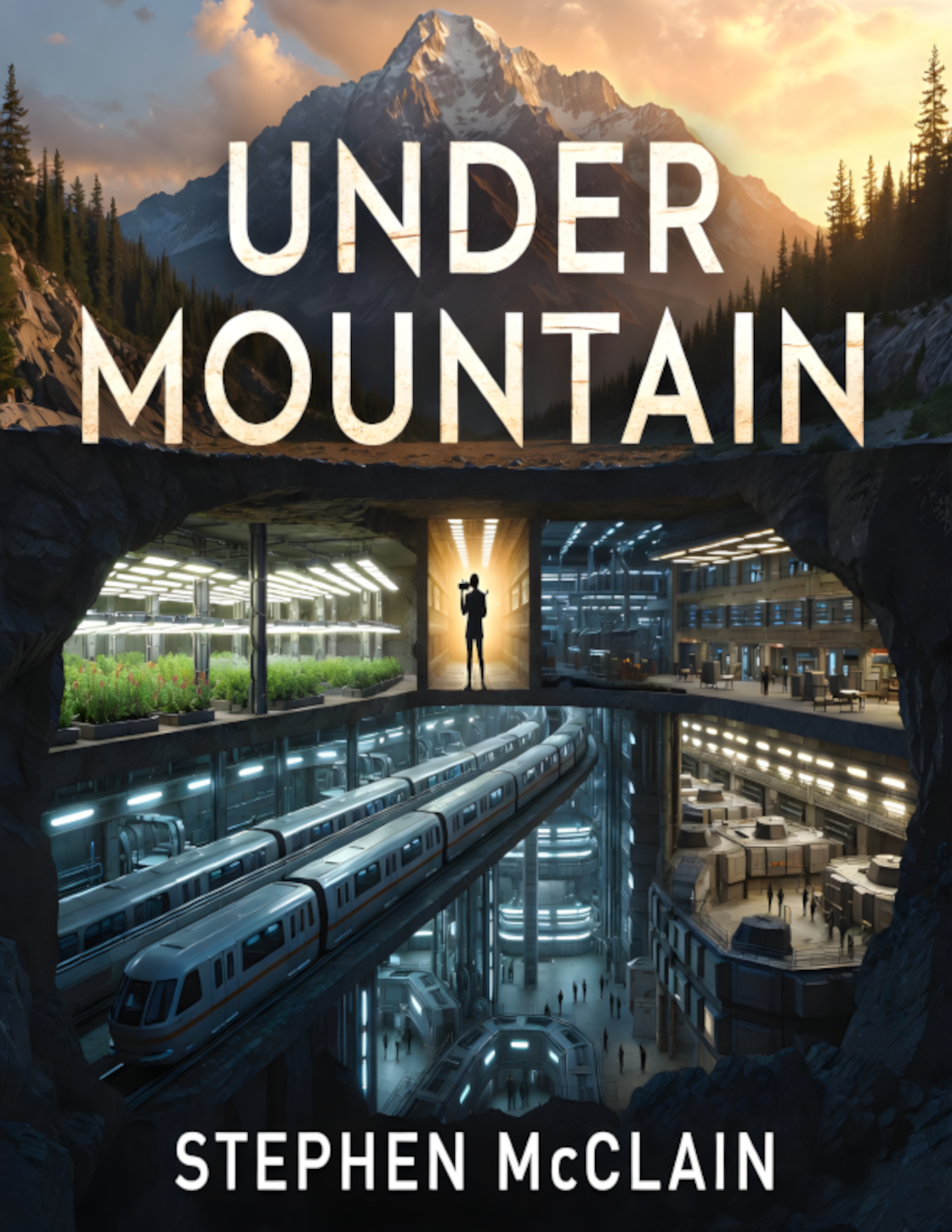
When an investigative journalist uncovers a vast network of underground cities built for the elite to escape an impending global collapse, she has only weeks to expose the conspiracy—and decides the only way to save humanity is to steal their sanctuary.
UNDER MOUNTAIN
by Stephen McClain
PROLOGUE
The screens in the boardroom displayed nothing but static, but Marcus Miller didn’t need a feed to know what was happening on the surface. He’d seen the projections. The models. The inevitable cascade of failures that would reduce civilization to chaos within eighteen months.
“The last transport leaves in seventy-two hours,” said the woman across the polished obsidian table. Her reflection was crisp in its surface, but her eyes were hollow. “After that, the entrance seals permanently.”
Marcus nodded, his throat tight. Through the reinforced windows of the Deep Underground facility—officially designated Site Olympus—he could see the mag-lev platform stretching into darkness, a silver snake disappearing into the earth’s depths. Beyond that platform lay three hundred miles of tunnel, connecting to another city, and another, and another. One hundred and twenty-nine interconnected facilities designed to preserve the best of humanity.
The best. That was what they called themselves now.
“What about the others?” he asked, though he already knew the answer.
“There are no others, Dr. Miller. Only us.” She stood, smoothing her suit. “I suggest you make your final arrangements. Bring only what you can carry. Everything else will be provided.”
As she left, Marcus turned back to the window. Somewhere, seven hundred feet above, people were living their ordinary lives. Working jobs. Raising children. Making plans for futures that would never come. And they had no idea that beneath their feet, an entire world was being prepared. A world they would never see.
He pulled out his phone—it wouldn’t work for much longer, not down here—and scrolled through his contacts. Three hundred names. Friends. Colleagues. Family. People he would have to leave behind.
People who would die so that he could live.
Marcus deleted the contacts one by one. It was easier than saying goodbye.
ACT ONE: THE BREACH
Chapter 1
The spreadsheet made Alex Morrison’s eyes hurt. Line after line of classified expenditures, each one bleeding into the next until they formed an incomprehensible mass of taxpayer money flowing into projects with names like “Infrastructure Modernization” and “Subterranean Asset Development.” Individually, they meant nothing. Together, they formed a pattern.
And Alex had made a career out of finding patterns.
She leaned back in her office chair, the ancient springs groaning in protest. The Denver Post didn’t exactly spare expenses on furniture. Or heating, she thought, pulling her cardigan tighter. Outside her window, November snow fell on the city, transforming it into something clean and new. If only the budget could be so easily whitewashed.
“Morrison! My office. Now.”
Alex minimized the spreadsheet and grabbed her notebook. Tom Reeves, her editor, didn’t shout across the newsroom unless he was genuinely annoyed. Given that his default state was mildly irritated, this was concerning.
She wound through the maze of desks, past Junior reporters typing furiously at their keyboards, past the coffee station where someone had left a pot burning for so long it smelled like charred rubber. The newsroom was half-empty these days. Ad revenue was down. Staff was down. Hope was down. But the work remained.
“Close the door,” Tom said without looking up.
Alex obeyed, settling into the chair across from his desk. Tom was fifty-six, gray-haired, and perpetually exhausted. He’d been at the Post for thirty years, had won two Pulitzers, and now spent most of his time explaining to corporate why investigative journalism still mattered. It was a losing battle.
“I’m killing your infrastructure piece,” he said.
Alex felt her stomach drop. “Tom, that story—”
“That story is three months of work chasing shadows.” He finally looked at her, and his eyes were sympathetic. That made it worse. “You’ve got FOIA requests from six agencies, all denied. You’ve got anonymous sources who won’t go on record. And you’ve got a hypothesis about underground spending that you can’t prove.”
“The numbers don’t lie—”
“The numbers are classified. Everything is classified. Christ, Alex, you’ve filed seventeen FOIA requests in three months. You know what that does? It makes us look like conspiracy theorists. It makes the paper look bad.”
“Since when do we care about looking bad?”
Tom rubbed his temples. “Since advertising is down forty percent and corporate is breathing down my neck about ‘optics.’ Look, I’m not saying drop it entirely. I’m saying you need something concrete. Something I can show the lawyers that isn’t spreadsheets and redacted documents.”
Alex’s jaw tightened. She knew he was right. She hated that he was right. “What if I had physical evidence? Photos of the facilities?”
“Then we’d have a story.” He leaned forward. “But Alex? Be careful. If these projects are as classified as they seem, the people running them won’t appreciate you poking around.”
She left his office with renewed determination. Physical evidence. She could do that.
That night, alone in her apartment, Alex spread her research across the living room floor. Maps, printouts, satellite imagery. The pattern was there, hidden beneath layers of bureaucracy and classification, but visible if you knew where to look.
Clusters of spending near military installations. Sudden spikes in tunnel boring equipment purchases. Construction companies winning no-bid contracts for “maintenance” on facilities that didn’t officially exist. And then there were the geological surveys—dozens of them, all focused on areas with stable bedrock suitable for deep excavation.
One location kept appearing: a site in the Colorado Rockies, forty miles northwest of Denver. According to official records, it was an abandoned Cold War research facility. According to satellite imagery, heavy equipment had been moving in and out for the past five years.
Alex pulled up the geological surveys. The area sat on solid granite, perfect for underground construction. Water tables were deep. Seismic activity was minimal. If you wanted to build something substantial below ground, you couldn’t pick a better location.
She needed photos. Documentation. Something undeniable.
She needed to go there.
Chapter 2
The drive to the mountains took two hours, the last forty-five minutes on increasingly rough roads that Google Maps insisted didn’t exist. Alex’s ten-year-old Subaru handled the terrain better than expected, though she winced every time the undercarriage scraped against rock.
She’d told exactly no one where she was going. Stupid, probably. If something happened, no one would know where to look. But if Tom was worried about looking like a conspiracy theorist, she couldn’t exactly file a travel voucher for “investigating secret underground base.”
The November air was crisp and thin at this elevation, each breath visible in the morning light. Pine trees crowded the mountainside, their branches heavy with snow. Beautiful. Isolated. Perfect for hiding secrets.
According to her research, the facility entrance should be near an old mining road, concealed behind what satellite imagery suggested was a natural rock formation. Alex parked the Subaru behind a stand of trees and continued on foot, her camera bag bouncing against her hip.
The cold bit through her jacket. She should have dressed warmer. Should have brought more supplies. Should have told someone. Too late now.
She found the rock formation after twenty minutes of hiking: a granite outcrop that looked entirely natural until you noticed the too-straight edges, the absence of weathering patterns. Alex circled it slowly, running her hands along the stone. There had to be a seam, a door, something—
Her fingers found it. A gap, barely wider than a knife blade, running vertically for eight feet. She followed it around, tracing the outline of what had to be a massive door. But there was no handle, no keypad, no obvious way to open it.
Alex pulled out her camera and started documenting. The concealed door. The unmarked service road. The fresh tire tracks in the mud that hadn’t frozen yet. Someone had been here recently.
She was reviewing her photos when she heard it: a low mechanical hum, growing louder. The ground beneath her feet began to vibrate.
The door was opening.
Alex stumbled backward as the granite facade swung inward with impossible smoothness, revealing a tunnel lit by harsh fluorescent lights. The hum grew louder. Something was coming up from below.
She should run. Every instinct screamed at her to run. Instead, she raised her camera and started shooting.
A vehicle emerged from the tunnel—sleek, electric, unmarked. It rolled past her without slowing, the windows tinted black. The driver either didn’t see her or didn’t care. The vehicle continued up the service road and disappeared into the trees.
The door began to close.
Alex made a decision that would change everything. She ran.
She slipped through the gap just as the door sealed shut behind her with a pneumatic hiss. Silence fell, broken only by the hum of ventilation and her own ragged breathing. She was inside.
The tunnel stretched ahead, curving gently downward. Emergency lights created pools of illumination every twenty feet. The walls were smooth concrete, precisely engineered. This wasn’t some abandoned Cold War bunker. This was active. Maintained. Expensive.
Alex started walking, her footsteps echoing. The temperature was constant, climate-controlled. The air smelled sterile, processed. Every hundred yards, security cameras watched from recessed housings. Were they recording? Was someone watching her right now?
She documented everything. The industrial lighting fixtures. The ventilation ducts. The occasional service panel with warning labels about high voltage. This wasn’t just a tunnel. It was infrastructure for something larger.
The tunnel descended for what felt like miles. Alex’s ears popped twice. She was deep now. Very deep.
Then the tunnel opened up.
Alex stepped into a cavern so vast she couldn’t see the far end. But it wasn’t a natural cavern. It was a station.
Mag-lev rails stretched into the darkness, their silver tracks gleaming under industrial lights. Platforms lined both sides, marked with designation numbers and destination codes. Electronic displays showed departure schedules. Everything was clean. Modern. Empty.
But recently used. The air had that particular sterile quality of climate-controlled spaces. No dust on the platforms. No cobwebs. This place was operational.
Alex walked to the nearest information panel and started photographing. The destination codes meant nothing to her, but she documented them all: OLYMPUS-7, ARCADIA-3, ELYSIUM-12. Mythological names for facilities that supposedly didn’t exist.
A map on the wall showed the network. Her hands shook as she photographed it. Lines connecting dozens of sites across North America. Each node marked with a code. Each one representing a facility like this one. Underground cities, hidden from the world above.
One hundred and twenty-nine facilities. The number was printed at the bottom of the map, along with a date: Network Operational: July 2024.
Alex’s mind reeled. This wasn’t just a bunker. This was a parallel civilization.
She moved deeper into the station, finding corridors that branched off the main platform. Signs pointed to: RESIDENTIAL SECTOR, HYDROPONICS, MEDICAL, ADMINISTRATION. Each direction leading to another impossibility.
She chose hydroponics.
The corridor was wide enough for cargo transport, the floor marked with guide lines. More cameras. More ventilation. Everything suggesting a facility designed for thousands of people.
The hydroponics facility was the size of a football field. Row after row of growing stations, each one equipped with UV lights and automated nutrient delivery. Lettuce. Tomatoes. Wheat. Potatoes. A complete agricultural system underground.
Everything was running. The lights were on. The nutrient pumps hummed. The plants were healthy, green, thriving. Someone was maintaining this.
But where were they?
Alex spent three hours exploring. She found residential sectors with thousands of dormitory-style rooms, each one furnished and ready. She found medical facilities that would make most hospitals jealous. She found water treatment plants, power generation stations, air recycling systems. Everything needed to sustain a population indefinitely.
And it was all empty.
The wrongness of it grew with each discovery. This wasn’t abandoned. It was waiting.
She was photographing a control room when she heard voices.
Chapter 3
Alex ducked behind a bank of servers, her heart hammering. Two men in gray maintenance uniforms entered the control room, their conversation echoing in the sterile space.
“—telling you, we should have been in full operation mode weeks ago. The timeline’s moved up.”
“That’s above our pay grade. We just keep the systems running.”
“Yeah, but for who? Place is empty. Has been for months. What’s the point of maintaining everything if nobody’s using it?”
The second man lowered his voice. “You haven’t heard?”
“Heard what?”
“They’re moving people in. Not here—other sites. Olympus. Arcadia. The primary facilities. Quietly. Corporate executives. Political families. Anyone with the right connections and enough money.”
A long pause. “Moving them in? Why?”
“Because of what’s coming.”
“Christ, not this again. The Surface Event is still theoretical—”
“It’s not theoretical anymore. They’ve moved the timeline. Eighteen months, maybe less. When it hits, everything up there—” He gestured upward. “Everything ends. And down here? We survive. Some of us, anyway.”
Alex’s fingers found her camera, slowly raising it to capture the conversation. The men were checking equipment now, running diagnostics on panels she didn’t understand.
“What about us? The maintenance crews?”
“We’re essential personnel. We’ll get allocated to whichever facility needs us. Better than the alternative.”
“And everyone else?”
The second man didn’t answer. He didn’t need to.
They worked in silence for another ten minutes, then left the way they came. Alex waited, counting to one hundred, before emerging from her hiding spot. Her hands were shaking.
Surface Event. Timeline moved up. Everything ends.
She needed more information. Needed proof. The control room had terminals, banks of them, all showing various system statuses. Alex approached the nearest one, her journalistic instincts warring with her survival instincts.
The terminal was unlocked. Careless, or evidence of how secure they thought this facility was. She navigated through menus, finding databases of information. Facility specifications. Resource allocations. Personnel manifests.
And there, buried in a subfolder marked CLASSIFIED: PROJECT EXODUS.
Alex inserted her camera’s memory card into the terminal and started copying. Files upon files. Schematics. Communications. A complete archive of the underground network.
One document stopped her cold: TIMELINE ASSESSMENT – SURFACE EVENT PROBABILITY.
She opened it. Her eyes scanned the text, each word more horrifying than the last.
Environmental collapse. Not from climate change alone, but from a cascade effect that scientists had been tracking for years. Ocean acidification killing the food chain. Topsoil depletion making agriculture impossible. Antibiotic-resistant diseases spreading unchecked. Resource wars that would make the 20th century look peaceful.
It wasn’t a single catastrophe. It was everything at once. A perfect storm of human-caused disasters reaching critical mass simultaneously. And the people who knew about it—the ones with access to the data and the resources—had built themselves an escape.
The document estimated 85% population reduction within five years of onset. The remaining 15% would face starvation, disease, and violence. Civilization as they knew it would cease to exist.
Timeline to critical mass: 16-22 months.
Alex’s vision blurred. Sixteen months. Just over a year. And the people who could stop it, who could warn the world, had instead built underground cities and started quietly disappearing inside.
She copied everything. Every file. Every schematic. Every communication. The memory card filled, and she swapped in her backup. More files. More evidence. More proof of the conspiracy that made every internet forum look sane.
An alarm cut through the silence.
Red lights began flashing. A computerized voice announced: “UNAUTHORIZED ACCESS DETECTED. SECURITY PROTOCOLS INITIATED. ALL PERSONNEL REPORT TO STATIONS.”
Alex grabbed her memory cards and ran.
The corridors that had seemed vast and empty now felt like a maze. She retraced her steps, running toward the mag-lev station. Behind her, she heard voices, boots on concrete. They were coming.
She burst into the station to find it transformed. Lights blazing. Security personnel emerging from side corridors. They wore tactical gear, carried weapons that looked far too sophisticated for simple facility security.
“Stop! Hands where we can see them!”
Alex didn’t stop. She veered left, toward a corridor she’d noted earlier but not explored. Service access. The sign was faded, the entrance darker than the main passages. She plunged into it.
The service tunnel was narrow, lit only by emergency strips. It sloped upward. Emergency exit, maybe. Or ventilation access. She didn’t care as long as it led to the surface.
Behind her, flashlight beams cut through the darkness. Heavy footsteps. Getting closer.
The tunnel branched. Left or right? She chose left, hoping, praying. The slope increased. Her lungs burned from the thin processed air and exertion. Keep moving. Just keep moving.
Fresh air. She smelled it suddenly—cold, pine-scented, real. An exit. There had to be an exit nearby.
She found it: a maintenance hatch, secured with a simple mechanical lock. No electronics. No keypads. Just metal and leverage. Alex slammed her shoulder against it once, twice, three times. The lock gave with a shriek of protest.
She emerged into snow and sunlight, three miles from where she’d entered. The forest was thick here, undisturbed. Alex didn’t look back. She ran through the trees, branches whipping her face, snow soaking through her shoes.
Behind her, shouts. The security team had reached the hatch. But she had a head start, and she knew these mountains. Grew up hiking them. If she could reach her car—
The Subaru was where she’d left it. Alex threw herself inside, started the engine, and gunned it down the logging road. The undercarriage screamed against rocks. She didn’t care. She needed distance. Needed civilization. Needed witnesses.
Her phone had signal again. Her hands shook as she pulled over and called Tom.
“Morrison? It’s Sunday. This better be—”
“I need to come in. Now. I have… Tom, I have everything. Photos. Documents. Proof of all of it.”
Silence on the other end. Then: “Where are you?”
“Mountains. Northwest of Denver. I’m heading back now.”
“Alex.” His voice was careful. “What did you do?”
“I found them, Tom. The underground cities. They’re real. All of it is real. And it’s worse than we thought.”
ACT TWO: THE REVELATION
Chapter 4
The Denver Post’s conference room had never felt smaller. Alex stood at the head of the table, her laptop connected to the projector, while Tom sat with the paper’s legal counsel and two senior editors. Outside, the city went about its Monday morning, oblivious.
“These are the facility schematics,” Alex said, clicking through images. “One hundred and twenty-nine interconnected underground cities. Each one designed to house thousands. Complete with hydroponics, medical facilities, power generation. Everything needed for long-term habitation.”
The legal counsel, Margaret Davis, leaned forward. “How did you obtain these documents?”
“I accessed them from a terminal inside the facility.”
“You broke in.” It wasn’t a question.
“The door was open. I walked through it.”
“And then accessed classified government systems without authorization.”
“The system wasn’t secured. The terminal was unlocked.”
Margaret sighed. “Ms. Morrison, what you’ve described is criminal trespass at minimum, possibly violations of the Computer Fraud and Abuse Act. If we publish this—”
“If we don’t publish this, millions of people are going to die ignorant.” Alex pulled up the timeline document. “Look at this. They’re predicting complete civilizational collapse within sixteen months. Environmental cascade. Resource depletion. Mass starvation. And instead of warning people, instead of trying to stop it, they built themselves an escape and started disappearing.”
The room fell silent. Tom was the first to speak. “Show us everything.”
For the next three hours, Alex walked them through her findings. The network maps. The evacuation manifests showing which families had already relocated underground. The communications discussing the Surface Event. The budget documents showing trillions in classified spending funneled through shell corporations and black budget programs.
Senior editor David Walsh spoke up. “The science. Can we verify it?”
“I’ve been making calls,” Alex said. “Climatologists. Epidemiologists. Agricultural scientists. Off the record, they’re all seeing the same patterns. Ocean acidification rates are accelerating. Topsoil is degrading faster than projections. Antibiotic resistance is spreading. No one’s putting it together into a single catastrophic timeline, but the pieces are all there.”
“Because if they did,” Tom said quietly, “it would cause panic.”
“It should cause panic,” Alex shot back. “People deserve to know. Deserve a chance to prepare, to fight back, to do something other than die in ignorance while the elite hide underground.”
Margaret tapped her pen against her legal pad. “The liability here is enormous. We’d need corroboration. Multiple sources. And even then, we’d be facing every government agency, every corporation with skin in this game.”
“I have a source,” Alex said. “Inside the project. He reached out after I escaped. Said he wants to talk.”
Tom’s eyes narrowed. “Someone from inside the facility contacted you?”
“Anonymous email. Encrypted. He said he’s been working on the project for three years and can’t live with what they’re doing. He wants to meet.”
“It could be a trap,” David said.
“It could be. But it’s also our best shot at corroboration.”
Tom stood, walking to the window. The city spread out below, alive and unaware. “If this is real—if even half of it is real—we have a responsibility to report it. But we do it right. Verified sources. Airtight documentation. We can’t afford mistakes.”
He turned back to the room. “Alex, meet with your source. Get verification. Margaret, start preparing for legal challenges. David, I want you digging into the corporations mentioned in these documents. Find the money trail.”
“And Tom?” Alex asked. “When do we publish?”
“When we’re ready to go to war.”
The meeting with the whistleblower was set for Wednesday night at a public location—a 24-hour diner in Aurora. Alex arrived thirty minutes early, choosing a booth with a clear view of the entrance. Her laptop bag contained recording equipment and a backup drive with copies of everything she’d found.
The diner was nearly empty. Third-shift workers nursing coffee. A couple in the corner, having a whispered argument. The waitress looked like she’d been on her feet for twelve hours.
At 10:47 PM, a man entered. Early forties, graying at the temples, wearing a nondescript jacket and baseball cap. He scanned the room, his eyes finding Alex. He nodded once and approached.
“Ms. Morrison.”
“You have me at a disadvantage.”
“Call me David. Not my real name, but it’ll do.” He slid into the booth across from her, ordering coffee when the waitress wandered over.
“You said you worked on the project,” Alex began.
“I’m a structural engineer. Specialized in underground construction. I’ve been consulting on Project Exodus for three years. Helped design the residential sectors at six different facilities.” He pulled out his phone, showed her credentials. They looked legitimate, but Alex had learned not to trust appearances.
“Why come forward now?”
David stared at his coffee. “Because I have a daughter. She’s eight. And when I signed onto this project, I thought… I thought we were building something for humanity. A backup plan. Insurance against catastrophe. But it’s not that.”
“What is it?”
“It’s triage. They’re not trying to save humanity. They’re trying to save themselves. The selection process—it’s not based on skills or knowledge or anything that would actually help rebuild. It’s based on wealth. Power. Connections. They’re abandoning the surface and everyone on it.”
“The Surface Event. How bad is it really?”
David leaned forward. “Worse than the documents you found. The cascade is already starting. Ocean phytoplankton populations have dropped forty percent in the last five years. That’s forty percent of the planet’s oxygen production gone. The feedback loops are accelerating. Within eighteen months, maybe less, agricultural systems worldwide will begin to collapse. And when the food runs out…”
“Mass starvation.”
“Mass everything. Starvation. Disease. Violence. Governments will fall. Infrastructure will fail. And the people who saw it coming, who had the resources to warn everyone and coordinate a response? They’ll be underground, waiting it out.”
Alex felt sick. “Can it be stopped?”
“Maybe. If every nation coordinated. If we radically transformed our agricultural systems, our energy production, our entire way of life. But that would require the kind of global cooperation we’ve never achieved. And it would require the people with power to sacrifice their wealth for the common good.” He laughed bitterly. “Instead, they’re building bunkers.”
“I need you on record. Your real name. Verification.”
David reached into his jacket. For a moment, Alex tensed. But he only pulled out a flash drive. “Everything I have. Communications. Engineering specifications. Personnel manifests. Budget documents. And my sworn affidavit, with my real name and credentials.”
He slid it across the table. “But you need to understand something, Ms. Morrison. When you publish this, they will come for you. They will use every legal, financial, and political tool at their disposal to destroy you and discredit the story. And if legal means don’t work…” He didn’t finish the sentence.
“I understand.”
“Do you? Because I have the luxury of anonymity. I can disappear. You’re going to be in the spotlight. They’ll dig into every aspect of your life. Every mistake. Every vulnerability. And they won’t stop until either the story is dead or you are.”
Alex met his eyes. “Then I better make the story count.”
David nodded slowly. “One more thing. The timeline has been moved up again. They’re accelerating evacuations. The final lockdown—when they seal the facilities permanently—is scheduled for thirty days from now.”
“Thirty days.”
“After that, no one gets in. The doors seal. The network goes dark. Everyone left on the surface… they’re on their own.”
He stood, dropping cash on the table for his untouched coffee. “Good luck, Ms. Morrison. You’re going to need it.”
Alex sat alone in the booth long after he left, the flash drive heavy in her pocket. Thirty days. Four weeks to expose the conspiracy, verify the information, and publish before the elite sealed themselves away forever.
Four weeks to save the world.
Or at least give it a fighting chance.
Chapter 5
The newsroom transformed into a war room. For the next week, Alex and the team worked around the clock, verifying David’s information, cross-referencing documents, building the story into something airtight.
David Walsh tracked the money. The budget trail led through dozens of shell corporations, private military contractors, and classified government programs. Trillions of dollars, moving in patterns that only made sense if you knew what you were looking for. Construction equipment purchases. Advanced tunnel boring machines. Life support systems. Agricultural technology. Everything needed to build and sustain underground cities.
Margaret Davis worked her contacts in government, carefully probing without revealing what they knew. What she learned was disturbing: key officials had quietly resigned in recent months. Corporate executives had sold off assets and disappeared from public view. Military families were being relocated to classified locations under the guise of new assignments.
Tom coordinated with journalists at other publications, building a coalition to publish simultaneously. If the story came from just one paper, it could be dismissed as conspiracy theory. But if The New York Times, The Washington Post, The Guardian, and a dozen other major outlets all published the same evidence at the same time…
Alex focused on the science. She interviewed climate scientists, oceanographers, agricultural experts. Off the record, they confirmed the accelerating collapse. On the record, they were more cautious, but the data was there. Ocean acidification. Topsoil degradation. Cascading ecological failures. The timeline might be debatable, but the direction was clear.
By day seven, they had something unprecedented: a fully documented, multiple sourced expose of the largest conspiracy in human history. The underground cities were real. The elite evacuation was happening. The collapse was coming.
And they had twenty-three days until lockdown.
The story was scheduled to publish on Sunday. Coordinated release at 6:00 AM Eastern. Every major outlet running it simultaneously. Front page. Digital front page. Breaking news alerts. The works.
But on Friday afternoon, three days before publication, Alex received a visitor.
The woman who entered the newsroom looked like corporate America personified. Expensive suit. Careful makeup. The kind of confidence that came from never having to question your place in the world. She approached Alex’s desk directly.
“Ms. Morrison. I’d like a word. In private.”
Alex recognized power when she saw it. “And you are?”
“Someone who would prefer not to have this conversation in front of your colleagues.” The woman’s smile didn’t reach her eyes. “Conference room. Five minutes.”
Tom joined her in the conference room, along with Margaret. The woman introduced herself as Victoria Hale, representing what she called “interested parties.”
“We understand you’re planning to publish certain information,” Victoria began. “Information that is both classified and, frankly, dangerous.”
“Information the public has a right to know,” Tom countered.
“Do they? Let me paint you a picture, Mr. Reeves. You publish this story. What happens? Mass panic. Stock market collapse. Runs on banks. Looting. Violence. Governments overwhelmed. And for what? To expose a contingency plan designed to preserve humanity in the event of catastrophic failure?”
“A contingency plan that excludes ninety-nine percent of humanity,” Alex said.
“Because that ninety-nine percent cannot all be saved. The capacity doesn’t exist. The resources don’t exist. So we save who we can. The people with the skills, the knowledge, the means to rebuild.”
“The wealthy, you mean. The connected. The elite.”
Victoria’s expression hardened. “This isn’t a debate, Ms. Morrison. I’m here to make you an offer. You kill the story. You destroy your evidence. And in exchange, you and your immediate family receive slots in the facilities. Safe passage. Survival.”
The room fell silent. Alex felt her heart pounding. Survival. Safety. A future for her parents, her sister, her nephew. All she had to do was let billions die in ignorance.
“No,” she said.
Victoria blinked. “I’m sorry?”
“I said no. We’re publishing.”
“Then you’re condemning your family to death.”
“You’re the ones condemning them. We’re just refusing to be complicit.”
Victoria stood. “Very well. But understand this: we will fight your publication with everything we have. Legal injunctions. Defamation suits. We’ll destroy your credibility, your careers, your lives. And when the collapse comes—and it will come—you’ll die knowing you could have been saved.”
“At least we’ll die human,” Tom said.
After she left, Alex turned to Tom. “They’re going to come at us hard.”
“Let them. We’ve got the truth on our side.”
“The truth hasn’t been enough before.”
“Then we make it enough.” Tom’s jaw was set. “We publish Sunday. And we make damn sure the whole world is watching.”
Chapter 6
Publication day arrived like a thunderstorm.
At 6:00 AM Eastern, synchronized across two dozen publications worldwide, the story went live. THE UNDERGROUND CONSPIRACY: How the Elite Abandoned Earth.
Within minutes, it was trending globally. Within an hour, it was the only thing anyone was talking about. Social media exploded. News networks scrambled to cover it. Government spokespeople issued denials. Corporate PR teams went into overdrive.
Alex watched it unfold from the newsroom, her phone ringing constantly. Interview requests. Threats. Supporting messages from scientists confirming the environmental data. Hate mail from people calling her a liar. It was chaos.
But the documents were too detailed to dismiss. The evidence too comprehensive. And most importantly, people started looking up. Started noticing the disappearances. The quiet relocations. The pattern that had been there all along if anyone had cared to see it.
By noon, the first facility was found. Citizens in Colorado, following Alex’s original reporting, located an entrance and forced their way inside. Video from inside the empty underground city went viral. Proof. Undeniable, visual proof.
Other facilities were identified. People started organizing, sharing information, mapping the network. The conspiracy that had been hidden for years was now exposed in sunlight, and it was metastasizing into action.
But with revelation came rage.
Protests erupted outside corporate headquarters. The homes of executives were surrounded by crowds demanding answers. Violence broke out in major cities as people grasped the magnitude of betrayal. The elite had planned to let them die.
Alex watched it on the newsroom monitors, feeling the weight of what she’d unleashed. Yes, people deserved to know. Yes, the truth mattered. But truth had consequences, and right now those consequences looked like civilization tearing itself apart.
“Second-guessing yourself?” Tom appeared beside her.
“Wondering if we made things worse.”
“They were already worse. We just pulled back the curtain.” He gestured to the screens. “Yeah, it’s chaos. But it’s honest chaos. People making informed decisions instead of dying ignorant.”
“Some of those decisions include violence.”
“Some of them include organization. Look.” He pointed to another screen showing coordination efforts. Citizens forming mutual aid networks. Scientists offering free workshops on sustainable agriculture. Engineers volunteering to help retrofit buildings for self-sufficiency. “Humanity at its worst, but also at its best.”
Alex’s phone buzzed. Unknown number. She almost didn’t answer, but something made her pick up.
“Ms. Morrison.” The voice was familiar. David, her whistleblower source. “You need to get somewhere safe. Now.”
“What? Why?”
“Because they’re coming for you. Private security. They’re not going to arrest you—they’re going to disappear you. You have maybe an hour.”
Alex’s blood ran cold. “How do you know?”
“Because I just intercepted the order. Get out of the building. Get somewhere public with lots of witnesses. And Alex? They’re also moving up the lockdown. Twenty-four hours. After that, the facilities seal permanently.”
The line went dead.
Twenty-four hours. The elite were panicking, accelerating their timeline. Alex looked around the newsroom, at her colleagues working to cover the biggest story of their lives. If she ran, if she disappeared, it would undermine everything.
But if she stayed, she’d never finish the work.
She made a decision.
“Tom, I need you to do me a favor.”
“What kind of favor?”
“The kind where you tell people I’m dead.”
ACT THREE: THE DESCENT
Chapter 7
Going underground wasn’t part of the plan. But then again, Alex had stopped believing in plans around the time she’d walked through that first facility door.
She wasn’t alone. The publication had sparked a movement. Thousands of people descended on identified facility locations, demanding entry, demanding survival. Some were turned away by security. Others were met with closed doors and armed resistance.
But some facilities—the ones that were still empty, still in preparation phase—those were vulnerable. And people were desperate.
Alex joined a group in Utah, citizens who’d located a facility entrance and were preparing to breach it. They had engineers, mechanics, doctors, teachers. People with skills. People who understood they were fighting for their survival.
The entrance was hidden in a rock formation similar to the one Alex had found in Colorado. But this time, they had cutting tools. Explosives. Determination.
It took four hours to break through.
The facility beyond was smaller than the Colorado site, but fully functional. Hydroponic systems hummed. Life support was active. Residential sectors waited, empty and pristine. Capacity for three thousand people.
There were sixty-two of them.
“We need to let more people in,” someone said. A woman named Sarah, a structural engineer. “We can’t just save ourselves.”
“We don’t have time,” countered Marcus, a former military logistics officer. “The lockdown is in hours. We need to secure this facility, make sure the systems are stable, and seal the entrance before anyone from the main network notices we’re here.”
“So we become exactly what we’re fighting against?” Sarah’s voice rose. “We let everyone else die while we hide?”
“We save who we can. Then we figure out how to help from down here.”
Alex listened to them argue, understanding both sides. Survival versus morality. Security versus compassion. There were no good answers.
“We broadcast,” she said finally.
Everyone turned to look at her.
“The facility has communications equipment. We broadcast worldwide. Tell people where we are. Give them the access codes we’ve figured out. Let them know there are empty facilities they can claim. We can’t save everyone, but we can give them a chance.”
“That brings security down on us,” Marcus warned.
“Then we deal with security. But we don’t become them. We don’t leave people to die without trying.”
They voted. Thirty-eight in favor. Twenty-four against. Democracy, even in the apocalypse.
Alex found the communications center with Sarah’s help. The equipment was military-grade, designed to connect with the entire network. She could broadcast to every facility simultaneously. Could hijack their communications system to reach the surface.
She started recording.
“My name is Alex Morrison. If you’re watching this, you’ve probably heard about the underground facilities. I’m here to tell you they’re real, and they’re empty. Not all of them. Some have been claimed by the elite. But others—dozens of others—are sitting vacant, fully operational, waiting.”
She pulled up facility maps, access codes, security protocols. Everything they’d learned from the breach. Everything that could help people claim these spaces for themselves.
“The lockdown is coming. Hours from now, the network seals. After that, no one gets in or out. This is your chance. Your only chance. Find a facility. Breach it. Claim it. Survive.”
She uploaded the video to every platform she could access, then broadcast it through the facility network itself. Within minutes, it was everywhere.
And within an hour, the response began.
Reports flooded in. Facilities breached in Oregon. Idaho. Montana. Nevada. People claiming the underground cities that had been built for the elite. Some faced resistance. Some succeeded. Chaos and hope in equal measure.
But there was also a darker response.
The facility network’s security protocols activated. Armed teams deployed to contested sites. The elite weren’t going to give up their escape plan without a fight.
And they were heading to Utah.
Chapter 8
The security team arrived six hours before lockdown.
Thirty heavily armed operators in tactical gear, carrying weapons that belonged in a war zone. They didn’t negotiate. Didn’t announce themselves. They came in through the entrance the group had breached, moving with military precision.
But they hadn’t counted on resistance.
Marcus had been military. So had three others in the group. They’d spent the hours since the broadcast preparing defensive positions, setting up choke points in the facility’s corridors. It wasn’t much, but it was something.
The first shots echoed through the underground facility like thunder.
Alex huddled in the communications center with ten others, watching security monitors as the battle unfolded. It was surreal. Unreal. This was supposed to be civilization’s backup plan, and they were fighting a war for access to it.
“We need to evacuate non-combatants,” Sarah said, her voice tight. “Get them deeper into the facility.”
“Where?” someone asked. “This place was designed with only one entrance.”
“The mag-lev tunnel,” Alex said suddenly. “It connects to other facilities. If we can access it—”
“The network’s locked down,” Marcus’s voice crackled over the radio. “Central command sealed the mag-lev system two hours ago. No one’s going anywhere.”
Trapped. They were trapped between armed security and a sealed network.
Alex stared at the communications equipment. She’d broadcasted once. She could broadcast again. This time to the people in the sealed facilities. The elite who’d claimed their spots underground.
She started recording.
“This message is for everyone in the underground network. You’re safe now. Sealed away from the chaos. But you’re also complicit. Your security teams are killing people who just want to survive. People with skills. Knowledge. People who could help rebuild.”
She pulled up footage from the security monitors. The firefight in the corridors. The desperate defense.
“You built these facilities with public money. Billions in classified spending that could have gone to preventing the collapse. Instead, you hid it. Built an escape. And now you’re killing the people you left behind to protect your bunkers.”
She leaned closer to the camera.
“Is this who you want to be? When you emerge in five years, ten years, whenever you decide it’s safe—is this the legacy you want? The people who chose survival over humanity?”
She broadcast it through the network. Didn’t know if anyone was watching. Didn’t know if anyone cared.
But thirty minutes later, the shooting stopped.
Marcus’s voice came over the radio. “They’re pulling back. Security’s withdrawing.”
“Why?” Sarah asked.
“Don’t know. Don’t care. We’ve got two hours until lockdown.”
The answer came twenty minutes later. Another broadcast, this one from inside the network. A woman’s face filled the screen—older, dignified, wearing the kind of expression that came from making impossible decisions.
“My name is Dr. Eleanor Reeves. I’m the director of Project Exodus. And I’m calling for a ceasefire.”
Alex stared at the screen.
“Ms. Morrison’s broadcast has… created discussion within the network. Many of us are questioning the path we’ve chosen. The violence. The exclusion. We built these facilities to preserve humanity, but if we have to kill to maintain them, what exactly are we preserving?”
She paused, seeming to gather herself.
“I’m proposing a new protocol. Open facilities to anyone who can reach them before lockdown. Skill-based, not wealth-based. We’ll coordinate to maximize capacity. It won’t save everyone. But it will save more than we planned.”
The broadcast ended. For a long moment, no one in the communications center spoke.
Then Sarah laughed. It was slightly hysterical, but genuine. “We did it. We actually did it.”
“Not yet,” Alex said. “We’ve got ninety minutes until lockdown. Let’s not waste them.”
The final ninety minutes were chaos. Coordinated chaos, but chaos nonetheless. The network opened its communications, sharing facility locations and access protocols. People flooded toward the sites. Some made it. Some didn’t. Security teams that had been ordered to repel intruders now helped process arrivals, checking skills, organizing logistics.
It wasn’t perfect. It wasn’t fair. But it was better than silence and abandonment.
When the lockdown came, it was both climactic and anticlimactic. No alarms. No dramatic sealing. Just facility entrances closing with quiet finality, cutting off access between the surface and the network below.
Alex stood in the Utah facility’s command center, watching the status board. One hundred and twenty-nine facilities. Eighty-two now occupied. Forty-seven sealed empty. Capacity for three hundred thousand people. Actual population: one hundred and forty-seven thousand.
Not enough. Nowhere near enough. But more than there would have been.
“What now?” Sarah asked.
“Now we survive,” Alex said. “And when we come back up, we do better.”
EPILOGUE
Five Years Later
The surface wasn’t dead. That was the first surprise.
When the reconnaissance teams emerged from the facilities, they found a world transformed but not destroyed. The collapse had come, just as predicted. Governments had fallen. Infrastructure had failed. Billions had died from starvation, disease, violence.
But some had survived. Small communities. Resilient groups who’d learned to farm without industrial agriculture. Who’d built water systems. Who’d organized mutual defense and cooperation.
They hadn’t needed underground bunkers. They’d needed knowledge. Preparation. Community.
Alex emerged on a spring morning in Utah, five years after the lockdown. The air was cleaner than she remembered. Sharper. The sky was impossibly blue.
A group waited at the facility entrance. Not security. Not government. Just people. Survivors from the surface, drawn by the reports of the underground cities emerging.
“You’re from below?” one asked. A woman, maybe forty, weathered by five hard years.
“We are,” Alex confirmed.
“You have food? Medicine? Technology?”
“We do. And we’re here to share it.”
The woman’s eyes narrowed. “Why? You hid while we suffered. Why help now?”
Alex met her gaze steadily. “Because we were wrong. Some of us knew it then. All of us know it now. We can’t undo the past. But we can help build the future.”
“And if we don’t want your help?”
“Then we’ll offer it anyway. No conditions. No control. Just resources and knowledge. What you do with them is up to you.”
The woman studied her for a long moment. Then, slowly, extended her hand. “My name is Rachel. We have a community three miles east. Forty-seven people. We could use medical supplies.”
Alex shook her hand. “We’ll get you everything we can.”
Over the next months, a new pattern emerged. The underground facilities didn’t remain sealed refuges for the elite. They became resource centers. Medical hubs. Agricultural research stations. Teaching facilities. The people who’d hidden below didn’t rule the surface. They supported it.
It wasn’t utopia. There were conflicts. Disagreements. Old resentments between those who’d hidden and those who’d endured. But there was also cooperation. Shared struggle. A common goal of rebuilding something better than what they’d lost.
Alex continued her work, but it had changed. Instead of exposing conspiracies, she documented rebuilding. Instead of investigating the powerful, she told the stories of communities finding new ways to survive. To thrive.
The underground cities became part of the new world’s infrastructure, but not its foundation. That was built by the people who’d stayed on the surface. Who’d proven that humanity didn’t need bunkers and elite planning to endure.
They needed each other.
One evening, Alex stood at the facility entrance, watching the sun set over the mountains. Sarah joined her, carrying two cups of tea from the hydroponics-grown herbs they’d shared with surface communities.
“Do you ever regret it?” Sarah asked. “Publishing the story? Starting all of this?”
Alex considered. “Every day. And never.”
“That doesn’t make sense.”
“Neither does any of this. But we’re here. We survived. And we’re building something new. That has to mean something.”
Sarah smiled. “Dr. Reeves called from Olympus. They’re sending engineers to help with the water reclamation project in Nevada.”
“The woman who ran Project Exodus is helping surface communities?”
“Times change. People change. Even her.”
Alex sipped her tea, tasting mint and hope. The collapse had come. The elite had hidden. The world had transformed. But humanity endured. Imperfect. Struggling. But enduring.
Under mountain and under sky, they built a new world. One story at a time. One community at a time. One choice at a time to be better than they’d been before.
The underground cities had been meant to preserve the elite. Instead, they became monuments to humanity’s capacity for both failure and redemption. Reminders that survival without morality was meaningless. That the future belonged not to those who hid from catastrophe, but to those who faced it together.
Alex Morrison had exposed a conspiracy. But in the end, she’d helped create something far more important: a chance. Not for the elite. Not for the privileged. But for anyone willing to fight for a better world.
Under mountain and under sky, the work continued. And the story—the real story—was just beginning.
THE END
This is a work of fiction. While it may be based on historical figures and events, all supernatural elements, characterizations, and plot developments are entirely fictional. Any resemblance to actual persons, living or dead, or actual events is purely coincidental.
©OneSynapseShort. All rights reserved